PTA 220 chp 4 Articular System: Types, Structures, and Pathologies in Joints
 Call Kai
 Learn
Learn Practice Test
 Spaced Repetition
 Match
Match Flashcards
 Knowt Play
1/54

There's no tags or description
Looks like no tags are added yet.
Name | Mastery | Learn | Test | Matching | Spaced | Call with Kai | Chat |
|---|
No analytics yet
Send a link to your students to track their progress
55 Terms
Anatomical Joint
Connection between two bones.
Osteo
Bone.
Arthro
Joint.
Synarthrosis
Type of joint that provides stability.
Diarthrosis
Type of joint that provides mobility.
Synarthrodial Joint
Fibrous joint with essentially no motion, provides shape and strength.
Suture
Layer of fibrous periosteum between two bones, i.e. sutures of the skull.
Syndesmosis
Ligamentous joint held together by fibrous tissue, ligaments, and interosseous membranes.
Gomphosis
Joint where a tooth is anchored in its dental socket.
Cartilaginous Joint
Also called an amphiarthroidial joint, allows a small amount of motion and provides stability.
Diarthrodial or Synovial Joint
Joint with no direct union between bone ends, filled with synovial fluid.
Gliding Joint
Nonaxial joint with irregular shape, allowing joint surfaces to glide over one another.
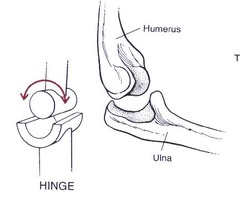
Hinge Joint
Uniaxial joint allowing movement in one plane, such as flexion and extension.
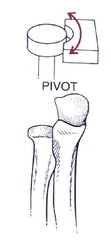
Pivot Joint
Uniaxial joint allowing rotation around a bone.
Condyloid Joint
Biaxial joint allowing movement in two directions.
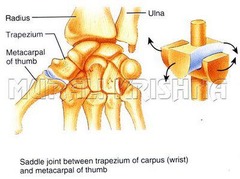
Seller (Saddle) Joint
Biaxial joint with surfaces that are both convex in one plane and concave in the other.
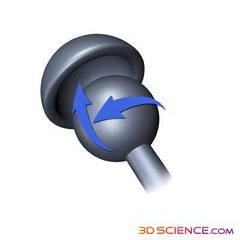
Ball and Socket Joint
Triaxial joint allowing for motion in all three axes.
Joint Motion
The specific movement allowed by a type of joint.
Flexion
Bending movement that decreases the angle between body parts.
Extension
Straightening movement that increases the angle between body parts.
Abduction
Movement away from the midline of the body.
Adduction
Movement toward the midline of the body.
Bone
Usually two bones make up a joint. Direction and amount of movement dictated by the articular surface of the bones at each end.
Ligament
Supports and holds two bones together. Bands of fibrous connective tissue. Flexible but not elastic - allows motion but keeps bones close together. Prevent excessive joint movement.
Capsule
Found in every synovial joint. Surrounds and encases the joint and protects the articular surfaces of the bones. Outer layer - fibrous tissue. Provides support and protection to the joint. Usually reinforced by ligaments.

Capsule (Inner layer)
Lined with a synovial membrane. Secretes synovial fluid. Reduces friction. Helps joint move freely. Provides some shock absorption. Source of nutrition for articular cartilage.
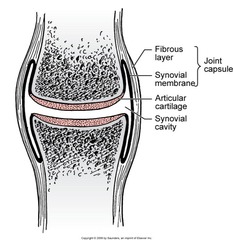
Cartilage
Dense fibrous connective tissue capable of withstanding a great amount of pressure and tension. 3 types of cartilage: Articular (Hyaline), Fibrocartilage, Elastic.
Articular (Hyaline) Cartilage
Covers the ends of opposing bones. Provides a smooth articulating surface in all synovial joints. Has no blood or nerve supply - receives nutrition from synovial fluid. If damaged, unable to repair itself.
Fibrocartilage
Acts as a shock absorber. Important for weight-bearing joints, i.e. meniscus at the knee, disks between the vertebrae and between the sternum and clavicle. Labrum is composed of fibrocartilage. Deepens the glenoid fossa in the shoulder joint.
Elastic Cartilage
Designed to help maintain the shape of a structure, found in the external ear and larynx.
Tendon
Connects muscle to bone. May be encased in tendon sheath to protect the tendon from pressure and friction, i.e. tendons passing over the wrist.
Aponeurosis
Broad, flat, tendonious sheet. Provides a base for muscle to attach when bone is not present, i.e. abdominal muscles at midline attach to linea alba.
Bursa
Small padlike sac that reduces friction between moving parts. Located under tendons and over bony prominences, i.e. olecranon bursa over the olecranon process. Lined with synovial membrane and filled with clear fluid.
End Feel
Quality of the feel when slight pressure is applied at the end of the joint's passive range of motion.
Bony end feel (Hard)
Hard abrupt limit to joint motion where bone contacts bone at the end of the ROM, i.e. terminal elbow extension.
Capsular (Firm) End Feel
Hard with slight give, i.e. wrist flexion/extension.
Soft tissue approximation (Soft)
Soft tissue of body segments prevent further motion, i.e. hip flexion in sitting, elbow flexion.
Boggy End Feel
Wet sponge feel, associated with edema.
Empty End Feel
Lack of mechanical limitation of joint range of motion; pain may limit the movement.
Springy block End Feel
Rebound movement that occurs with internal derangement of a joint.
Muscle guarding
Reflex muscle spasm during movement as a protective response.
Ovoid joint
Two bones forming convex-concave relationship; most synovial joints are ovoid.
Sellar (saddle-shaped) joint
Each joint concave in one direction and convex in another, i.e. carpometacarpal joint of the thumb.
Congruent Joint Position
Maximum contact, tightly compressed, difficult to distract; also known as 'closed-packed' position.
Incongruent Joint Position
All other positions; referred to as 'open-packed' position (resting position).
Types of Arthrokinematic Motion
Roll - Rolling of one joint surface on another. Glide (slide) - Linear movement of a joint surface parallel to the plane of the adjoining joint surface. Spin - Rotation of the movable joint surface on the fixed adjacent surface.
Convex-Concave Rule
When concave surface is moving on a convex surface, they roll and glide in the same direction as distal end of bone. When convex surface moves on concave surface, they roll and glide in the opposite direction distal end of bone.
Dislocation
Complete separation of two articular surfaces of a joint.
Subluxation
Partial dislocation of a joint.
Sprain
Partial or complete tearing of fibers of a ligament.
Strain
Overstretching of muscle fibers.
Tendonitis
Inflammation of a tendon.
Tenosynovitis
Inflammation of the tendon sheath.
Synovitis
Inflammation of the synovial membrane.
Capsulitis
Inflammation of the joint capsule.