Microbiology - Ch 1 The Microbial World And You - flashcards
 Call Kai
 Learn
Learn Practice Test
 Spaced Repetition
 Match
Match Flashcards
 Knowt Play
1/56

There's no tags or description
Looks like no tags are added yet.
Name | Mastery | Learn | Test | Matching | Spaced | Call with Kai | Chat |
|---|
No analytics yet
Send a link to your students to track their progress
57 Terms
What is a microbe?
Organism too small to be seen with the unaided eye.
"Micro" = small.
Needs aid of microscope; requires high magnification of the image. (not the object)
What are the 4 major groups of microbes?
Bacteria.
Viruses.
Fungi.
Parasites.
What is the study of bacteria called?
Bacteria = Bacteriology.
What is the study of viruses called?
Virus = Virology.
What is the study of fungi called?
Fungi = Mycology.
myc = fungi
What is the study of parasites called?
Parasites = Parasitology.
Give an example of bacteria.
E. coli.
Salmonella.
Give an example of viruses.
Coronavirus.
Herpes.
HIV.
Give an example of fungi.
Mold (cold, can’t grow on humans).
Yeast (heat).
Give an example of parasites.
Protozoan parasites.
Worms.
What temperature does mold prefer to grow?
Cold.
What temperature does yeast prefer to grow?
Heat/warm.
What do parasites do to their host?
Take advantage of the host.
What are the 4 important roles of microbes?
Key Ecological Roles.
Bioremediation.
Commercial Uses.
Applications in Medicine.
What is the key ecological role of microbes?
Natural uses of microbes in the environment; beneficial to humans.
What is bioremediation?
Artificial uses of microbes; developed by human needs.
What are commercial uses of microbes?
Microbes involved in the food & beverage industry.
What are applications of microbes in medicine?
Microbes involved in medicine production.
What are the 3 key ecological roles of microbes?
Decomposers of organic wastes.
Photosynthesis.
Nitrogen Fixation.
Who are the decomposers of organic waste and what is the benefit?
Who: Bacteria and fungi.
Benefit: Break down wastes and recycle elements back into nature.
Ex: Dead tree gets broken down.
Who performs photosynthesis among microbes and what is the benefit?
Who: Cyanobacteria and Algae (protozoa). (NOT TREES)
Benefit: Produce oxygen.
Equation: CO₂ + H₂O → glucose + O₂.
Photosynthesis gives O2
What is nitrogen fixation and what is the benefit?
Where does it take place?
Bacteria converts Nitrogen (N2) into nitrates, which plants use for growth.
Nitrogen has to be converted before it's useful.
This takes place in soil.
What is the pathway of nitrogen fixation?
Free air nitrogen → soil, reaching bacteria on plant roots → bacteria convert Nitrogen into nitrates → plant growth → humans eat plants.
Helps plants with growth.
Helps humans when humans eat the plant.
What is bioremediation?
Artificial (non-natural) process developed by human needs.
Bacteria introduced into environments they are NOT normally found in.
Bacteria use pollutants as energy or produce enzymes to break down toxic waste.
Give 2 examples of bioremediation
Oil spills → bacteria introduced into ocean → remove toxic substances.
Drain clogs → bacterial enzymes in drain cleaners → remove clogs without harmful chemicals.
How do bacteria make dairy products (cheese/yogurt)?
Bacteria added to milk → ferment its sugar into lactic acid → which coagulates the milk protein.
==== (not on the exam)
What is Botox derived from?
A bacterial toxin.
How do fungi (yeast) make alcoholic beverages (wine)?
Yeast ferment grape sugar → acid → wine.
==== (not on the exam)
How do fungi (yeast) make bread rise?
Yeast in dough breaks down sugar → produces CO₂ gas → bread rises.
==== (not on the exam)
What are antibiotics?
Medicines that destroy bacteria; produced by microbes.
Give 2 examples of antibiotics.
Penicillin, Neomycin.
What is the source of Penicillin?
Fungal mold (Penicillium) found in mushroom gills.
What is the step-by-step process of making Penicillin?
Penicillium mold is fermented with sugar → mold produces PCN → PCN is collected & purified and sold as antibiotic.
What does "patho-" mean?
Disease (DZ); caused by a harmful (pathogenic) microbe.
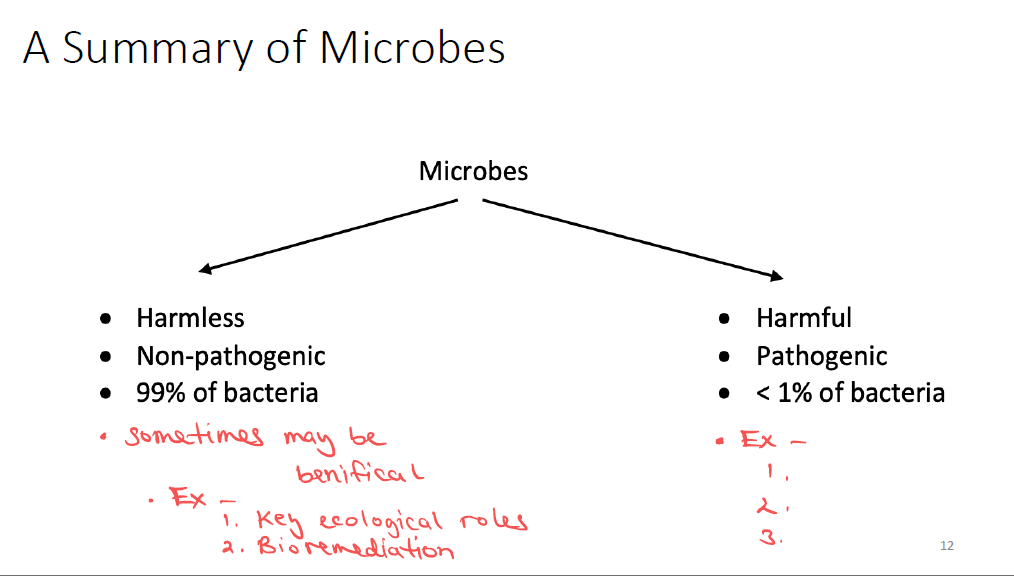
Are all bacteria harmful?
No — 99% of bacteria are non-pathogenic; less than 1% are harmful (pathogenic).
This fact only applies to bacteria.
What is a pathogen?
A live microbe capable of causing disease (harm) in a host.
Give 3 examples of pathogens and the diseases they cause.
Neisseria gonorrhoeae (bacteria) → Gonorrhea.
Tinea pedis (fungal yeast) → Athlete's foot.
SARS-CoV-2 (virus) → COVID-19.
Summarize microbes as well as you can:
What is normal microbiota “normal flora”?
Resident microbes normally found in/on the human body that cause no harm.
Sometimes beneficial. (non pathogenic)
==
This comes up during every exam.
How can normal microbiota be beneficial?
Produce useful substances (e.g., Vitamin K) = speeds up clotting process.
Prevent harmful microbes from overgrowing.
Give 3 examples of normal microbiota and their locations.
Streptococci → mouth.
==
Staphylococci → skin.
==
Escherichia coli → colon (Makes vitamin K & prevents overgrowth of harmful microbes)
N.M. will rapidly multiply to prevent growth
N.M. will take all nutrients, none left for invaders.
E.coli anywhere on the body other than the colon becomes pathogenic (harmful).
Who is van Leeuwenhoek and what is he known for?
Father of microbiology, lens maker, first to observe live microbes, made detailed drawings.
Who is Jenner and what is he known for?
Father of vaccines, ended smallpox.
Cowpox-infected milkmaids were protected → took cowpox pustule material → injected healthy host → host never got smallpox → first vaccine.
What is Spontaneous Generation and who disproved it?
Pasteur disproved it.
Spontaneous Generation = belief that life could arise from non-living matter (non-living thing → living thing).
What is the Theory of Biogenesis and who established it?
Pasteur disproved Spontaneous Generation and he established Theory of Biogensis.
Living cells arise only from pre-existing living cells (living thing → living thing).
What is the Germ Theory of Disease and who established it?
Robert Koch.
Germ Theory of Disease: Microorganisms (a microbe) cause disease — diseases don't just happen spontaneously.
How did Pasteur disprove Spontaneous Generation? (3 steps)
Open straight-neck flask → microbes enter easily → broth contaminated (cloudy).
Boiled broth to remove contamination → bent flask neck into S-shape → made it difficult for microbes to enter.
Result: broth NOT cloudy → no growth → microorganisms did not appear even after long periods.
Who is Lister and what is he known for?
Surgeon; created idea of sterile surgical procedures.
Used antiseptics (chemical solutions) to treat surgical wounds and kill microbes.
Reduced surgical infections and deaths.
Applied Germ Theory (Koch’s) to medicine — pathogenic microbes cause disease.
Who is Robert Koch and what is he known for?
Established Germ Theory — infectious diseases caused by live pathogens (specific pathogen → specific disease with specific symptoms).
Discovered Bacillus anthracis as cause of Anthrax in cattle & sheep.
Established Koch's Postulates.
What are Koch's Postulates?
Steps or set of rules used to establish Germ Theory.
Sequence of experimental steps linking a specific microbe to a specific disease with specific symptoms.
Who is Ehrlich and what is he known for?
Treatment of disease with drugs/drug therapy.
Developed concept of chemo/drug therapy — discovered first chemical substance against Syphilis.
Coined "magic bullet" — drug that selectively targets specific pathogens without harming the host.
Who is Fleming and what is he known for?
Discovered first antibiotic: Penicillin (came from fungal mold).
Observed mold colonies on culture plates → clear areas around mold → no bacterial growth → bacteria died because mold produced PCN.
Who is Marshall and what is he known for?
Proved most peptic ulcers caused by bacterium Helicobacter pylori (H. pylori).
H. pylori → peptic ulcers → gastric (stomach) cancer.
Drank the bacteria himself to prove it, won a Nobel Prize.
What are Emerging Infectious Diseases (EIDs)?
New or changing diseases that are increasing or have potential to increase in frequency.
Give 4 examples of EIDs and the diseases they cause.
SARS-CoV-2 → COVID-19.
Zika Virus → Zika Virus Disease.
West Nile Virus → West Nile Virus Encephalitis.
Influenza Virus → Influenza.
What are the 6 key factors contributing to the emergence of EIDs?
Global travel.
Rapid urbanization.
Natural disasters.
Climate change.
Frequent gene mutations.
Developing drug resistance.
How does each factor contribute to EIDs?
Global travel = easy, fast spread of pathogens (ex: air travel).
==
Rapid urbanization = disturbs contaminated soil → airborne pathogens.
==
Natural disasters = no electricity → disrupts clean water facilities → contaminated water → diarrheal disease.
=
Climate change = wet areas → mosquito-transmitted disease; dry areas → airborne-transmitted disease.
==
Frequent gene mutations = DNA changes → harmless microbes become harmful.
==
Developing drug resistance = pathogen no longer responds to drug.