BI 375 transport of substances across and between cell membranes
 Call Kai
 Learn
Learn Practice Test
 Spaced Repetition
 Match
Match Flashcards
 Knowt Play
1/21

Earn XP
Description and Tags
throws up
Name | Mastery | Learn | Test | Matching | Spaced | Call with Kai | Chat |
|---|
No analytics yet
Send a link to your students to track their progress
22 Terms
passive transporters (pore-based transporters)
AQPs
ion channels
uniporters
porins
ALL enable facilitated diffusion
selective transporters
AQPs
ion channels
uniporters
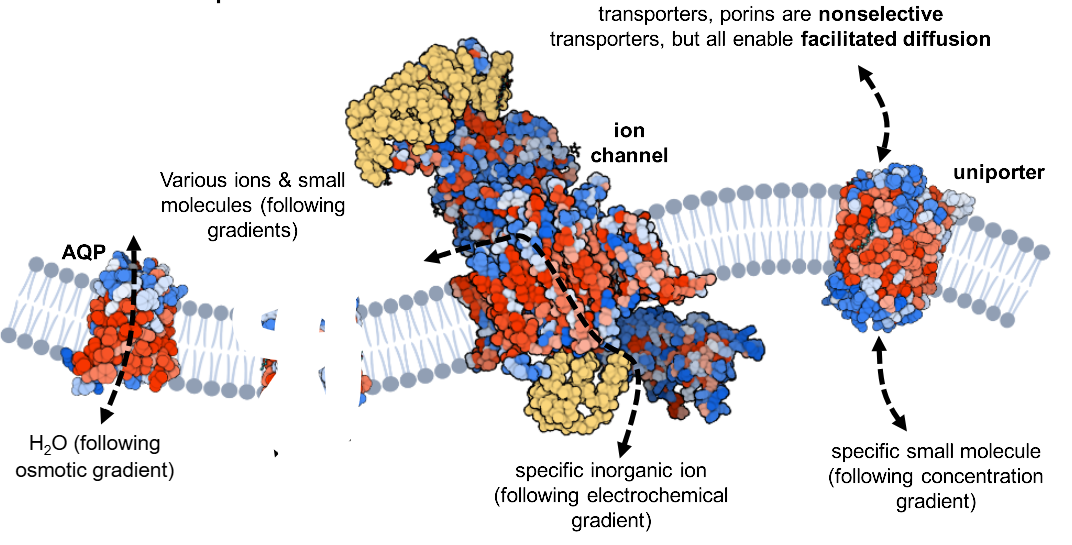
nonselective transporters
porins

AQP (aquaporin)
narrow pore diameter, selective for water
porin
relatively large pore diameter, allows any substance that can fit through, non-gated
ion channel
very small pore diameter with selectivity filter for specific ion & (in most) a gating domain that can conformationally cycle open or closed
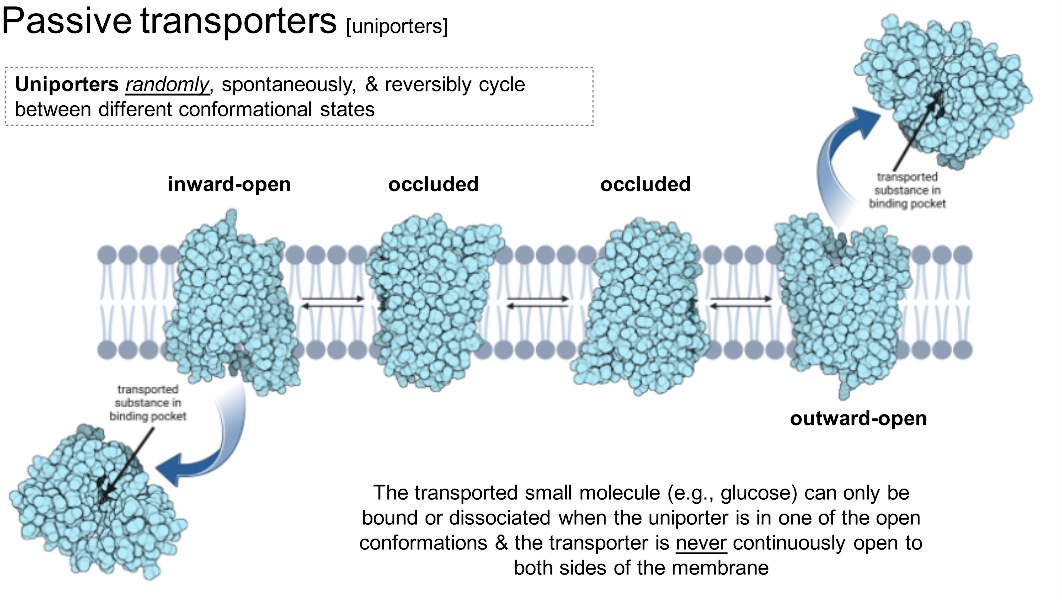
uniporters
randomly, spontaneously & reversibly cycle btwn different conformational states
the transporter is NEVER continuously open to both sides of the membrane
primary and secondary active transporters
active transporters
primary active transporters
ATP driven pumps
Redox-driven pumps
Photon-driven pumps
secondary active transporters
gradient-driven pumps or co-transporters
active transport (give definition)
transport of a substance AGAINST a concentration or electrochemical gradient (low → high)
requires ATP and a carrier protein (ion pumps)
primary active transport
transportation of a substance across PM is directly coupled with hydrolysis of ATP
secondary active transport
the movement of two substances simultaneously across membrane indirectly coupled to ATP hydrolysis
(indirect utilization of ATP as an energy source)
simple diffusion w/ concentration gradient
mechanism for movement of freely bilayer permeant substance
simple diffusion OR facilitated diffusion (
via passive transport protein) [w/ concentration gradient]
mechanism for movement of somewhat bilayer permeant substance
facilitated diffusion (w/concentration or electrochemical gradient)
mechanism for movement of bilayer impermeant substance
active transport (via active transport protein)
mechanism for movement of any substances moving in absence of or against gradient
symporter (explain process)
Up, open side, facing high end of gradient so x wants to bind
Substance that is moving down gradient MUST bind first
Second binding site for y substance ONLY becomes operational AFTER first substance has bound
X binds -> Y then can bind
Only comes off or dissociates when down open side
Follows same rules that uniporter would in isolation
X and Y bind ONTO transporter on same side of membrane and come off same side of the membrane on opposite side
Down open conformation:
X wants to come off
X comes off, Y is forced off as well
X behavior 100% dictated by it’s gradient
Y is forced to move in same direction as X
antiporter (explain process)
Opposite relationship between two substances
X behavior is SAME, the DIFFERENCE is in y
Y can only bind once x has come OFF and can only come off once x is ON
X still moves in same direction, Y moves in OPPOSITE direction
using nerst equation to calculate the eq potential
how to predict net direction of inorganic ions down EC gradients?
Efflux occurs: value of membrane potential gets more negative
Influx occurs: value of membrane potential gets more positive/
efflux vs influx for CATIONS
Efflux: value of membrane potential gets more positive
Influx: value of membrane potential gets more negative
efflux vs influx for ANIONS