Basal Ganglia
 Call Kai
 Learn
Learn Practice Test
 Spaced Repetition
 Match
Match Flashcards
 Knowt Play
1/45

There's no tags or description
Looks like no tags are added yet.
Name | Mastery | Learn | Test | Matching | Spaced | Call with Kai | Chat |
|---|
No analytics yet
Send a link to your students to track their progress
46 Terms
Basal Ganglia
control mechanism for cognitive, emotional, and motor activity
components in the telencephalon (cerebrum), midbrain, and diencephalon
lesion: disorders of movement (PD, hemiballismus, resting tremor, dystonia), OCD, Tourette’s, dementia
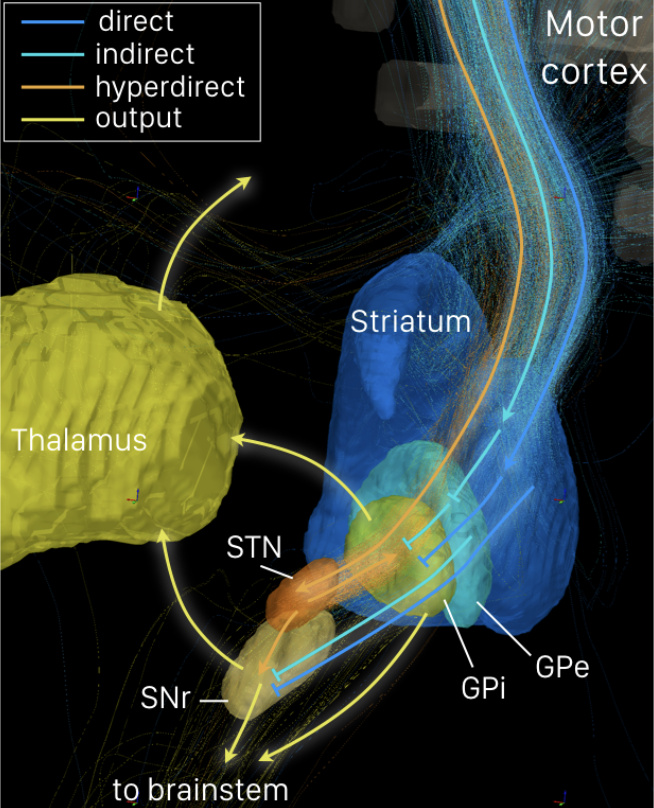
Motor control
motor learning- mostly reward-associated
motor program selection
no direct projections to LMNs
regulate UMNs mostly in cx
cortical UMN- subcortical loop linking most of the cx with UMN motor cortices
brainstem and diencephalon- direct projections to the motor center
if the cx makes a wish, the BC decides whether or not to grant it
Input
excitatory mostly
cerebral cx- excitatory
substantia nigra pars compacta (dopaminergic)
dorsal striatum via nigrostriatal pathway
ventral striatum via mesolimbic pathway
excitatory and inhibitory

Output
inhibitory
globus pallidus internus (GPi) and substantia nigra pars reticulata (SNpr)- tonic inhibitory signals to thalamus and BS


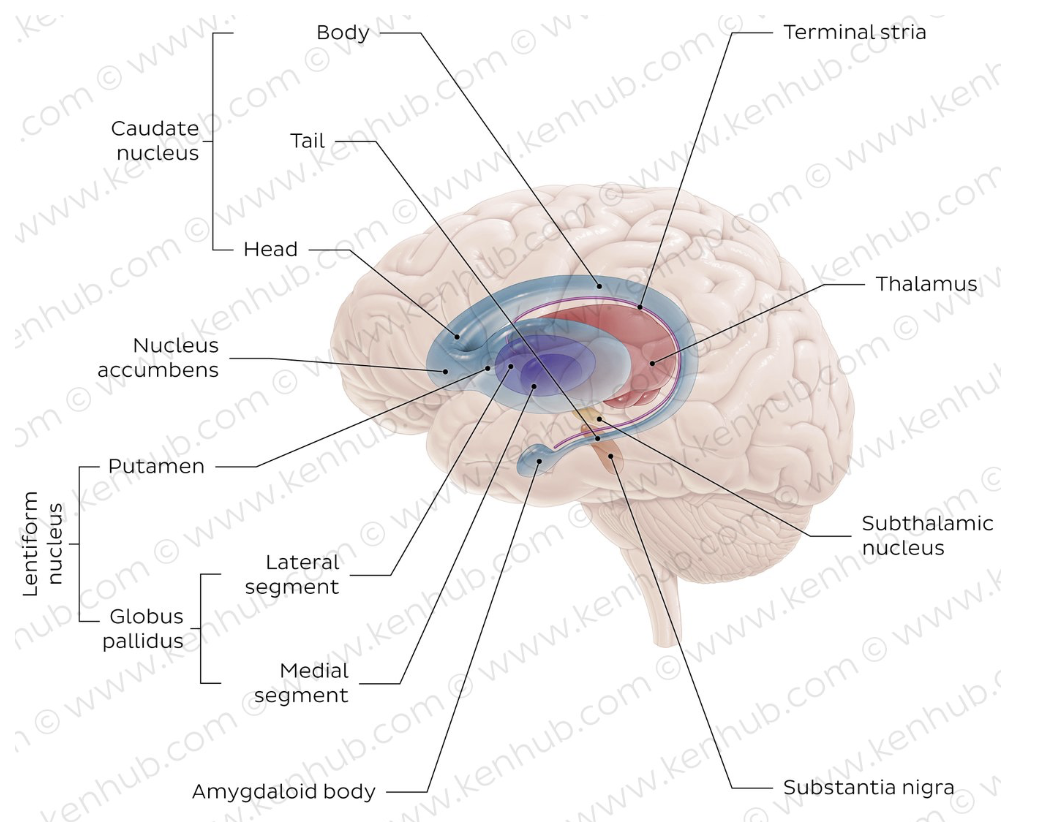
Basal Ganglia Anatomy: Cerebrum/Telencephalon
3 large subcortical nuclei: caudate, putamen, and globus pallidus
striatum = caudate + putamen
lentiform nucleus = putamen + globus pallidus

Basal Ganglia Anatomy: subcortical and BS
subthalamic nucleus (STN) in the diencephalon
substantia nigra in the midbrain
pars reticulata
pars compacta

Striatum (caudate + putamen)
function: selection and filtering of incoming/outgoing signals
rostral: associative and cognitive function
caudal: sensorimotor function
input section of BG:
all of cortex, glutamate = excitatory
thalamus
SNc = dopamine modulatory input
Histology:
medium spiny neurons (MSN)
projection neurons
GABAergic = inhibitory
95% of cells
interneurons
ACh
others: GABA, neuropeptides, etc.
Globus Pallidus
GPe:
input from striatum (GABAergic) = inhibitory
output- GABAergic projections to STN = inhibitory
GPi: output section og BG
function: tonically suppresses motor, emotional, and cognitive processes
input from striatum (GABAergic) = inhibitory
input from STN = excitatory
Subthalamic Nucleus (in Diencephalon)
Inputs:
GPe (indirect pathway) = inhibitory
Cortex (hyperdirect pathway) = excitatory
Thalamus
Output:
Glutamatergic = excitatory
to GPi, diencephalon, and BS motor centers

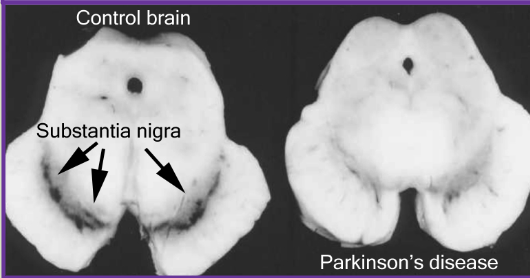
Substantia Nigra (in BS)
Pars Reticulata (SNr):
GABAergic = inhibitory
output section of BG → thalamus and BS
role in eye movement and cognition
Para Compacta (SNc):
Dopaminergic (DA) = excitatory and inhibitory
makes dopamine, makes melanin (how it gets its color)
densely packed, pigmented cells
projections to striatum
facilitates movement, reward
VTA = ventral tegmental area, produces dopamine
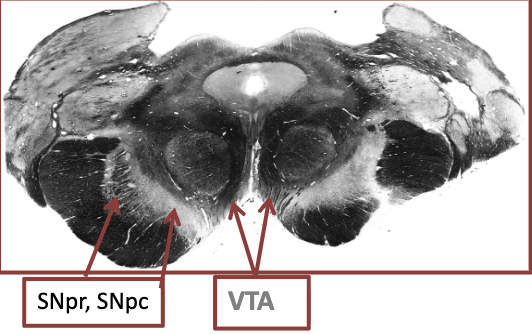
Basal Ganglia Input/Output summary
Input section:
striatum- receives majority of inputs
subthalamic nucleus (STN)
Output section:
Globus pallidus internus (GPi)- majority of output
substantia nigra pars reticulata (SNr)
Basal Ganglia: Limbic System Association
Ventral Striatum (VS)- nucleus accumbens (largest component) and olfactory tubercle; input
Ventral Pallidum (VP); ouput
VS and VP are part of the limbic loop
function- regulate emotional and motivated behavior, mood transition
Ventral Striatum
Input Zone
analogous (similar to) dorsal striatum
nucleus accumbens and olfactory tubercle
input from:
limbic cx
amygdala and hippocampus
basal forebrain
medial thalamus
midbrain (VTA)
output:
ventral pallidum- analogous to projection pattern of dorsal striatum
VTA
function: decision making and reward-related behavior; role in addiction; site of pleasure center (hedonic hotspot)

Ventral Pallidum
Output Zone
analogous to globus pallidus- output zone of BG
GABAergic neurons
some cholinergic or glutamatergic neurons
area ventral to to anterior commissure
Input: ventral striatum and VTA
Output: VTA, STN, Thalamus (MD)
site of pleasure center (hedonic hotspot)
function: decision making, goal-directed behaviors, reward prediction, reward-related behaviors, role in addiction
critical role in drug self-administration, extinction, and reinstatement in drug-seeking behaviors

Basal Ganglia and Brain Stem Motor Centers
evolutionary conserved
Input: Striatum (caudate and putamen)
from cortex and thalamus
Output: SNr and GPi
targets: locomotor regions (tectum, mesencephalic, and diencephalic)
locomotion, posture, eye movements
Dopamine- similar actions to those in sub-cortical loops

Striatal Neurons: Caudate and Putamen
medium spiny neurons (MSN)- aka spiny projection
95% of cell population
interneurons: ACh, neuropeptides, GABA

Neuronal circuits of striatum
Input from:
Cerebral cx/Thalamus- principal input
Substantia Nigra pars compacta (SNpc)- dopaminerginic input, excitatory or inhibitory depending on receptor type on MSN
corpus striatum- local circuit neurons
MSP- hyperpolarized (takes more stimuli for AP)→ decreases likelihood of depolarization and AP
little spontaneous activity, requires summation of inputs from SNpc and Cx to be activated
THIS IS WHY DOPAMINE IS IMPORTANT
Take Home: the striatum (input nuclei) receives a lot of input but it is difficult to get the signal to continue to the output nuclei (GPi/SNr) without input from the BS and cortex as well
Striatum is a filter
Substantia Nigra Reticulata (SNr) and Globus Pallidus Internus (GPi): Output
high level of tonic activity
use GABA as NT
inhibits motor cx indirectly via thalamus
inhibits brainstem motor centers directly
If action is needed, striatum inhibits SNr and GPi
→ disinhibits cortex and brainstem centers —> movement, behavior, and cognitive processes

Inhibition and Disinhibition
inhibition: neuron releases (usually) GABA
disinhibition: usually glutamate

Tripartite Hypothesis
describes anatomical separation of sensorimotor, limbic, and associative pathways
now we recognize that the division of labor may not be so distinct and there may be overlapping boundaries
Rate Model (Go/NoGo)
described anatomical and neurochemical connections between nuclei
postulate: imbalanced electrical activity or abnormal rates of firing in BG nuclei → human movement disorders
model is too simple to account for all observed phenomena (tremors), but accurate enough to be retaiend

Direct Go Pathways
motor cx sends a Go command
inhibitory firing of striatum increases
inhibitory firing in GPi decreases
motor thalamus disinhibited
movement


Indirect NoGo Pathway
motor cx sends a stop command
inhibitory firing of striatum increases
inhibitory firing of GPe decreases
excitatory firing of STN increases
inhibitory firing of GPi increases
motor thalamus is inhibited
movement stopped/inhibited (stopping a movement, inhibiting a competing movement)

Direct vs Indirect (Go/NoGo
Take Home: indirect = inhibitory and direct = excitatory
probably more complex than this
Direct: Striatum → GPi
releases thalamic neurons from tonic inhibition; disinhibition of excitatory thalamic neurons
Indirect: Striatum → GPe → STN → GPi
increases level of tonic inhibition by GPi; increases tonic inhibition of thalamus
producing motion is dependnt on the balance of activity in direct and indirect pathways
both pathways are activated before and during movement
both pathways are quiet during inactivity


Hyperdirect Pathway
motor cortex sends a stop command
excitatory firing of STN increases
inhibitory firing of GPi increases
motor thalamus inhibited
movement stopped/inhibited
Take Home: the motor cortex has direct/rapid control over output nuclei
part of global stopping network

Why do we have 2 competing circuits?
standard view: pathways work together to open/shut physiological gates that initiate and terminate movement
new view: BG circuits also work to suppress competing motor programs → focused selection
hyperdirect and indirect pathways used to suppress competing motor programs
center-surround organization of direct and indirect pathways: activation of indirect pathways → neurons in a “surround” region of GPi are driven by excitatory input from STN → suppresses large number of competing motor programs → focus the disinhibition of the thalamus by GPi
Why do we need a hyperdirect pathway?
still researching but we think…
gives the motor cx direct control over output nuclei
allows for more specific top down control
inhibits premature responses (batter waiting to swing)
is a brake during decision conflict
brake during surprising events
resets or suppresses cortical activity related to ongoing movement and prepares for forthcoming movement
stops irrelevant movement before movement initiation
prey and predator response (freeze)
Dopamine Producing Areas
Nigrostriatal pathway: SNpc → Striatum
enables us to take action toward or away from stimulus
Mesolimbic pathway: Midbrain (meso) to ventral striatum (nucleus accumbens) via medial forebrain bundle
ventral tegmental area (VTA) produces dopamine (DA)
projects to other limbic areas
reward pathway
“DA nigrostriatal circuit allows us to open doors, and DA in mesolimbic circuit allows us to appreciate being able to open doors”

Dopamine (DA) and Aging
decrease in DA with age → contributes to a decrease in eagerness ot explore new things
DA and Parkinson’s Disease
decrease in DA levels with disease progression
deficits in memory, attention, learning and solving visuospatial tasks
need large mental effort to perform simple tasks
DA circuits: Movement
dopaminergic cells in substantia nigra pars compacta (SNpc)
relatively small amount of neurons, but profound effect on cortical input to striatum
DA input to striatum can be excitatory or inhibitory
dependent on receptors on postsynaptic striatal cells
D1 receptors: enhances input from cx
D2 receptors: dampens input from cx
overall DA has an excitatory effect on the generation of movement
D1 + D2 activation needed for disinhibition
DA excites the Direct (Go) pathway and depresses the Indirect (NoGo) pathway
in reality D1 and D2 receptors have a more mixed effect

Cholinergic Circuits
Acetylcholine (ACh) is a NT in striatal interneurons
ACh excites GABAergic fibers
normally ACh’s GABAergic excitation is balanced by DA inhibition of GABAergic fibers, via D2 receptors

BG: Learning and Memory
incorporates limbic, sensory, and executive info from higher-order brain nuclei to influence motor behavior → generates behavioral strategies for gaining favorable outcomes
non-declarative memory: procedural or habit learning; gradual learning of stimulus-response association over many trials; compute probability of outcomes → “gut feeling”
reward-based learning: reward prediction and feedback processing
motor sequence chunking: learning a piece of music
Movement Disorders
Hyperkinetic- too much movement
Hypokinetic- not enough movement

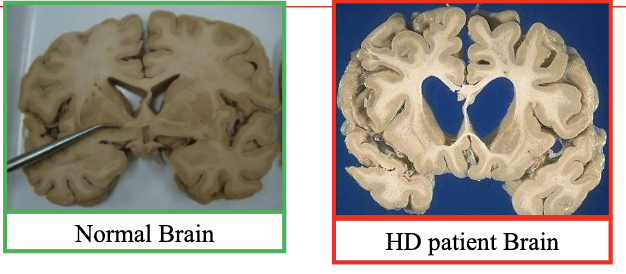
Huntington’s Disease (HD)
hyperkinetic disorder; progressive, autosomal dominant neurodegenereative disorder
decreased tonic inhibition of thalamus; increased disinhibition of thalamus
etiology: inherited; loss of projections to GPe, reduced size of caudate and putamen, loss of MSN in striatum
motor symptoms: chorea (brief involuntary movements that flit from one body part to another randomly; can be graceful or dancelike)
non-motor symptoms: cognitive disturbances, reduced memory, verbal fluency, judgement, reasoning, poor concentration, difficulty planning, apathy, depression, irritability/temper, withdrawal, anxiety
Parkinson’s Disease
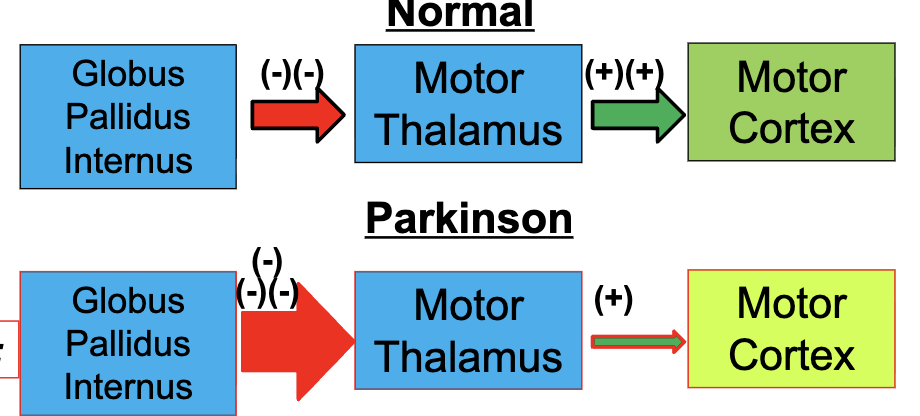
Hypokinetic disorder; most common BG disease
increased tonic inhibition of thalamus by BG; decreased disinhibition to thalamus —> overactivity og GPi
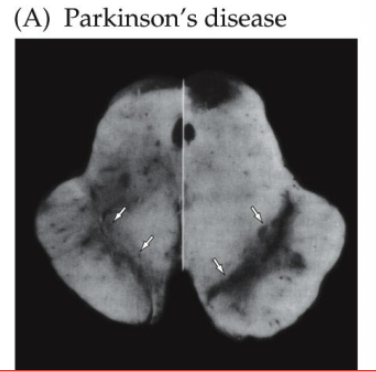
etiology: loss of dopaminergic neurons in SNpc, decreases the drive to the striatum
motor symptoms: bradykinesia, resting and pill-rolling tremor, cogwheel rigidity (freezing, falling, postural instability)
non-motor symptoms: dementia, depression
Tx: levodopa, DA agonists, Anti-cholinergics, deep brain stimulation
Tremor
neurological disorder that causes shaking movements in one or more body parts, most often hands
can occur in arms, legs, head, vocal chords, and torso
rhythmic pattern caused by unintentional muscle contractions
postural tremor- most prominent when limbs are actively held in a position
resting tremor- most prominent when limbs are at rest
intention (ataxic) tremor- occurs as patients attempt to move their limb towards a target
Dystonia
hyperkinetic: repetitive, stereotypes involuntary movements that can be twisting, writhing, jerking; can also be fixed abnormal postures
co-contraction of agonist and antagonist muscles
associated with lesions in the putamen; presumed reduction in GPi output
Hemiballismus
large amplitude, forceful, flinging movments involving mostly the proximal musculature
muscles of shoulder and pelvic girdle; kicking or throwing movements
lesions of the contralateral subthalamic nucleus; usually from stroke
usually leads to choreoathetotic movements within days or weeks
tx: dopamine antagonists
Newer Perspective
Antagonist pathways: structurally and functionally intertwined, not anatomically segregated
co-expression of D1 and D2 receptors on medium spiny neurons
co-activated during movement, both silent during inactivity
abnormally synchronized oscillatory activity observed in PD patients
suggest it may not be so much change in overall firing rate but change in oscillatory activity that is responsible for PD symptoms
Motor Loop (Cortico-basal ganglia-thalamic loop)
Motor Cx → Striatum → GPi → thalamus (VA, VL) → cortex
nuclei are in a feedback circuit with UMN in cerebral cx, brain, and diencephalon
initiating and terminating movement
determining selection of motor programs
Eye Movement Loop (oculomotor circuit)
FEF → Caudate (body) → GPi, SNr → thalamus (VA, MD) → cortex
Goal-directed behavior loop (dorsolateral prefrontal circuit)
diPFC → head of caudate → GPi, SNr → thalamus (VA, MD) → Cx
important in initiating and terminating cognitive processes
planning, decision making, working memory, attention

Social Behavior loop (lateral orbitofrontal circuit)
orbitofrontal/anterior cingulate cx (limbic) → head of caudate → GPi, SNr → thalamus (MD) → Cx
important for recognizing social cues, impulse restrait, separating relevant/non-relevant info

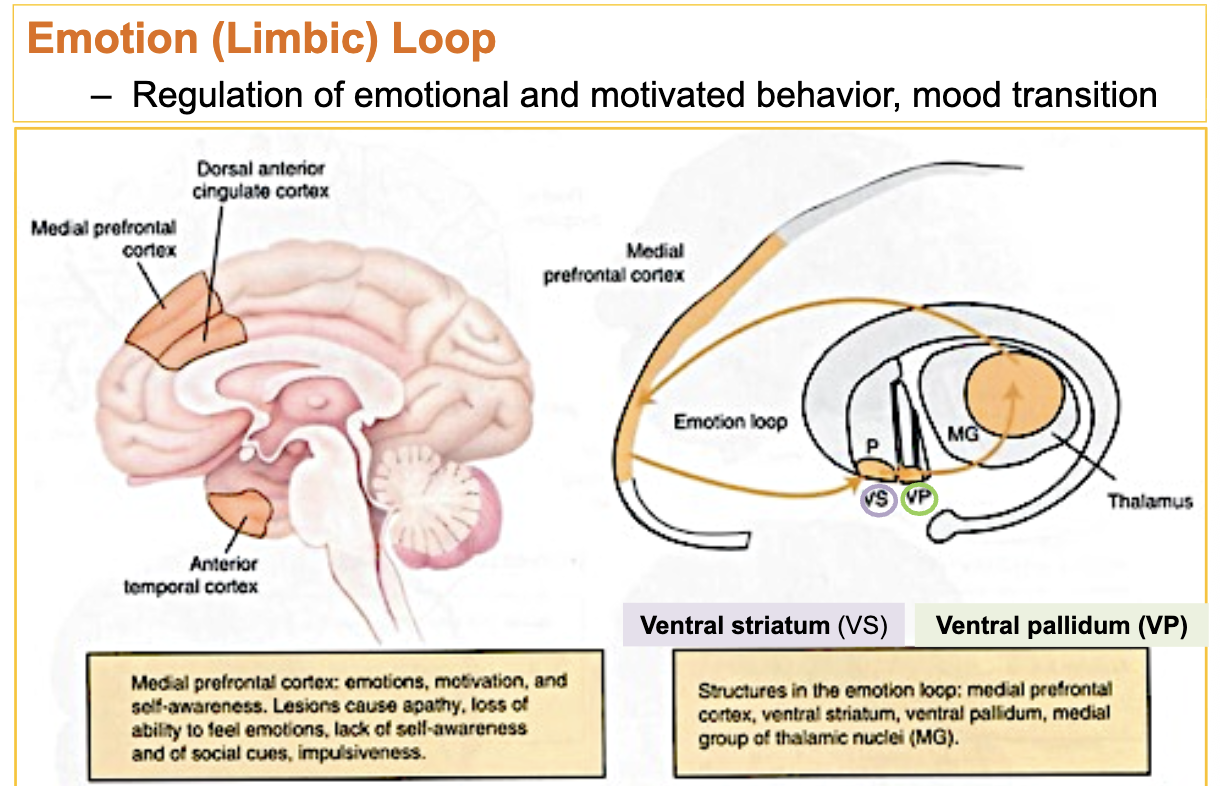
Emotion loop ( medial prefrontal/anterior cingulate circuit [ACC])
medial pre-frontal, anterior cingulate cx → ventral striatum → ventral pallidum → GPi, SNr → Thalamus (MD) → Cx
important for regulating emotional and motivated behavior, determining reward, mood transition
hyjacked in addiction
Emotion (limbic) and Motor Loop
motor loop: Motor Cx → Dorsal Striatum → GPi, SNr → thalamus (VA, VL)
limbic loop: pre-frontal + anterior cingulate cx → ventral striatum (nucleus accumbens + olfactory tubercle) → ventral pallidum → thalamus (MD)

BG: Summary
Basal nuclei in feedback circuit with UMN in cerebral cx
direct connection with BS and motor centers
facilitates desired movement by disinhibition of thalamus or BS motor centers
direct, indirect, and hyperdirect pathways work together to suppress unwanted/competing movement/cognitive/emotional processes and facilitate desired movement/cognition
important for determining the selection of motor program
role in motor learning- reward-associated