Lecture 1: Pathophysiology and Principles of Drug Therapy for Epilepsy
 Call Kai
 Learn
Learn Practice Test
 Spaced Repetition
 Match
Match Flashcards
 Knowt Play
1/42

Earn XP
Name | Mastery | Learn | Test | Matching | Spaced | Call with Kai | Chat |
|---|
No analytics yet
Send a link to your students to track their progress
43 Terms
What is defined as a seizure?
A brief, discrete event that is intermittent, irregular, and unpredictable.
Results from abnormal, excessive, and synchronous discharge of cortical neurons
What is defined as a convulsion?
Seizure manifested by muscle contractions
Describe the initiation of a seizure:
Small group of abnormal neurons undergo prolonged depolarizations →
Recruit adjacent neurons into rapid firing →
Discharge of large number of neurons become abnormally linked (synchronized) (this is defined as a clinical seizure)
What is a seizure (from a neurochemical perspective)?
A imbalance between excitatory and inhibitory influences in CNS
What are proposed causes of seizures?
Abnormalities in voltage/ligand gated ion channels
Reduced inhibitory neurotransmission (GABA)
Enhanced excitatory neurotransmission (glutamate)
Clinical manifestations of seizures:
Symptoms may include a change in:
Motor activity
Sensation
Autonomic function
Consciousness
Symptoms may vary depending on site of origin and spread of abnormal electrical activity
What is epilepsy?
Neurological condition characterized by recurrent (2 or more) seizures unprovoked by any immediately identifiable cause
Separated by >24 hours
What are the two mains categories of seizures?
1) Focal (partial) seizures
a. Simple partial - aware
b. Complex partial - impaired awareness
2) Generalized seizures
Involves loss of consciousness
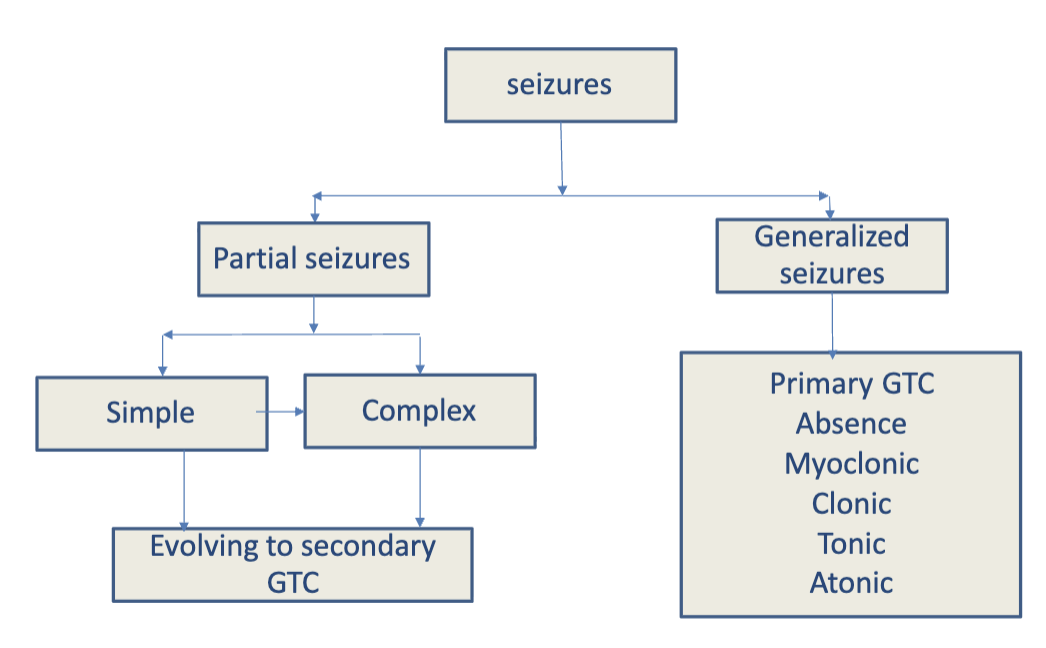
Focal or partial seizures can develop into secondary generalized tonic clonic seizures (electrical disturbance starts with one side of the brain and spreads to both sides)
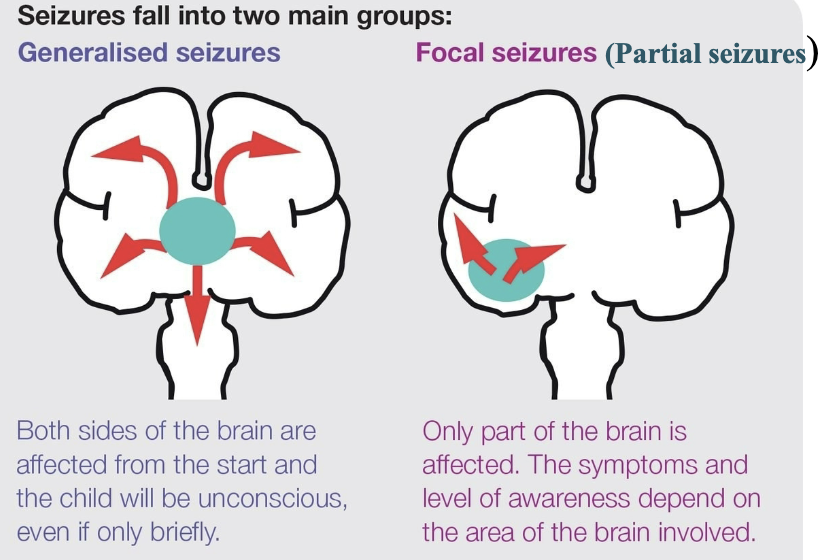
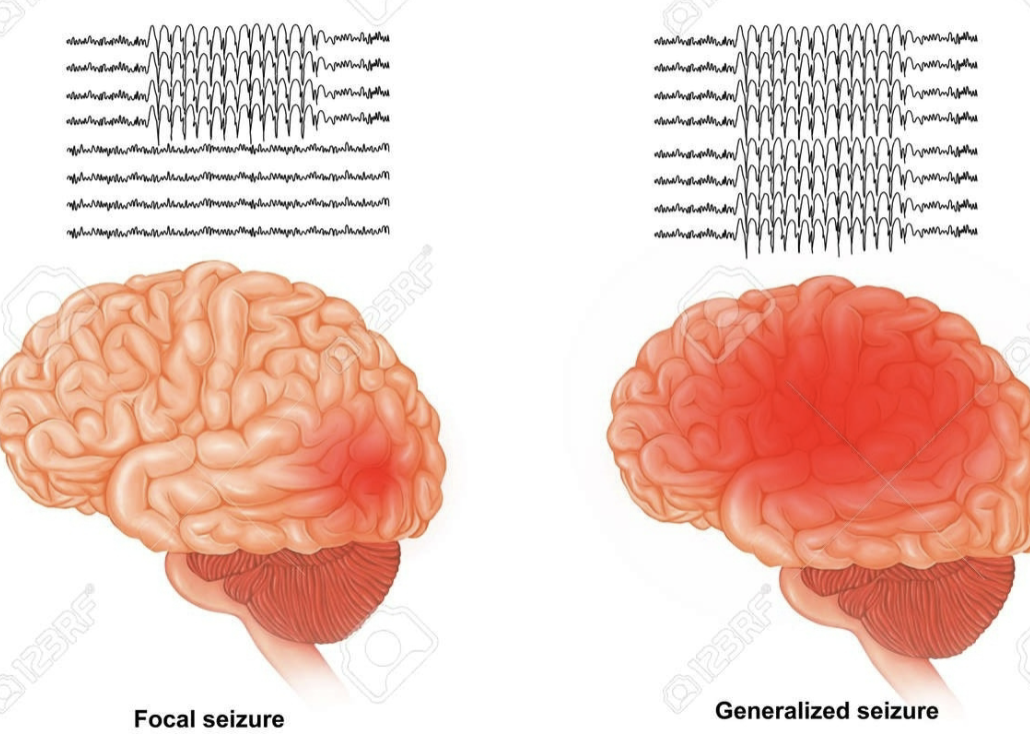
What’s the difference between focal and generalized seizures?
Focal (partial): only part of the brain is affected. The symptoms and level of awareness depend on the area of the brain involved.
Generalized: Both sides of the brain are affected from the start and the patient will be unconscious, even if only briefly
What is aura?
Subjective phenomenon that, in a given patient, may precede an observable seizure. If alone, it constitutes a sensory seizure (focal aware seizure).
Can include: flashing lights, blurry visions, strange smell/taste, intense emotions
What is automatism?
a set of unconscious behavior observed during seizures (ie: chewing, swallowing, lip smacking, fumbling movements of hands, mumbling, etc.
What is ictal?
The seizure period or events due to a seizure
What are the antiseizure meds that are important for this lecture?
Carbamazepine (Tegretol)
Phenytoin (Dilantin)
Valproic acid (Depakote)
Lacosamide (Vimpat)
Lamotrigine (Lamictal)
Levetiracetam (Keppra)
Oxcarbazepine (Trileptal)
Topiramate (Topamax)
What is the general management strategy for seizures?
Appropriate diagnostic evaluation
Confirm diagnosis of epilepsy
Classify seizure type (epilepsy syndrome)
Identify underlying cause
Assess need for ASM therapy
Institute appropriate ASM therapy
When is antiseizure medication not indicated?
1) If seizure are due to a reversible cause
2) If it is the patient’s first unprovoked seizure
3) For specific types of epilepsies (i.e. febrile seizures)
What are the 4 principles of antiepileptic drug therapy?
1) Match drug to patient:
seizure type (epilepsy syndrome)
age, lifestyle, other medical conditions; side effects, administration issues, cost
2) Start low, increase slowly
3) Restrict therapy to one drug (monotherapy) whenever possible
4) Monitor patient for:
seizures
drug interactions
side effects
compliance
What are the drugs of choice for Focal onset seizures (aware and impaired awareness) and focal to bilateral tonic-clonic seizures?
Initial: (CLLO)
Carbemazepine
Lamotrigine
Levetiracetam
Oxcarbazepine
‘Carb’ and ‘Lamo’ ‘Levet-ated’ to the ‘Ox’
Other options/alternatives:
Lacosamide, Phenytoin, Pregabalin, Valproic acid, Topiramate Zonisamide, Briviracetam, Eslicarbazepine
What are the drugs of choice for generalized onset tonic-clonic seizures?
Initial:
Levetiracetam
Lamotrigine
Topiramate
‘Leve & Lamo’
Other options:
Phenytoin
Valproic acid
What are the drugs of choice for absence seizures?
Initial:
Ethosuximide and Valproic acid
Others:
Lamotrigine
Levetiracetam
What are the drugs of choice for atonic or myoclonic seizures?
Initial:
Lamotrigine (atonic only)
Topiramate (atonic only)
Valproic acid (both)
Others:
Clobazam, Clonazepam, Levetiracetam, Rufinamide, Zonisamide
Drugs of Choice: Seizure types table

Drugs of choice: Epilepsy Syndromes

What are the drugs of choice for childhood absence epilepsy syndrome?
First line: Ethosuximide or Valproic acid
Second line: Lamotrigine or Topiramate
What are the drugs of choice for juvenile absence epilepsy syndrome?
First line: Lamotrigine or Valproic acid
Second line: Ethosuximide or Topiramate
What are the drugs of choice for juvenile myoclonic epilepsy syndrome?
First line: Levetiracetam or Valproic acid
Second line: Lamotrigine or Topiramate
What are the drugs of choice for infantile myoclonic epilepsy syndrome?
First line: Valproic acid
Second line: Clonazepam
What are the drugs of choice for Lennox-Gastaut epilepsy syndrome?
First line: Valproic acid or Lamotrigine
Second line: Clobazam, Rufinamide, Topiramate
What are the drugs of choice for Temporal lobe epilepsy syndrome?
First line: Carbamazepine or Lamotrigine
Second line: Levetiracetam, Topiramate, or Valproic acid
Are antiseizure medications generally well tolerated?
Yes, little to not side effects.
What we have to worry about it drug interactions
Carbamazepine: dose-related AEs, interactions, other indications
Dose-related AEs: sedation, dizziness, ataxia, blurred vision, nystagmus (uncontrolled movement of eyes)
Interactions: CYP 3A4 inducer
Other indications: Migraine, depression, bipolar
Lamotrigine: dose-related AEs, interactions, other indications:
Dose-related AEs: dizziness, drowsiness, double vision
Interactions: Induced/inhibited by other ASMs and hormonal contraception
Other indications: Bipolar disorders
Levetiracetam: dose-related AEs, interactions, other indications:
Dose-related AEs: agitation, dizziness, headache, irritability, anxiety
Interactions: none!!! (safe to use with everything)
Other indications: none
Valproic acid: dose-related AEs, interactions, other indications:
Dose-related AEs: sedation, tremor, dizziness, nausea, ataxia
Interactions: CYP 2C9, glucuronidation inhibitor
Other indications: migraine, depression, bipolar
What are the steps to dosing ASMs?
Individualize dosing! Start low and slowly increase until seizures are controlled
Steps in ASM dosing:
Select initial target dose
Dependent on age, weight, current drug therapy, other diseases
Decide on how to achieve initial target
Determine optimal maintenance dosing
How do we determine optimal maintenance dosing?
Increase dose in small increments assessing seizure control or AEs after each change in dose.
Allow adequate time to assess response
Steady state achieved (PK)?
Seizures frequency
Decide dose adjustment based solely on clinical response (controlled vs uncontrolled)
If AEs develop, reduce dose to previous tolerated level and restart with smaller dose increments
What if seizures aren’t controlled at the maximally tolerated dose of the first ASM?
Reevaluate:
– Diagnosis of epilepsy
– Classification of seizure type
– Adequate dose/duration of therapy
– Medication compliance (plasma concentration)
What if a patient has failed therapy with a given ASM?
Consider addition of a second ASM
Consider if monotherapy with the second ASM a possibility or if patient needs to continue with polytherapy
Alternative forms of treatment
Surgery
Vagal nerve stimulator
Ketogenic diet
What is Oxcarbazepine (Trileptal) indicated for?
Focal onset seizures (partial seizures)
What are things to note about Oxcarbazepine (Trileptal)?
It is a pro-drug
Immediately metabolized in the liver to active metabolite 10-MHD
CYP450 enzyme inducer
Follows linear kinetics
What is Valproic acid (Depakote) indicated for?
Broad spectrum of activity (efficacy for both focal/partial & generalized onset seizures)
What are things to note about Valproic acid (Depakote)?
Metabolized hepatically
Is an inhibitor
Inhibits 2C9 → which increases phenytoin cncentration
Inhibits glucur. → which increases Lamotrigine concentration
Inhibits CBZ 10,11 epoxide → which increases CBZ 10,11 epoxide concentration
Follows linear kinetics
What is Levetiracetam (Keppra) indicated for?
Broad spectrum of activity (both focal/partial & generalized onset seizures)
What are things to note about Levetiracetam (Keppra)?
Eliminated renally, mainly unchanged
No enzyme induction/inhibition - meaning, no drug-drug interactions!
Follows linear kinetics