Introduction to ceramics
 Call Kai
 Learn
Learn Practice Test
 Spaced Repetition
 Match
Match Flashcards
 Knowt Play
1/61

There's no tags or description
Looks like no tags are added yet.
Name | Mastery | Learn | Test | Matching | Spaced | Call with Kai | Chat |
|---|
No analytics yet
Send a link to your students to track their progress
62 Terms
Up until the 18th century no suitable material had been identified for use to replace natural dentition
Removable and fixed prostheses were routinely manufactured using carved ivory or shaped cadaveric human and animal teeth or a combination!


In the 18th century techniques first developed in 10th century China were used to create a translucent white ceramic known as porcelain.
In 1774, a French chemist, Alexis Duchateau reported an unsuccessful attempt to manufacture a set of artificial teeth constructed entirely from baked porcelain
In 1788 Duchateau in collaboration with a Parisian dentist Nicholas de Chemant successfully produced a porcelain prosthesis that fitted sufficiently well for Duchateau to wear.
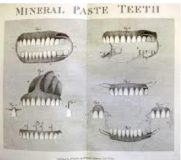
De Chemant published his work and received French and English patents for his porcelain dentures which he described as being constructed of ‘incorruptible mineral paste’ De Chemant’s prosthesis of baked porcelain was constructed with a base and teeth as a single unit and as a consequence was difficult to accurately construct
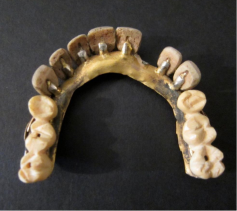
In 1808, an Italian dentist Giuseppangelo Fonzi manufactured individual porcelain teeth of improved colour and translucency containing an embedded platinum pin that allowed the teeth to be attached to a metallic base
This led to commercial production of ‘Fonzi’ teeth on a mass scale led to the foundation of the S.S.White Company in the United States and Claudius Ash in England
In 1887, the first successful porcelain jacket crown was attributed to Charles Land who patented his platinum matrix technique.
The adaptation of the platinum matrix method subsequently allowed for the production of ceramic inlays which were cemented into prepared cavities.
Ceramic applications - Primary areas of application: 7
Inlays
Onlays
Veneers
Crowns
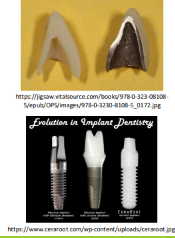
Implant components
Fixed partial prostheses
Denture Teeth
why are ceramic applications widely used? 5
Used widely because of their optical similarities to teeth - shade, translucency, luster
Brittle in nature → microstructure and defects/flaws play a major role in determining strength
Excellent aesthetics
Biocompatibility
Chemical stability
Increasing use in digital dentistry
Widely used for crowns, veneers, inlays, onlays and implants
what is a drawback to ceramic applications?
Brittle in nature → microstructure and defects/flaws play a major role in determining strength- can only undergo little deformation before they fail. failure will originate at pre-existing defects such as a surface scratch
Ceramics -definition
Defined by the American Ceramic Society as inorganic, non-metallic materials which are:
Compounds formed between metallic (or metalloid) elements and non-metallic elements
e.g. Silicon-oxygen –in silicate glasses
e.g. Lithium-oxygen Silicon-oxygen –in lithium silicate ceramics - common
are ceramics crystalline or non crystalline?
Can be crystalline or non-crystalline – if non crystalline usually termed a ‘glass’ or amorphous structure
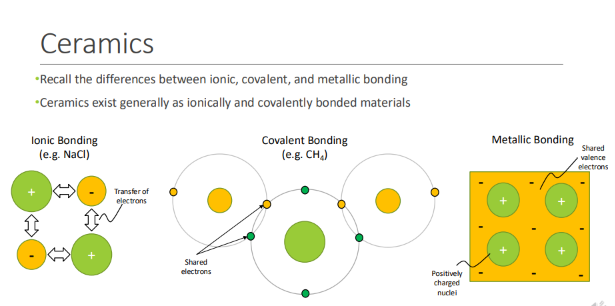
Ceramics - bonding
Ceramics exist generally as ionically and covalently bonded materials
ceramics do NOT have metallic bonding
what’s the deal with teh word ‘porcelain’?
You will frequently hear the term ‘porcelain’, as in porcelain crown or porcelain veneer.
Porcelain is a ceramic but not all ceramics are porcelains
Refers to a specific composition of kaolin - clay (Al2Si2O5 (OH)4 – hydrated aluminosilicate), quartz, and feldspar (KAlSi3O8 , NaAlSi3O8 , and CaAl2Si2O8 – potassium, sodium, and calcium aluminosilicates) exposed to high temperatures during formation.
Types of ceramics used in dentistry - Consist of
Silicate glasses (entirely non crystalline –used as glazes)
Porcelains (predominantly non-crystalline –used as a veneering material)
Glass ceramics (mixture of crystalline and noncrystalline phases – proportions vary –used for inlays only as crowns and anterior bridges
Highly crystalline materials (polycrystalline –used for crowns bridges and implant components)
silicate glasses
(entirely non crystalline –used as glazes)
porcelains
(predominantly non-crystalline –used as a veneering material) - used where we want translucency or the optimum cosmetic appearance
glass ceramics
(mixture of crystalline and noncrystalline phases – proportions vary –used for inlays only as crowns and anterior bridges - low load bearing bridges
highly crystalline materials
(polycrystalline –used for crowns bridges - larger and implant components)
what are the key properties of dental ceramics?
Do not readily react with most liquids, gases, alkalis and weak acids
Remain stable over long periods of time
Can exhibit high strength but their fracture toughness is much lower than metals
Have high hardness
Are optically favorable for cosmetic applications
what is fracture toughness?
amount of energy required to cause a crack to propagate
Glassy phase of dental ceramics
The glass phase is made up of a silicon oxygen (silicate) network characterized by SiO4 tetrahedra in which Si4+ cations are positioned in the centre of each tetrahedron with four O- anions at the corners
The SiO4 tetrahedra are linked by sharing corners. Silicon is known as a network former as it is critical to the linked network
Alkali cations such as potassium or sodium can be added to disrupt silicate chains to modify sintering temperatures or properties such as thermal expansion coefficient –these are known as network modifiers
Atoms such as titanium, aluminum, zirconium can act as an intermediate with both network forming and modifying actions
The structure contains both ionic and covalent bonds

Recap differences between glassy and crystalline states
Here we have the same composition (Silicon and oxygen) in two arrangements
On the left – we have a disordered structure in the glassy (amorphous) state.
On the right we have crystalline silicate –namely quartz –here we have a highly ordered structure with repeating unit cells
Greater energy is required to disrupt ordered systems –so increasing the crystallinity of a dental ceramic enhances the mechanical properties...... but there are also unfavorable consequences

Brittle Nature of Ceramics
The microstructure and bonding of ceramic leads to their brittle nature.
Very little plastic deformation at failure
Failure occurs rapidly
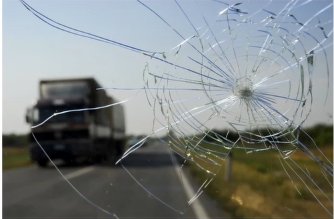
Think about how quickly a crack in your windshield can spread after a large enough rock chip…
Windshield without chips can support high loads
After a “large enough” chip, cracks propagate quickly and the windshields ability to support force greatly diminishes
Defect size and distribution are strength limiting with regards to ceramics!
dental ceramics - mechanical properties - fracture toughness
Fracture Toughness
Fracture toughness is a measure of the resistance to crack growth under a state of tensile stress.
Dental ceramics have low to moderate fracture toughness which means that they are a brittle material
lowest is for the glassy materials , then increasing in toughness for glass ceramics, then the higher toughness is for polycrystalline materials such as allumina and zirconia
dental ceramics - mechanical properties - tensile strength
Dental ceramics restorations fracture under tensile loading.
The theoretical tensile strength (how much energy required to pull atoms apart) of ceramics is extremely high
But ceramics are never defect free, and these defects (and their statistical distribution) determine the actual strength of the material.
Strength varies with specimen size, shape, loading rate, surface preparation and environment (all of these are variables that are affected by restoration fabrication, cementation and clinical usage).
Feldspathic Ceramics (Porcelain) -mainly glassy –minor crystalline component
First ceramics used in dentistry are known as feldspathic ceramics
Feldspar is main component, KAlSi3O8
When Feldspar is melted, it forms:
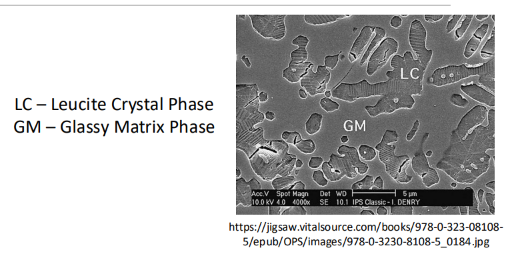
Leucite, KAlSi2O6 - crystalline componenet
Molten glass
Upon cooling, the separate structure of leucite and glass remains - leucite crystals within glassy matrix
Flexural strengths typically 60-80MPa - low
Translucent in nature - aesthetic
Addition of other crystal phases (e.g. fluorapatite) in contemporary materials increases mechanical performance.
can closely match the shade, translucency and luster of natural dentition
But is low strength and prone to mechanical failures
Mechanical Toughening of Glassy Ceramics
Crystalline Reinforcement
Distribute higher strength crystals throughout the glassy matrix result in the crack having to go around the crystals in order to propagate → “Put stuff in the way” but Crystal phase must have compatibility with the glass to be effective!
If the crystal phase is not compatible with the glass, it will serve as a defect itself, but if you get this correct it can exert a stabilizing residual strain on the surround glass –effectively toughening it.
Examples include:
leucite reinforced glasses (e.g. Empress I, Ivoclar Vivadent)
Lithium disilicates (e.g. IPS e.max, Ivoclar Vivadent; Vita Suprinity, VITA Zahnfabrik)

We now have a wide range of ceramics with different microstructures available to us
Crystal phases are used to reinforce the ceramic
Up to 99% of the ceramic can be crystalline in nature, depending on the method and crystal phase used
Remainder is amorphous glassy phase.
But increasing crystalline content has a draw backs in terms of dimensional accuracy during fabrication (shrinkage during sintering) and also in decreasing transparency.
Crystal size, type, and amount will determine mechanical and optical properties
Matching the refractive index of the crystal and amorphous phase is critical for translucency
But increasing crystalline content has a draw backs
But increasing crystalline content has a draw backs in terms of dimensional accuracy during fabrication (shrinkage during sintering) and also in decreasing transparency.
We now have a wide range of ceramics with different microstructures available to us
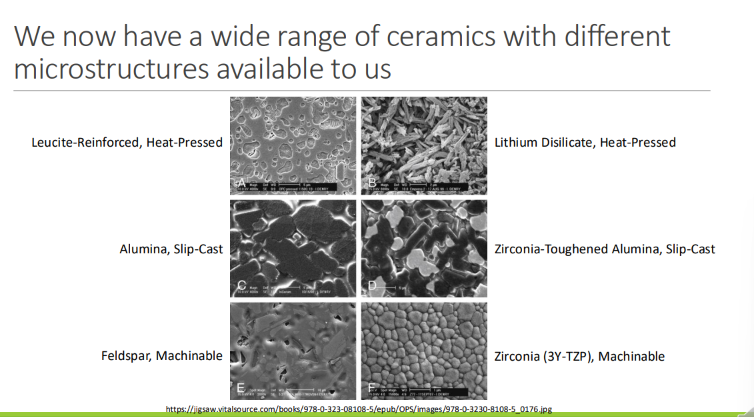
Different manufacturing methods have been devised to accommodate the use of different ceramic microstructures - what are the differnt methods? 4
Different manufacturing methods for all-ceramic restorations:
Sintering
Heat-pressing
Slip-casting
Computer Aided Drafting – Computer Aided Manufacturing (CAD-CAM)
Sintered All-Ceramic Restorations
Sintering of dental ceramics: the final object is formed by first pressing the constituents in powdered form under pressure into a mold, and then firing the pressed object at high temperatures - ie melting then coalescence
Final ceramics are typically veneered (covered) in a translucent porcelain and glazed (heat treated) to improved esthetic appearance
Two main types of crystalline reinforced sintered dental ceramics:
Alumina-based (up to ~40 wt% crystalline phase)
Leucite-reinforced
Sintered All-Ceramic Restoration: Alumina-Based Materials
not really used anymore - stopped 80s 90s ish
Alumina is an aluminum oxide, Al2O3
Typically added in levels of up to 40-50% by weight
Exhibits an excellent bond with the glass phase
Coefficient of thermal expansion between glass and alumina phases should be closely matched
Alumina ceramic is formed by dry-pressing and then sintering at a temperature of ~1550°C
During sintering procedure shrinkage between 10-20% can occur
Final alumina ceramic has a flexural strength of ~600MPa depending on concentration
Large alumina crystals lead to crack deflection
Key problems – shrinkage during sintering leading to dimensional inaccuracies; opacity of core necessitates veneering with glassy material to achieve esthetics.
Rarely used system now – but many functioning crowns out there !
Sintered All-Ceramic Restoration: Leucite-Reinforced Materials
Compound of potassium, aluminum, silicone, and oxygen, K[AlSi2O6 ] → A component of traditional feldspathic porcelain, but is increased up to 45% by volume
Increased leucite content over traditional feldspathic porcelain increases flexural strength to over 100MPa
The leucite crystals have up to a 3-fold larger thermal coefficient of expansion compared to the glassy phase
During cooling, the leucite contracts more than the glass resulting in residual stresses
Residual stresses act as a crack deflecting mechanism and increase strength
Highly aesthetic – have been extensively used for anterior crowns and inlays
Heat-Pressed All-Ceramic Restorations
Heat pressing of dental ceramics: the simultaneous application of both heat and pressure to form and sinter the ceramic.
Employs a lost wax process.
Contrast with sintering where the constituent powders are first pressed and then fired
wax mold holds ingot of the material - placed into the mold
Pressures generally in range of 0.3-0.4MPa for 10-20 minutes
Temperature will depend on the ceramic used
Heat pressing is typically used over classical sintering as it improves crystal dispersion, can obtain higher crystallinity, and decrease crystal size → improved mechanical properties
As with sintered ceramics, the final heat-pressed ceramic is veneered with translucent porcelain
Ceramic materials used in heat pressing:
Leucite-reinforced ceramics
Lithium disilicate-based ceramics
Ceramic materials used in heat pressing:
Leucite-reinforced ceramics
Lithium disilicate-based ceramics
Heat Pressed All-Ceramic Restoration: Leucite-Reinforced Materials
Ceramics reinforced with K[AlSi2O6 ] in amounts between 35-55% by volume
Contrast with 45% achievable using sintering
Crystal sizes typically in the range of 1-5micron
Final porosity nearing 9% by volume
Final flexural strength of ~120MPa
Increase over the strength of sintered leucite-reinforced ceramics (~100MPa)
Reduced operator induced variability compared with sintered leucite ceramics
Improved strength a result of increased crystallinity and improved dispersion
As with sintered leucite-reinforced ceramics, the coefficient of thermal expansion mismatch between crystal and glass phases creates a crack-deflecting mechanism
Heat Pressed Ceramics: Lithium Disilicate Materials
Lithium disilicate, Li2 Si2O5 , is the major crystal phase up to 65% by volume
Prismatic crystal structure of approximately 5micron in length and 0.8micron in diameter,
Final porosity of 1% by volume
Flexural strength of 300-400MPa
Similar to leucite-reinforced ceramics, the crystal phase has a coefficient of thermal expansion mismatch with the crystal phase
In addition, crack deflection is further improved by the interlocking of elongated crystals
Widely used ceramic composition – at Guy's we use a product called IPS e.max
Slip-Cast All-Ceramic Restorations
Slip-cast dental ceramics: an interpenetrating phase composite
A ceramic frit layer is first condensed on a refractory die and is then pre-sintered to create an inter-penetrating phase or a layers is machined from a preformed block
A glass phase is then drawn into the porous ceramic at high temperatures after the crystal phase has been sintered
Three types of materials are used in slip-casting:
Alumina-based
Spinel-based
Zirconia-toughened alumina
Much less common now –but for many years' products such as Vita Inceram provided high strength ceramics for crown manufacture with flexural strengths ~500MPa
Three types of materials are used in slip-casting:
Alumina-based
Spinel-based
Zirconia-toughened alumina
CAD-CAM All-Ceramic Restorations
Computer Aided Drafting – Computer Aided Manufacturing (CAD-CAM)
may be milled to the desired dimensions or milled to an oversized version to account for shrinkage during final sintering
The desired restoration (tooth or teeth) is scanned to obtain a digital reconstruction (CAD) and then imported to a milling device for machining of a bulk ceramic material (CAM)
Disadvantages can manifest through the use of machining with a brittle material

CAD-CAM All-Ceramic Restorations - hard vs soft machining
Bulk ceramic materials are either sintered or partially sintered in a block format, which are then machined to the final shape
Hard Machining – when the ceramic is fully sintered before machining
Can be fully crystallized or partially crystallized
sinter → machining
highly geometrically accurate
but limited in terms of choices of materials - as some may blunt machine very quickly
Soft Machining – machining is performed on a partially sintered ceramic
Full sintering occurs after machining
partial sinter → machining oversized form→ partial sinter
must consider shrinkage
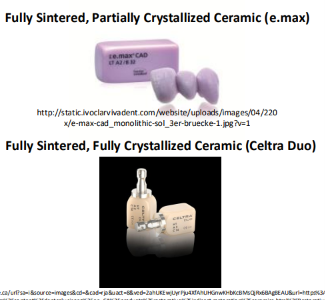
Three types of materials are currently used in the fully sintered state in CAD-CAM restorations: - hard?
Feldspar
Leucite-reinforced
Lithium disilicate
have lower fracture toughness
CAD-CAM restoration production route with fully sintered materials can allow for rapid production of restorations in-clinic (hours) with more “practical” equipment as compared to other manufacturing methods
CAD-CAM All-Ceramic Restorations: Fully Sintered Materials - feldspar
Feldspar ([Na, K]AlSi3O8 ):
Concentration of 30% by volume
Flexural strength of 120MPa → considered moderate
CAD-CAM All-Ceramic Restorations: Fully Sintered Materials -leucite re-inforced
Leucite-reinforced (K[AlSi2O6 ]):
Machined in very similar form to heat-pressed leucite-reinforced ceramics
Ceramic contains 35-55% leucite by volume
Typical flexural strength of 120MPa
CAD-CAM All-Ceramic Restorations: Fully Sintered Materials - lithium disilicates
Lithium disilicates:
Can be machined both fully and partially crystalllized
When partially crystallized, the structure contains both lithium metasilicate (Li2SiO3 ) and disilicate (Li2Si2O5 )
Blend of silicates will dictate mechanical and optical properties
Crystallization procedure post-machining will depend on concentration of lithium disilicates
Flexural strength can range, but ~360MPa is typical
CAD-CAM All-Ceramic Restorations: Partially Sintered Materials include : 3
Alumina
Spinel (see slip-cast)
Zirconia
CAD-CAM All-Ceramic Restorations: Partially Sintered Materials - alumina
Alumina
High purity aluminum oxide (99%)
Designed and manufactured in an oversized form to accommodate for shrinkage during sintering
Flexural strengths (500-650MPa)
Opaque so requires a veneering layer (feldspathic or glass-ceramic)
CAD-CAM All-Ceramic Restorations: Partially Sintered Materials -Zirconia
most common
Tetragonal zirconia polycrystals are partially stabilized with yttrium (Y-TZP)
Highest flexural strength of all dental ceramics ranging from 900-1500MPa
Y-TZP is only metastable → straying from prescribed surface/heat treatments can alter structure/properties!
Mechanical Toughening of Zirconia
Phase Transformation Reinforcement:
Specific to zirconia (ZrO2 ) ceramics
Tetragonal phase zirconia is only stable between 1170 and 2370°C
Yttria oxide (Y2O3 ) or cerium oxide (CeO2 ) can stabilize zirconia in its tetragonal form at room temp
When stabilized, tetragonal phase zirconia reaches a threshold stress, it undergoes a transformation to monoclinic phase zirconia which includes a volume increase
The volume increase results in compressive stresses around the crystal which stabilizes the crack
Ceramic-Metal Restoration - definition
Ceramic-Metal Restoration: restoration formed by at least two layers of ceramic on a metal framework
Ceramic-Metal Restoration
Ceramic-Metal Restoration: restoration formed by at least two layers of ceramic on a metal framework
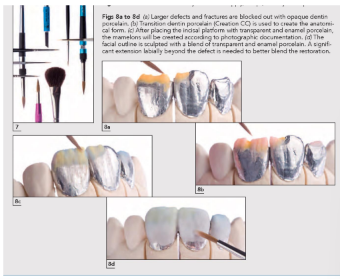
Layer 1: Ceramic with opacifying oxides - opaquing layer
Critical for bonding to the metal structure and esthetically hiding the metal
Additional Layers: Application of more translucent porcelain for size and color matching
Ceramic frit powder is mixed with water (may contain a binder such as starch) and applied as necessary –using the technician's artistry

Ceramic-Metal Restoration - continued
After additional layers are added, the restoration is vibrated and slowly dried to condense ceramic
Restoration is then sintered under vacuum at 0.1atm (0.01MPa)
Vacuum is essential for decreasing porosity
in a ceramic-metal restoration, why is the restoration vibrated and slowly dried?
to condense the ceramic
in a ceramic-metal restoration - what is essential for decreasing porosity?
Restoration is then sintered under vacuum at 0.1atm (0.01MPa)
Vacuum is essential for decreasing porosity
remember any small defects can act as a stress concentrator - fracture

Ceramic-Metal Restoration: Ceramic Driven Requirements
the metal must have a melting temperature significantly greater than the firing temperature used for the ceramic → metal cannot melt during application of the ceramic to metal core
Veneering porcelain should have a low temperature of fusion to eliminate distortion during sintering
Base porcelain must be able to wet the alloy adequately for proper ceramicmetal adhesion
Strong adhesion between the ceramic and metal – achieved primarily through oxides on the metal surface (chemical adhesion) and increased metal surface roughness (mechanical adhesion)
Coefficients of thermal expansion must be compatible → the metal is typically designed to have a slightly higher coefficient of thermal expansion to place the ceramic in a state of compression upon cooling
High metal elastic modulus is desirable to mitigate stresses and strains within the weaker porcelain
Metal shape should not change during the firing cycle of the ceramic → prolonged exposure of metals to heightened temperatures can cause changes in shape which can reduce fit with ceramic
Design of shape is critical to reduce regions of stress concentration resulting from areas of thin material, sharp changes in geometry, etc
the metal must have a melting temperature significantly greater than the firing temperature used for the ceramic
metal cannot melt during application of the ceramic to metal core
Veneering porcelain should have a low temperature of fusion
to eliminate distortion during sintering
Base porcelain must be able to wet the alloy
for proper ceramicmetal adhesion
Strong adhesion between the ceramic and metal – achieved primarily through …
oxides on the metal surface (chemical adhesion) and increased metal surface roughness (mechanical adhesion)
Coefficients of thermal expansion must be compatible
the metal is typically designed to have a slightly higher coefficient of thermal expansion to place the ceramic in a state of compression upon cooling
High metal elastic modulus is desirable…
to mitigate stresses and strains within the weaker porcelain
Metal shape should not change during the firing cycle of the ceramic
prolonged exposure of metals to heightened temperatures can cause changes in shape which can reduce fit with ceramic