Ch. 26 LEC - Fluid, Electrolyte, Acid-Base Balance
 Call Kai
 Learn
Learn Practice Test
 Spaced Repetition
 Match
Match Flashcards
 Knowt Play
1/28

Earn XP
Description and Tags
Lecture Exam 5
Name | Mastery | Learn | Test | Matching | Spaced | Call with Kai | Chat |
|---|
No analytics yet
Send a link to your students to track their progress
29 Terms
the typical body water content of adult males is _% water
60
the typical body water content of adult females is _% water
50
why is the average body water content in adult females less than that of males?
females have higher fat content and less skeletal muscle mass
body water content declines to _% in old age
45
the typical body water content of infants is _% water or more
73
why is the average body water content in infants greater than that of adults?
infants have low body fat and low bone mass
define intracellular fluid (ICF)
fluid located inside tissue cells
define extracellular fluid (ECF)
fluid located outside of cells
define interstitial fluid (IF)
a sub-compartment of the ECF, this is the fluid found specifically in the spaces between cells
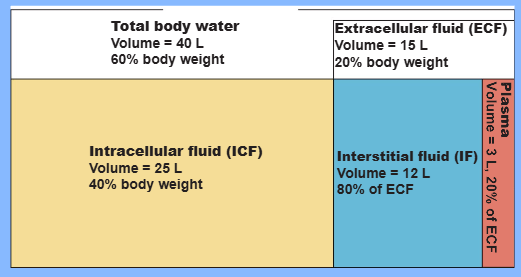
![<p>The total body water content is about [<strong>NUMBER</strong>] L. ICF makes up [<strong>FRACTION</strong>] ([<strong>NUMBER</strong>] L) while the ECF makes up [<strong>FRACTION</strong>] ([<strong>NUMBER</strong>] L) of the body water content. Of the 15 liters of ECF, [<strong>NUMBER</strong>] L is plasma and [<strong>NUMBER</strong>] L is interstitial fluid. The rest of the ECF is composed of lymph, CSF, humors of the eye, synovial fluid, serous fluid, and GI secretions</p>](https://assets.knowt.com/user-attachments/a3dadae4-4ad1-4e80-b618-66a63e0a18b6.png)
The total body water content is about [NUMBER] L. ICF makes up [FRACTION] ([NUMBER] L) while the ECF makes up [FRACTION] ([NUMBER] L) of the body water content. Of the 15 liters of ECF, [NUMBER] L is plasma and [NUMBER] L is interstitial fluid. The rest of the ECF is composed of lymph, CSF, humors of the eye, synovial fluid, serous fluid, and GI secretions
40, 2/3, 25, 1/3, 15, 3, 12
water is the universal [SOLUTE/SOLVENT/SOLUTION]
solvent
the 2 main classes of solutes in bodily fluids are _ and _
electrolytes, nonelectrolytes
characterize nonelectrolytes and provide examples
mostly organic substances that do not dissociate in water (e.g., glucose, lipids, creatinine, urea)
characterize electrolytes and provide examples
the most numerous solutes in the body and can dissociate into ions in water (e.g., inorganic salts, all acids and bases, some proteins)
identify the reason electrolytes are crucial to the body
have great osmotic power → contributes to fluid shifts
determine chemical and physical reactions of fluids
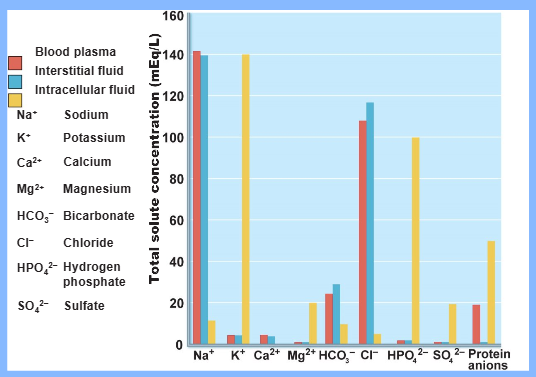
name the major cation(s) and anion(s) of the ECF
cation: Na+
anion: Cl-
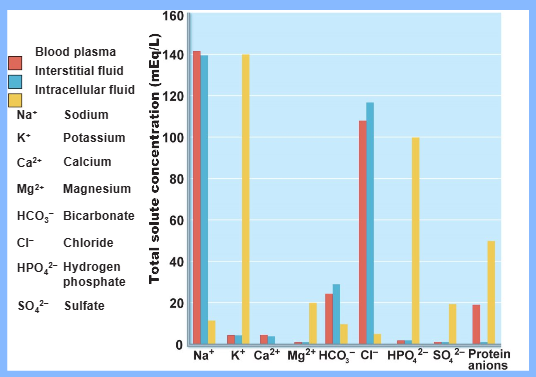
name the major cation(s) and anion(s) of the ICF
cation: K+
anion: HPO4 2-
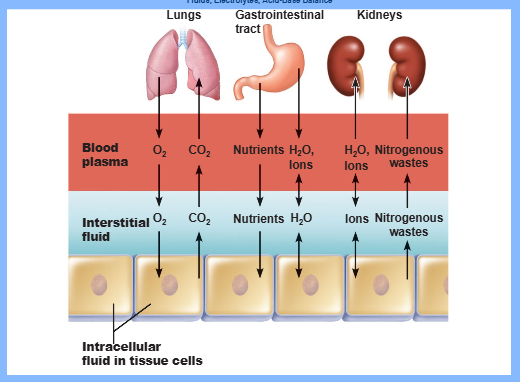
fluid movement among compartments (ECF, ICF) is regulated by__ and __ pressures
osmotic, hydrostatic
what element is central to water regulation?
Na+
list the possible sources of water intake
beverages, food, metabolic water
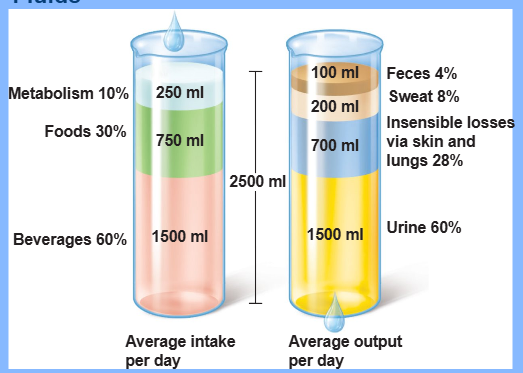
list the possible sources of water output
urine, insensible water loss (skin and lungs), perspiration, feces
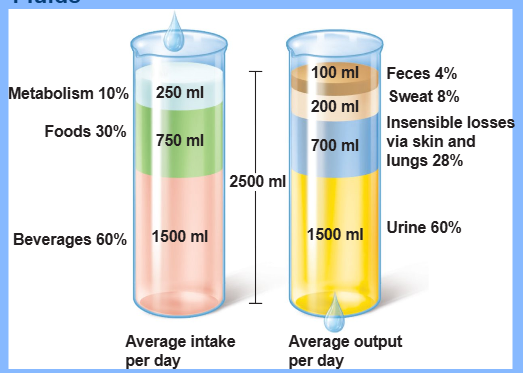
true/false: the amount of water intake is usually higher than water output
false - the amount of water intake is usually equal to water output
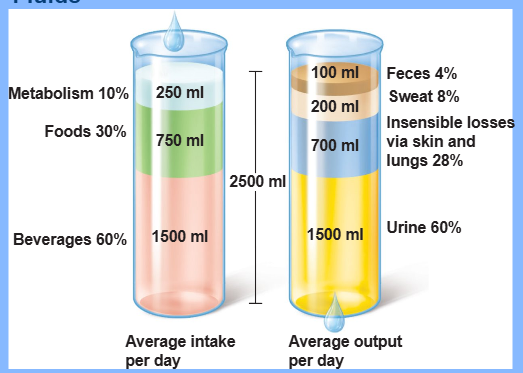
water intake = water output = [NUMBER] mL/day
2500
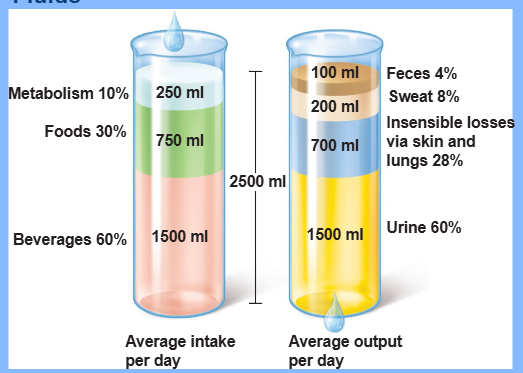
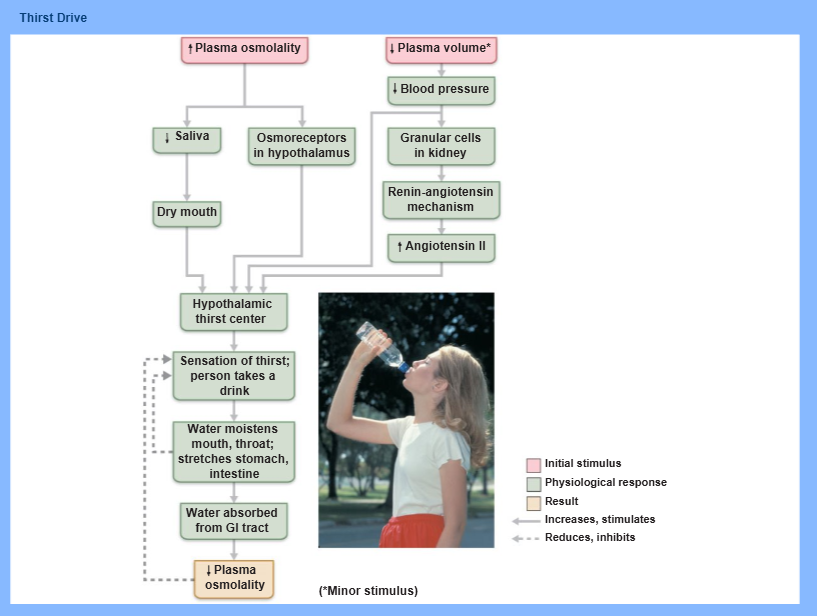
the neurological driving force for water intake is the _
hypothalamic thirst center
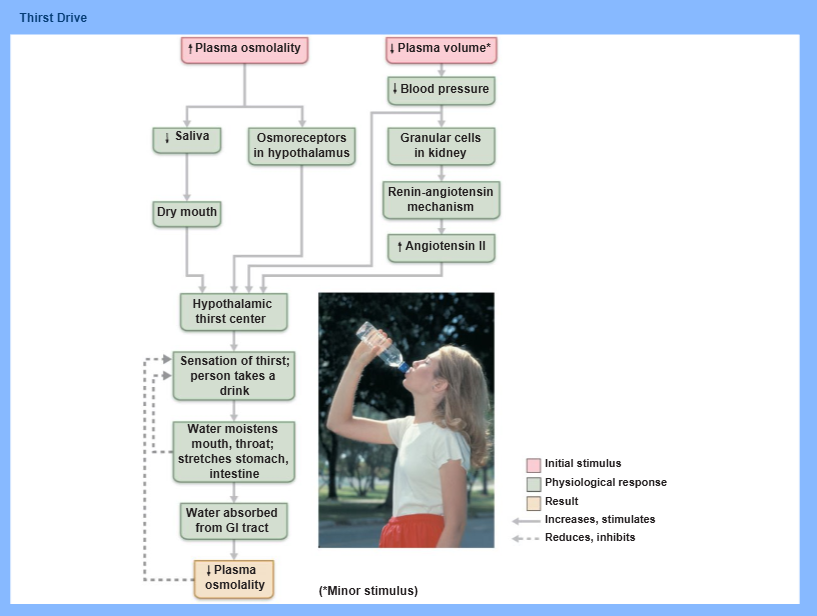
list the factors that stimulate the osmoreceptors of the hypothalamic thirst center
high plasma osmolality (2-3%)
angiotensin II
dry mouth
substantial decrease in blood volume or pressure
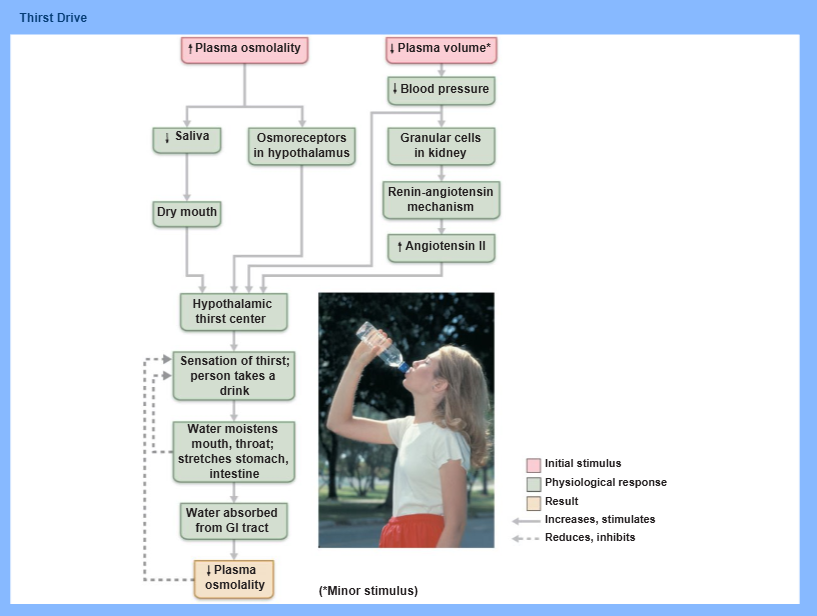
low osmolality ([LOW/HIGH] water/[LOW/HIGH] particles → thirst center is [INHIBITED/ACTIVATED] → [YES/NO] thirst
high, low, inhibited, no
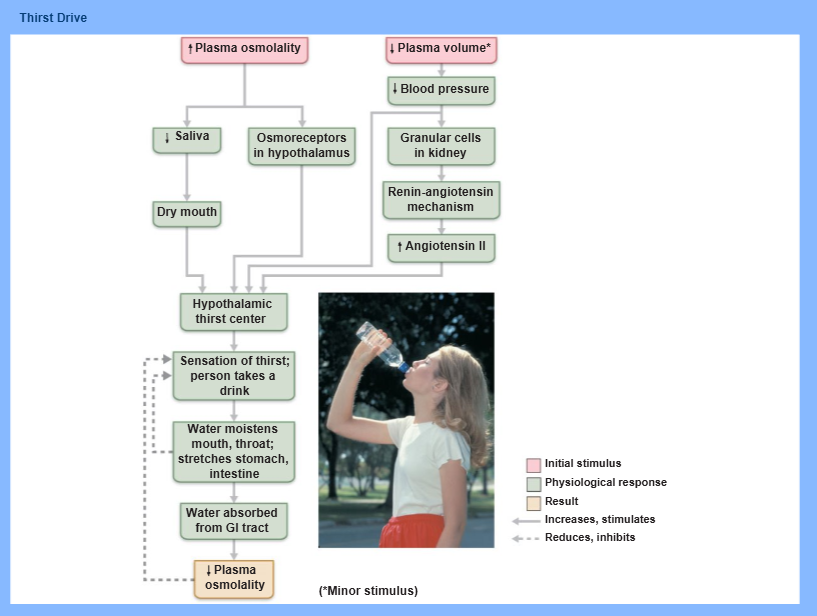
high osmolality ([LOW/HIGH] water/[LOW/HIGH] particles → thirst center is [INHIBITED/ACTIVATED] → [YES/NO] thirst
low, high, activated, yes
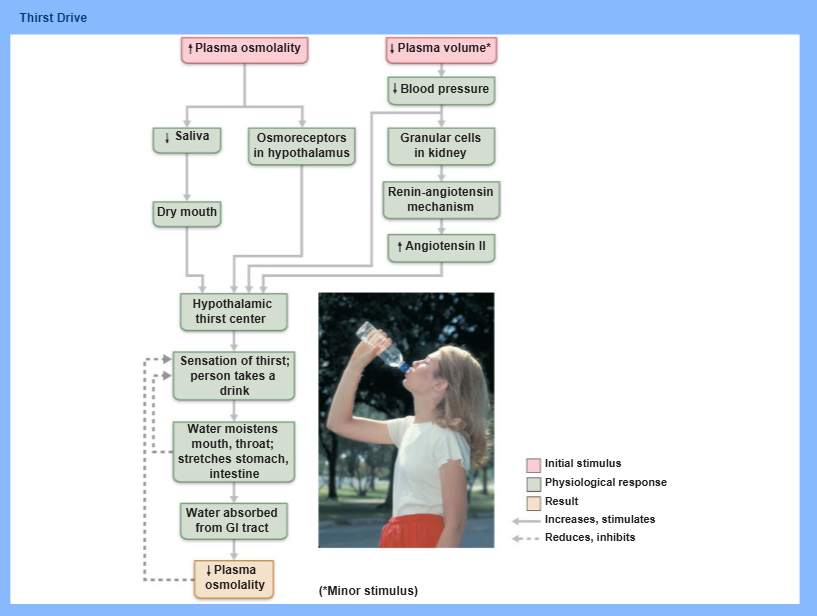
water intake:
drinking water creates [INHIBITION/ACTIVATION] of the thirst center
[INHIBITORY/ACTIVATORY] feedback signals include:
relief of [DRY/WET] mouth
activation of stomach and intestinal [CONSTRICTING/STRETCHING] receptors
inhibition, inhibitory, dry, stretching