The Chemical Level of Organization (part 2)
 Call Kai
 Learn
Learn Practice Test
 Spaced Repetition
 Match
Match Flashcards
 Knowt Play
1/32

Earn XP
Description and Tags
fudge
Name | Mastery | Learn | Test | Matching | Spaced | Call with Kai | Chat |
|---|
No analytics yet
Send a link to your students to track their progress
33 Terms
Macromolecules
Big molecules that we would find in our system
Carbohydrates
Contains carbon, hydrogen, and oxygen
Monosaccharides
One sugar, building blocks of carbohydrates. A single ring of 5/6 carbon atoms
Glucose
The monosaccharide that our body uses for fuel, and is also known as “blood sugar”. The body converts other monosaccharides into glucose. Produces ATP
Disaccharides
“Double sugars.” Formed when 2 monosaccharides are joined together. Must be broken down into simple sugars before they can be absorbed into the blood from digestive tract
Disaccharides examples
Sucrose (glucose +fructose) cane sugar
Lactose (glucose + galactose) found in dairy
Polysaccharides
Long branching chains linking simple sugars that are useful to store sugars
Polysaccharides examples
Starch, found in plants
Glycogen, found in animal/human tissue, such as skeletal muscles and liver
Primary role of carbohydrates
Source of energy
Glycogen
Excess blood glucose, used for storing energy for later use
Lipids
Fats, insoluble in water but are soluble in other fats
Triglycerides
Most abundant concentrated source of usable energy for the body. Storage for this is under the skin and around organs for insulation and protection of the body

Phospholipids
Form cell membranes, hydrophobic vs. hydrophilic sections. Polar head group (hydrophilic) and nonpolar tails (hydrophobic). In watery environment, automatically line up with heads facing water on either side and tails hiding away from the water.
Steroids (type of lipid)
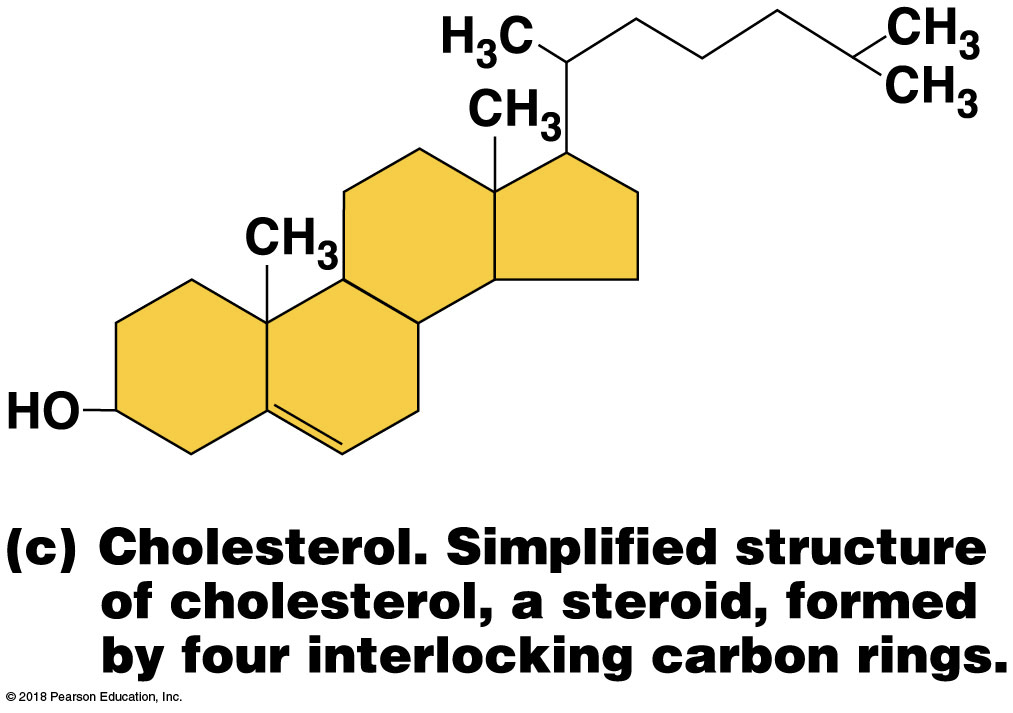
Flat molecules from 4 interlocking carbon rings
Cholesterol
Most important steroid. Bile salts are a by product from this, which are required for fat digestion and absorptoin
Steroid (hormone)
Essential for the body
Saturated fats
Solid at room temperature, no bend legs
Unsaturated fat
Liquid at room temperature, has a kink in the leg
Hydrophilic
Water loving
Hydrophobic
Fears water
Proteins
Most abundant organic components of the human body and have the most varied functions. Contains nitrogen, which separates them from being a carbohydrate or a lipid.
Amino acids
Building blocks of proteins. 20 different kinds.
What does a chain of <50 amino acids mean
It’s a polypeptide
What does a chain of >50 amino acids mean
It’s a protein
What does a chain of 50 to thousands of amino acids mean
Large, complex proteins
Protein example of structure
Collagen, found in all connective tissue, most abundant protein in the body. Responsible for the tensile strength of bones, tendons, and ligaments. Its function is mechanical support.
Protein example of enzyme
An enzyme essential for virtually every biochemical reaction in the body. Disaccharidases hydrolyze disaccharides
Protein examples for transport
Moving substances. Hemoglobin transports oxygen in blood
Protein examples of contractile
Movement, Actin and myosin cause muscle cell contraction and function in cell division in all cell types
Protein examples of Communication
Transmitting signals. Insulin (a protein) acts as a receptor to regulate blood sugar levels.
Protein example of Defense
Protect against disease. Antibodies released by certain immune cells are specialized proteins that bind and inactivate foreign substances
Protein shapes
Made up of chains of amino, bonded by peptide bonds