6 - Density , Specific Gravity , and Specific Volume
 Call Kai
 Learn
Learn Practice Test
 Spaced Repetition
 Match
Match Flashcards
 Knowt Play
1/35

Earn XP
Description and Tags
Important terms only
Name | Mastery | Learn | Test | Matching | Spaced | Call with Kai | Chat |
|---|
No analytics yet
Send a link to your students to track their progress
36 Terms
c. Density
Mass per unit volume of a substance
a. Weight
b. Mass
c. Density
d. Volume
d. g/cm³ or g/mL
[Density]
Most commonly used unit for density
a. lbs/gallon
b. grains/fluidounce
c. g/L
d. g/cm³ or g/mL
d. g/L
[Density]
Unit used for densities of gases
a. g/mL
b. grains/fluidounce
c. lbs/gallon
d. g/L
g/cm³ or g/mL
grains/fluidounce
lbs/gallon
[Density]
Units for density may be expressed as ______ [3]
d. 1 g/mL
[Density]
Density of water at 4°C
a. 0.5 g/mL
b. 1.5 g/mL
c. 2 g/mL
d. 1 g/mL
d. Water
[Specific Gravity]
Standard used for measuring specific gravity of liquids and solids
a. Hydrogen
b. Air
c. Alcohol
d. Water
c. Hydrogen or air
[Specific Gravity]
Standard used for measuring specific gravity of gases
a. Water
b. Alcohol
c. Hydrogen or air
d. Chloroform
d. 25°C except for alcohol which is 15.56°C (60°F)
[Specific Gravity]
USP standard temperature for specific gravity measurement
a. 15.56°C except for alcohol which is 25°C
b. 37°C except for alcohol which is 15.56°C
c. 4°C except for alcohol which is 25°C
d. 25°C except for alcohol which is 15.56°C (60°F)
a. 15.56°C (60°F)
[Specific Gravity]
USP standard temperature for specific gravity measurement is 25°C except for alcohol which is _______
a. 15.56°C (60°F)
b. 20°C (68°F)
c. 25°C (77°F)
d. 37°C (98.6°F)
c. Lighter than water
[Specific Gravity]
Substances with SG less than 1 are classified as
a. Heavier than water
b. Same weight as water
c. Lighter than water
d. Equal to water
d. Heavier than water
[Specific Gravity]
Substances with SG greater than 1 are classified as
a. Same weight as water
b. Lighter than water
c. Equal to water
d. Heavier than water
d. Lighter than water
[Specific Gravity]
Specific gravity of Mineral oil (SG 0.89) compared to water indicates it is
a. Equal to water
b. Heavier than water
c. Same weight as water
d. Lighter than water
c. 1.00
[Specific Gravity]
Specific gravity of Water
a. 0.89
b. 1.47
c. 1.00
d. 0.50
d. Heavier than water
[Specific Gravity]
Specific gravity of Chloroform (SG 1.47) compared to water indicates it is
a. Lighter than water
b. Equal to water
c. Same weight as water
d. Heavier than water
d. Mineral oil (0.89), Water (1.00), Chloroform (1.47)
[Specific Gravity]
Arranging these substances from lightest to heaviest based on specific gravity
a. Water (1.00), Mineral oil (0.89), Chloroform (1.47)
b. Chloroform (1.47), Water (1.00), Mineral oil (0.89)
c. Mineral oil (0.89), Chloroform (1.47), Water (1.00)
d. Mineral oil (0.89), Water (1.00), Chloroform (1.47)
a. Density
[Density vs. Specific Gravity]
Concrete number
a. Density
b. Specific Gravity
b. Specific Gravity
[Density vs. Specific Gravity]
Abstract number
a. Density
b. Specific Gravity
d. 1.0 g/mL
[Density vs. Specific Gravity]
Density of water expressed as a concrete number
a. 1.5 g/mL
b. 0.5 g/mL
c. 2.0 g/mL
d. 1.0 g/mL
c. 1.0
[Density vs. Specific Gravity]
Specific gravity of water expressed as an abstract number
a. 1.5
b. 0.5
c. 1.0
d. 2.0
a. Density
[Density vs. Specific Gravity]
Vary with the table of measure
a. Density
b. Specific Gravity
b. Specific Gravity
[Density vs. Specific Gravity]
No dimension (unitless)
a. Density
b. Specific Gravity
c. Common system
[Density vs. Specific Gravity]
Density and specific gravity are different when density is expressed in this system
a. Metric system
b. SI system
c. Common system
d. Apothecary system
c. Pycnometer or Specific Gravity Bottle
Instrument used to measure specific gravity of liquids
a. Densitometer
b. Hydrometer
c. Pycnometer or Specific Gravity Bottle
d. Viscometer
d. Geissler Pycnometer
BEQ: Specific type of Pycnometer prepared by the USP
a. Ostwald Pycnometer
b. Gay-Lussac Pycnometer
c. Sprengel Pycnometer
d. Geissler Pycnometer
c. 0.78 (Lighter than water)
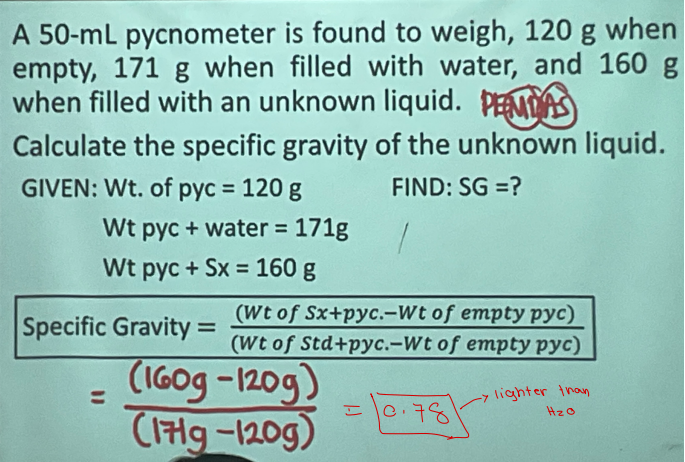
[Specific Gravity of Liquid]
PRACTICE PROBLEM:
A 50-mL pycnometer is found to weigh 120 g when empty, 171 g when filled with water, and 160 g when filled with an unknown liquid.
a. 0.68
b. 0.72
c. 0.78
d. 0.82
c. Displacement or Plummet method
[Specific Gravity of Liquid]
Method used to measure specific gravity of liquids based on Archimedes Principle
a. Pycnometer method
b. Hydrometer method
c. Displacement or Plummet method
d. Viscometer method
a. Archimedes Principle
[Specific Gravity of Liquid]
States that a body immersed in a liquid displaces an amount of the liquid equal to its own volume and suffers an apparent loss in weight equal to the weight of the displaced liquid
a. Archimedes Principle
b. Pascal's Principle
c. Bernoulli's Principle
d. Boyle's Law
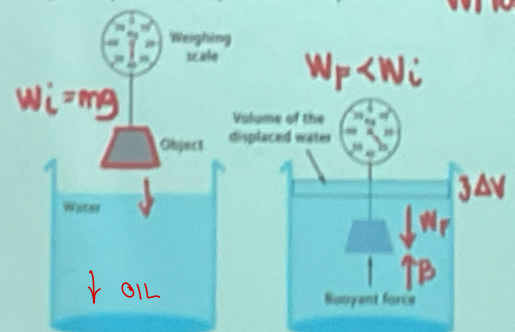
c. WF < Wi
📌NOTE:
WF → Weight of buoyant force
Wi → Weight of object in air (mg)
[Specific Gravity of Liquid]
Relationship between WF and Wi in the Displacement method
a. WF = Wi
b. WF > Wi
c. WF < Wi
d. WF ≥ Wi
d. Upward
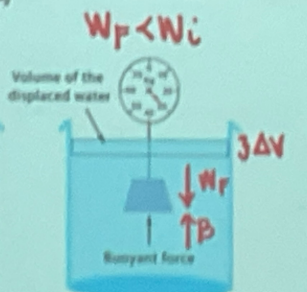
[Specific Gravity of Liquid]
Buoyant force in the Displacement method acts in this direction
a. Sideward
b. Downward
c. No direction
d. Upward
d. Lower specific gravity than water
[Specific Gravity of Liquid]
In the Displacement method, oil is placed in water because oil has this characteristic compared to water
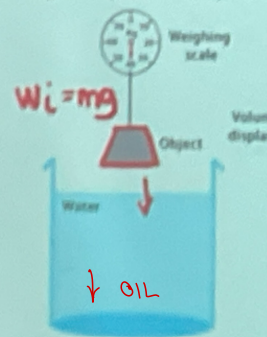
a. Higher specific gravity than water
b. Same specific gravity as water
c. Equal density to water
d. Lower specific gravity than water
a. Specific gravity
[Specific Gravity of Applications]
________ is employed when a pharmacist wishes to convert the weight of an ingredient or preparation to volume or vice versa
a. Specific gravity
b. Density
c. Pycnometer
d. Archimedes Principle
b. 383.1 mL
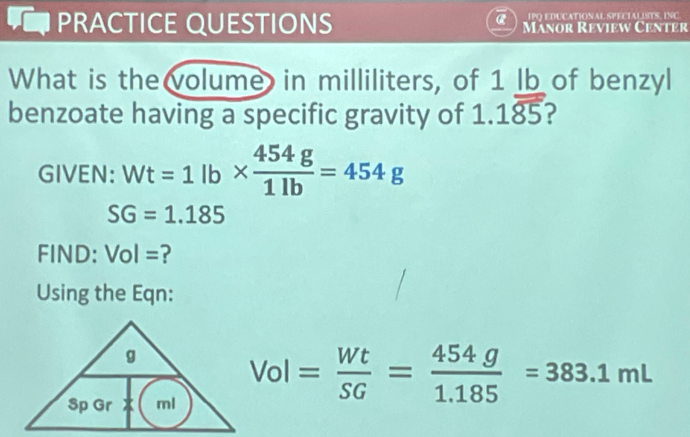
[Specific Gravity of Applications]
PRACTICE PROBLEM:
What is the volume in milliliters, of 1 lb of benzyl benzoate having a specific gravity of 1.185?
a. 350.0 mL
b. 383.1 mL
c. 400.0 mL
d. 420.5 mL
a. Specific volume
This is the reciprocal of specific gravity
a. Specific volume
b. Density
c. Weight
d. Mass
b. Specific gravity
Compares weights of equal volumes
a. Specific volume
b. Specific gravity
c. Weight
d. Mass
a. Specific volume
Compares volumes of equal weights
a. Specific volume
b. Specific gravity
c. Weight
d. Mass
b. SV = 0.37 ; SG = 2.7
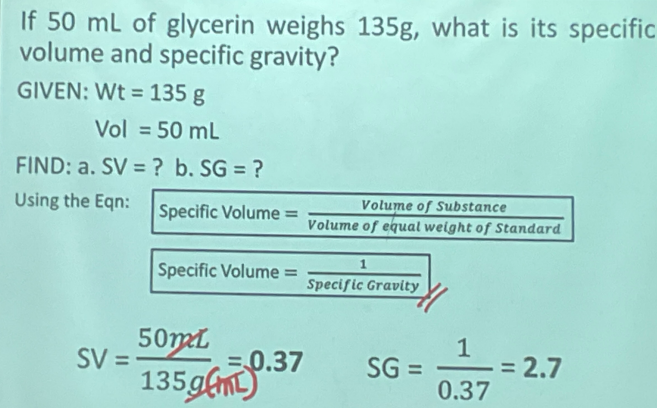
[Specific Gravity & Specific Volume]
PRACTICE PROBLEM:
If 50 mL of glycerin weighs 135g, what is its specific volume and specific gravity?
a. SV = 0.27 ; SG = 3.7
b. SV = 0.37 ; SG = 2.7
c. SV = 0.47 ; SG = 1.7
d. SV = 0.57 ; SG = 1.8