C3 - Eighteenth-Century Colonial America
 Studied by 0 people
 Call Kai
 Learn
Learn Practice Test
 Spaced Repetition
 Match
Match Flashcards
 Knowt Play
1/30

Earn XP
Description and Tags
1. Colonial Society and Economy 2. Rivals for Empire: The Seven Years’ War (1756-1763)
Name | Mastery | Learn | Test | Matching | Spaced | Call with Kai |
|---|
No study sessions yet.
31 Terms
when and why did England start paying attention to the colonies ?
first, colonies rather autonomous politically with own representative assemblies → second half 17th, England started paying attention to political organization to exert tighter eco-politico control as colonies profitable
what did the English Parliament do to keep with the mercantilist theory during the second half of the 17th ?
passed several Navigation Acts → stating only English merchants / English ships w English crews could take part in trade with colonies
1699 / 1732 / 1750 +
Woolen Act : banned manufacture of cloth in colonies (England only)
Hat Act : banned export / intercolonial sale of hats
Iron Act : outlawed making of iron equipment in colonies
→ part of Brtiish empire so expected to generate revenue for mother country
what were Charles II and James II’s policies regarding the northern colonies ?
revoked charters of the northern colonies, always been more independent than others
1684
Massachusetts’ colonial charter revoked as ‘colony refused implementing Navigation Acts’ and showed religious intolerance towards Anglicans
1686 +
Dominion of New England created including all colonies from NJ to NY northward → Sir Edmund Andros appointed to supervise as single governor = overthrown in 1688 as colonists rebelled and dominion collapsed
1691 / 1702 / 1729 +
royal charter by William III for Province of Massachusetts Bay becoming a Crown colony → made voting based on financial grounds + senior officials of government appointed by Crown and no longer elected
NJ royal colony
Carolinas royal colony
1696
English government instituted a Board of Trade and Plantations → examine colonial legislation + nominate high officials in royal colonies + write instructions for governors
what are the first cause behind 18th colonial America spectacular population growth ? +
natural increase : immigrants young adults when arrived in North America hence higher fertility rate than Europe + land at first available meant sooner independence and early children + mortality low as healthful environment and population mostly in rural so diseases spread limitedly → North < South as tropical climate
what are the second cause behind 18th colonial America spectacular population growth ? +
immigration : first mainly English then French, German, Ireland, Scotland → most white immigrants came as young indentured servants from farming/laboring families
what was an indentured servant ?
individual agreed to work on plantations for specific period (4-7 years) in exchange for free passage to America and plot of land when indenture over → few lived long enough to enjoy land promised as working conditions terrible and almost half died before freedom
what was the Middle Passage ? +
the journey between Africa and America → slave ships living conditions horrible and numbers never made it to the New World
1675 +
Bacon’s Rebellion in Virginia → results of indentured servants starting to rebel as didn’t receive land promised
what ‘encouraged’ planters to rely more on slavery from the 1670s ? +
fear of uprisings after Bacon’s Rebellion
more difficult to find indentured servants as less pressure on immigration in England
slaves better investment as initially more expensive but lifetime-lasting
1690
more slaves than indentured servants in Chesapeake colonies → Slave Codes by end 17th
what was the southern colonies relation to slavery ? +
as plantation colonies, relied heavily on it, becoming slave societies → Maryland, Virginia and N.C. grew tobacco while S.C. grew indigo and rice → rice cultivation so difficult white workers refused and planters in S.C. and Georgia grew dependent on slave labor + westaf valued as expert in rice cultivation
1765
blacks (nearly all slaves) outnumbered whites 90K to 40K in S.C.
what was the northern colonies (Penn, NJ, NY, NEs) relation to slavery ? +
fewer slaves as lack of plantation-based economies dominated by a single crop like in Massachusetts where slaves worked farms varied-crops and also domestics and tradesmen → economy in North closely linked to slavery through trade = so-called triangular trade
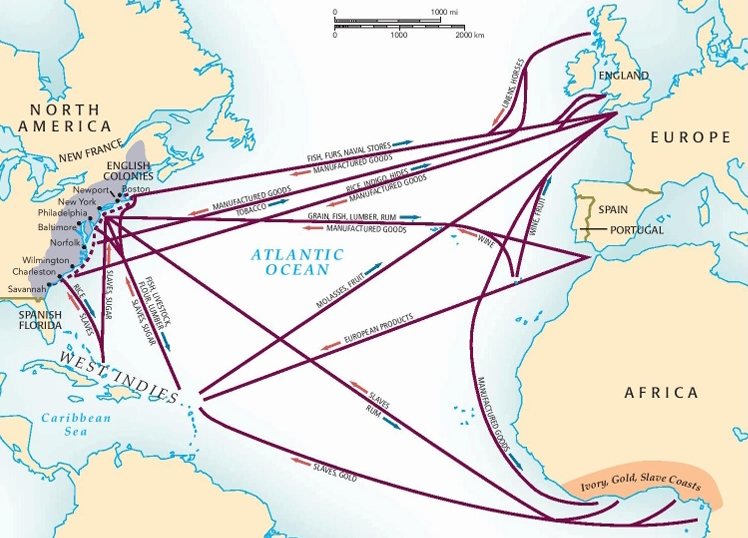
how did the slave contributed to the economy of North American colonies and the emergence of a wealthy elite ?
slave labor + imperial trade system + massive immigration = boom of North American colonies economy in 18th
social gap between colonists widened → very poor in largest cities while merchants part of colonial trade developed = though sharp social distinctions in colonies, unlike class system of England, less about ownership and more workforce so more social mobility
what led to the Great Awakening ?
apparent decline in religious piety in American society beginning 18th caused by
movement of population, scattering settlements and loss with organized religion
rise of commercial prosperity created secular outlook in urban areas
progress of science and free thought caused doubts
1660s New England warned of decline in power of church → eventually spread to other regions
what was the Great Awakening ? +
a revival beginning in 1730s emphasizing potential for everyone to break away from past constraints and start anew relationship with God → appeal to women, younger sons, enslaved people
powerful evangelists helped spread the revival like George Whitefield or Jonathan Edwards
led to division of existing congregations and the founding of new ones
what was the Second Hundred Years’ War ?
conflict between French empire and English empire → competition in European countries had consequences on their colonies + need for alliances with Indian tribes
1689 to 1815
Second Hundred Years’ War
1756 to 1763
Seven Years’ War
1754 to 1763 +
French and Indian War → first imperial conflict starting on American continent, in three main phases
2 first years, mainly local North American conflict
then rivalry led Britain to declare war on French → war expanding to West Indies, India and Europe
then 1757, British secretary of state brought war fully under British control and planned military strategy and more + impressment + pressure on Americans (supplies seized, offer shelter) → William Pitt eventually relaxed these policies and won thanks to alliance with Iroquois
1763 +
Treaty of Paris → overall exclusion of France from continent and Britain leading colonial power
Britain acquired all French territory (…) + Spanish Florida (→ France ceded them Louisiana)
France kept Caribbean central to economy of empire (Martinique, Saint-Domingue, etc) a.k.a most profitable sugar colony
1763 to 1767 +
Pontiac’s War → confederacy of Native tribes in former Frenc territory against new supremacy of British → Indians lost
1763 (and 1767) +
Royal Proclamation by British government → aim to organize new North American empire + stabilize relations with Natives + regulate trade and limit westward expansion (protect tribes fighting with British in Seven Years’ War) → disagreement from many wealth Americans like Washington and Franklin about the decision to prevent moving westward as believed lands earned by blood
new Proclamation but later agreements with tribes pushed border outward, despite treaties
how was Great Britain after the SYW ? +
at peace since a long time so attention to organization of the empire
public debt had increased after Seven Years’ War → England already heavily taxed so turned to colonies
how was SWY meaningful for American colonists ?
first experience of acting in concert against common enemy
how was America and Britain’s relation after the SYW ?
Britain → contemptuous and angry as colonists made few financial contributions to struggle for their own benefit + colonial merchants sold good to French in West Indies during conflict = London wanted reorganization and increased authority over colonies
America → resented Britain’s wartime demands and government in London = accustomed to more free self-government and colonial assemblies power