ACCA FA
 Call Kai
 Learn
Learn Practice Test
 Spaced Repetition
 Match
Match Flashcards
 Knowt Play
1/462

Earn XP
Description and Tags
CAB-GL = Cash at Bank general ledger
Name | Mastery | Learn | Test | Matching | Spaced | Call with Kai | Chat |
|---|
No analytics yet
Send a link to your students to track their progress
463 Terms
Define financial reporting and its objective
main objective is to provide financial information about the reporting entity to users of the FSs that is useful in making decisions about providing economic resources to the entity, as well as other financial decisions
Identify and define types of business entity
Sole trader
Partnership
Limited liability companies
Identify users of the financial statements and their information needs
Investors, interested in:
profit and returns
security of their investment
future profits estimated from past performance, as shown in SOP&L
Customers
need to know if entity can continue to supply them into the future
particularly true if customer is dependent on entity for specialist supplies
Suppliers
need to know if they will be paid
new suppliers may require reassurance about financial health of entity before agreeing to supply G&S
Lenders
need to know if they will be repaid, depends on solvency of entity (SOFP)
long-term loans backed by collateral assets - the value of these in the SOFP
Government
how economy is performing in order to plan policies
tax authorities use SOFP as basis for assessing amount of tax payable by an entity
Competitors
The public
assess effect of entity on economy, local environment & community
Employees
trade union representatives need to know if employer can offer secure employment / pay rises
interest in salaries and benefits enjoyed by senior management
divisional profitability if entity is threatened with closure
Management
Identify the purpose of the main financial statements
To report the financial performance and position of a business
Define the elements of the financial statements
Asset
Liability
Equity
Income
Expense
Define and explain accounting concepts and characteristics
Sole trader
simplest form of business entity
business is owned and operated by 1 individual, although it may employ any no. of people
no legal distinction between owner and business
owner receives all profits + unlimited liability for all the losses and debts of business
capital account which represents financial interest of owner in the business
Partnership
Owners collectively receive all profits and have unlimited liability for the losses and debts of the business
at least 2+ owners
joint owners are jointly and severally liable for the losses the business makes
capital structure = each partner will have financial interest in the business and this will be divided between capital account and current account
capital account = a fixed amount that will only charge upon a partner joining or leaving the business
current account = includes the share of profit or loss that each partner is entitled to, less any personal drawings by that partner
Limited liability companies
established as separate legal entity to their owners, achieved through the legal process of incorporation
owners of company (shareholders) invest capital in company in return for a shareholding that entitles them to a share of the residual assets of the company
shareholders aren’t personally liable for the debts of the company and whilst they may lose investment if company becomes insolvent they won’t have to pay outstanding debts
company is also not affected by insolvency of individual shareholders
LLM are managed by a board of directors who are elected by the shareholders
capital structure = more formalised, shareholders can’t make withdrawals from business they instead receive a ROI in the company (i.e a dividend) which is paid from accumulated profits
How are ‘sole traders‘ viewed differently in the eyes of the law and accounting conventions?
Accounting conventions recognise the business as a separate entity from its owner.
Legally, the business and personal affairs of a sole trader are not distinguished in any way
Advantages of operating as a sole trader
flexibility and autonomy
can manage the business as they please and can introduce or withdraw capital at any time
What is a partnership often referred to as?
A firm
Advantages of partnership
mainly stem from there being many owners
more resources, including capital, specialist knowledge, skills and ideas
admin expenses may be lower than for sole traders due to economies of scale
partners can substitute or act for each other to spread individual responsibilities and workloads
Compare companies to sole traders / partnerships (ST/P)
Property holding
LLM - property belong to company, change in ownership of shares has no effect on ownership of company property
P - firm’s property belongs directly to partners who are entitles to their share of each asset if they leave the partnership
Transferable shares
LLM - shares can be transferred without consent of other shareholders
P - new partner can’t be introduced into a firm without consent of all existing partners
Suing and being sued
LLM - can sue and be sued in its own name, judgements relating to companies don’t affect members personally
Security for loans
LLM - greater scope for raising loans and may secure them with floating charges
Law doesn’t permit ST/P to secure loans with a floating charge
Taxation
LLM - legally separate so it’s taxed separately from shareholders
ST/P - personally liable for income tax on their share of the profits made by their business
Disadvantages of incorporation
Cons of being a LLM arise mainly from restrictions imposed by relevant company law:
When being formed, companies have to register and file formal constitution documents with the company registry, referred to in the UK as Registrar of Companies. Registration fees and legal costs must be paid. It is likely that many countries have a similar registration process to establish a company.
In addition, it is normally a requirement for a company to produce annual financial statements that must be submitted to the company registry. It is also usually a requirement for those financial statements to be audited (in some countries this is only a requirement for large and medium sized companies). The costs associated with this can be high. Partnerships and sole traders are not subject to this requirement unless it is required by a regulatory authority, such as a professional body.
A registered company's accounts and certain other documents are open to public inspection. The accounts of sole traders and partnerships are not open to public inspection.
Limited companies are subject to strict rules in connection with the introduction and withdrawal of capital and profits.
Members of a company may not take part in its management unless they are also directors, whereas all partners are entitled to share in management of the business, unless the partnership agreement provides otherwise.
What is a ‘floating charge‘?
A mortgage over the constantly fluctuating assets of a company providing security for the lender.
It doesn’t prevent the company using the assets in the ordinary course of business.
Such a charge is useful when a company doesn’t have non-current assets (eg) land, buildings) but does have significant and valuable inventories
What is the purpose of the Conceptual Framework?
To assist the IASB in the development of FRS
To assist preparers of FSs to develop accounting policies when reporting standards don’t provide sufficient guidance
Useful reference document to assist in understanding, interpreting and applying accounting standards
Explain ‘prudence‘
The exercise of caution when making judgements under conditions of uncertainty.
Helps to ensure that assets and income aren’t overstated in the FSs, and that liabilities and expenses aren’t understates
What are the qualitative characteristics that make info provided in the FSs useful to others?
Fundamental qualitative characteristics
Relevance
Faithful representation
Enhancing qualitative characteristics
Comparability
Verifiability
Timeliness
Understandability
‘Relevance‘ as a fundamental qualitative characteristic of FSs
Information is relevant if:
it has the ability to influence the economic decisions of users
it is provided in time to influence those decisions
materiality has a direct impact on the relevance of information
info that is relevant has predictive, or confirmatory value
predictive value enables users to evaluate or assess past, present or future events
confirmatory value helps users to confirm or correct past evaluations and assessments
What is a ‘threshold quality‘?
One that needs to be studied before considering the other qualities of that information
a cut-off point - if any info doesn’t pass the test of the threshold quality, it’s not material and doesn’t need to be considered further
info is material if omitting, misstating or obscuring it could reasonably be expected to influence the decisions that the users of FSs make
‘Faithful representation‘ as a fundamental qualitative characteristic of FSs
if info is to represent faithfully the transactions and other events that it purports to represent, they must be accounted for and presented in accordance with their substance and economic reality and NOT merely their legal form
To be a perfectly faithful representation, financial info should possess following characteristics:
Completeness
contain all necessary descriptions and explanations
Neutrality
free from bias
Free from error
doesn’t mean perfectly accurate, just that it doesn’t present any material error that leads to it being false or misleading
‘Comparability‘ as an enhancing qualitative characteristic of FSs
Users must be able to:
compare FSs of an entity over time to identify trends in financial performance and position
compare FSs of different entities to evaluate their relative financial performance and position
for this: consistency and disclosure is needed
compliance with accounting standards
‘Verifiability‘ as an enhancing qualitative characteristic of FSs
can be direct and indirect
direct verification - verifying an amount or other representation through direct observation (i.e counting cash)
indirect verification - checking the inputs to a model, formula or other technique and recalculation of the outputs using the same methodology
‘Timeliness‘ as an enhancing qualitative characteristic of FSs
having info available to decision makers in time to be capable of influencing their decisions
generally, the older the info is, the less useful it becomes
‘Understandability‘ as an enhancing qualitative characteristic of FSs
Depends on:
the way in which info is presented
capabilities of users
Assumed that users:
have a reasonable knowledge of business and economic activities
are willing to study the info provided with reasonable diligence
Asset
A present economic resource controlled by the entity as a result of past events.
Liability
A present obligation of the entity to transfer an economic resource as a result of past events.
e.g) unpaid tax obligation or a bank loan is a liability
Equity
This is the ‘residual interest‘ in the assets of the entity after deducting all liabilities.
It is effectively what is returned to the owners (shareholders) when the business ceases to trade.
Income (as an element of the FS)
Consists of the increases in assets or decreases in liabilities that result in increases in equity (other than those relating to contributions from holders of equity claims)
Can be achieved through: e.g) generating revenue from sales or through the increase in the value of an asset
Expense (as an element of the FS)
Consists of the decreases in assets or increases in liabilities that result in decreases in equity (other than those relating to distributions to holders of equity claims)
Can be achieved through: e.g) Purchasing G&S from another entity or through the reduction in value of an asset
Compare current assets to non-current assets
CURRENT ASSETS
assets expected to be realised, sold or consumed within the normal operating cycle
or expected to be realised within 12 months after the reporting period
or held primarily for trading
e.g) inventory, receivables, cash
NON-CURRENT ASSETS
any tangible or intangible asset acquired on a long-term basis to be used in providing a service to the business
not held for resale in the normal course of trading
not expected to be realised within 12 months after the reporting period
e.g) land and buildings, motor vehicles, plant and machinery
Compare the current liabilities and non-current liabilities
CURRENT LIABILITIES
expected to be settled within the normal operating cycle
or held primarily for trading
or is due to be settled within 12 months after the reporting period
or there is not an unconditional right to defer settlement for at least 12 months after the reporting period
NON-CURRENT LIABILITIES
have not been classified as current
payment can be deferred unconditionally for more than 2 months after the reporting period
e.g) loan
Statement of Financial Position
Summarises the assets, liabilities, and equity balances of the business at the end of a reporting period
Statement of Profit & Loss (& other comprehensive income)
Summarises the revenues earned and expenses incurred by the business throughout the reporting period
What 3 subtotals must be bold in the SOP&L? IFRS 18
Operating profit
Profit before financing and income taxes
Profit for the year
Statement of changes in equity
Summarises the movement in equity balances (share capital, share premium, revaluation surplus and retained earnings) from the beginning to the end of the reporting period.
It applies only to limited LLC and would not be required for a ST/P
Statement of Cash Flows
Summarises the cash paid and received throughout the reporting period.
Normally only relevant to only LLC’s.
Notes to the Financial Statements
Comprise a statement of accounting policies and any other disclosures required to enable to the shareholders and other users of the FSs to make informed judgements about the business.
Usually more detailed and extensive for a LLC’s FSs than for a ST/P
What 10 accounting principles underpin the preparation of FSs?
Materiality
Substance over form
Going concern
The business entity
Accrual accounting
Prudence
Consistency
Offsetting
Duality
Historical cost and current value
Materiality
item regarded as material if its omission or misstatement is likely to change the perception of the users of that info
subjective assessment made by preparers of FSs, requires them to consider the reliability of the FSs for decision-making purposes by users
aggregation of similar items is permitted
Substance over form
If info is presented faithfully, the economic reality must be accounted for and not just the strict legal form
Going concern
FSs are prepared on the assumption that the entity is a going concern, and will continue to operate for the foreseeable future
i.e it is reasonable, based on current knowledge, to assume the business will continue to operate for the next 12 months
HOWEVER, there is no guarantee that this will always be the case as evidenced by business failures and insolvencies
The business entity
This principle means that the FA info presented int he FSs relates only to the activities of the business and not to those of the owner.
From an accounting perspective, the business is treated as being separate from its owners
Accrual accounting
Transactions are recorded when revenues are earned and when expenses are incurred
This pays no regard to any associated cash payment or receipt
Prudence
Exercising caution
i.e) assets and income shouldn’t be overstates whilst liabilities and expenses shouldn’t be understated
helps to ensure FSs are fairly stated and can be relied upon by users
Consistency
relies not only from one accounting period to the next, but also within an accounting period so that similar transactions are accounted for in the same way
application of IFRS helps promote this
Should be comparable over a no. of years
Offsetting
netting-off transactions and balances, which results in recording or presenting only the net effect of those transactions and balances
reduces info available to users of FSs and isn’t permitted
Duality
recognises that every transaction has 2 effects, so must be recorded twice in accounting books
fundamental principle for double-entry bookkeeping
Historical cost and current value
historical cost = original monetary value of a transaction at the date that transaction was entered into
bears no relation to the current value
current value may increase significantly due to cumulative effect of inflation and other economic factors or from factors like:
depreciation
wear and tear
changes in tech
Explain the purpose of the financial reporting regulatory system
Necessary because:
ensure needs of users of FSs are met with at least a basic minimum of info
ensure all info is provided in the relevant economic arena - both comparable and consistent
increase users’ confidence in the FR process
regulate the behaviour of companies and directors towards their investors
Explain the role of IFRS Accounting Standards
Due to increasingly global nature of investment and business operations - move towards ‘internationalisation‘ of FReporting
‘harmonisation‘ was considered necessary to provide consistent and comparable info to an increasingly global audience
IFRS-AS aren’t automatically enforceable in any country
Developed by an international organisation that has no international authority
To become enforceable, they must be adopted by a country’s national FR standard setter
Explain what is meant by corporate governance
According to Cadbury Report 1992: “the system by which companies are directed and controlled“
in the interests of shareholders and in relation to those stakeholders beyond the company boundaries
Describe the duties and responsibilities of company directors
Responsibility to:
economy
society at large
public duty
corporate social responsibility
If directors have responsibility to these groups then they must also be held accountable to them
A typical national regulatory framework structure includes…
National financial reporting standards
National law
Market regulations
Security exchange rules
What are the entities within the international regulatory system?
IFRS Foundation
IASB - International Accounting Standards Board
ISSB - International Sustainability Standards Board
IFRS Interpretations Committee
IFRS Advisory Council (provide advice to IFRS Foundation, IASB, IASSB)
IFRS Foundation
supervisory body for the IASB
responsible for governance issues and ensuring that each member body is properly funded
consists of a monitoring board that deals with public accountability and a board of trustees that has responsibility over governance, strategy, and oversight of activities
What are the principle objectives of the IFRS Foundation?
develop a set of high quality, understandable, enforceable and globally accepted financial reporting standards
promote the use and rigorous application of those standards
take account of the financial reporting needs of emerging economies and small and medium sized entities
bring about the convergence of national and international financial reporting standards
International Accounting Standards Board (IASB)
independent standard setting body of the foundation
primary objective: develop a set of high-quality, understandable and enforceable global accounting standards that require transparent and comparable info in the FSs of all companies
responsible for the development and publication of IFRS-AS and interpretations developed by the IFRIC
many national standard setting bodies are represented on the Board and their views are taken into account so that a consensus can be reached
IFRIC - IFRS Interpretations Committee
reviews widespread accounting issues on a timely basis and provides authoritative guidance on these issues
meetings are open to the public and, similar to the Board, works closely with national standard setters
IFRS-AC - IFRS Advisory Council
the formal advisory body to the Board and the Foundation
it’s comprised of a wide range of members who are affected by the Board’s work
What are the objectives of the IFRS-AC?
advising the Board on agenda decisions and priorities in their work
informing the Board of the views of the council with regard to major standard-setting projects
giving other advice to the Board or to the Trustees
What is the procedure for the development of an IFRS Accounting Standard?
The Board identifies a subject and appoints an advisory committee to advise on the relevant issues
The Board publishes an exposure draft for public comment, being a draft version of the intended standard
Following the consideration of comments received on the draft, the Board publishes the final text of the standard
At any stage the Board may issue a discussion paper to encourage comment
The publication of an IFRS-AS, exposure draft or IFRIC interpretation requires the votes of at least 8/15 Board members
ISSB - International Sustainability Standards Board
objective: delivering a comprehensive global baseline of sustainability-related disclosure standards
this should provide relevant info to investors and other interested parties to help them make informed decisions concerning sustainability-related risks and opportunities relevant to individual companies
to meet objectives: ISSB has commitment to publish standards that are cost-effective, decision-useful and market informed
helps ensure they’re user-friendly and companies producing sustainability-related disclosures and relevant to users of that info
What are the 4 principal objectives of the ISSB?
to develop standards for a global baseline of sustainability disclosures
to meet the info needs of investors
to enable companies to provide comprehensive sustainability info to global capital markets
to facilitate the flow and communication of sustainability-related info and disclosures that are jurisdiction-specific and/or aimed at broader stakeholder groups
What is a ‘company‘?
A corporate body that has registered in accordance with the requirements of a relevant national company law, thus becoming a legal entity.
Ownership of the company is evidenced by the issuing of shares to the owners (i.e the shareholders)
What leads to the separation of ownership and control?
The appointment of directors to manage the business on behalf of the owners
What can be done to reduce the risk of directors acting in their own interests and not being accountable to shareholders?
An effective system of corporate governance to encourage effective and responsible management of companies, along with having annual FSs subject to 3rd party examination or audit to ensure that they’re credible
What is the purpose of an audit?
To provide an opinion to the shareholders on whether the FSs are ‘fairly stated‘ or ‘true and fair‘
An audit places a certain amount of credibility to the FSs of a company so the users can trust it more / rely on it
What is the purpose of corporate governance?
To monitor those parties within a company who control the resources and assets of the owners.
The primary objective of sound corporate governance is to contribute to improved corporate performance and accountability in creating long-term shareholder value
Summarise the primary and supporting purposes and objectives of corporate governance?
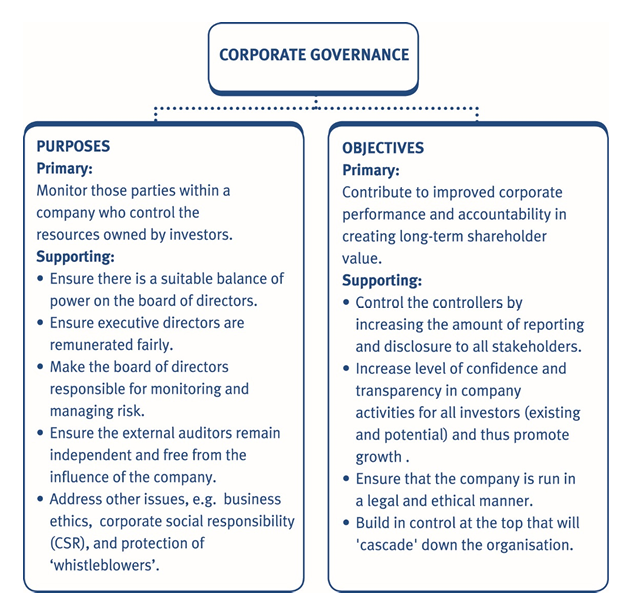
Why is there a need for corporate governance?
There needs to be a system that ensures publicly-owned companies are run in the interests of the shareholders and that provides adequate accountability of the people managing those companies
What are the 7 basic elements of sound corporate governance?
Effective management
Effective systems of internal control
Oversight of management by non-executive directors
Fair appraisal of director performance
Fair remuneration of directors
Fair financial reporting
Constructive relationships with shareholders
In order to be accountable to the stakeholders of the business, the directors of a company have a range of duties, such as…
a general duty of care to act in good faith for the benefit of the company and its shareholders
a duty of care to avoid a conflict of interest between personal interests and those of the company and its stakeholders, and to make disclosure if such conflict arises
Directors responsibilities that are more specific are normally imposed by law or regulation in many countries and typically include the following responsibilities…
establishing and maintaining an adequate system of internal controls which prevents and detects fraud and error
maintaining adequate accounting records that provide a basis for the preparation of the annual FSs
preparing annual FSs that show a ‘true and fair‘ view of the financial position and performance of the company, including compliance with relevant laws, regulations and IFRS Accounting standards
responsibility to approve the annual FSs prior to their publication, and to distribute or file the annual FSs in accordance with local law and regulations
Explain the main forms of business transactions and documentation
Understand and apply the concepts of duality, double-entry bookkeeping and the accounting equation
Identify, explain, and understand the main forms of accounting record, including: accounting records and systems, source documents
E
Explain, understand and apply ledger accounting and the use of the journal
What is the purpose of a ‘source document‘?
To confirm that the transaction did take place, where and when the transaction took place and the monetary value of the transaction
What are the 13 principal business documentation and data sources for an accounting system?
Quotation
Purchase requisition
Purchase order
Sales order
Despatch note (goods despatched note - GDN)
Sales Invoice
Purchase (supplier) invoice
Supplier statement
Credit note
Debit note
Remittance advice
Receipt
What is the contents and purpose of the quotation?
Contents:
quantity and description of goods required
Purpose:
to establish the price from various suppliers and cross-refer to purchase requisition
What is the contents and purpose of the purchase requisition?
Contents:
Name of the requestor
Date of request
Details and reason for G&S requested
(may) include suggested supplier and cost
Purpose:
Completed by an employee to request the purchase of G&S by the entity
Must be approved by a responsible person to generate a purchase order
If a quotation has been received, that would be included as well
What is the contents and purpose of the purchase order?
Contents
Details of supplier
Quantity
Price and description of goods
T&Cs of delivery, payment, etc
Purpose:
Sent to supplier as a request to supply based upon details from the purchase requisition
When goods received, this info will be checked against the supplier despatch note and invoice to ensure that the correct goods, quantity and price are as expected
What is the contents and purpose of the sales order?
Contents
Quantity / description / details of goods required by a customer including price and other criteria (e.g date required)
Purpose
Generated by the supplier
When received, will be cross-checked with the purchase order placed by the customer
sent to stores / warehouse department for processing
What is the contents and purpose of the GDN?
Contents
Details of supplier
Quantity and description of goods despatched by the supplier to the customer
Purpose
Issued by the supplier
Checked by customer against goods received and purchase order
What is the contents and purpose of the GRN?
Contents
Quantity and description of goods received by the customer
Purpose
Produced by the customer as proof of receipt
matched with despatch note and purchase order
What is the contents and purpose of the sales invoice?
Contents
Name and address of supplier and customer, details of goods
Purpose
Issued by the supplier of goods as a request for payment
Usually be in a standard format and sequentially numbered
What is the contents and purpose of the purchase (supplier) invoice?
Contents
Name and address of supplier and customer
details of goods
Purpose
Received by the customer as a request for payment from the supplier
customer may allocate a sequential number to each purchase invoice received to aid recording and tracing of transactions
What is the contents and purpose of the supplier statement?
Contents
Details of supplier
includes details of date, invoice numbers and values, payments made by customer, refunds, amount owing
Purpose
Issued by the supplier to the customer
summarises transactions recorded by the supplier in the previous month
customer can use this to check against other documents to ensure that the amount demanded by the supplier is correct
What is the contents and purpose of the credit note?
Contents
Details of supplier
Contains details of goods returned
Purpose
Issued by the supplier to the customer
checked against records of goods returned
What is the contents and purpose of the debit note?
Contents
Details of the supplier containing details of goods returned
Purpose
Produced by the customer
Cross-referenced to the credit note subsequently issued by the supplier
What is the contents and purpose of the remittance advice?
Contents
Raised by the customer and contains details of payment made to supplier
Purpose
Sent to supplier with, or as notification of payment
What is the contents and purpose of the receipt?
Contents
Details of payment received
Purpose
Issued by the supplier confirming the payment received
What is the accounting equation?
A simple expression that at any point in time, an entity’s assets = liabilities + equity/capital, where:
equity/capital is the residual interest in the assets after all liabilities have been settled which si due to the owner(s) of the business
What does equity (a.k.a capital) represent?
The net assets of the entity (the net investment that the sole proprietor has in the business)
Summarise the process to prepare FSs?
Transactions occur
Effects recorded in ledger accounts
Ledger accounts balanced off
Trial balance
Year end adjustments made and ledger accounts closed off
Financial Statements
When an accounting transaction has occurred, it must be recorded in the accounting system using…
double-entry bookkeeping principles
Depending upon the nature of the transaction, data recorded is likely to include:
transaction date
nature of the transaction (e.g purchase on credit, cash sale, journal entry)
product quantity plus description or code
monetary value, including any sales tax element if applicable
any trade or early settlement discount applicable
the due date of payment on credit terms
Irrespective of the size and complexity of an entity, what 3 components does an accounting system always have?
Inputs
source documents
standing data
Accounting system processes
calculations
ledgers
journal entries
record keeping
Outputs
trial balance
reports