Property Practice
 Call Kai
 Learn
Learn Practice Test
 Spaced Repetition
 Match
Match Flashcards
 Knowt Play
1/142

There's no tags or description
Looks like no tags are added yet.
Name | Mastery | Learn | Test | Matching | Spaced | Call with Kai | Chat |
|---|
No analytics yet
Send a link to your students to track their progress
143 Terms
What is completion?
Completion is the stage when the bulk of the purchase money is paid to the seller and the transfer deed is completed to transfer the property to the buyer
Why is an exchange of contracts useful?
It fixes the completion date and gives the buyer time between exchange of contracts and completion in order to make final preparations. It is also useful where the parties are agreed that conditions must be fulfilled before completion can take place. The contract records the agreed terms and can be relied upon if anything goes wrong in the period between exchange of contracts and completion
Must there be a gap in time between exchange of contracts and completion?
No they can take place simultaneously, or the parties can agree to proceed straight to completion without an exchange of contracts
How can a buyer avoid a seller pulling out of the transaction after they have incurred considerable time and expense?
The buyer to exchange contracts as soon as they make an offer so that, for example, they are not gazumped by a new buyer offering a higher price
When should a buyer enter into a contract
They should not enter the contract until they have carried out numerous searches, enquiries and a survey of the property
What is the ‘caveat emptor’ principle?
‘Let the buyer beware’ - the seller is not obliged to disclose information about the property, other than about limited matters of title, and would not be liable for any defects in the property which later come to light. So the onus is on the buyer to discover as much about the property as possible before exchanging contracts and committing to the purchase. Caveat emptor does not entitle the seller to give misleading answers to the buyer’s enquiries
Why is it important for a conveyancing transaction to start with the solicitors for both parties taking instructions from their client?
To establish the degree of consensus between parties and identify any outstanding issues that may cause delay, frustration and additional costs later in the transaction
What is included in a pre-contract package of documents to the buyer’s solicitor?
It includes a draft contract and evidence of the seller’s title to the property being sold
What must the buyer’s solicitor ensure in the pre-contract package of documents?
The seller is entitled to sell the property and there are no encumbrances (such as restrictive covenants) which would prevent the buyer from using the property as they intend. It is important that the buyer’s solicitor is satisfied with the title before exchange of contracts because the contract will usually include a provision prohibiting the buyer from raising further queries on the title, known as ‘requisitions’ after exchange
What might a buyer’s solicitor want to carry out additional searches and enquiries to find out?
Boundaries, access
Disputes
Outgoings
Previous works carried out at the property
What happens if the seller incorrectly replies to the searches and enquiries of the buyer?
The buyer could have an action for misrepresentation
In addition to making enquiries of the seller, what else might a buyer’s solicitor carry out?
Pre-contract searches of various statutory, public and private bodies to help the buyer obtain information about the property. The buyer’s solicitor must decide which ones are most appropriate for the client and the property as nearly all of them incur a fee
How much will a buyer usually pay on exchange of contracts?
The buyer will usually pay a deposit, typically 10% of the purchase price, although it can be any figure the parties agree. The deposit is usually held by the seller’s solicitor until completion
When are the parties bound to complete the transaction?
It is only when contracts are exchanged that the parties are bound to complete
What should be done pre-completion?
The time between exchange and completion is spent making sure all the correct documentation and the completion money will be available on the completion date
The transfer deed will need to be prepared and executed in readiness for completion
The buyer’s solicitor will carry out pre-completion searches to check that the information obtained at the pre-contract stage remains valid and to ensure that there will be no problems registering the buyer’s title at the Land Registry
What happens on completion?
The buyer will pay the balance of the purchase money and the seller will hand over the keys to the property
What must the seller’s solicitor ensure in the post-completion stage?
Any mortgage the seller had on the property is paid off and removed from the title. They will usually have given an undertaking to do this
What must the buyer’s solicitor ensure in the post-completion stage?
Stamp Duty Land Tax or Land Transaction Tax is paid on the transfer. The buyer’s solicitor must register their client as the new owner of the property and register any new mortgage over the land
What is the purpose of the Law Society Conveyance Protocol?
It is designed to standardise the residential conveyancing process; it is a set of instructions to conveyancers as to how to carry out a residential sale and purchase and is accompanied by a series of standard documents issues under the ‘TransAction’ brand e.g. where the Protocol is used, the form of standard pre-contract enquiries to the seller that the seller’s solicitor will ask their client to complete for a freehold property is called a Property Information Form
What must a seller’s solicitor do in the pre-contract stage in a sale and purchase of a freehold property?
Take instructions from the seller client
Investigate title and produce evidence of title (deduce title) to the buyer
Reply to buyer’s pre-contract enquiries
Draft the contract
What must both solicitors do in the pre-contract stage of a sale and purchase of a freehold property?
Check for conflicts of interest
Obtain client signature to the contract
What must a buyer’s solicitor do in the pre-contract stage in the sale and purchase of a freehold property?
Take instructions from the buyer client (and possibly the lender client)
Investigate title
Raise pre-contract searches and enquiries (and check buyer client has commissioned survey)
Approve draft contract
Prepare pre-exchange report to client(s)
What must a seller’s solicitor do in the pre-completion stage in the sale and purchase of a freehold property?
Approve the draft transfer deed
Reply to buyer’s pre-completion enquiries, including giving undertaking to discharge seller’s mortgage
What must the buyer’s solicitor do in the pre-completion stage in the sale and purchase of a freehold property?
Draft the transfer deed
[Draft the mortgage deed if acting for the lender and] obtain client execution of mortgage deed
Raise pre-completion searches and enquiries (updating and, if acting for the lender, checking buyer’s solvency)
Submit report on title/certificate of title to lender and request mortgage advance (if appropriate)
What should the first question in a property transaction be?
‘Can we act on behalf of this client?’ and then ‘can we carry out the client’s instructions’?
Can a solicitor act for a buyer and a seller?
Paragraph 6.2 in the Code of Conduct states that, subject to certain exceptions, a solicitors cannot act for both parties if there is a conflict of interest or a significant risk of such a conflict. Acting for a buyer and a seller carried a high risk of conflict of interests where the land is being transferred for value
Can the exception of ‘substantially common interest’ apply to a seller and a purchaser?
No it does not apply to property purchase. Although both clients will have a common interest in completing the sale, they also have different interests, since one is buying and one is selling
Is it acceptable for a solicitor to act for joint buyers?
It is usually acceptable provided that the solicitor can comply with paragraph 6.2 in the Code of Conduct. It may be necessary to advise residential buyers separately about how they want to hold the equitable interest in the property, particularly if they are not married or in a civil partnership
It is acceptable for a solicitor to act for a borrower and a lender?
Acting for a lender and borrower is possible unless, under paragraph 6.2, there is a conflict of interest or a significant risk of such a conflict.
The risk of conflict is high if:
The mortgage is not a standard mortgage of property to be used as the borrower’s private residence
The mortgage is a standard mortgage but you do not use the approved certificate of title
Is it possible for a solicitor to act for more than one party if there is a conflict of interest?
Yes where the parties have a substantially common interest provided that both clients have given their informed written consent, effective safeguards have been put in place to protect any client confidential information and that the solicitor is satisfied that it is reasonable for them to act for both clients. However, they must bear in mind the duty of confidentiality may come into conflict with the duty of disclosure to the other client
Why might the lender usually have its own solicitors in a large commercial property transaction?
The mortgage documents are likely to be subject to negotiation between the solicitors for the two parties, and so will not be on standard terms
Why is it common for the lender’s solicitor to ask the borrower’s solicitor to carry out the title investigation and the searches and enquiries and to report the results to the lender and the borrower?
This avoids duplication of costs and time and the clients have a substantial common interest in wanting the borrower to obtain good title to the property and ensuring that there are no problems adversely affecting the property’s value
Is it acceptable for a solicitor to act for joint borrowers?
It is usually acceptable, provided no conflict of interests exists or is likely to arise
Give an example of when a problem can arise when acting for joint borrowers?
A matrimonial home is owned by a married couple jointly and one of them agrees to mortgage it as security for a business loan. If the spouse agrees to the loan and the business subsequently fails, the bank will enforce the security against the matrimonial home. In such circumstances the spouse may seek to have the mortgage set aside on the basis of undue influence. Although thee is no rebuttable presumption of undue influence between married people, the lender is put on enquiry because the transaction is not to the spouse’s advantage
What are the guidelines for solicitors acting in circumstances involving potential undue influence commonly referred to as?
The Etridge guidelines
What are the Etridge guidelines?
The lender should, with the borrowers consent, provide the solicitor with the following information:
The purpose for which the loan is being made available
The current amount of the borrower’s indebtedness
The amount of the current overdraft facility
The amount and terms of the new loan and
A copy of any written application made by the borrower for the loan
The solicitor should:
Explain to the spouse the purpose for which the solicitor has become involved
Explain that the lender will rely on the solicitor’s involvement to counter any suggestion that the spouse has been unduly influenced or has not fully understood the nature of the transaction and
Obtain confirmation from the spouse that they wish the solicitor to act for them in the transaction, and to advise them on the legal and practical implications of the transaction
One solicitor can advise both parties, provided that the Etridge guidelines are followed and they can comply with paragraph 6.2
What is a contract race?
A contract race is where a pre-contract package is sent to multiple buyers who then compete to be ready to exchange contracts first. This is regarded as a legitimate selling technique so long as all the prospective buyers know that they are engaged in a race
What problems arise in contract races?
Problems arise when the seller instructs their solicitor that they do not want the prospective buyers to know. Where a solicitor acts for a seller of land, they must not mislead or attempt to mislead the buyers, either by their own acts or omissions, or by being complicit in the acts or omissions of others. This means that the solicitor should inform all buyers immediately of the seller’s intention to deal with more than one buyer. If the seller refuses to agree to such disclosure, the solicitor cannot disclose the contract race to the prospective buyers because they have a duty of confidentiality to the seller client. The solicitor should stop acting in the matter immediately
What is an undertaking?
An undertaking is a statement made by or on behalf of a solicitor, or the firm, to someone who reasonably places reliance on it, that the solicitor or firm will do something, causing something to be done, or will not do something
What information must a solicitor provide to the client regarding fees?
A solicitor is obliged to provide the client with the best possible information about the likely overall cost of their matter, at the beginning and at appropriate points throughout the transaction. This involves clearly explaining the fees, when they are likely to change and warning the client about any other payments for which the client may be responsible
When can a solicitor provide financial advice?
If the solicitor is carrying out a regulated activity in relation to a regulated mortgage contract, then they must be authorised to do so under the Financial Services and Markets Act 2000
What is a regulated mortgage?
A regulated mortgage contracts is where the borrower is an individual, the lender takes a first legal charge over property and at least 40% of the property is intended for occupation by the borrower or a member of their immediate family
What is a regulated financial activity?
It includes arranging or advising on a regulated mortgage contract but not giving generic advice such as the differences between types of mortgage, or arranging the execution of a mortgage chosen independently by the client or on the advice of an authorised person
What is the s 327 exemption?
If a regulated activity is involved and the firm is not authorised by the Financial Conduct Authority to carry out regulated activities, the solicitor can still arrange or advise on a regulated mortgage contract by relying on the s 327 exemption. This allows solicitors to carry out regulated activities if they are incidental to the provision by the firm of professional services
What is the arrangement or advisement on a regulate mortgage contract under the exemption for professional firms subject to?
It is subject to the solicitor complying with the SRA Financial Services Rules and SRA Financial Services Rules. These rules do not allow a solicitor to recommend that a client enters into a regulated mortgage contract, except where the advise is an endorsement of a recommendation made to the client by an authorised person
What are the two most common types of mortgage available in the market?
Repayment and interest-only mortgages
What is a repayment mortgage?
The borrower will make monthly payments to the lender made up partly of instalments of the original amount borrowed and partly of interest chargeable on the loan
The borrower can choose to pay interest at the lender’s standard variable rate, fix the interest rate for a set period or agree a ‘tracker’ rate of a certain percentage above the UK base rate set by the Bank of England
What is the advantage of a repayment mortgage?
By the end of the mortgage term, the borrower will have paid off everything they owe
What is a interest-only mortgage?
The borrower will make monthly payments to the lender but those payments will only comprise interest chargeable on the land
What is the advantage of a interest-only mortgage?
The monthly repayments for an interest-only mortgage are likely to be lower than under a repayment mortgage, but at the end of the mortgage term the borrower will still owe the lender the whole of the original amount borrowed. The borrower must therefore find an alternative way to pay off the loan if they want to be free of the mortgage at the end of the term
Give an example of a Sharia compliant finance scheme
The bank buys the property and resells it to the buyer at a higher price. The buyer repays the excess to the bank by instalments over a period of years. Alternatively, the bank buys the property and leases it to the buyer in return for rent, and at the end of the lease the bank transfers the property to the buyer
What tax will a buyer have to pay for a residential property?
They may have to pay either Stamp Duty Land Tax in England or Land Transaction Tax in Wales, when they purchase the property
Will a seller who makes a capital gain by selling the property for more than they bought it for have to pay Capital Gains Tax?
They will not have to if they have used the property as their only or main residence
What tax will a buyer of a commercial property have to pay?
They will pay Stamp Duty Land Tax or Land Transaction Tax just lie a residential buyer but the rate at which the tax is calculated are different and they may have to pay VAT on the purchase. A commercial property is likely to be owned by a company and companies pay Corporation Tax on their income and capital profits. So if the property is rented out the landlord will pay Corporation Tax on the rent. Corporation Tax will also be payable on any gain if the property is sold for more than its purchase price
How can first-time buyers of residential property claim relief from SDLT?
They can claim relief if they intend to occupy the property as their main residence and the purchase price is no more than £500,000. They do not pay anything on purchases up to £300,000 and pay 5% on the portion from £300,001 to £500,000
What are the SDLT rates for residential buyers who are not first-time buyers?

How much SDLT is payable on the purchase of a £275,000 by a second-time buyer?
£3,750
Priya is intending to sell her current house and buy a new house. The purchase price for the new house is £575,000, but Priya has asked you to apportion £10,250 to the carpets and curtains. What information will you need to obtain from Priya before you can advise her on the tax she will have to pay on her purchase?
Need to make sure that the £10,250 is a fair reflection of the value of the carpets and curtains, because if it is not, the apportionment could be treated as a fraud on HMRC and result in criminal sanctions
There are higher rates of SDLT if the buyer already owns a property and is buying an additional property or if the buyer is not a UK resident.
Price before reduction:
£125,000 × 0.02 = £2,500
£575,000 - £250,000 = £325,000 × 0.05 = £16,250
£2,500 + £16,250 = £18,750
Price after reduction
£575,000 - £10,250 = £564,750
£125,000 × 0.02 = £2,500
£564,750 - £250,000 = £314,750 × 0.05 = £15,737.50
£15,737.50 + £2,500 = £18,237.50
So will save her £513.50 in SDLT
What is the basis of charge for non-residential or mixed use freehold property (SDLT)?

What is the SDLT payable on the purchase of a £275,000 commercial property?
The SDLT payable is £3,250 (0% on £150,000, 2% on £100,000, and 5% on £25,000)
If VAT is charged, SDLT is payable on the VAT-inclusive sum
How is SDLT paid?
SDLT is paid to HMRC accompanied by a form called on SDLT1 which provides the necessary details of the transaction. It must be paid within 14 days of completion and if it is not paid, the transfer of the property to the buyer will not be registered by the Land Registry. Failure to file and pay on time will also attract penalties and interest
What is the difference between SDLT and LTT?
There is no relief for first-time residential buyers from LTT and a land transaction return must be submitted to the Welsh Revenue Authority within 30 days of completion, rather than 14 days
What are the LTT rates for those who are buying residential freehold property?
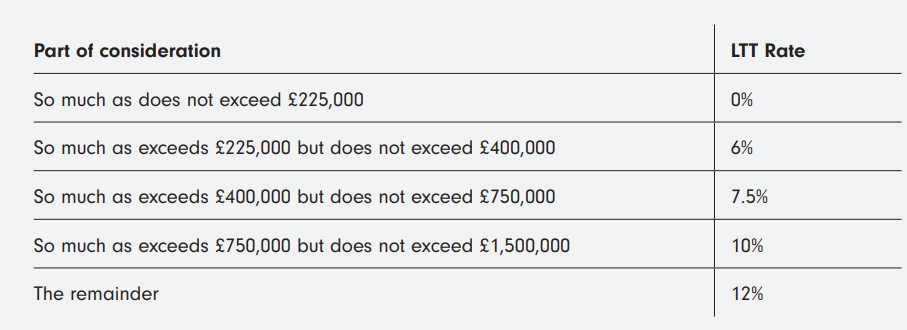
What is the LTT payable on the purchase of a £275,000 home?
£3,000 (0% on £225,000 and 6% on £50,000). There are higher rates of LTT if the buyer already owns a property and is buying an additional property or if the buyer is not a UK resident
What are the LTT rates for non-residential or mixed used freehold properties?
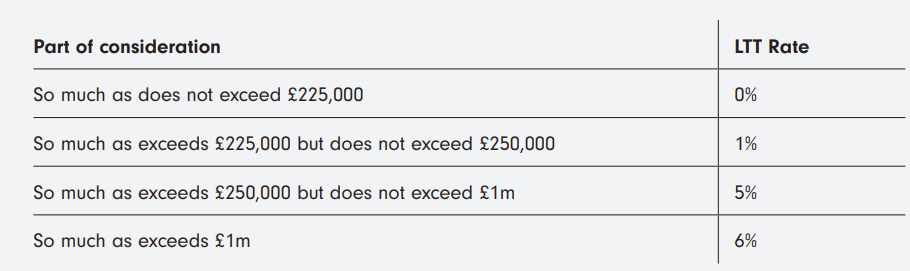
What is the LTT payable on the purchase of a £275,000 commercial property?
£1,500 (0% on £225,000, 1% on £25,000 and 5% on £25,000). If VAT is charged, LTT is payable on the VAT-inclusive sum
What is capital gains tax?
It is charged on gains made on ‘chargeable assets’ within the meaning of Taxation of Chargeable Gains Act 1992. This includes freehold and leasehold property, and the interests of co-owners in the case of jointly owned property
Give some other transactions that are incidental to the sale of land which also give rise to a charge of CGT
Where a separate payment is made for the release or modification of an easement or covenant. Gifts also fall within the meaning of ‘disposal’ for the purposes of CGT
How is capital gains tax calculated?
By deducting the purchase price of the property from its current sale price. But certain forms of expenditure incurred in acquiring or improving the property can also be deducted in appropriate cases
When is a seller of a residential property likely to be able to claim the benefit of private residence relief?
If it is the sale of an individual’s dwelling house used as their only or main residence
What must a seller do to qualify for private residence relief?
The seller must have occupied the dwelling house as their only or main residence throughout the period of ownership. If an individual has more than one residence, they can choose which of their residences will qualify for PRR by making an election to HMRC. PRR will also be available to trustees if the property is occupied by a beneficiary as their principle residence
When may private residence relief be lost?
If the seller has a garden of more than 0.5 hectares, the gain on the excess is chargeable to CGT unless the seller can demonstrate to HMRC that the extra garden was necessary for the reasonable enjoyment of the house. The relief may be lost on any part of the house used exclusively for business use
It is 2026 and you act for Priya who is selling the house she bought back in 2010 for £138,000. The agreed sale price is £410,000. What information will you need to obtain from Priya before you can advise her on the tax she will have to pay on her sale?
If her sale completes, Priya will have made a capital gain of £272,000. However, she will not have to pay CGT on the gain if she can claim the private residence relief. You will need to know whether:
• Priya lived in her house continuously from 2010
• She owned and/or lived in more than one house during this time
• The garden is more than 0.5 hectares
• She used any part of the house for a business use
What is VAT?
It is a tax on ‘taxable’ supplies e.g. some goods and services provides by a taxable person in the course or furtherance of a business. It is charged by the supplier who adds it to the price of goods or service
What must a supplier do to charge and collect VAT?
The supplier must be a ‘taxable person’. A taxable person is a person whose turnover over the past 12 months has exceeded the registration limit, currently £85,000
Write out the steps a supplier will do when completing a VAT return to HMRC online
Output tax is the VAT charged by the supplier on its goods or services (e.g. its output)
The supplier delineates this output VAT separately on its invoices when charging its customers
The customer, the recipient of the goods or services, pays the VAT. In a customer’s business this is called input tax
To calculate the VAT due to HMRC, the supplier deducts input tax it has paid against the output tax it has charged and only the net amount is sent to HMRC
The supplier accounts to HMRC for the value added by its business; input tax paid by the supplier is recovered
What are the differences between standard, exempt and zero-rated supplies?
VAT is charged at different rates depending on the type of supply
Standard rated supplied attract VAT as the standard rate, currently 20%
There is a reduced rate of 5% for items such as domestic fuel supplies and certain construction, conversion and renovation services
Zero-rated supplies are still taxable supplies, but are charged at a zero rate
Exempt supplies are non-VATable. However, sometimes a supplier of land has the option to charge VAT (‘the option to tax’)
What constitutes a taxable supply in residential property transactions?
The vast majority of residential transactions do not involve the payment of VAT. The sale of a new build house by a developer is zero rated so the buyer will not pay any VAT, and the subsequent sale of a residential property by a private individual will not be in the course of a business, so the seller will not be charging VAT to the buyer in addition to the purchase price
What constitutes a taxable supply in commercial property transactions?
A new commercial property is one which is within three years from completion of the building. Supplies of interests in, rights or licences to occupy commercial land or buildings are generally exempt. However, the following supplies are taxable supplies, or can be made into taxable supplies by the seller exercising the ‘option to tax’:
The sale of a greenfield site is exempt, subject to the option to tax
The supply of construction services is standard rated
Professional services, provided by an architect or surveyor are standard rated
The sale of a new freehold building is standard rated
The sale of an old freehold building is exempt, subject to the option to tax
The grant of a lease is exempt, subject to the option to tax
Why might a client want to make an option to tax?
A seller of an old building may want to do this to enable recovery of the input tax incurred in relation to the building e.g. on building work costs and professional fees incurred in renovating the building to get it ready to sell
What is a possible disadvantage of opting to tax the supply an old building?
The seller has to charge VAT on the purchase price
If the buyer is VAT-registered and makes taxable supplies:
They can usually recover the VAT they paid as input tax
Therefore, the VAT is not really a cost to them
Opting to tax is less of a problem
If the buyer cannot recover VAT (or can only recover some of it):
The VAT becomes a real cost to the buyer
This effectively increases the cost of buying the building
The building becomes less attractive to these buyers
Buyers who cannot fully recover VAT are called “VAT-sensitive” buyers
For example, some financial businesses
They may therefore be less willing to buy a property where VAT is charged
Summarise the key points about VAT
Most real estate transactions are exempt from VAT
VAT is not usually paid on residential transactions
VAT is only compulsory on ‘new’ commercial properties
VAT is not always charged on ‘old’ commercial properties
The seller has an option to tax the supply of ‘old’ commercial properties
The seller needs to opt to tax only if it has paid VAT that it wants to recover
If the seller opts to tax, the buyer will usually be able to recover the VAT paid
If the buyer makes only exempt supplies, such as insurance or financial supplies, it may be unable to recover fully VAT it has to pay
So, a buyer that makes exempt supplies will resist the seller’s option to tax, or seek a compensatory reduction in the purchase price
What must solicitors when taking instructions from their clients at the beginning?
Firstly, they will need to check what has been agreed at the marketing stage and that the buyer has been provided with an Energy Performance Certificate for the property
The seller must make one available to the buyer free of charge within 28 days
It is important to establish the degree of consensus between the parties and identify any outstanding issues that may cause delay, frustration and additional costs later in the transaction
If important issues are missed, the seller client may lose the sale, or the buyer client may end up with a property that has a defective title, or which cannot be used for the purposes the client intended, or one that is not worth what the client paid for it
What is the investigation of title?
Investigation of title is the process of establishing who owns the property and whether there are any rights or rules which could affect the owner’s use and enjoyment of it
What is the distinction between registered and unregistered land?
The Land Registration Act of 1925 introduced a system in England and Wales which was designed to ensure that ownership of land was registered in a central database: the Land Registry
How do you investigate title to freehold registered land?
In order to investigate a registered title, the seller’s solicitor needs to obtain copies of the register of title for the property, which are called ‘official copies’. They will also need to get a copy of the Land Registry plan for the property, which is known as the ‘title plan’.
What is ‘deduction of title’?
The expression used for the seller’s obligation to prove to the buyer their ownership of the property they are trying to sell. This ownership is proved by producing documentary evidence of title to the buyer. With registered land, the seller should supply to the buyer, at their own expense, official copies that are less than six months old. The buyer’s solicitors will also need to investigate whether there are any overriding interests affecting the property
How are official copies set out in registered land/.
Show the title number to the property and an ‘edition date’, which is the date on which the Land Registry last updated the title. They also show the date which is often referred to by conveyancers as the ‘search from date’, the specific date of the official copies showing the entries subsisting on the register at a certain time
What will the property register contain?
A description of the land by reference to the postal address and the title plan
Indicate whether the title is freehold or leasehold
It also may indicate if there are easements or rights benefiting the land and, if so, that those easements/rights are subject to obligations
And that certain things one might usually expect to come with the land (e.g. rights of light and air over adjacent land) have been excluded from the title
What will the Proprietorship register tell you?
Will always identify the current owners and their address
Class of title
May also indicate the price paid for the land by the current owners
If the owners gave an indemnity covenant when they bought the land, which will be evidence of a chain of indemnity covenants
Any restrictions on the owners’ ability to sell
What are the three possible classes of title for freehold land?
Absolute title: the best class - the registered proprietor has vested in them the legal estate subject only to the entries on the register, overriding interests and where the proprietor is a trustee, minor interests of which they have notice, such as the interests of the beneficiaries under the trust
Possessory title: granted where the proprietor is in possession of the property but has lost the title deeds or is claiming through adverse possession, this means that the proprietor is also subject to all adverse interests existing at the date of first registration
Qualified title: granted where there is a specific identified defect which the Registrar feels cannot be overlooked or ‘cured’ by the grant of absolute title
Why might a client be concerned if the class of title is not absolute?
It may affect their ability to obtain a loan to purchase the property and/or sell it in future
What does the presence of a restriction on the Proprietorship register indicate?
That the proprietor’s ability to deal with the property is limited or that a prior condition must be satisfied in order for a disposition to be registered. The protection afforded by the restriction may be permanent or for a specified period, it may be absolute or conditional (e.g. a restriction requiring the consent of another party to a disposition)
What will the Charges register identify?
The incumbrances e.g.:
Covenants affecting the property, which can be restrictive or positive
Easements affecting the land, such as a right of way over the property
Charges over the land, most commonly mortgages
Leases granted over the whole or part of the property
Notices registered by third parties claiming an interest in the property
How would you investigate title to freehold unregistered land?
First check whether the land is already registered or is the subject of a pending application for first registration
Possible that a third party has lodged a caution against first registration, warning any person attempting to deal with the land that they have an interest in the land
If the third party cannot establish their rights over the land the in a given time period then the registration will proceed and the cautioner will lose their rights
If the title has not been registered, then title is proved by the title deeds
The seller provides the buyer with copies of the title deeds and, if the sale is a sale of the whole of the property, hands over the originals to the buyer on completion
If the sale is a sale of part, the seller will keep the original title deeds and hand over certified copies to the buyer on completion
At completion, the buyer’s solicitor carries out a ‘verification of title’
How would a seller deduce title to the buyer in unregistered land?
Involves examining the parchment or paper deeds which have been used to transfer ownership of the property in the past e.g. conveyances, mortgages, assents
The seller’s solicitor will usually be able to obtain the title deeds from the client if the property is mortgage free
Having obtained the title deeds, the seller’s solicitor must consider whether any transaction in the property’s history should have triggered first registration of title
What should the seller do if the title should have already been registered?
The seller will be required to register it before any other transactions can proceed
The buyer’s lender is likely to insist that this defect in title is remedied before completion of the buyer’s purchase
Look through the title deed and find the document from which to begin the title investigation (‘root of title’) - usually the most recent document that satisfied all of the requirements of a good root of title
Once the root of title is identified any older documents can be ignored
The seller’s solicitor will prepare an ‘epitome of title’ - a schedule of all the documents from and including the root up until the present day
According to s 44 of the LPA 1925, what are the requirements for a good root of title?
A root of title must:
Deal with or show who owns the entire interest (legal and equitable) that is being sold by the current owner
Contain a recognisable description of the relevant land
Do nothing to cast doubt on the seller’s title
Be at least 15 yrs old
Why is a conveyance generally considered preferable to the mortgage?
It is more likely to contain a detailed description of the property by reference to a plan and more details of the incumbrances affecting the property and deal expressly with the legal and equitable interests in the property
Why is a conveyance on sale or legal mortgage generally acknowledged to be the most acceptable root of title?
Because it effectively offers a double guarantee. The current buyer will be investigating the seller’s title back for a minimum period of 15 years, and the buyer under the root conveyance should similarly have investigated title over a period of at least 15 years prior to when they bought the property. Thus the current buyer is provided with the certainty of the soundness of the title over a minimum period of at least 30 years