Notes Traffic Psychology
 View linked note
 Call Kai
 Learn
Learn Practice Test
 Spaced Repetition
 Match
Match Flashcards
 Knowt Play
1/111

There's no tags or description
Looks like no tags are added yet.
Name | Mastery | Learn | Test | Matching | Spaced | Call with Kai | Chat |
|---|
No analytics yet
Send a link to your students to track their progress
112 Terms
Skill models
a drivers perceptual and motor skills are what contribute to their safety
Attitude theories
individuals hold certain attitudes towards behavior
Theory of planned behavior (TPB)
predicts human behavior based on 4 factors
In the theory of planned behavior, what are the 4 factors that predict behavior?
attitude, subjective norm, perceived control, intention
Utility theories
individuals aim to maximize gain and minimize loss when making decisions
Risk homeostasis theory (RHT)
individuals have a target level of risk and will take action if experienced risk deviates from this target
Risk Allostatic Theory (RAT)
individuals have a preferred range of feeling of risk and respond accordingly to different situations
Is the risk homeostasis theory (RHT) fixed or dynamic?
fixed
Is the risk allostatic theory (RAT) fixed or dynamic?
dynamic
Zero risk theory
risk is hardly ever experienced when it is, it acts as a warning
Safety margin model
threshold model which motivates to be “comfortable”
What is an example of a safety margin that is monitored?
personal space
Rasmussen’s human performance model
model about different levels of human performance and decision-making
What are the three levels in Rasmussen’s human performance model?
knowledge level - bounded rationality and thinking, rule level - pattern matching and recognition, skill level - highly automated
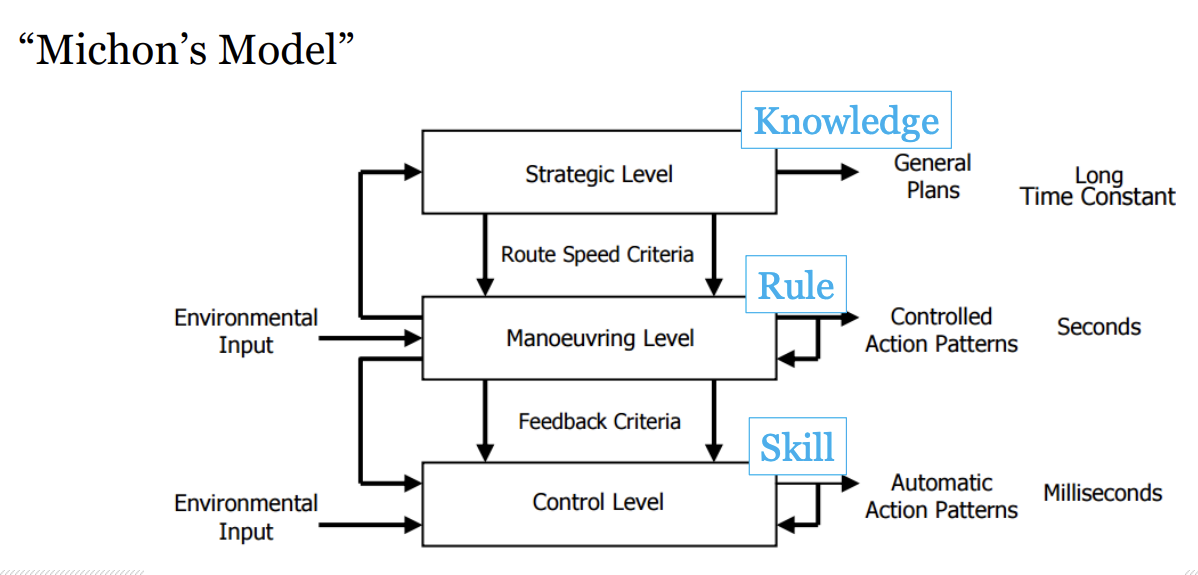
Michon's model
hierarchical decision-making model suggests that decision-making involves different levels
What are the three levels in Michon’s model?
strategic level, manoeuvring level, control level
MABA-MABA assumption
states that men are better at certain tasks while machines are better at others
What are humans better at?
judgment, reasoning, improv
What are machines better at?
repetitive tasks, precision, quick response
Of what two things does automation in traffic consist?
support systems, automated driving
Name 3 examples of support systems
navigation, speed limit info, ADAS
What is does the abbreviation ADAS stand for?
advanced driver assistance systems
Name an example of ADAS feature
cruise control
What are the 5 different levels of automation?
no automation 2. decision support 3. consentual ai 4. monitored ai 5. full automation
At which three levels do humans still have control and at which two levels do humans have no control?
human can control: 1-3, human cannot control: 4-5
Terms in humans and automation: Use
voluntarily activating/disengaging automation
Terms in humans and automation: Abuse
task is taken over by machine without considering consequences for operator
Terms in humans and automation: Disuse
neglect automation
Terms in humans and automation: Misuse
unjustified overreliance
Phileas
Phileas was a "tram on tires" that had three modes of operation with different levels of automation.
Adaptable automation
humans determine how automation is applied
Adaptive automation
system assigns automation level
Issues of automation
errors, transfer of control between manual and automatic modes, mixed traffic, sensors failing due to external factors
Wizard of Oz testing
testing method that involves simulating automated systems while having a human operator pretend to be the automation
Rasmussen's model in automation errors
skill based - failing sensors, rule based - pattern recognition, knowledge based - preprogrammed or sufficiently trained with data
Name three ethical concerns about automation
hacking, terrorism, smuggling
External human-machine interface (eHMI)
screen on the outside of a car that interacts with humans through text or smiley faces
Name the 6 driving assessment methods
Behind-the-wheel examination (BTW) 2. instrumented vehicle 3. virtual reality driving simulation 4. crash statistics 5. self-reports 6. neuropsychological assessment
What are the pros and cons of behind the wheel examinations?
+ direct, quantifiable measurement - subjective, no challenging scenarios
What are the pros and cons of instrumented vehicles?
+ direct, quantifiable measurement - expensive, no challenging scenarios
What are the pros and cons of virtual reality driving simulations?
+ objective, quantifiable measurement, safe challenging scenarios - not really comparable to real world
What are the pros and cons of crash statistics?
+ clinical relevance - collected after the fact, infrequent events, only known if reported
What are the pros and cons of self-reports?
+ easy to assess - self-report bias
Of what three things does neuropsychological assessment consist?
behavioral observations, self-reports, neuropsychological tests
Terms in fitness to drive decision making: Dichotomization
a single cut-off: unfit drivers and fit drivers
Terms in fitness to drive decision making: Trichotomization
2 cut-offs: unfit drivers, uncertain and fit drivers
Terms in fitness to drive decision making: Sensitivity
how many of older people unfit to drive do I classify as unfit
Terms in fitness to drive decision making: Specificity
how many of older people fit to drive do I classify as fit
Terms in fitness to drive decision making: Positive predictive value
how many of older people classified as unfit to drive are actually unfit
Terms in fitness to drive decision making: Negative predictive value
how many of older people classified as fit to drive are actually fit
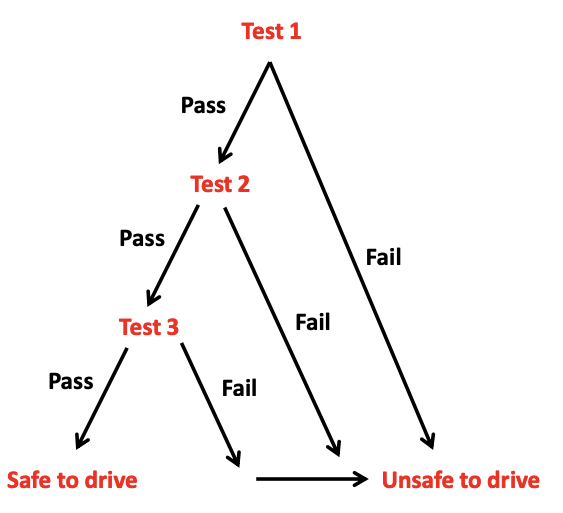
What kind of decision making do you see here?
serial dichotomization
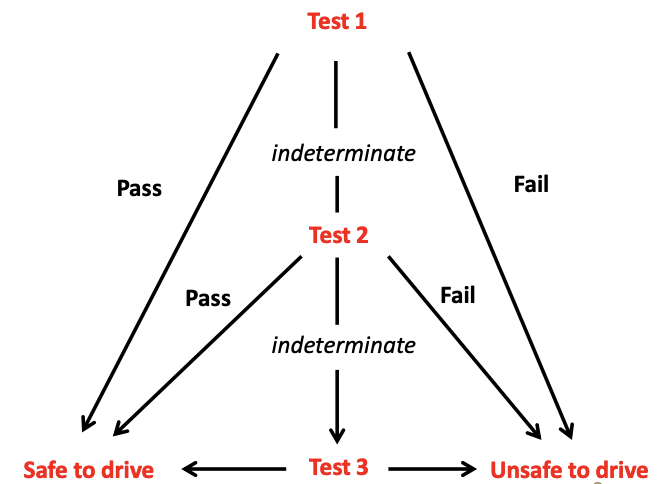
What kind of decision making do you see here?
serial trichotomization
Name the four interventions and alternatives for unfit drivers
ADAS, cognitive interventions, educational interventions, clinical interventions
Mental workload
the difference between the processing resources to the operator and the resource demands of the task
Fill in: demand > capacity = workload … → performance …
high, decreases
Fill in: demand < capacity = workload … → performance …
low, increases
The availability of resources depends on what three things?
individual differences, arousal, motivation
Task complexity
increases with an increase in the number of stages of processing that are required to perform a task
Difficulty of a task
related to the processing effort (amount of resources) that is required by the individual for task performance
Mental workload can be high as a result of what two things?
high task demand, reduced capability to deal with the task demands
Compensatory effort
counteract reduced state
Computational effort
deal with increased task demands
Fatigue
subjective experience of tiredness and unwillingness to continue working
What are the three types of fatigue?
sleep-related fatigue 2. active task related fatigue 3. passive task related fatigue
Fatigue detection by what 3 things?
psychophysiology, steering wheel movements, facial monitoring
Warning display structure should be?
noticed, read, understood, accepted, and should not lead to adverse reactions
Signal detection theory
aims to discriminate signals from noise and is relevant for understanding the detection of warning signals.
Education, licencing and driver training: what two levels are there when training people to drive?
skill level 2. strategic level
Experience paradox
independent driving experience leads to safe behavior but to get experience you need experience
What is the solution for the experience paradox?
supervised practise
Graduated Driving License (GDL)
allows young drivers to gain driving experience under supervision and with certain restrictions
Protection Motivation Theory
explains how people perceive and respond to threats. It says individuals protect themselves based on their assessment of threat severity and their ability to cope.
Why does fear appeal?
elicit fear can motivate but also lead to defense response (e.g. denial, ridiculing, minimising)
The message-relevant effect
short-term: negative emotional appeals, long-term: positive appeals
Name three examples of traffic enforcement
speed, traffic lights, drink-driving
Deterrence theory
criminal activity happens in case of positive utility
Distance halo
the distance over which the effects of an enforcement operation last after a driver passed the enforcement site
Time halo
the length of time that the effects of enforcement on driver’s speed behavior continue after the enforcement operations have been ended
Self explaining roads
design of roads results in correct driving behavior
What is the most effective Es
engineering
Disinhibition model
people drink and drive because they can’t control their inhibitions when drunk
Myopia model
people drink and drive because they can’t see beyond the now when drunk
How is epidemiological research done?
with surveys, road side drug testing, hospital registrations
Of what three things does experimental research consist?
driving related tasks 2. on road driving 3. driving simulator tasks
Name three driving related tasks
alertness, memory, risk taking
Pros and cons of driving related tasks
pros: easy to administer, widely available cons: in isolation, not representative of real world
Pros of on-road driving
pros: representative cons: not always possible (ethics)
Pros and cons of driving simulator tasks
pros: easy to administer, interaction with traffic cons: simulator sickness, not representative
Conclusion on alcohol in traffic
affects judgement and skills
What are the positive effects of THC on driving and traffic safety?
altered perception, relaxation, increased awareness
What are the negative effects of THC on driving and traffic safety?
anxiety, dissociation
What are the positive effects of amphetamines on driving and traffic safety?
improved neuropsychological task performance
Why do amphetamines have no negative effects but are still not safe in traffic?
tasks that are tested do not cover everything
On what six factors does driving impairment due to drugs depend on?
substance 2. dose 3. time after intake 4. half-life of drug 5. tolerance 6. precondition
Name three examples of vulnerable road users (VRU):
elderly, children, cyclists
What compromises pedestrian safety?
bigger cars (SUV’s)
Common problems for older cyclists
soft shoulder lanes, swerving
Possible solutions for cyclist safety
optical illusions, forgiving shoulder lanes
'“Forgiving” shoulder lane
space added in the shoulder as buffer area
what are the three types of shoulder lanes?
grey artificial grass, green artificial grass, concrete strip