Bio 251 lab 1
 Call Kai
 Learn
Learn Practice Test
 Spaced Repetition
 Match
Match Flashcards
 Knowt Play
1/66

There's no tags or description
Looks like no tags are added yet.
Name | Mastery | Learn | Test | Matching | Spaced | Call with Kai | Chat |
|---|
No analytics yet
Send a link to your students to track their progress
67 Terms
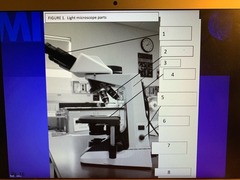
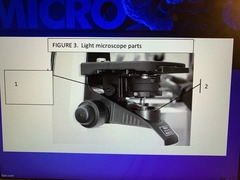
ocular lens
what is 1 ( Lens located in eye piece with 15x magnification)
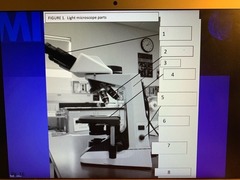
objective lens
what is 2 (Lenses on revolving nose piece, 4x, 10x, 40x, and 100x magnification)

arm
what is 3 (Metal area in back for holding microscope with hand)

Stage
what is 4 ( Flat surface for placing slide.)

lamp switch
what is 5 (On/Off switch for light source.)
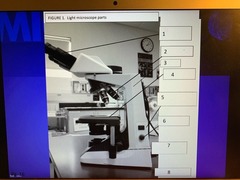
Rheostat
what is 6 (Knob that regulates the amount of light leaving the lamp)
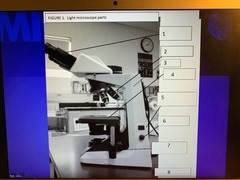
Mechanical stage
what is 7 (Knobs that move the platform stage from side to side and forward and backward.)
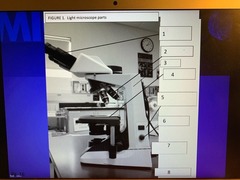
Mechanical Stage 6
what is 6 (Knobs that move the platform stage from side to side and forward and backward.)

fine adjustment knob
what is 1 and 2 (Small inner knob on both sides next to coarse adjustment knob, used for fine focus with 40x and 100x objective

Base
What is 8 (Flat metal bottom for holding microscope when carrying.)
Condenser Lens
What is 3 (concentrates the light reaching the specimen.)
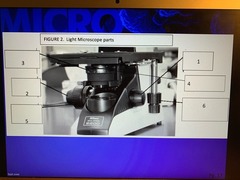
Course Adjustment Knob
What is 5 (Large knob on both sides toward base, used with 4x and 10x for initial focusing.)
Iris Diaphragm
What is 4 (Lever on condenser that regulates amount of light entering specimen.)
condenser adjustment knob
What is 1 (raises and lowers the condenser)

Lamp/light source
What is 2 (provides light to illuminate the object)
60x
Calculate total magnification:
15x x 4x
150x
Calculate total magnification:
15x x 10x
600x
Calculate total magnification:
15x x 40x
1500x
Calculate total magnification:
15x x 100x
0.2 micrometers
what is the Maximum Resolution
Parfocal
A property whereby an image in focus in a lower power will remain in focus when changing to a higher power objective.
Archaea
Microorganisms that are similar to bacteria in size and simplicity of structure but radically different in molecular organization. They are now believed to constitute an ancient intermediate group between the bacteria and eukaryotes.
Bacteria
Unicellular microorganisms that have cell walls but lack organelles and an organized nucleus, including some that can cause disease.
Eukarya
Any of various single-celled or multicellular organisms of the domain Eukaryota, characterized by cells that contain a distinct membrane-bound nucleus and by the occurrence of DNA transcription inside the nucleus and protein synthesis in the cytoplasm, in contrast to prokaryotes.
Protists
Generally microscopic, growing as individual cells or occasionally in colonial form (small groupings). Eukaryotic cells with one or more nuclei and organelles. In general, they are larger and more complex than bacteria.
Animals
Worms are multicellular and are more complex in structure than archaea and bacteria, protists, or fungi. They are generally, but not always, larger in size as well.
Paramecium
What is this?

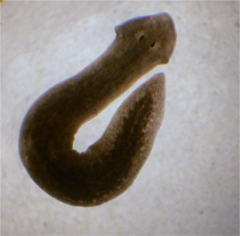
Planaria
What is this?
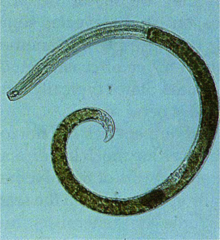
Turbatrx (Vinegar Eels)
What is this?
Penicillium
What is this?

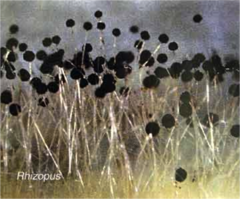
Rhizopus
What is this?
Volvox
What is this?
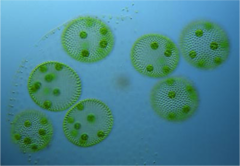
Amoeba
What is this?

Euglena
What is this?
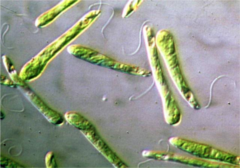
Saccharomyces cerevisiae
What is this?

Aspergillus
What is this?

1.That lab coat, goggles, closed-toe shoes, and hair ties (for long hair) are required in the lab.
what is the basic safety in the lab?
4.Wash hands before and after the lab session:
when should you wash your hands
Lab coat buttoned up completely when worn. Leave lab coats in the lab, stored in a plastic bag, labeled with your name.
how should your lab coat be worn and store away
Goggles are required for lab. wear goggles and
Are goggles require in lab ?
leave in the lab in a sealed plastic bag,
how are goggles store
Goggles should always be used when working with liquid cultures
when should you bee using goggles
is not know to cause disease in human to 4 that can be life threatening to human
what are the Bio safety levels (BSL) 1 - 4.
-Not known to cause disease in healthy humans
-Standard open bench microbiology
what are the health risk and practices needed for each level for BSL 1
-Associated with human disease in healthy but easily contained. Transmission through percutaneous, ingestion, mucous membrane
- BSL-1 practice plus: Limited access Biohazard warning signs, "Sharps" precautions, disposal of waste and surveillance
what are the health risk and practices needed for each level for BSL 2
-Disease may have serious or lethal consequences
--BSL-2 practice plus: controlled access
What are the health risk and practices needed for each level for Bs3
-Agents with high risk of life threatening disease
-BSL-3 practice plus
what are the health risk and practices needed for each level for Bs4
They can be found in every habitat on earth
what is Ubiquitous
special type of interaction between species. Sometimes beneficial, sometimes harmful,
what is symbiotic relationship
are microbes that inhabit our bodies in ways that may benefit both them and us. ( ex: Barnacles and Whales. The barnacles are just along for the ride. They don't harm the whales or feed on the whales as true parasites do. Barnacles don't serve any obvious advantage to the whales, but they give helpful lice a place to hang onto the whale without getting washed away by water.)
what is commensals
because when they have the opportunity to cause disease they will often do so
what is opportunists
The introduction of a pathogen or antigen into a living organism to stimulate the production of antibodies.
what is Inoculation
distinct and separated from other similar masses, it is called a
what is Colonies
Culture media can be liquid or solid at room temperature is used as a nutrient source to allow microbes to grow.
what is culture media, is it solid or liquid and what is it use for?
allow the growth of many microorganisms that do not need special growth factors.
General purpose media
contain special growth factors required by some microorganisms to grow
what is Enrichment media?
show differences between microbial colonies based on their cultural characteristics (what they look like when growing in colonies).
Differential media
is used to inhibit the growth of some groups of microorganisms and select for the growth of other microorganisms.
what is Selective media
General or all-purpose media
what culture media for TSA (Tryptic soy agar )
Selective media
what culture media for SDA ( Sabouraud's agar plate )
Enrichment and differential media
what culture media is the sheep BAP (Blood agar place)
light microscopy is commonly used by beginning microbiologists.
what is Microscopy
which is a property whereby an image in focus in a lower power will remain in focus when changing to a higher power objective.
what is parfocal design
Lens located in eye piece with 15x magnification
what is ocular
Lenses on revolving nose piece, 4x, 10x, 40x, and 100x magnification
what is objective lens
Lens system below the stage that concentrates the light reaching the specimen.
condenser
Domains: Archaea, Bacteria, and Eukarya.
what are the 3 domains. Know the characteristics of prokaryotic and eukaryotic cells. Know how to characterize each domain with each cell type (for example, bacteria are prokaryotic).