Chemistry- Matter Measurement and Problem solving
 Call Kai
 Learn
Learn Practice Test
 Spaced Repetition
 Match
Match Flashcards
 Knowt Play
1/60

Earn XP
Description and Tags
General Chemistry Chem 101
Name | Mastery | Learn | Test | Matching | Spaced | Call with Kai | Chat |
|---|
No analytics yet
Send a link to your students to track their progress
61 Terms
Image of water molecule
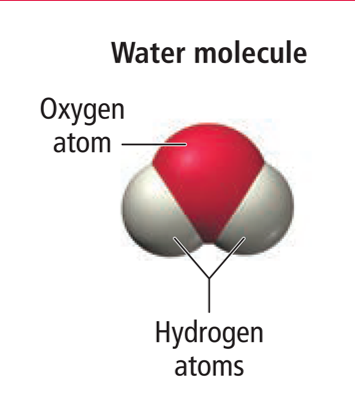
What is liquid water composed of?
Liquid water is composed of water molecules
What does each water molecule contain?
Each molecule contains two hydrogen atoms and an oxygen atom held together by a chemical bond
What are observations also known as, what are they descriptions about and what do they often lead scientists to formulate?
Observations are also known as data, they are descriptions about the characteristics or behavior of nature, and they often lead scientists to formulate a hypothesis
What is a scientific law, what does it allow you to do, and can you choose to violate it?
A brief statement that summarizes past observations and predicts future ones. It allows you to predict future observations so you can test the law with experiments and unlike civil or governmental laws, you cannot choose to violate a scientific law
What is the law of conservation of mass
In a chemical rection, matter is neither created nor destroyed
What may form a basis for a scientific theory?
One or more well-established hypothesis may form the basis for a scientific theory
What is a scientific theory
A scientific theory is a model for the way mature is and tries to explain not merely what nature does, but why
What are theories validated by?
Theories are validated by experiments
Can theories ever be exclusively proven?
Theories can never be exclusively proven because some new observation or experiment always has the potential to reveal a flaw
What is matter
Matter is anything that occupies space and has mass (Your textbook, your desk your chair and even your body are all composed of matter)
How can we classify matter?
We can classify matter according to its state (physical form) and its composition (the basic components that make it up)
What can we classy matter as?
Matter can be classified as solid, liquid, or gas based on what properties it exhibits
How does the state of matter change
The state of matter changes from solid to liquid to gas with increasing temperature
What are the two states of matter solid matter can be?
In solid matter, atoms or molecules pack as closely together as possible, and can either be: Crystalline or Amorphous
What is the structure of the solid state of matter Crystalline
Its atoms or molecules are in patterns with long-range, repeating order
What is the structure of the solid state of matter Amorphous
Its atoms or molecules do not have any long-range order
What is the structure of liquid matter
Atoms or molecules pack about as closely as they do in solid matter, but they are free to move relative to each other
What is the structure of gaseous matter?
The atoms or molecules have a lot of space between them (gases are the only state that is compressible)
what is the only state of matter that is compressible
Gases
What is the first division of classification of matter
The first division in the classification of matter is between a pure substance and a mixture
What is a pure substance made up of?
A pure substance is made up of only one component, and is invariant
What is a mixture made up of?
A mixture, is a substance composed of two or more components in proportions that can vary form one sample to another
What is an element
An element is a substance that cannot be chemically broken down into simpler substances
What are the basic building blocks of matter, and how are they composed
Elements. They are composed of a single atom, like helium
What is a compound
A compound is a substance composed of two or more elements in fixed definite proportions
True or False: Most elements are chemically reactive? (elaborate)
Most elements are chemically reactive and combine with other elements to form compounds like water, sugar, etc.
What are the two types of mixtures
A heterogenous mixture and a homogenous mixture
What is a heterogenous mixture
A heterogenous mixture is one in which the composition varies from one region of the mixture to another
e.g. a salt and sand mixture
What is a homogenous mixture?
A homogenous mixture is one made of multiple substances but appears to be one substance
e.g. Sweetened tea
What methods can you use to separate mixtures
-A mixture of sand and water can be separated by decanting - carefully pouring off the water into another container
-A homogenous mixture of liquids can usually be separated by distillation, a process in which the mixture is heated to boil off the more volatile (easily vaporizable) liquid
-A mixture of an insoluble solid and a liquid can be separated by filtration, a process in which the mixture is poured through filter paper in a funnel.
What are physical changes
Changes that alter only the state or appearance of a substance, but not composition, are physical changes.
The atoms or molecules that compose a substance do not change their identity during a physical change
example: phase changes
What are chemical changes
Changes that alter the composition of matter are chemical changes
During a chemical change, atoms rearrange, transforming the original substances into different substances.
Example: Rusting of iron is a chemical change
What is a physical property (2)
A physical property is a property that a substance displays without changing its composition.
The smell of gasoline is a physical property.
Odor, taste, color, appearance, melting point, boiling point, and density are all physical properties.
What is a chemical property (3)
Chemical property is a property that a substance displays only by changing its composition via a chemical change (or chemical reaction).
The flammability of gasoline, in contrast, is a chemical property.
Chemical properties include corrosiveness, acidity, and toxicity.
What is energy
Energy is the capacity to do work
What is work
Work is defined as the action of a force through a distance
Give an example of when you have done work
When you push a box across the floor or pedal your bicycle across the street, you have done work
What is kinetic energy
Kinetic energy is the energy associated with the motion of an object.
What is potential energy
Potential energy is the energy associated with the position or composition of an object.
What is chemical energy
Chemical energy is a form of potential energy that relates to position and composition of a chemical sample.
What is thermal energy
Thermal energy is the energy associated with the temperature of an object.
Picture of the standard SI base units
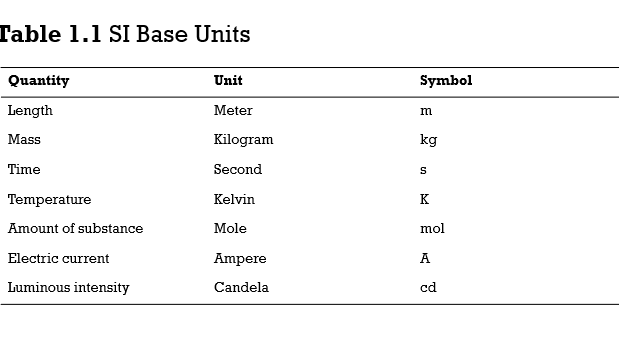
What is the mass of an object
The mass of an object is a measure of the quantity of matter within it.
SI unit of mass = Kilogram Kg
Another common unit of mass is gram (g)
What is the weight of an object
The weight of an object is a measure of the gravitational pull on its matter.
Information on the measure of time
Measure of the duration of an event
SI units = second (s)
1 s is defined as the period of time it takes for a specific number of radiation events of a specific transition from cesium-133.
Information on Kelvin measure of temperature
The Kelvin (K) is the SI unit for temperature
The temperature is a measure of the average amount of kinetic energy of the atoms or molecules that compose the matter.
Temperature also determines the direction of thermal energy transfer, or what we commonly call heat.
Thermal energy transfers from hot to cold objects.
The operating’s of the Kelvin Scale
Kelvin scale (absolute scale) assigns 0 K (absolute zero) to the coldest temperature possible.
Therefore, the Kelvin temperature scale cannot have negative values
Absolute zero (−273°Celsius or −459°Fahrenheit) is the temperature at which molecular motion virtually stops. Lower temperatures do not exist.
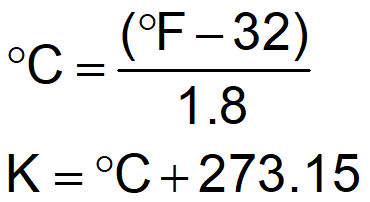
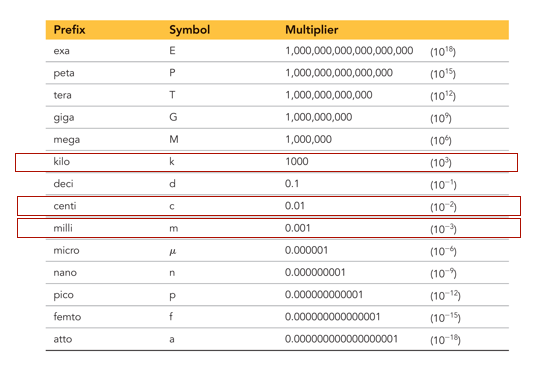
Image of SI Prefix multipliers
What is volume, what is density (Derived units)
Volume is a measure of space; it has units of length cubed (i.e., cm3) or liters (L)
Density is the ratio of a substance’s mass to volume; it has units of mass/volume.
When does density affect
Density affects if a substance will sink or float in another. The less dense substance floats.
What is densities relationship to temperature
Density decreases as temperature increases, and the sample will expand.
Vice versa is also true.
Image of the densities of some common substances at 20 degrees celcius
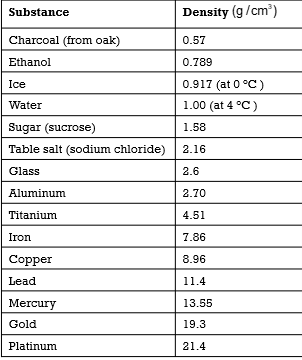
What is an intensive property
An intensive property is a characteristic that is independent of the amount of substance
What is an extensive property
An extensive property is a characteristic that is dependent on the amount of substance
How many significant figures in this number: 5.213
4
Nice to know about significant figures
The greater the number of significant figures, the greater the certainty of the measurement
Significant figure rules
1.All nonzero digits are significant.
2.Interior zeroes (zeroes between two nonzero digits) are significant.
How many significant figures in this number: 0.0540
2 (if you don’t understand go to counting significant figures page on PowerPoint)
Go through significant figures, rules for calculations
yep