Monohyrbid crosses, dihybrid crosses, test crosses and linked genes
 Call Kai
 Learn
Learn Practice Test
 Spaced Repetition
 Match
Match Flashcards
 Knowt Play
1/26

There's no tags or description
Looks like no tags are added yet.
Name | Mastery | Learn | Test | Matching | Spaced | Call with Kai | Chat |
|---|
No analytics yet
Send a link to your students to track their progress
27 Terms
What is a monohybrid cross?
Monohybrid cross: A cross that tracks the inheritance of one single trait
The likelihood of a trait being produced during a monohybrid cross can be mapped out using a punnet square
How is a punnet square useful for geneticists?
Punnet square: A grid used predict the probability of offspring's inheriting certain genotypes and phenotypes
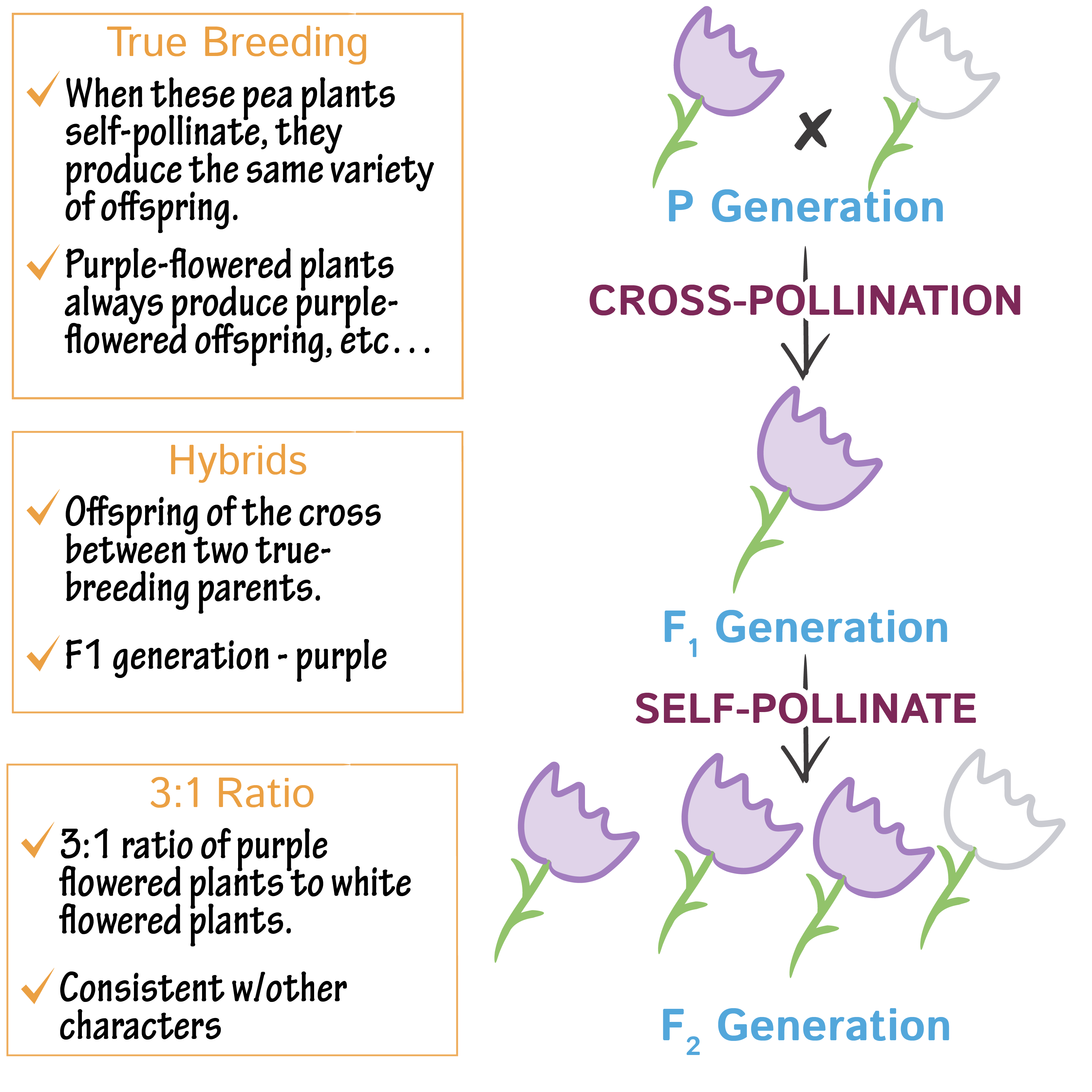
How does a hyrbid individual differ from a true breeding individual?
True breeding: Individuals homozygous for a trait
Hybrid: Individuals heterozygous for the trait
Who discovered modern genetics and by what experiments did they discover it?
Gregor Mendel (1822-1884), Austrian monk
Studied inheritance patterns in pea plants
First experimented by crossing pure-breeding (homozygous) plants
Focused on one characteristic at a time (EG stem length) to determine frequency of phenotypes’ → made it easier to understand the laws controlling inheritance
Over 7 years, Mendel experimented on more than 28,000 pea plants
Why were Austrian monk Gregor Mendel’s experiments successful?
Pea plants grow quickly and are available in pure-breeding (homozygous) strains
Many pea plant characteristics show discontinuous variation; they are either one form or another, with no intermediates meaning that their phenotypes are easily distinguishable
What are some common phenotypic and genotypic ratios for monohybrid, dihybrid, test cross and sex-linked genetic crosses?
Type | What you're crossing | Genotype ratio | Phenotype ratio |
Monohybrid | 2 heterozygous: Aa × Aa | 1:2:1 | 3:1 |
Monohybrid | Heterozygous × recessive: Aa × aa | 1:1 | 1:1 |
Monohybrid | Dominant × recessive: AA × aa | 100% Aa | 100% dominant |
Monohybrid | Dominant × heterozygous: AA × Aa | 1:1 | 100% dominant |
Monohybrid | 2 recessive: aa × aa | 100% aa | 100% recessive |
Dihybrid | 2 heterozygous: AaBb × AaBb | 1:2:1:2:4:2:1:2:1 | 9:3:3:1 |
Dihybrid test cross | Heterozygous × double recessive: AaBb × aabb | 1:1:1:1 | 1:1:1:1 |
Linked genes | Heterozygous × recessive: AB/ab × ab/ab | Parental > recombinant | Parental > recombinant |
Sex-linked recessive | Carrier female × unaffected male: XᴬXᵃ × XᴬY | 1:1:1:1 | 3 unaffected : 1 affected |
Sex-linked recessive | Carrier female × affected male: XᴬXᵃ × XᵃY | 1:1:1:1 | 1:1:1:1 |
How are test crosses used to form pure breeding strains?
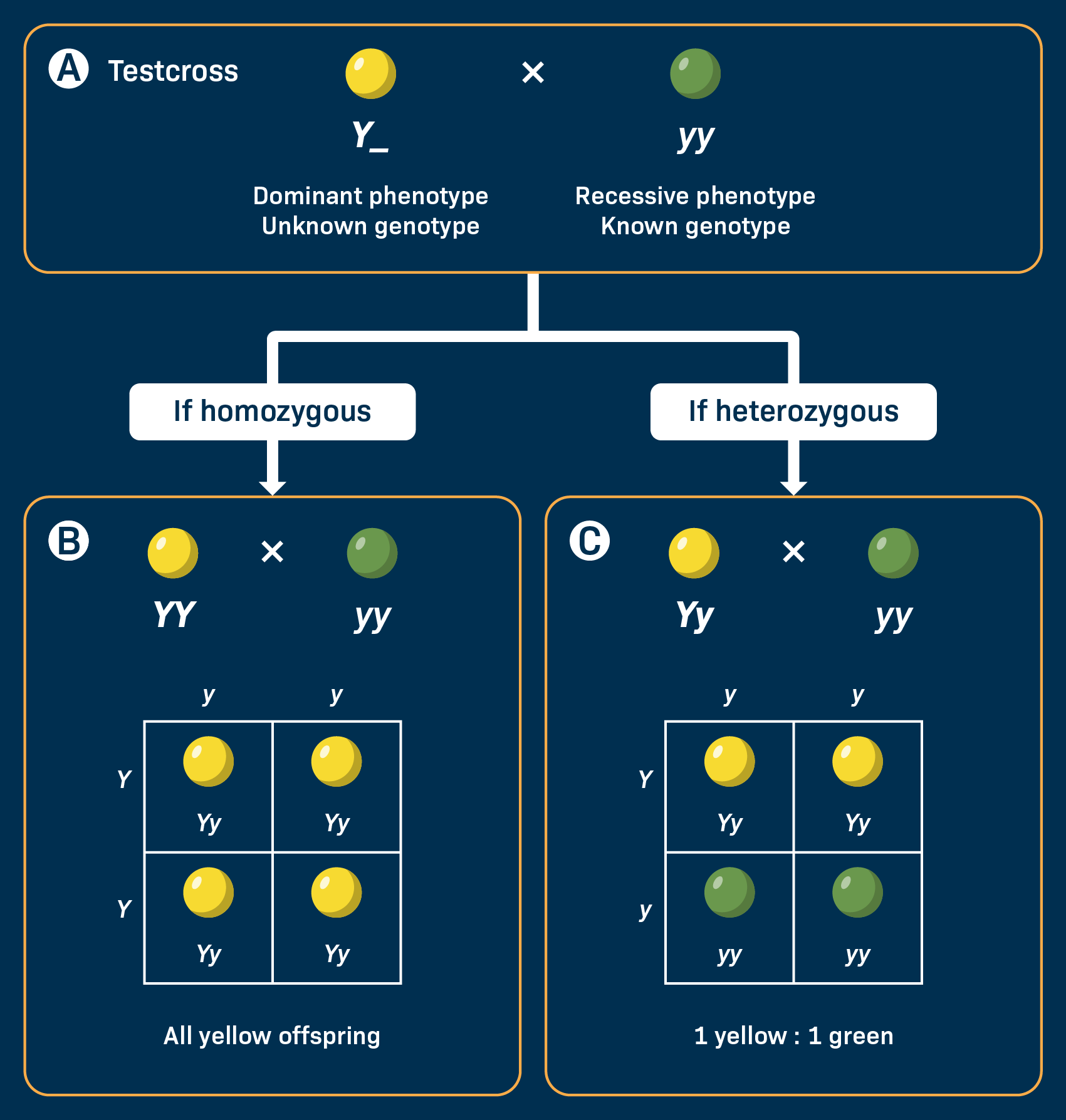
Test cross: A genetic method where the dominant individual with unknown phenotype is crossed with a homozygous recessive individual for the trait to determine their genotype
Test cross only confirmed after 16 crosses
Offspring phenotype reveal the genotype of the unknown parent
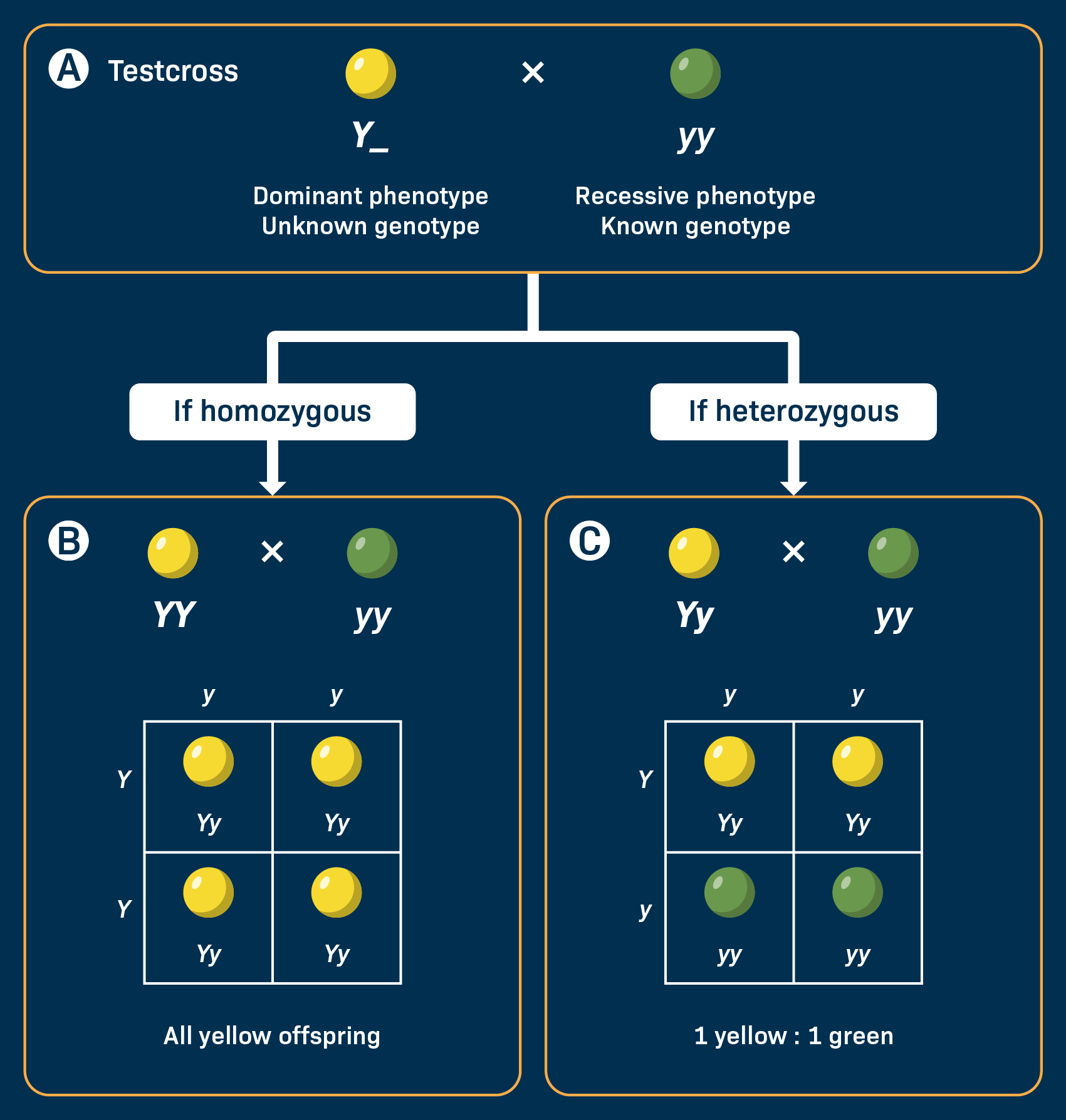
What are the resulting offspring of a test cross where the unknown genotype was homozygous dominant?
Results after 16 crosses:
All offspring will have the dominant trai t
All offspring possess the heterozygous genotype
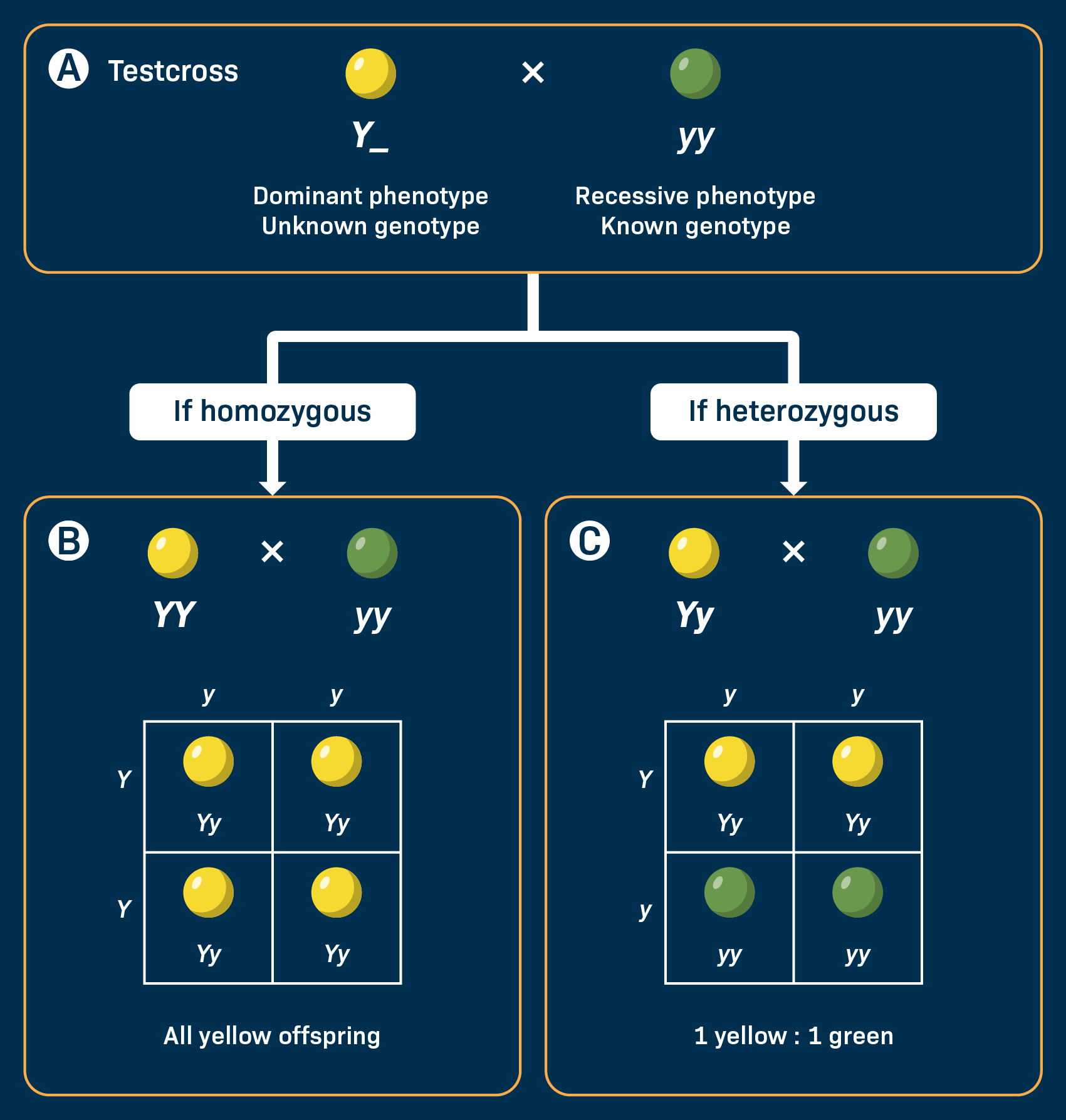
What are the resulting offspring of a test cross where the unknown genotype was heterzygous?
Results after 16 crosses:
Half the offspring will have the dominant trait (1:1 ratio)
Those with the trait are heterozygous carriers
Those with the recessive trait are homozygous recessive
Despite test crosses being confirmed after 16 offspring are produced, are the results 100% accurate?
Test crosses only show the theoretical probability which often differs from the experimental probability
Despite the ratio being 3:1, every 1 out of 4 offspring may not express the recessive trait
Therefore test crosses only work accurately with large sample sizes
What relationships can dihybrid crosses determine?
Dihybrid cross: Involves crossing 2 different genes to determine the relationship between the alleles for each gene and the relationship between those genes
What can dihybrid crosses be used to determine?
Used to determine:
Te relationship between the alleles for 2 genes
Whether genes are linked or unlinked
The inheritance of two different genes controlling different phenotypes
What are 3 commonly conducted dihyrbid crosses?
Crossing 2 heterozygotes
Crossing homozgyous dominant individuals (true-breeding pairs)
Crossing homzygous dominant with heterozygous
What genotype and phenotype ratios does a dihybrid cross of 2 heterozygotes produce?
BbRr x BbRr = Phenotype Ratio: 9:3:3:1
Genotype Ratio: 1:2:1:2:4:2:1:2:1 (9 different genotypes)
9 dominant for both traits
3 dominant for B, recessive for R
3 recessive for B, dominant for R
1 recessive for both traits
What genotype and phenotype ratios does a dihybrid cross of 2 true-breeding pairs (homzygous dominant individuals) produce?
BBRR x bbrr = Phenotype Ratio: 1:0 (100% express both dominant traits)
Genotype Ratio: 1:0 (100% BbRr)
All offspring heterozygous for both traits
What genotype and phenotype ratios does a dihybrid cross of a homzygous dominant individual x heterozygous individual produce?
BBRR x BbRr Phenotype Ratio: 1:0 (100% express both dominant traits)
Genotype Ratio: 1:1:1:1
1 BBRR
1 BBRr
1 BbRR
1 BbRr
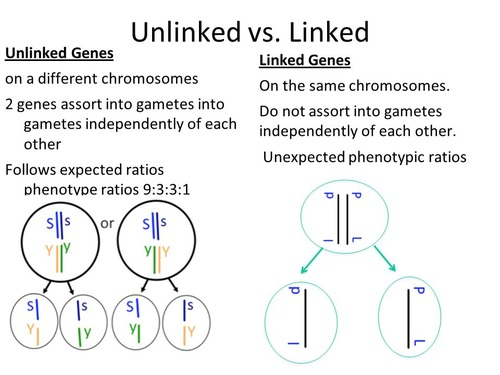
How does independent assortment affect linked and unlinked genes differently?
What are the steps for conducting a dihyrbid cross?
Determine allele combos for the parental genotypes
Draw the dihybrid cross, with parental allele combinations on the top and down the side. Combine the alleles in the boxes to determine the potential genotypes of the offspring
Determine the phenotypes of offspring
Address the question, which may involve determining the phenotypic ratio of the offspring or probability of certain phenotypes
What is a dihybrid test cross?
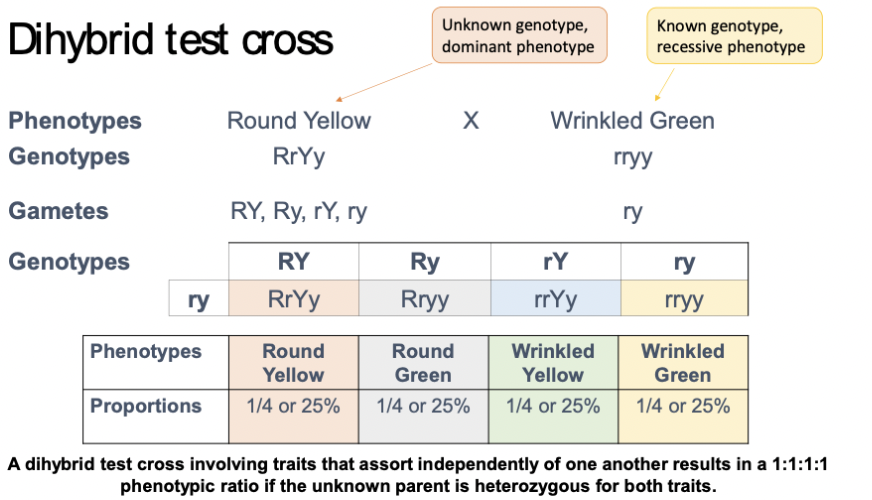
Dihybrid test cross: A genetic cross where an individual with the dominant phenotype for two traits (but an unknown genotype) is bred with a double homozygous recessive individual
How do dihybrid test cross outcomes differ between heterozygous and homozygous dominant genotypes?
Heterozygous (AaBb): produces 4 equal gamete types (AB, Ab, aB, ab) → 1:1:1:1 offspring ratio, showing a mix of dominant and recessive traits
Homozygous dominant (AABB): produces only one gamete type (AB) → all offspring are AaBb, 100% dominant phenotype, no recessive traits appear
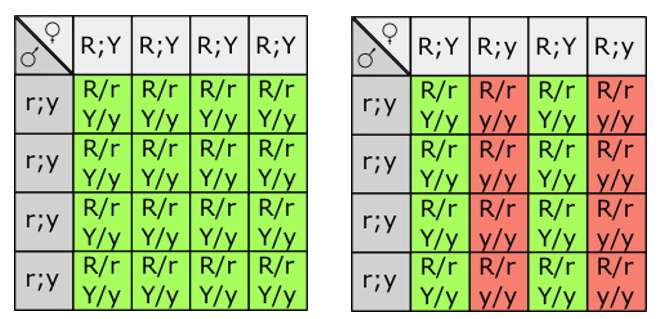
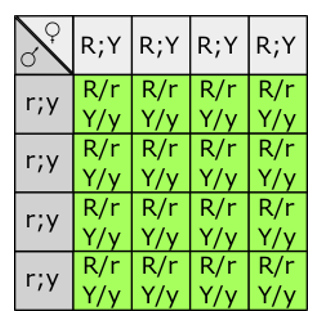
What is the dihybrid test cross outcome if the unknown dominant genotype is homzygous dominant?
If homozygous dominant (AABB)
Only one gamete type is produced: AB
All offspring are AaBb, showing 100% dominant phenotype for both traits — no variation
ow do dihybrid test cross outcomes differ between heterozygous and homozygous dominant genotypes?No recessive phenotypes appear at all
What is the dihybrid test cross outcome if the unknown dominant genotype is heterozygous?
If heterozygous (AaBb)
Independent assortment produces 4 gamete types in equal proportions: AB, Ab, aB, ab
Offspring ratio: 1:1:1:1 across four phenotype combinations
Shows a mix of dominant and recessive traits in the offspring
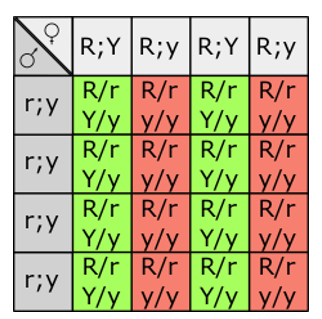
What is independent assortment, and how does it relate to linked vs unlinked genes?
Independent assortment: Random alignment and separation of homologous chromosome pairs at metaphase I, which sorts the alleles of two or more different genes into gametes independently of one another (law)
Relies on genes being on separate homologous pairs, since it's the random orientation of different pairs at the metaphase plate that shuffles them independently
Law applies fully to unlinked genes, but not to linked genes, which travel together on the same chromosome instead of assorting independently
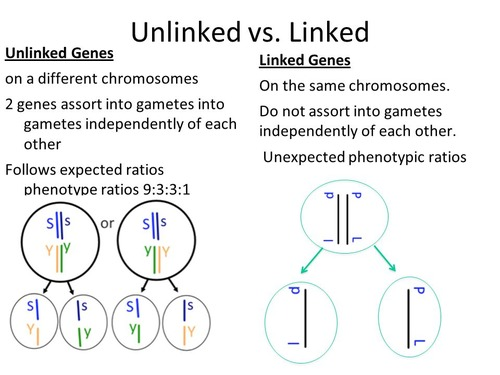
What are unlinked genes and how do they align and seperate during meisois I?
Unlinked genes: Genes located on separate chromosomes that independently assort during meiosis
Unlinked genes follow independent assortment fully
Their alleles combine randomly, producing all possible allele combinations in roughly equal proportions
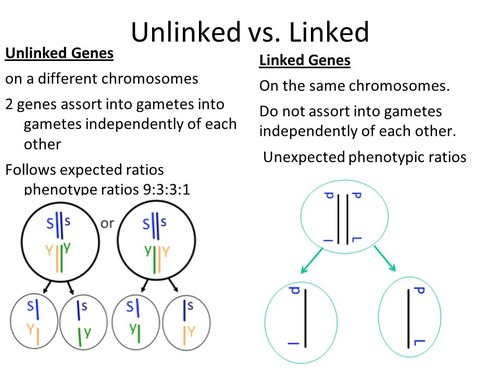
How are unlinked genes different to linked genes?
Unlinked genes: Genes located on separate chromosomes that independently assort during meiosis
Linked genes: Genes located on the same chromosome that tend to be inherited together rather than assorting independently
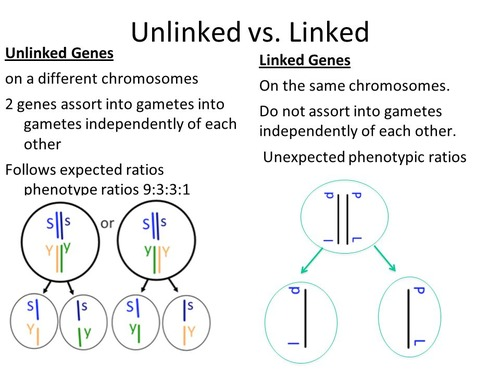
What are linked genes and how do they align and seperate during meiosis I?
Linked genes: Genes located on the same chromosome that tend to be inherited together rather than assorting independently
Not assorted independently because they’re physically joined and travel to the same pole during Anaphase I
Therefore the only way linked genes are separated is by crossing over during prophase I, but the closer together they are, the less likely recombination is to occur between them
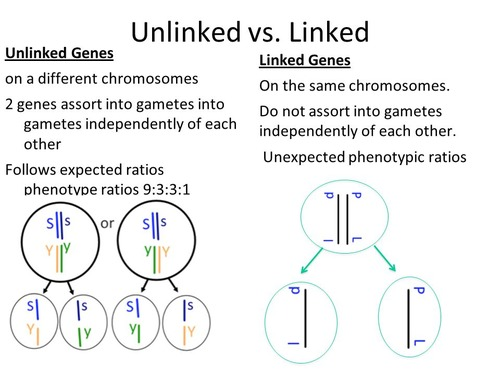
How do the allele combination outcomes differ between linked and unlinked genes?
Linked genes show a higher proportion of parental (non-recombinant) allele combinations
Unlinked genes show an even, equal mix of all possible allele combinations