Buffer Solutions
 Call Kai
 Learn
Learn Practice Test
 Spaced Repetition
 Match
Match Flashcards
 Knowt Play
1/92

There's no tags or description
Looks like no tags are added yet.
Name | Mastery | Learn | Test | Matching | Spaced | Call with Kai | Chat |
|---|
No analytics yet
Send a link to your students to track their progress
93 Terms
ionization
the process by which a neutral molecule gains/loses a proton; acquires a charge
electrolytes
substances that form ions in a solution
nonelectrolyte
compound that does not ionize when dissolve in water; neutral, uncharged species
common examples of nonelectrolytes
ethanol, dextrose, some steroids
these functional groups do NOT ionize in aqueous solutions
Alcohols
Sugars
Ethers
Esters
Ketones
Aldehydes
Majority of amides
A _______ __________ ionizes completely when dissolved in water, and exists solely in the form of positive and negative ions in solution
strong electolyes
Examples of a strong electrolyte
NaCl, KCl, Li2CO3
A _______ ___________ is ionizable, but ionizes partially
Weak electrolyte
Examples of weak electrolytes
acetic acid, ammonia
What properties are affected by ionization/unionization
absorption
distribution
binding to receptor
metabolism
elimination
the _______ form of indomethacin dissolves more rapidly and to a greater extent than the ________ form
ionized; unionized
only the ________ form of indomethacin will bind to the receptor
ionized
B-L acid
donates proton
B-L base
takes proton
what is the most compound present to receive proton from acid, or provide proton to a base
water
amphoteric
can behave as either a base or acid
H3O+
hydronium ion; product when water acts as a base
OH
alcohol; product when acid acts as an acid
ionization product constant of water
Kw = [H+] [OH-]
The value of Kw at 25 C is ____
10^-14
pH value
expresses the acidity of a solution
the symbol p in pH is a(n)
operator that converts a number into its negative log
pH scale
0-14
neutral pH
7; concentration of H+ ions = concentration of OH- ions
acidic solution has a pH ____ ______
below 7
in an acidic solution, the concentration of ________ ions exceeds the concentration of ________ ions
hydrogen; hydroxide
basic solution has a pH ____ _____
above 7
in a basic solution, the concentration of ________ ions exceeds the concentration of ________ ions
hydroxide; hydrogen
pH range of bodily fluids
1-8
pH range of the stomach
1-3
pH range of intestinal fluids
6-7
pH of blood
7.4
blood pH corresponds to a [H+] of ~_____
40 nM
the blood [H+} can vary from ______ to _______ without serious metabolic consequences
37 nM; 43 nM
tissue pH rarely exceeds _____
8
pH range a drug is expected to encounter?
1-8
if a drug does NOT have a functional group that ionizes within physiological pH environments, it behaves as a(n) _________ and remains __________ over the entire range
nonelectrolyte; unionized
reasons it is important to control the pH of a product
to minimize drug degradation
to improve patient comfort and compliance
improve delivery
why are pharmaceutical liquids with a higher pH (than physiological range) required?
makes drug more soluble
maintains good stability
allows for adequate shelf life
Examples of strong acids
HCl, H2SO4
Strong acids ________ __________ in water and exist entirely in their _________ form
dissociate completely; ionized
Strong acids are ______ electrolytes
strong
when a strong acid is added to water, concentration of hydrogen ions _______ and the pH ________
increases; decreases
Example of strong base
NaOH
when a strong base is added to water, concentration of hydrogen ions _______ and the pH ________
decrease; increase
T/F: there are NO strong acid or strong base drugs
true
weak acids and bases ______ ________ in water
partially dissociate
does the pH of water increase or decrease when a weak acid is added?
decreases
weak acids exist in solution in two forms:
un-ionized species
negatively charged ions
weak bases exist in solution in two forms:
un-ionized species
positively charged ions
common weak acids:
carboxylic acids
sulfonic acids
phenols
thiols
imides
an acid and base that differ only by a proton is known as a(n) ______________________
conjugate acid-base pair
Ka
acid dissociation constant

which is the conjugate base of HA?
A-
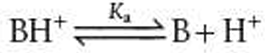
which is the conjugate acid of base B?
BH+
what does the law of mass action describe?
the dissociation of a weak acid and of the conjugate acid of a weak base
what does the law of mass state?
at equillibrium, the product of concentrations on one side of the equation divided by the product concentrations on the other side of the equation, is a constant reguardless of individual concentrations
A ______ Ka means the acid favors giving up protons and dissociates extensively
large

The larger the Ka the ________ the acid, and the ________ its conjugate base
stronger; weaker
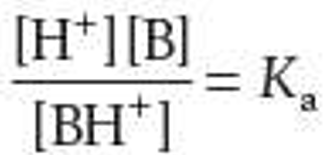
The larger the Ka the ________ the conjugate acid, and the ________ the base
stronger; weaker
pKa=
-logKa
higher pKa indicates a _______ acid or a ________ base
weaker; stronger
Naproxen is a ______ _______
weak acid
Clonidine is a ______ ________
weak base
How do you get the salt of a weak acid?
reacting it with a strong base (such as NaOH)
What kind of salt is made from a weak acid?
sodium salt
How do you get the salt of a weak base?
reacting it with a strong acid (such as HCl)
What kind of salt is made from a weak base?
hydrochloride salt
salts are ______ electrolytes
strong
Reasons drugs are often developed into the salt form.
more readily crystallized into stable, easy to manufacture crystals
dissolve faster in aqueous solutions
more stable in storage
easier to handle
Salts of amines are preferred over the _____ _______ form because…
weak base; many amines are volatile, unstable, have short shelf life as solids
Buffer solution
resists changes in its pH when small amounts of acid or base are added or when solution is diluted; contains both an acid and base (weak-weak or conjugate pair), which react with added OH- and H+, respectively
pH of acidic buffer solutions.
<7
Examples of acidic buffer solutions.
acetic acid and sodium acetate
if the acidic buffer has an equal amount of weak acid and salt, it will have a pH of ______. An example is _______
4.75; acetic acid

If additional H+ ions are added, the equilibrium shifts to the _____
left
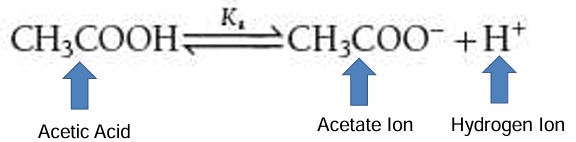
If OH- ions are added, the equilibrium shifts to the _______
right
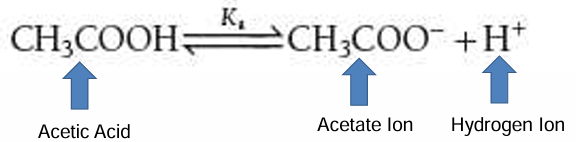
The concentration of ______ remains constant and thus ________ remains constant
H+; pH
pH of alkaline buffer solutions.
>7
Examples of alkaline buffer solutions.
ammonia and ammonium chloride
if the alkaline buffer has an equal amount of weak base and salt, it will have a pH of ______. An example is _______
9.25; ammonia
Buffer capacity
the ability of a buffer to maintain a constant pH; the amount of acid/base that can be added to a given volume of buffer solution before pH changes
Why is the pH of pharmaceutical formulations often controlled through buffers?
to minimize drug degradation
improve patient comfort/compliance
allow delivery of a sufficient drug dose
pH of pancreatic fluid
8
pH range of blood
7.35-7.45
pH range of cells
7-7.3
Proteins are the most important buffers in the body, because their _______ and ____________ groups act as proton acceptors or donors
amino; carboxylic acid
Th phosphate buffer system consists of _________ ____________ ions as the proton donor and ___________ ___________ ions as the proton acceptor
dihydrogen phosphate; hydrogen phosphate
_________ ___________ injection is often used to raise the pH of some parenteral preparations
sodium bicarbonate
__________ buffer is useful for low to mid pH range (3.6-5.6)
acetate
_______________ buffer is useful for pH 6-8
sorenson’s phosphate
__________ buffer is useful as a concentrated multipurpose buffer in the low to mid pH range (2.5-6.5)
citrate