IO THEORIES
 Call Kai
 Learn
Learn Practice Test
 Spaced Repetition
 Match
Match Flashcards
 Knowt Play
1/68

There's no tags or description
Looks like no tags are added yet.
Name | Mastery | Learn | Test | Matching | Spaced | Call with Kai | Chat |
|---|
No analytics yet
Send a link to your students to track their progress
69 Terms
An umbrella term for organizational theories that focuses on WORK, routinary tasks and responsibilities of a position. Highlights what is common among individuals
Classical Theories
An umbrella term for organizational theories focuses on WORKER, the individual, and how they relate to others. Highlights the individual differences among employees. Informal Organizational Structure
Neo-classical
Focuses on INTERNAL and EXTERNAL factors. Integrates multiple disciplines and emphasizes that no one-size-fits-all approach exists
Modern Organizational Theories
Views the organization as a machine whose focus is to run effectively by following a system. Believes that there is only one way to do a job.
Scientific Management Theory
a business efficiency technique that breaks down repetitive workplace tasks to measure how long each step takes and observe the physical movements required.
Time and Motion Studies
Highlights the processes / rules and regulations within the organization. Characterized by rules, standardized processes, procedures and requirements, meticulous division of labor, and clear hierarchies. Strict and logical rules.
BUREAUCRATIC THEORY
Principles of BUREAUCRATIC THEORY
Work is broken down into specific, specialized tasks. Employees handle duties that directly match their skills, which increases overall competence and productivity.
Organizations are structured in a strict pyramid or chain of command. Higher positions supervise and control lower levels, ensuring clear accountability and reporting lines
Comprehensive and documented guidelines establish standardized procedures for all operations. This ensures consistency, systematic control, and predictable employee behavior.
Rules and controls are applied uniformly to everyone without favoritism, emotion, or personal bias. Official interactions are kept strictly professional to maintain objective, fair treatment for all
Hiring, job placement, and promotions are strictly based on technical qualifications, such as training, education, or examinations—not personal connections.
Management is treated as a professional, full-time career. Officials have no ownership stake in the company but are provided job security and protection against arbitrary dismissal to encourage long-term dedication.
Division of Labor
Hierarchy of authority
Rules and regulation
Impartiality
Merit-based
Career Orientation
Bureaucracy
The management process of assigning specific tasks and the necessary decision-making power to subordinates.
Refers to the number of subordinates who report directly to a specific manager or supervisor
Delegation of authority
Span of control
this theory focuses on the management of the entire organization from a top-down perspective, outlining what managers should do to be effective.
Administrative management theory
14 PRINCIPLES OF ADMINISTRATIVE APPROACH
Individual functions based on specific job specialization
Imperative / Command to follow and accomplish organizational objectives. Impose disciplinary actions.
Taking orders from one superior
Members of the organization should jointly work toward the same goal
Not one person is more important than the others. Everyone should benefit
Can be based on diverse factors such as job responsibility, length of stay, compensable benefits, tenures, bonuses, hazard pay, allowances, profit and gain sharing
Can be based on diverse factors such as job responsibility, length of stay, compensable benefits, tenures, bonuses, hazard pay, allowances, profit and gain sharing
All decisions are centered on the upper management or lower management (Balance between the two)
Following a chain of common
Well-defined rules and standards for the work environment and work responsibilities
Fairness/justice should prevail in the organization
Job security improves performance
Should exist among the employees. Doing something without being instructed.
organizations need to have low turnover
Team spirit / camaraderie in the organization
Division of specialization
Authority
Discipline
Unity of direction
Unity of command
Subordination of personal interest
Renumeration
Centralization
Scalar chain
Order
Equity
Initiative
Stability of tenure
Espirit de corps
Types of groups
Determined by org’s hierarchical chart and composed of individuals that report to a particular manager
Those that have been brought together to complete a task
People who band together to attain a specific objective with which each member is concerned
Some together because they share common ideas, interests, or other similarities
Command
Task
Interest
Friendship
Hawthorne studies (human relations theory)
Lighting levels and productivity
It aimed to determine how changes in working conditions, such as rest breaks and payment methods, impacted employee productivity
To test the effect of group financial incentives on worker productivity
Illumination studies (instead of the inensity of light, the attention increased their productivity)
Relay assembly studies (Productivity went up in all conditions. Being valued by supervisors and Hawthorne effect)
Bank wiring room tests (informal social structure in work)
A theory of motivation that assumes that one must complete a stage before moving to the next. You cannot go back to the previous stage or re-allocate resources to focus on other needs.
Maslow’s Hierarchy of Needs
Proposed by Douglas McGregor. Shows contrasting assumptions about worker motivation
Theory X and theory Y
Belief that employees are lazy and need supervision/control. Argues that they are extrinsically motivated
people are self-motivated and seek responsibility. Intrinsictly motivated
Theory X
Theory Y
Organization theory that argues that organizations should support the psychological development and maturity of individuals. From immaturity to maturity
Growth perspective by Argyris
emotions are the source of human motivation and that these emotions are generated through four innate and universal drives
Four-drive theory
According to the four-drive theory, these are the 4 core universal drives
seek out, take, control, and retain objects and personal experiences
variation of the need for belonging and affiliation, motivates the people to cooperate and, essentially, for organizations and societies
need to know, discover answers to unknown
protect ourselves physically, psychologically, and socially
Acquire
Bond
Comprehend
Defend
motivational model that attempts to explain how the needs for achievement, affiliation, power affect the actions of people from a managerial context
McLelland’’s Acquired Needs Theory
McLelland’s theory
The need to acquire or succeed
The need for control or influence others
The need to form interpersonal relationships
NAch
NPow
NAff
Leadership motive pattern suggests that a good leader must have?
High need for power and low need for affiliation
Suggests that there are different types of needs related to existence, relatedness, and growth. An attempt to improve Maslow’s earlier theory. It’s tenets are more flexible, allowing to jump between stages and have multiple stages motivating someone
Alderfer’s ERG theory (existence, relatedness, Growth)
suggests two sets of factors influence job satisfaction. A lack of one can diminish the influence of the other.
Herzberg two factor theory
Herzberg’s theory
These are extrinsic elements of the work environment. While they do not increase job satisfaction or motivate employees, their absence creates significant dissatisfaction. (money, workplace accessibility, relationship with peers, etc.)
These are intrinsic elements of the job itself. They actively drive employees to perform better, achieve goals, and grow professionally (achievement, recognition, development, etc.)
Hygiene factors
Motivating factors
when a person's higher-level needs (like personal growth or recognition) are blocked or frustrated, they will revert to focusing on lower, more concrete needs.
Frustration regression
explains how individuals perceive fairness and equity in their work and how it affects their motivation. Input and output
Equity theory (adams)
process of establishing clear and usable targets, or objectives, for learning. Proposed by Edwin Locke
SMART Goals
Specific
Measurable
Achievable
Relevant
Time-bound
Evaluate
Revise
developed by Richard Hackman and Greg Oldham, is an organizational psychology framework used to increase employee motivation and job satisfaction. It posits that five core job dimensions influence critical psychological states, which in turn drive positive work outcomes like high performance and low turnover.
Job-characteristics model
Components of job-characteristics model
Demands different activities and specialized talents
The degree to which a job requires completing a whole, identifiable piece of work from start to finish, rather than just a tiny fragment.
The degree to which the job has a substantial, noticeable impact on the lives or well-being of other people, whether inside the organization or in the external world.
The amount of freedom, independence, and discretion given to the worker to schedule their tasks and decide the methods used to get the job done
The degree to which carrying out the work activities provides the employee with direct, clear information about the effectiveness of their performance. (Crucially, this refers to feedback built into the job itself, not just an annual review from a boss).
Skill Variety
Task Identity
Significance
Autonomy
Feedback
Job-characteristic model
Driven by Skill Variety, Task Identity, and Task Significance. The employee feels that what they do matters and is worthwhile.
Driven by Autonomy. The employee feels personally accountable for the successes and failures of the work.
Driven by Feedback. The employee actually knows how well or poorly they are doing on a regular basis.
Experienced meaningfulness of work
Experienced Responsibility for outcomes
Knowledge of the actual results
Views organization as existing in an interdependent relationship of its parts (like a human body)
Systems theory
Parts of an organization according to the systems theory
Kung sino yung nasa organization
Interrelated pattern of jobs that provides structure
Informal employee congregations
Differences between employee ranks
Environment and the degree of technology that characterizes the organization
Individuals
Formal organization
Small groups
Status and roles
Physical setting
a framework for designing organizations and systems that equally prioritizes human needs and technological efficiency.
Sociotechnical approach (Trist)
Components of the sociotechnical approach
The humans in the workplace, including their relationships, culture, values, skills, communication flows, and psychological needs.
The tools, machinery, procedures, hardware, and software used to produce the desired output.
Social system
Technical system
Assumption that every problem must be approach in a tailor-made manner. No one-size fits all solution.
Situational/contingency model
Contingency Model
This model suggests that one must focus on the production technology, whether by batch, mass production, or continuous production. If an organization uses batch production, then a more organic model might be beneficial for them
This model suggests that one must focus on the stability of their external environment and that organismic and mechanistic models not only exist between companies, but also for departments of a company. For example, an organization’s marketing team might benefit from a more flexible and creative model, while those in the production line might benefit from a more rigid model. There exists a differentiation between departments and
focused on how organizations naturally cluster into specific structural configurations based on a mix of factors: size, age, power dynamics, and how they coordinate their work (e.g., standardization vs. direct supervision). Organizations cannot be explained by just one factor, like technology or environment. Instead, you should examine how the organization is structured and coordinated.
Woodward
Lawrence and Lorsch
Mintzberg
Five basic parts of an organization, according to Mintzberg
Responsible for the overall success of an organization
Employees who possess specific technical expertise
Employees who have day-to-day authority for ensuring the overall goals set by the strategic apex are met.
Provides services that aid the organization
Responsible for conducting the basic work duties that gave the organization its defining purpose
Strategic Apex
Technostructure
Middle line
Support staff
Operating core
Organizations develop and change over time as a result of both external and internal forces. Organizations are not isolated entities but are in constant interaction with their external environment. They take in resources (inputs) from the environment, transform them internally (throughput), and release products, services, or waste (outputs) back into the environment. Assumes that there is no best way to organize an organization, and its environment continuously changes; hence, one must adapt.
Open-systems theory
Person orientation and task Orientation (BABALIKAN TO). Performance, turnover, and grievance rate
High Person and High task
High person and low task
Low person and High task
Low person and Low task
High Performance, Low Turnover, Low grievance
Low performance, Low turnover, Low grievance
High performance, High turnover, High Grievance
Low performance, High turnover, High Grievance
Managerial Grid Theory
(1, 1): Low concern for both people and production.
(9, 1): High concern for production, low concern for people.
(1, 9): low concern for production. Great concern for people
(5, 5): Moderate concern for both people and production.
(9, 9): High concern for both people and production.
Impoverished
Task management/ Produce or perish
Country club
Middle of the road
Team management
The Ohio State Leadership Studies (conducted in the 1940s) shifted behavioral science away from static "trait theories" to observable actions.
Focuses on interpersonal relationships, mutual trust, and respect. The leader is friendly, approachable, and highly concerned with the welfare and feelings of their subordinates.
Focuses on the work itself. The leader clearly defines roles, organizes tasks, establishes communication channels, and sets deadlines to achieve objectives.
Considerating structure
Initiating structure
involved identifying certain physical characteristics, including height, appearance, and energy level; other characteristics, such as intelligence; and personality traits, like extroversion, dominance, or achievement, that were associated with effective leaders
Trait theory
Lewin’s Leadership Styles
makes decisions independently with little input from the group
involves group members in decision-making, offering guidance but allowing input
offers little guidance and leaves decision-making to the group
Autocratic
Democratic (participative)
Laissez-faire
states that no single leadership style is universally effective
Fiedler’s contingency model
leaders with LOW LPC score tend to have ______________
Leaders with High LPC tend to have ______________
Task-oriented (Theory X, initiating, Task-management/produce or perish)
Relatedness (Theory Y, Consideration, country-club)
High LPC + High Situational favorability
High LPC + Moderate Situational favorability
High LPC + Low Situational favorability
Low LPC + High Situational favorability
Low LPC + Moderate Situational favorability
Low LPC + Low Situational favorability
Low Performance
High performance
Low Perfomance
High performance
Low Performance
High Performance
IMPACT Theory
A. State in order
leads through energy and optimism, but is characterized by low morale
leads by virtue of the power inherent in that position. Characterized by instability
This is commonly used in a climate of ignorance, where important information is missing from the group
leads by controlling and punishment. Known for times of crisis,
leads through strategy capable of organizing a disorganized situation
Leads by caring about people and building relationships.
A. Informational, magnetic, positional, coercive, tactical
Magnetic
Positional
Informational
Coercive
Tactical
Affiliation
a leader can adopt one of four behavioral leadership styles to handle each situation: Instrumental, Supportive, Participative, Achievement Oriented
Path-goal theory
Components of path-goal theory
call for planning, organizing, and controlling the activities of employees
The leader focuses on the well-being and needs of the employees, being friendly and approachable. Ideal when tasks are highly stressful, frustrating, or repetitive.
shares information with employees and lets them participate in the decision-making
Challenging goals and rewards increase performance
Instrumental/Directive
Supportive
Participative
Achievement-oriented
_____________________ – leadership based on the the ability and willingness to perform a particular task of subordinates. Theory
Situational leadership
Situational leadership
High ability + High willingness
High ability + low willingness
Low ability + High willingness
Low ability + Low willingness
Delegating
Supporting
Coaching
Directing
effective leadership is determined by the quality of the interaction between the leader and a particular workgroup member
Leder-member exchange theory
Transformational Leadership theory (next time na ito)
Action research model
Perrow’s model
Kotter’s Change Model
Next time na ito
change as a matter of those forces that are acting to keep things stable. “If its not broken, break it”
Lewin’s change model (Unfreezing, moving, freezing)
Person Being Changed
are people who enjoy change and often make changes just for the sake of it
are not afraid to change or make changes, but want to make changes only if the changes will improve the organization ◆ “If it ain’t broke, leave it alone; if it’s broke, fix it”
Will not instigate change but are willing to change ◆ “If it’s broke, I’ll help fix it”
Certainly not instigate or welcome change, but they will change if necessary ◆ “Are you sure it’s broken?”
hate change, are scared by it, and will do anything they can to keep change from occurring
Change agents
Change analysts
Receptive
Reluctant
Resistor
Vroom-Yetton Model – provide a flowchart that can tell a leader the process to go through when making a decision
Only the leader will make the decision
Will seek advise from subordinates without disclosing details of the problem before making a decision
Will talk to members individually about the problem before making own decision
Will conduct a meeting with members about the problem before making a decision
Will conduct a meeting with members and will democratically vote for a decision
A1 (autocratic)
A2
C1 (Consultative)
C2
G2 (Group 1 strategy)
Leadership power
stems from an individual’s formal position or role within the organizational hierarchy
comes from an individual’s access to and control over valuable and critical information that others need to make decisions or perform their jobs
is the ability to influence others through the threat of punishment or negative consequences
arises from an individual’s specialized knowledge, skills, or expertise that others depend on or respect
ability to offer positive incentives or benefits to influence others
is derived from an individual’s personal characteristics, charisma, likability, and the respect or admiration they inspire in others
Legitimate
Informational
Coercive
Expert power
Reward
Refferent
Task interdependence
Members work independently and simply combine their individual efforts and outputs to form the team's final product.
Tasks are organized in a line or order. The completed output of one team member serves as the direct input for the next member in the process.
Team members work closely together, constantly exchanging information, feedback, and materials back and forth. The output of one becomes the input of another, and vice versa.
Pooled
Sequential
Reciprocal
Stages of apperceptive inquiry
Clarify and define the exact topic or focus of the inquiry to ensure everyone is on the same page.
Identify what is currently working well. Analyze times when the organization or team was functioning at its best and uncover the root causes of those successes.
Imagine "what could be". Envision a desired, idealized future based on the strengths discovered in the previous step.
Plan and prioritize actionable steps to build an environment where that imagined future can become a reality. [1, 2]
Implement the design, empower team members, and adjust as necessary to sustain positive change.
define
discover
Dream
design
destiny (deliver)
The overarching system of managing people within an organization, covering recruitment, compensation, performance, safety, and employee relations to achieve strategic goals.
The process by which an organization forecasts future workforce needs (demand) and determines how to meet them with qualified internal or external talent (supply).
A framework within HRM focused on helping employees develop their personal and organizational skills, knowledge, and abilities through training, career progression, and learning initiatives
A granular breakdown of a specific job into its individual tasks, steps, and sub-actions to understand exactly how work is executed—often used to design training modules or safety protocols.
The process of systematically determining the relative worth or value of a job compared to other jobs within an organization, primarily used to establish equitable salary structures.
Outlines the role's duties and responsibilities. What the job entails
details the individual qualifications (KSAOs: Knowledge, Skills, Abilities, and Other characteristics) required to perform the role.
The process of investigating performance gaps to determine their root cause—identifying whether poor performance stems from lack of skill, poor motivation, flawed tools, or flawed workflows.
The formal evaluation and rating of an employee’s job performance over a specific period, typically used for administrative decisions (promotions, raises) and developmental feedback.
An individual-driven process where employees assess their own skills, interests, and values to set professional goals and map out their career path.
A joint, formal approach organized by an enterprise to ensure employees gain the qualifications, tools, and experiences needed to fill future organizational roles.
The process of identifying and developing internal high-potential employees to fill critical leadership or key operational roles when positions become vacant.
A long-term, science-backed approach aimed at improving an organization’s overall effectiveness, problem-solving capacity, culture, and alignment through planned interventions.
Any significant alteration in an organization’s strategy, structure, operational methods, technology, or culture to adapt to internal or external pressures.
HRM
HRP
HRD
Task analysis (ex. job enlargement, enrichment, rotation, crafting)
Job evaluation
Job description
Job specification
Performance analysis
Performance appraisal
Career planning
Career development
Succession planning
OD
OC
12 organizational changes
These can be further grouped into changes that occur in an incremental fashion or in a swift, overhauling manner.
Evolutionary and revolutionary change
Transformational
Incremental
Remedial
Developmental
System and process
People and culture
Structure
Downsizing
Merging
de-merging
Rellocation
Re-branding
Structural principles of IO
Scalar - vertical
Functional - horizontal
Line - actual goal
Staff - supports the line
Style of handling conflicts
Win win situation
Give and take
Mapagparaya
Get out the way ako masusunod
Collaborating
Compromising
Accommodating
Forcing
Members or departments work independently and make separate, discrete contributions that are combined at the end to form the group's overall output
Work flows in a one-way, linear order where one person's or department's finished output serves as the direct input for the next person in line
Team members or units are mutually dependent on each other, passing work back and forth in a cyclical exchange and constantly adjusting to feedback.
Pooled
Sequential
reciprocal
a psychological and sociological concept describing how temporary or virtual teams rapidly assume and act with mutual trust before a working history exists. Or new employees.
Swift trust
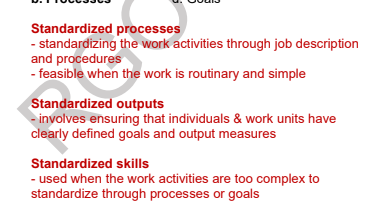
The overall benefits of the job
The bonuses, merit pay, etc.
Financial-value benefits and services provided to employees that are not direct cash salary.
Satisfaction and psychological value derived from the job duties or work environment itself.
direct Compensation
Core compensation
Indirect compensation
Non-financial compensation
Individual-Based vs. Group-Based Incentive
Tied directly to an individual’s objective output (e.g., units produced, calls handled). If the employee produces more, they make more; if they produce less, their earnings drop.
Tied to an individual’s subjective rating from a performance appraisal score (evaluating skills, behavior, or overall job execution) to give a permanent raise or bonus.
Might be permanent increase
provide employees with a percentage of profits above a certain amount
Rewards a plant or team financially when they achieve specific operational improvements (e.g., cost savings, safety improvements, or reduced waste).
employees are allowed to purchase stock in the future
Pay for performance
Merit pay
Merit pay
Profit-sharing
Gain-sharing
Stock-options