Linguistics
 Studied by 0 people
 Call Kai
 Learn
Learn Practice Test
 Spaced Repetition
 Match
Match Flashcards
 Knowt Play
1/56

There's no tags or description
Looks like no tags are added yet.
Name | Mastery | Learn | Test | Matching | Spaced |
|---|
No study sessions yet.
57 Terms
Complements
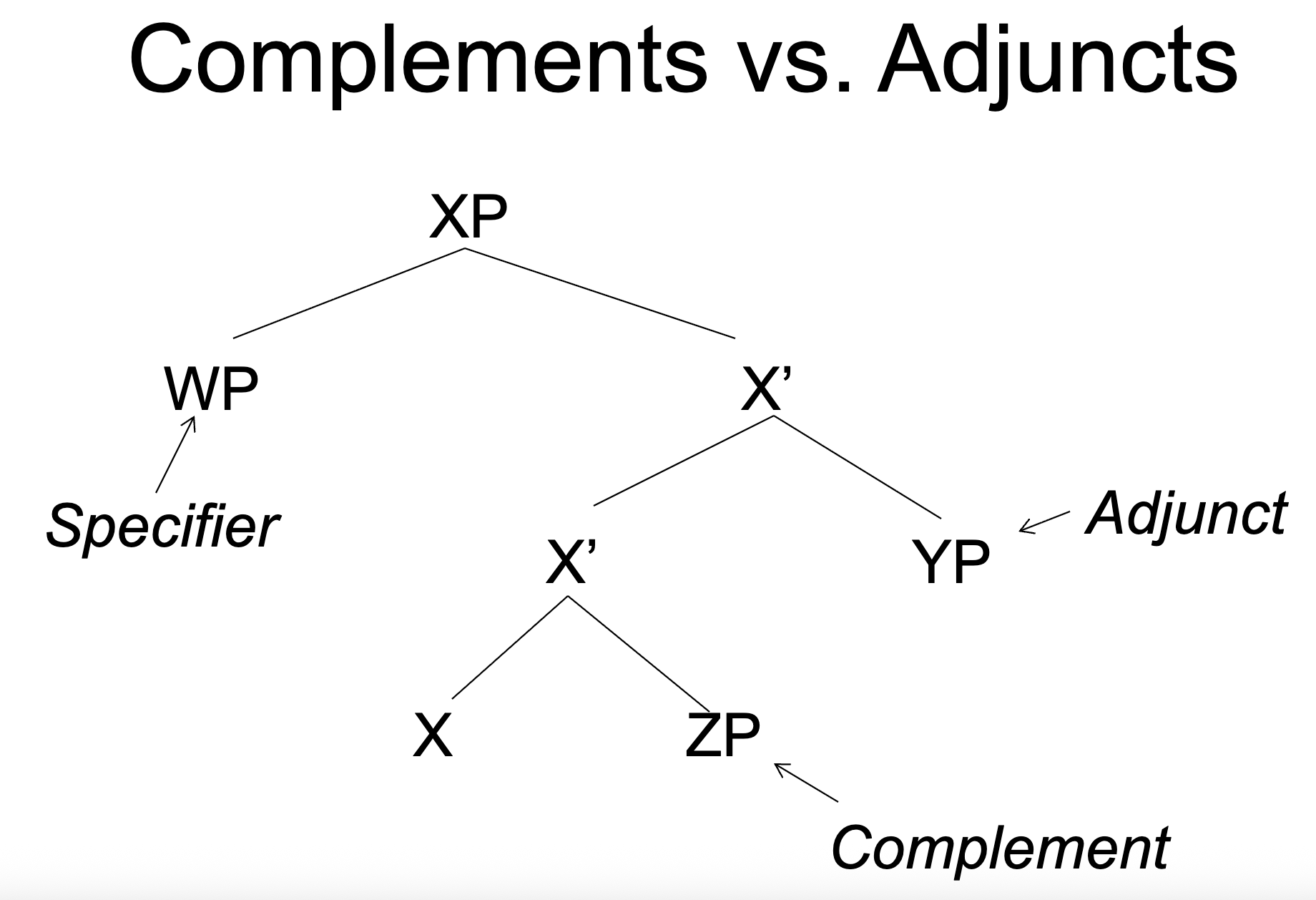
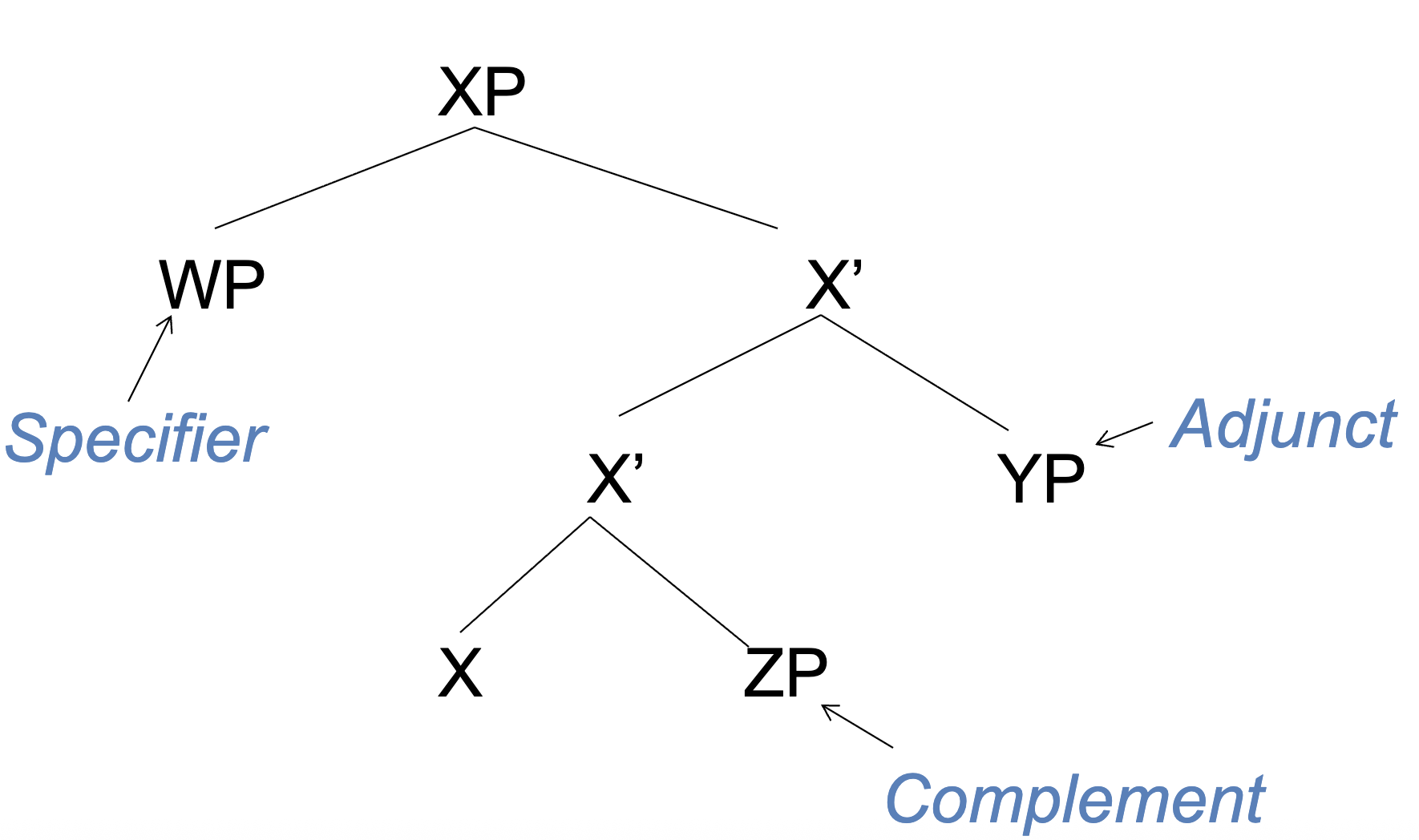
Structural position: sisters to X, daughters to X’
Head + complement is smallest string that will pass “one” or “do so” test; head itself will not pass
Meaning: complements are obligatory; are part of subcategorization frame of head
Adjuncts
Structural position: sisters to X’, daughters to X’
Add a layer of X’ structure
Meaning: adjuncts represent optional information; are not required to be there
location, time, manner, adv, adj, etc.
Specifier
daughter of XP, sister of X’
ex. Det
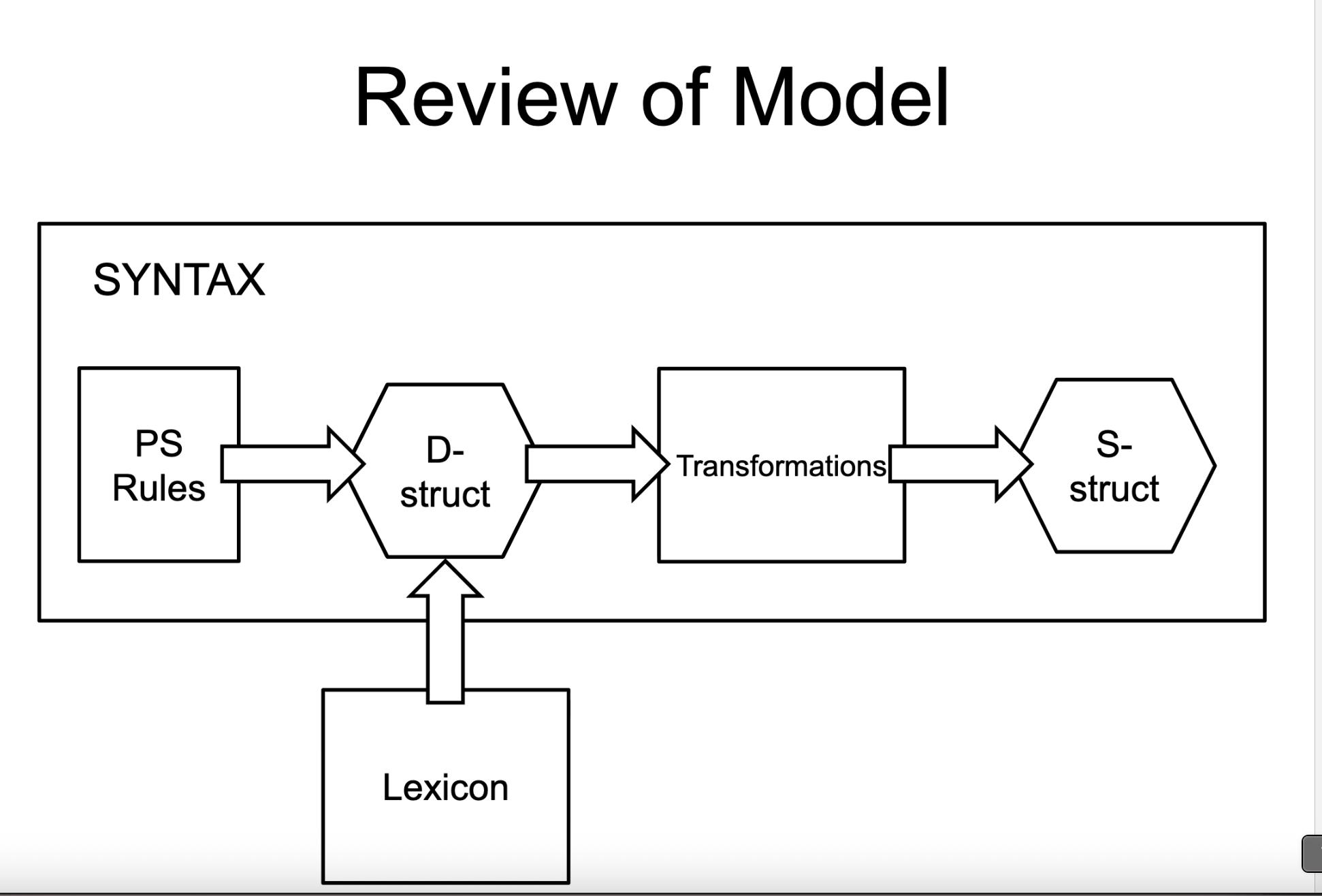
syntax model
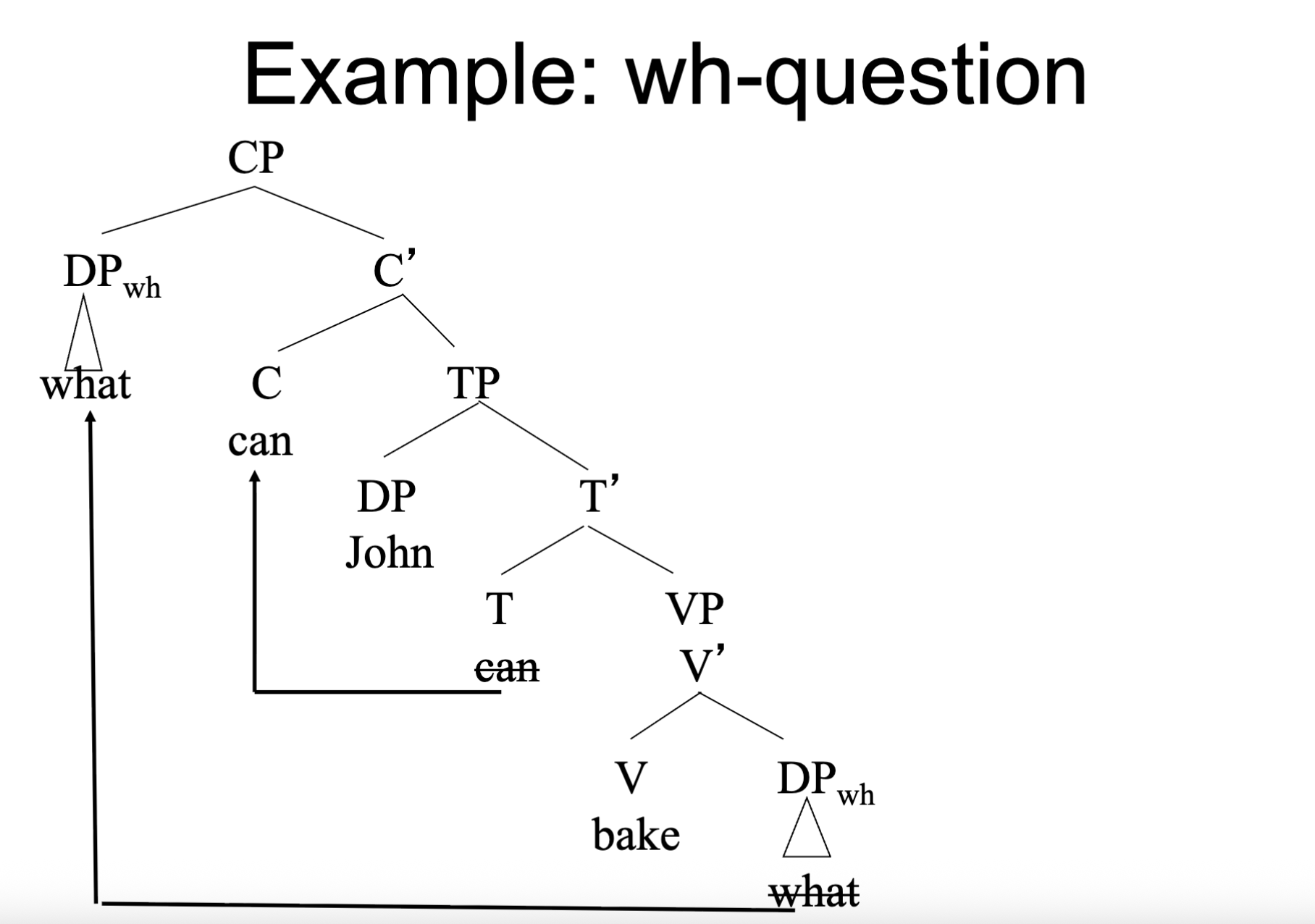
wh questions
start with a wh-phrase
– Questions that start with who, what, where, when, which, etc.
– Answer will be a content word or phrase
involve TWO types of movement: wh movement (wh→ specifier of CP) and auxiliary movement (T→ C)
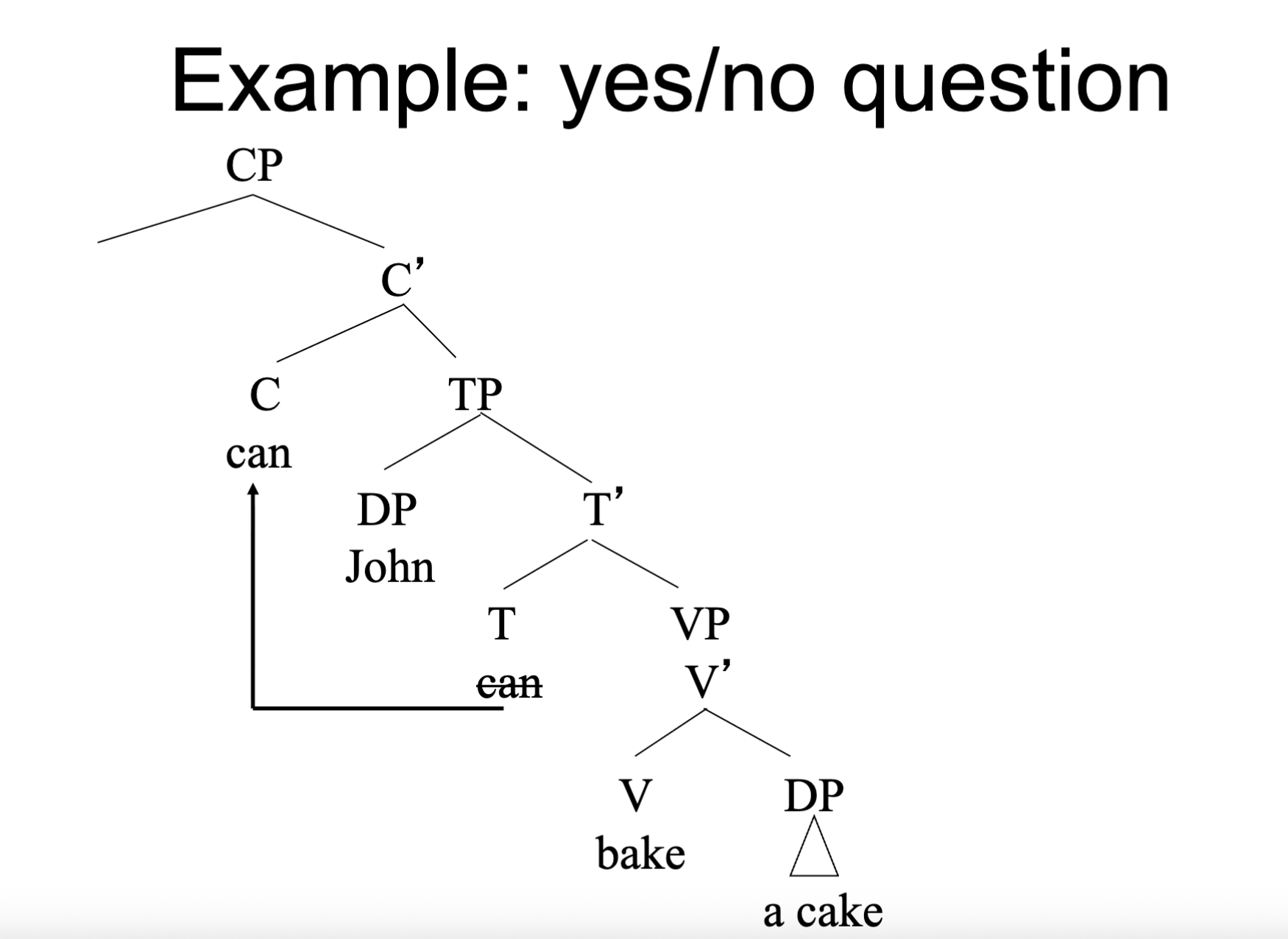
yes/no questions
– Answer will be yes or no
involve one type of movement: auxiliary movement (T→C)
wh movement (in wh questions)
movement of wh-phrase from original (base) position to sentence-initial position, specifier of CP (keeps same phrase structure)
auxiliary movement (in wh questions)
movement of T to C
– subject-aux inversion; “head to head movement”
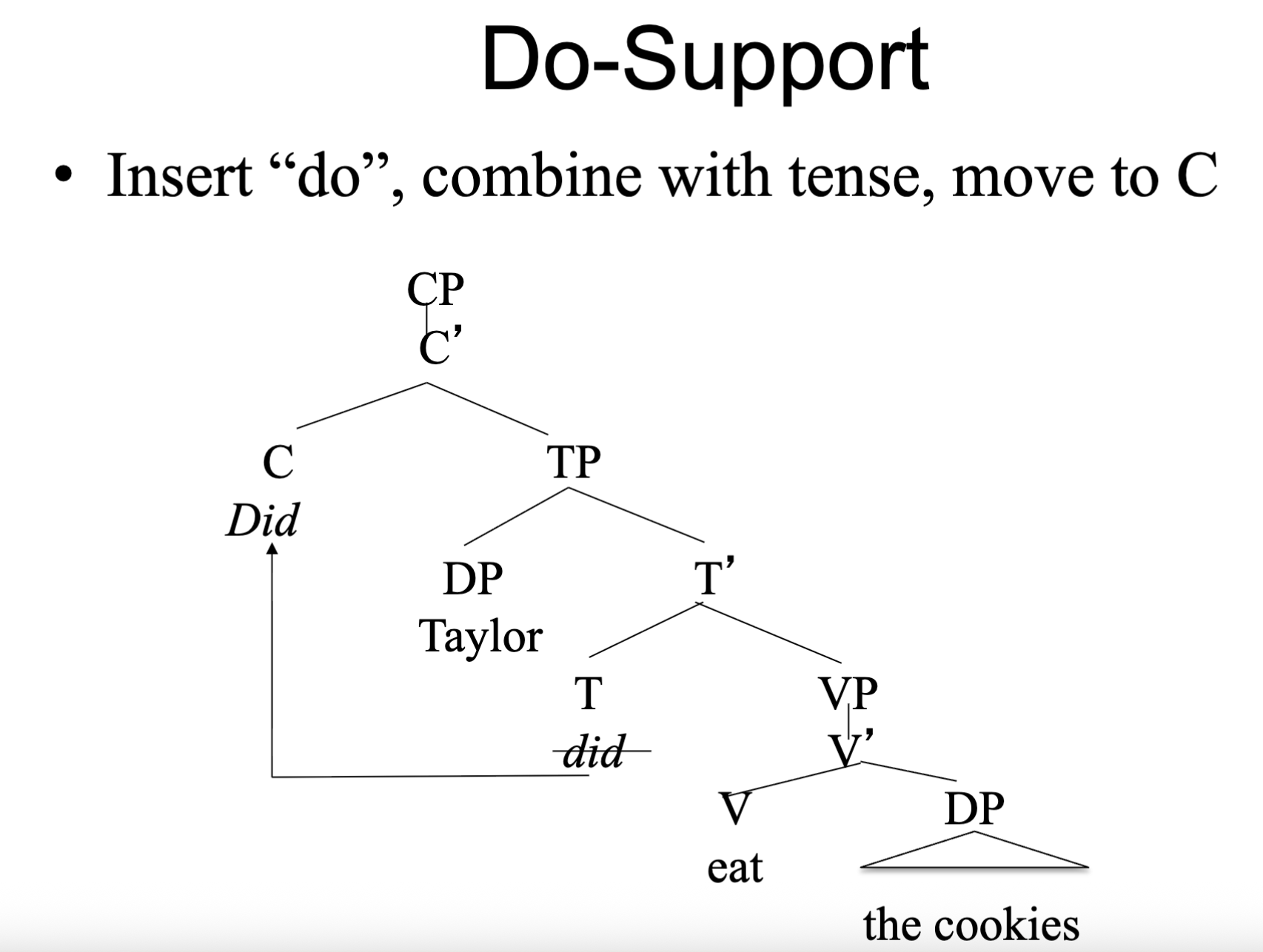
do-support in yes/no questions
But what happens when there is no auxiliary
Deep structure: Taylor ate the cookies
We have to insert an auxiliary so we have something to move!
do-support: insert dummy auxiliary (“do”) and move it to C
steps for yes/no question format
do-support: If there is no auxiliary, insert do.
Tense is generated in T, and attaches to auxiliary
Aux-movement: Move auxiliary in T to position
before subject (C)
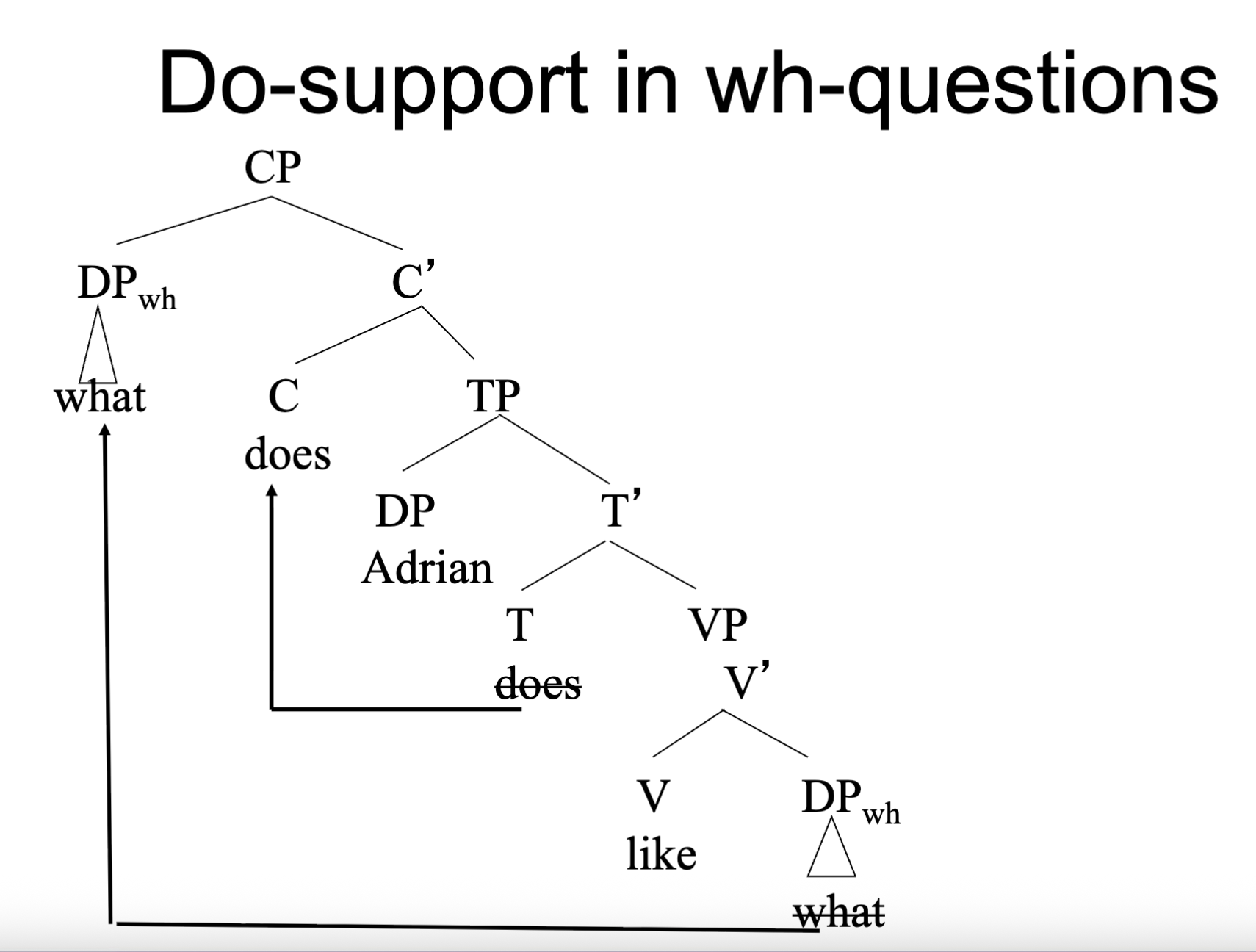
do-support in wh-
do-support: If there is no auxiliary, insert do.
Tense is generated in T, and attaches to auxiliary
Aux-movement: Move auxiliary to position before subject (C)
Wh-movement: Move wh-phrase to beginning of clause (specifier of CP)
embedded questions
Embedded questions only move the wh-phrase
– Auxiliary stays in deep structure position after subject):
I wonder [ who Leo will scare who ].
![<p><span style="color: rgb(255, 255, 255);"><span>Embedded questions only move the wh-phrase</span></span><span style="color: rgb(255, 255, 255);"><br></span><span style="color: rgb(255, 255, 255);"><span>– Auxiliary stays in deep structure position after subject):</span></span></p><p><span style="color: rgb(255, 255, 255);"><span>I wonder [ who Leo will scare who ].</span></span></p>](https://knowt-user-attachments.s3.amazonaws.com/2d4a840a-cd5b-4c27-9cce-42a13544ccdd.png)
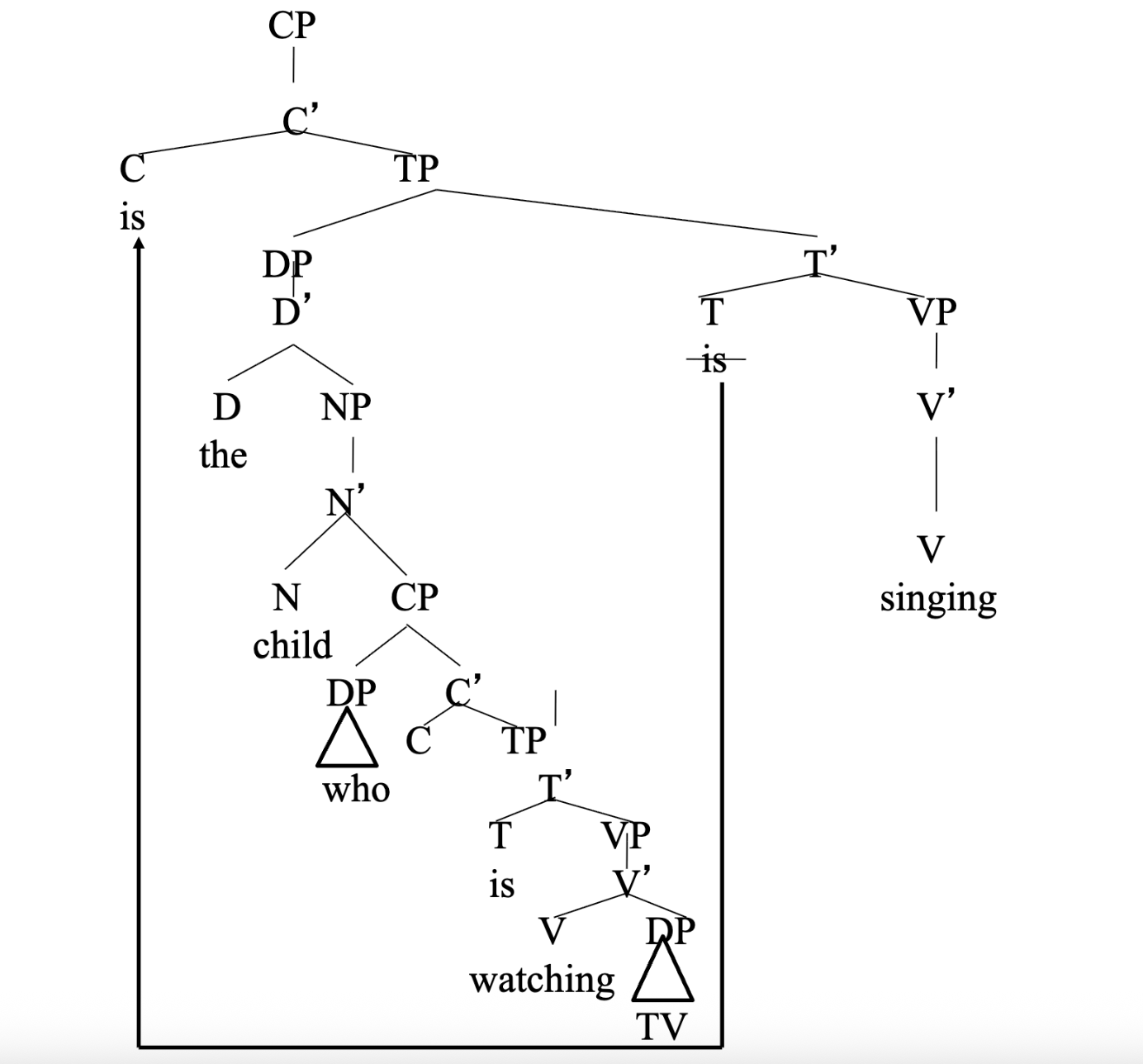
multiple auxiliaries? '
the highest auxiliary moves to the front of the sentence in yes/no questions
ex. The child who is watching TV is singing
Is the child who is watching TV ___ singing?
*Is the child who ___ watching TV is singing?
transformations are…
structure dependent!!!
VP Deletion
Delete VP when it is identical to preceding VP
Deep structure: Jo is wearing a sweater and Bob is wearing a sweater too.
Surface structure after VP-deletion: Jo is wearing a sweater and Bob is too.
Transformation description:
Delete VP constituent
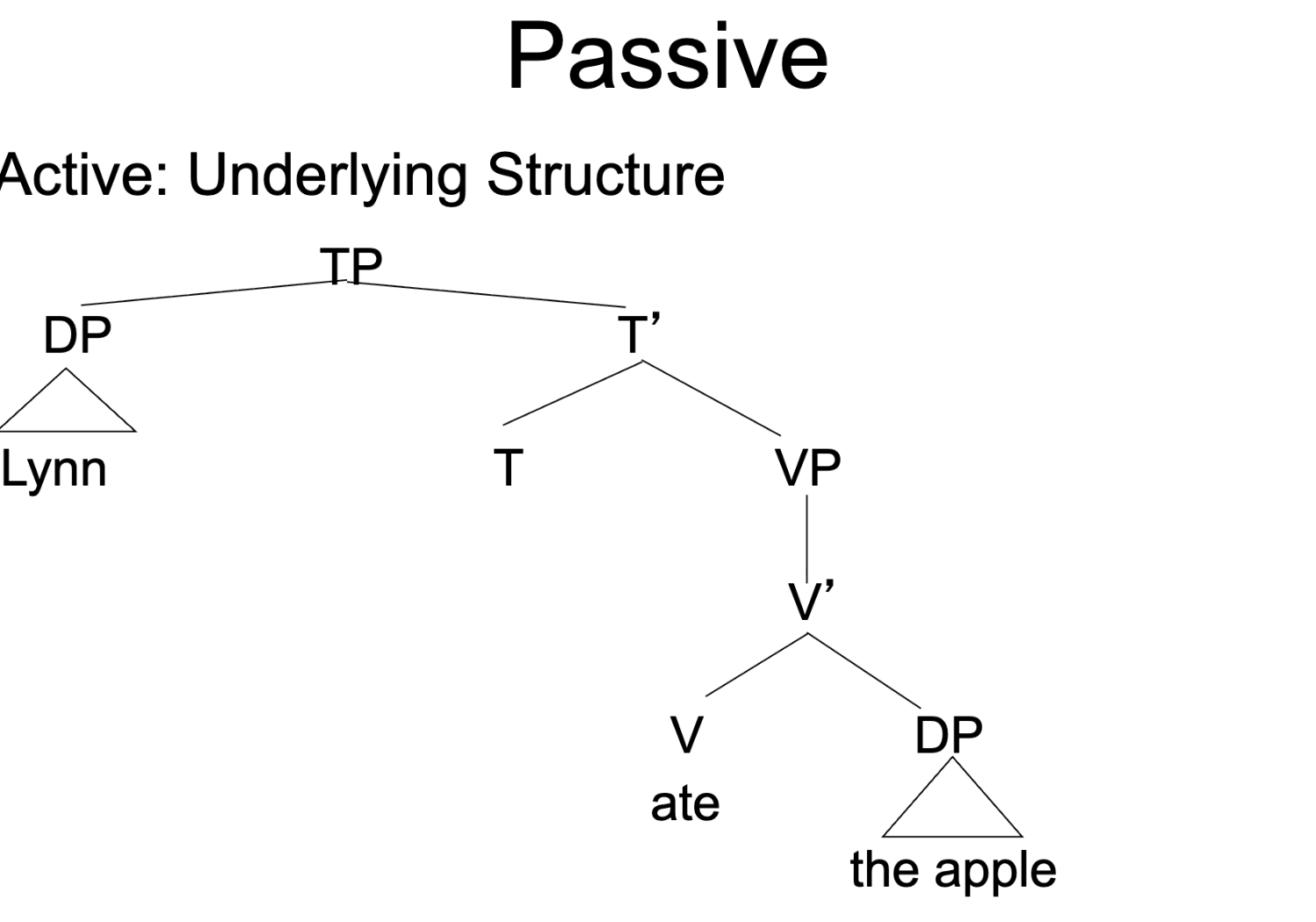
Passive transformation
Deep structure: Lynn ate the apple.
Surface structure after passive transformation: The apple was eaten (by Lynn).
Transformation description:
Subject is deleted (and optionally inserted into by-PP)
Direct object becomes subject
Auxiliary “be” inserted
Past participle morphology attached to verb
Passive deep structure vs surface structure
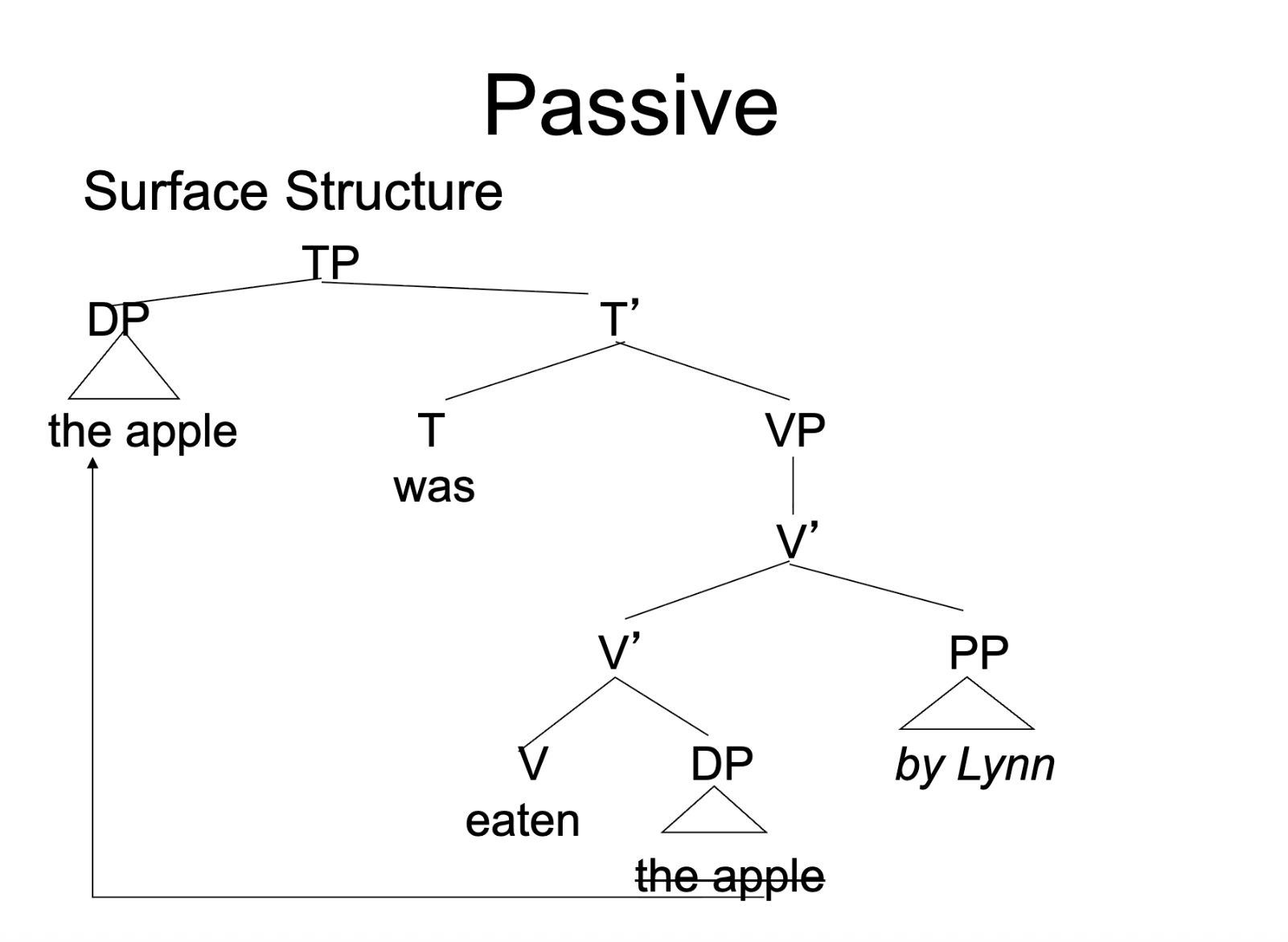
limits on what transformations can target
ONLY constituents
this is what allows us to use transformations as constituency tests
passive test helps to…
make sentences less ambiguous!
Lee squashed the bug with the stick.
– Ambiguous
– Why?
Passive test disambiguates!
The bug with the stick was squashed (by Lee).
PP “with the stick” is part of moved DP (adjunct in NP)
The bug was squashed with the stick (by Lee)
PP “with the stick” is adjunct in VP
subcategorization requirements must be…
met at deep structure!!!
→ If violated, resulting structure will be ungrammatical!
subject
the DP daughter of TP, sister of T’
The DP daughter of TP determines agreement marking on the verb (number, person)
Depending on the person and number of the subject, the verb may take a different form
1. The apple was eaten by the horse.
2. The apples were eaten by the horse.
direct object
DP sister to V
→ complement
→ Sister to V, daughter to V’ (also a DP/noun)
→ ex. she ate the apple
indirect object
DP or PP sister to V, daughter of V’
→ 2nd complement of V
→ ex. you gave me (indirect object) the book (direct object)
oblique
PP sister to V’, daughter of V’
→ adjunct
→ ex. They arrived this morning
→ ex. Olivia baked cookies for Henry
grammatical roles in passive transformation
The direct object becomes the subject
Subject becomes oblique
Active: The dog bit the children
Passive: The children were bitten by the dog
→ agreement in passive determined by surface subject (not Deep Structure
subject)— it’s bitten (to match children as the subject in surface structure), not bit (which would match deep structure’s subject)
morphosyntax
bc of agreement, where we see morphological consequences to our syntactic relationship, it is hypothesized that…
we have a single system!!
morphosyntax
– Governs structures of words and sentences
arguments
Together, subject, direct object, indirect object are known as arguments
• Arguments are required by the verb (they must appear)
– Arguments = subject + complements
→ Defined with respect to verb
→ All arguments other than the subject appear in the verb’s subcategorization frame
Selectional Restrictions
specify semantic criteria for what an argument can be/ what can appear in certain positions with particular verbs
– ex. ?Shelves fear mice → “fear” requires an animate subject
•These restrictions are encoded in syntax as thematic relations
thematic relations
semantic criteria for which arguments can appear in certain positions with certain verbs
agent
initiator, causer, do-er of an action
Ryan hit Andrew
Michael accidentally broke the glass
John sent the letter to Mary
experiencers
arguments that feel or perceive events (can appear in a range of positions, including subject and object)
Leah likes cookies
Lorenzo saw the eclipse
Syntax frightens Kenny
→ normally found only in verbs that involve a psychological component or express a notion that can be felt by a living being
ex. subjects of verbs of perception (see, perceive, hear, taste, feel, smell)
subjects and objects of verbs of emotion (frighten, fear, dishearten, motivate, etc.)
verbs of cognition (know, understand, etc.)
themes
entities that undergo actions, or are moved, experienced, or perceived
Alyssa kept her syntax book
the arrow hit Ming
the syntactician hates phonology
Goal
entity towards which a motion/action takes place (can involve abstract motion)
Krista went to Chicago
Dave was given the popsicle stick
An evil thought struck Nancy
recipient
type of goal; only occurs with verbs that indicate a change of possession
Mikaela gave Jessica the book
Daniel received a scolding from Hannah
source
the opposite of a goal; entity from which a motion originates
Maggie gave Stacy the syntax assignment
Steve came directly from Linguistics 260 class
Location
the place where the action occurs
Andrew is in Tucson’s finest apartment
we’re all at school
instrument
the object with which an action is performed
Chris hacked the computer apart with an axe
This key will open the door to the apartment
beneficiary
the one for whose benefit an event took place
he bought these flowers for Aaron
she cooked Harriet dinner
acquisition
• Learning a language clearly involves
exposure to a language (you learn the language you are surrounded with)
• But it likely takes place because of structures in our brain that are designed for language
– Universal Grammar
t-
Subcategorization Frames
Subcategory information (which types of phrases, if any, it requires to go with it)Lexical entry:
scare V [ ___ NP ]
(word lexical category [ ___ subcategory info)
why do we need this? overgeneralization. our model says that *The tigers scare is grammatical (it’s not)
One Substitution
a type of replacement test
I saw the member of Parliament with the green hat, and John saw the one with the red hat.
- We can replace “member of Parliament” with “one”, which suggests it is a constituent
X Bar Theory
XP → (YP) X’ SPECIFIER
X’ → X’ (ZP) or (ZP) X’ ADJUNCT
X’ → X (WP) COMPLEMENT
One Replacement Test
To see if an item is an N’, conjoin a phrase of the same type to the target NP, and replace the item in the second conjunct with “one”
See if you understand “one” to mean the item it has replaced
If result grammatical and meaning retained, then it is N’; otherwise, not
The large purple hippo
The large purple hippo and the small one
Grammatical and meaning retained! So “purple hippo” = N’
“Do so” Test
To see if an item is a V’, conjoin a sentence to the original one, introduce a new subject, and replace the item you are testing with “do so”
See if the meaning of the replaced phrase is retained
If result grammatical and meaning retained, then it is V’; otherwise, not
John slept until 9.
John slept until 9 and Mary did so (too).
Grammatical and meaning retained! “slept until 9” is a V’
Complements
Obligatory/selected by head
They are in subcategorization frame of head
Complements are sisters to the head X, daughters to X’
The shortest string that will pass a do so test is V + complement(s)!
the shortest string that will pass a one-test is N + complement (s)
head itself doesn’t pass
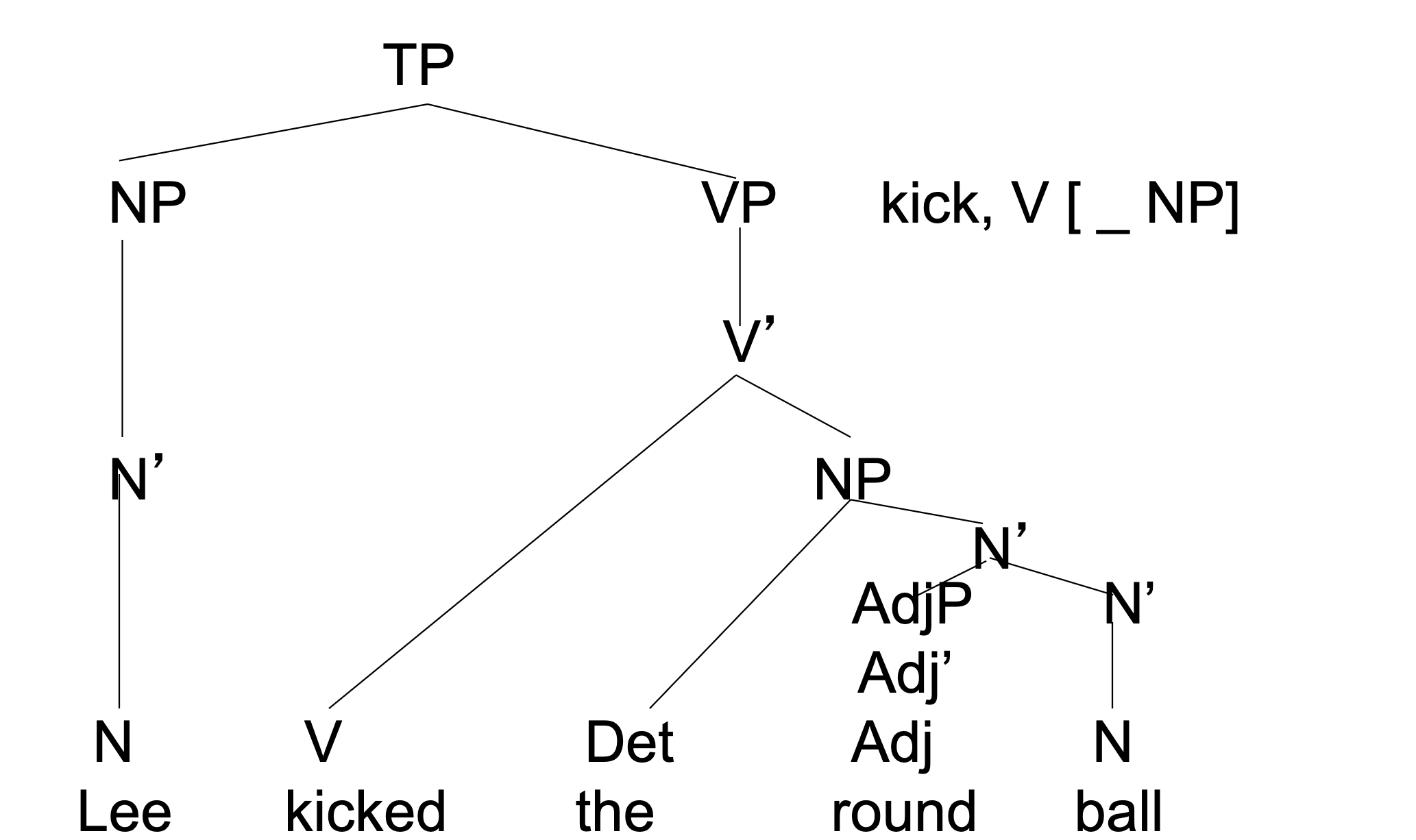
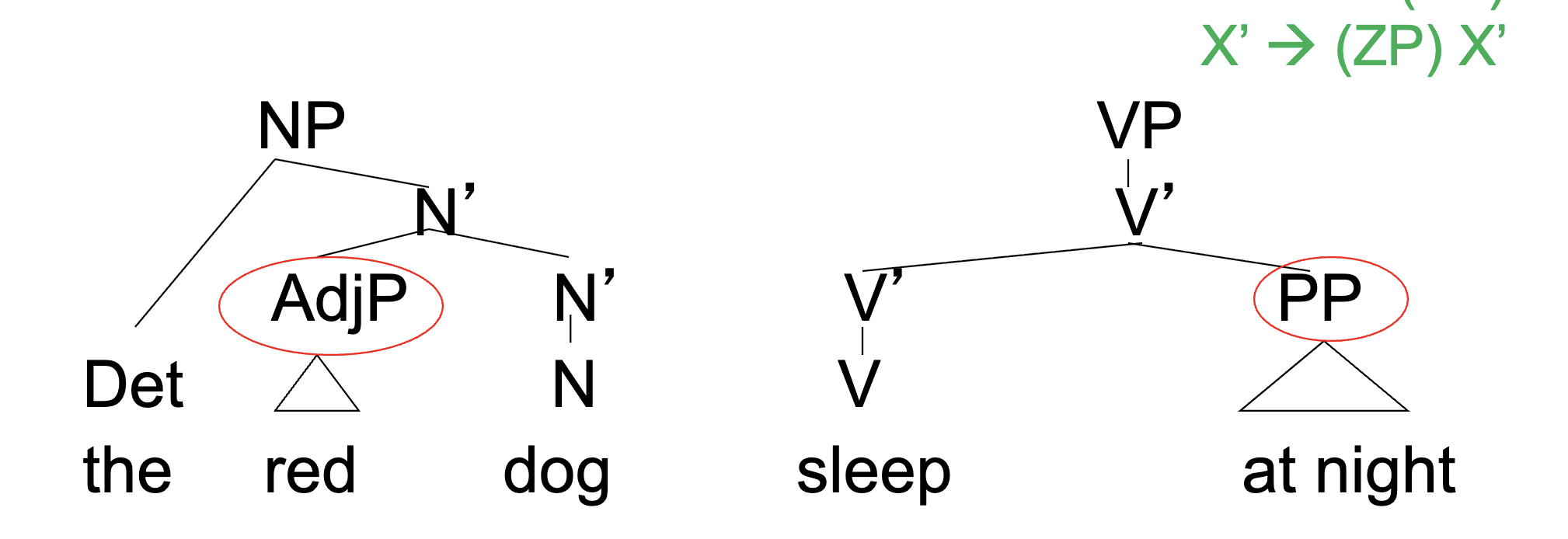
Adjuncts
Semantically optional/optional information (not required by the head/to be there)
Can occur with almost any head
ex. Adj, Adv, PP
Adjuncts add a layer of X’ structure
They are sisters to X’, daughters to X
Adjuncts in VP often give information about location, time, or manner
(5) The cat slept in the kitchen/under the sofa.
(6) Mary ate the cake in the afternoon / yesterday/on Thursday.
(7) Mary eats cake quickly/often.
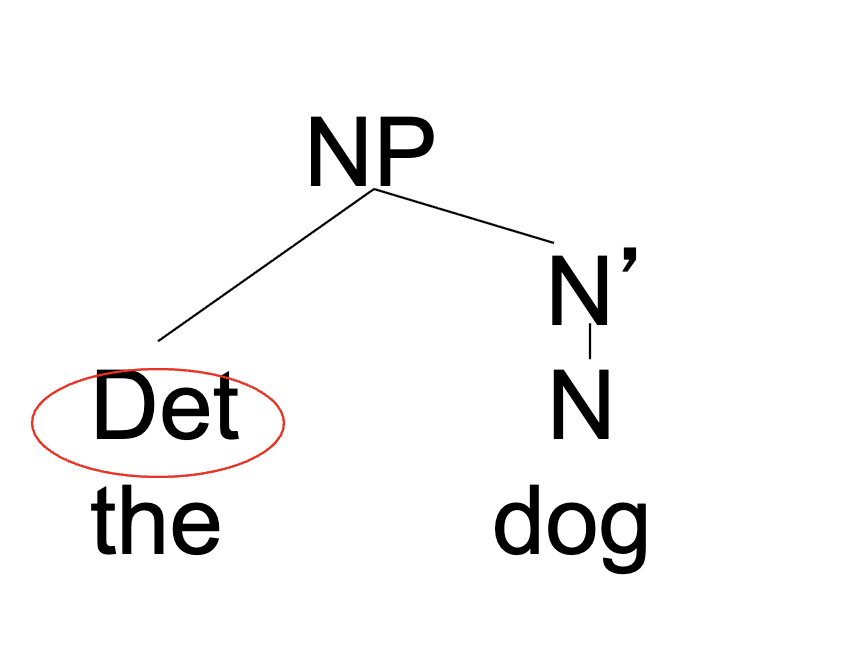
Specifiers
daughters to XP, sisters to X’
→ ex. DP
Complements v. Adjuncts
Parametrization
Limited number of things can vary from language to language
Many cross-linguistic universals
what DOES vary between languages
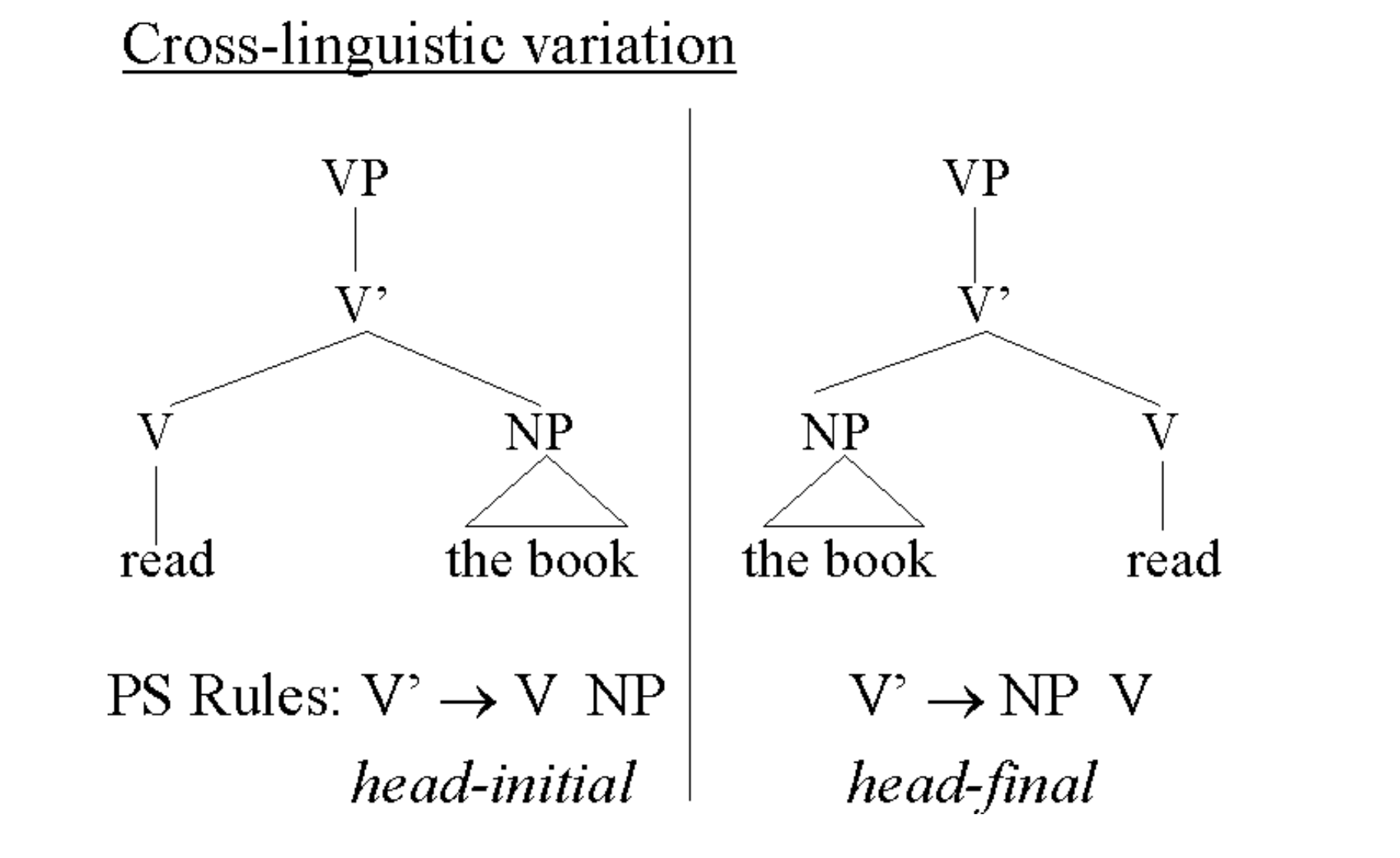
One thing that varies across languages is the order of elements within each rule
– Head-initial vs. head-final
– Only two possibilities!
Parameter setting involves figuring out which possibility is operating in your language
English is head initial
X bar structure
‘s genetives
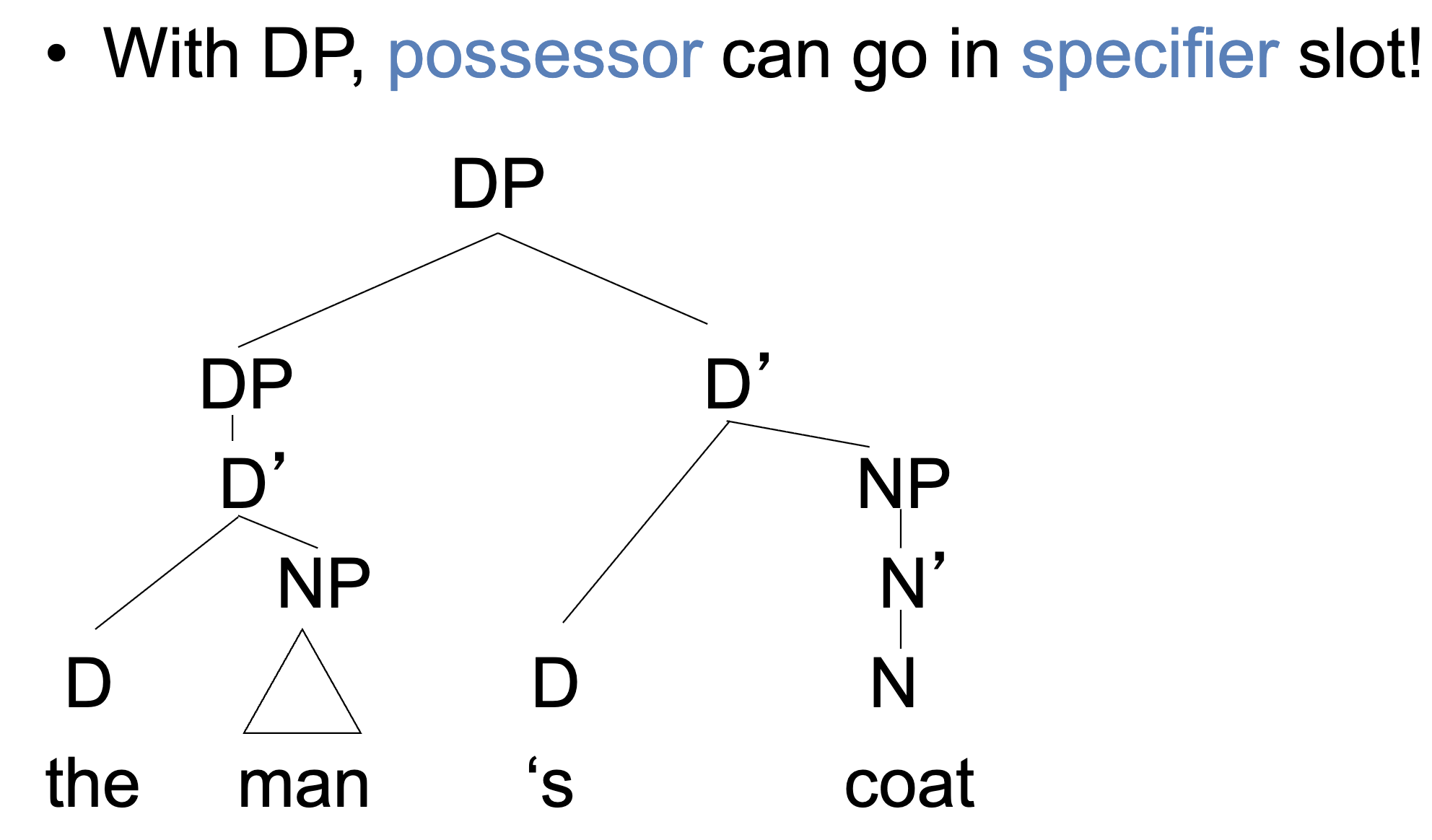
possessives indicated with with ‘s
- ex. the man’s coat
‘s and determiners being in complementary distribution suggests both are determiners
‘s + NP being possessed = D’
lowering
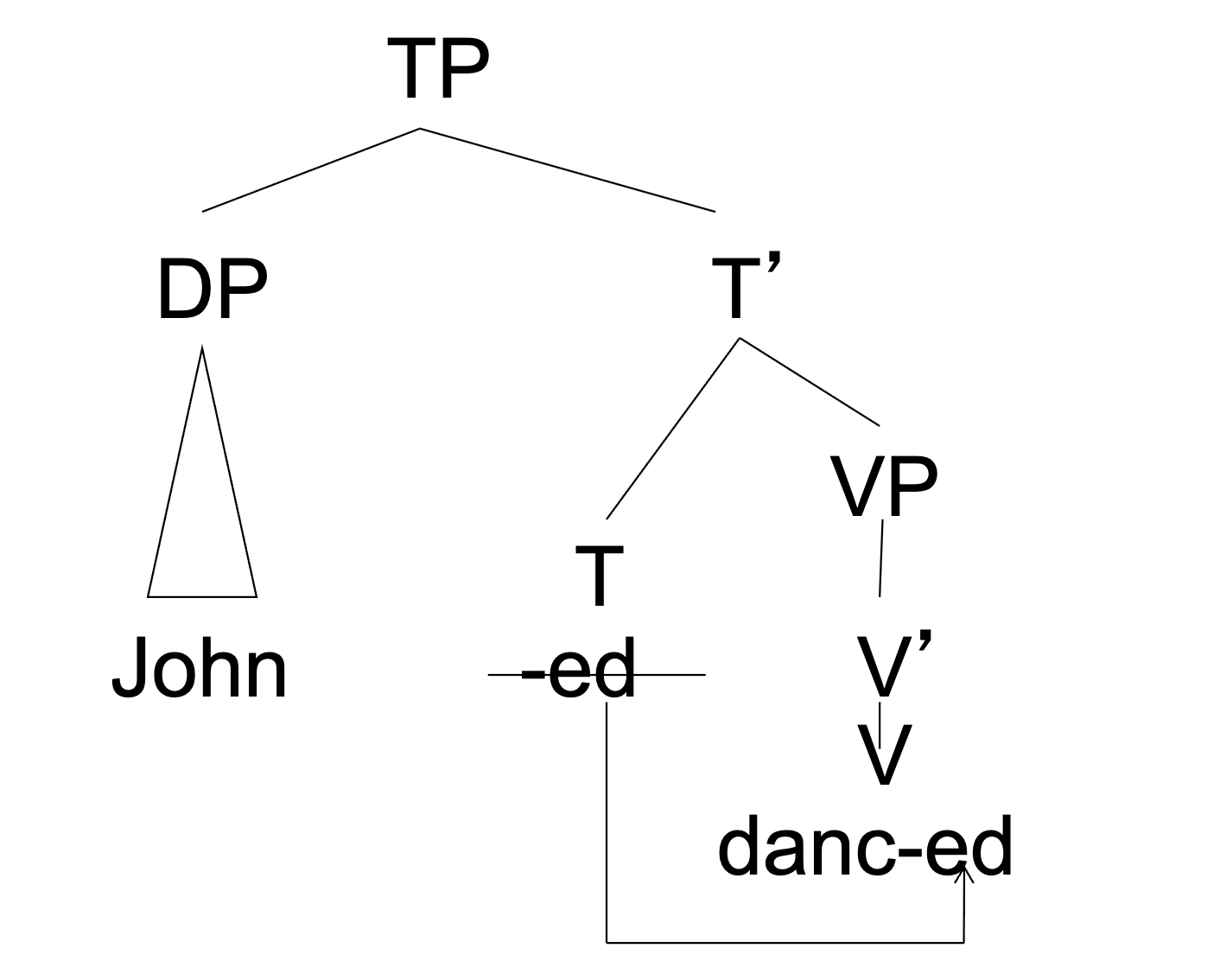
Inflectional suffixes are generated in T, but they must be attached to the verb, so they move by lowering and attaching to the verb
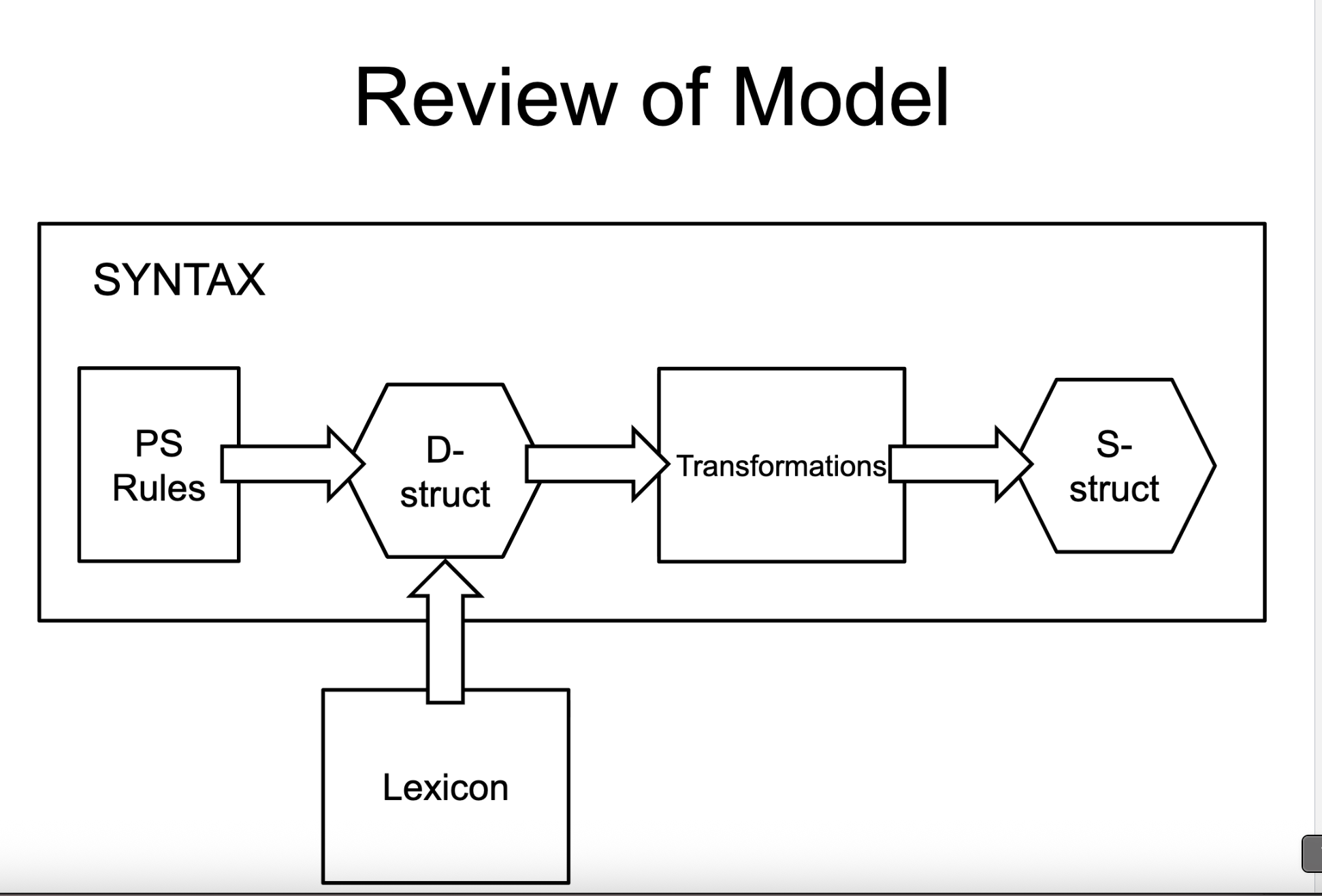
syntax model