HE 11 : Location competition : Burger King and McDonalds -Karteikarten | Quizlet
 Studied by 0 people
 Call Kai
 Learn
Learn Practice Test
 Spaced Repetition
 Match
Match Flashcards
 Knowt Play
1/9

There's no tags or description
Looks like no tags are added yet.
Name | Mastery | Learn | Test | Matching | Spaced |
|---|
No study sessions yet.
10 Terms
Two levels of competition in the fastfood industry ?
- Franchisors compete globally for customer loyalty
- Franchisors compete on local markets to acquire new customers
What is the most important selling point in the fast food industry ?
Convenience, has to be fast, close to customers and easy access
Since the products tend to be the same this is a differentiation point
What are F1 and F2 in the hotelling model ?
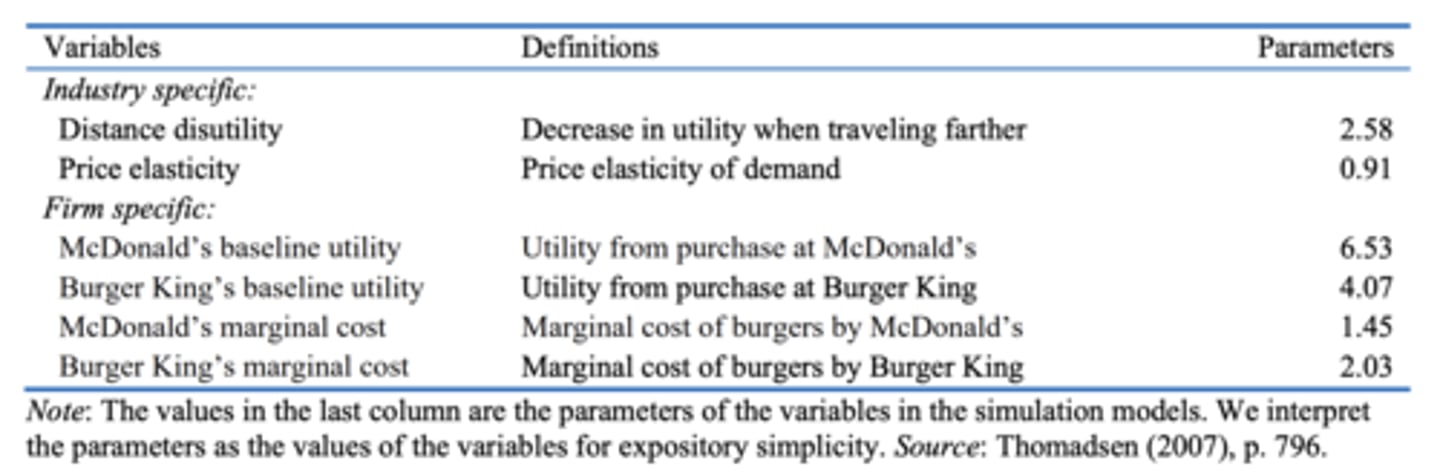
Symmetric firms, they posses same attributes or conditions and marginal costs
Reality of McDonalds and Burger King ?
• McDonald's has a higher baseline utility than Burger King; and
• McDonald's marginal cost is lower than Burger King's.
They are asymmetric
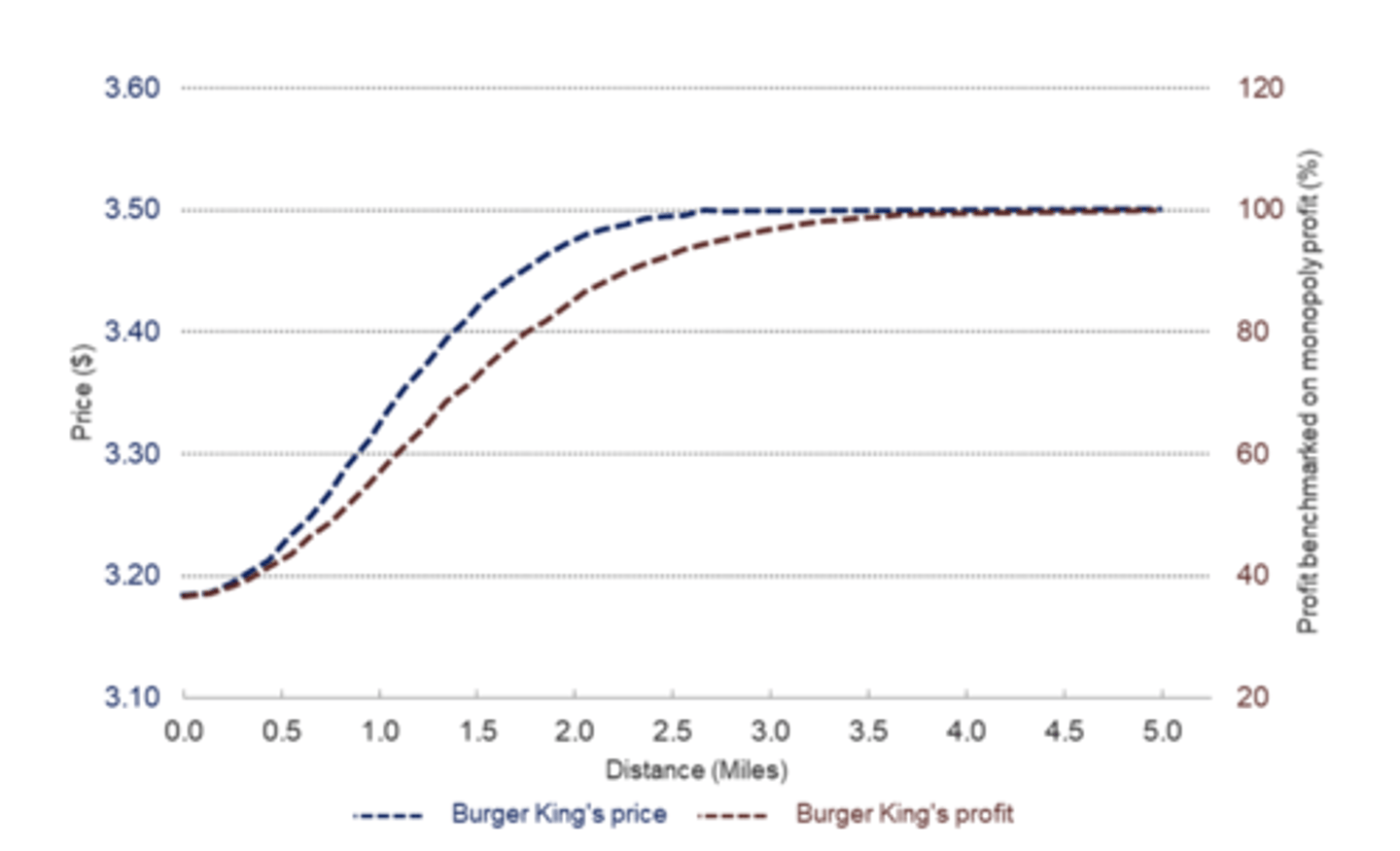
Burger king price and profit with distance ?
• 0−2.5 miles: Burger King's price increases monotonically with distance;
• More than 2.5 miles: Burger King's price stops responding to distance;
• 0−3.5 miles: Burger King's profit increases monotonically with distance;
• More than 3.5 miles: Burger King's profit stops responding to distance, fixed at the monopoly profit.
What is the PRE ?
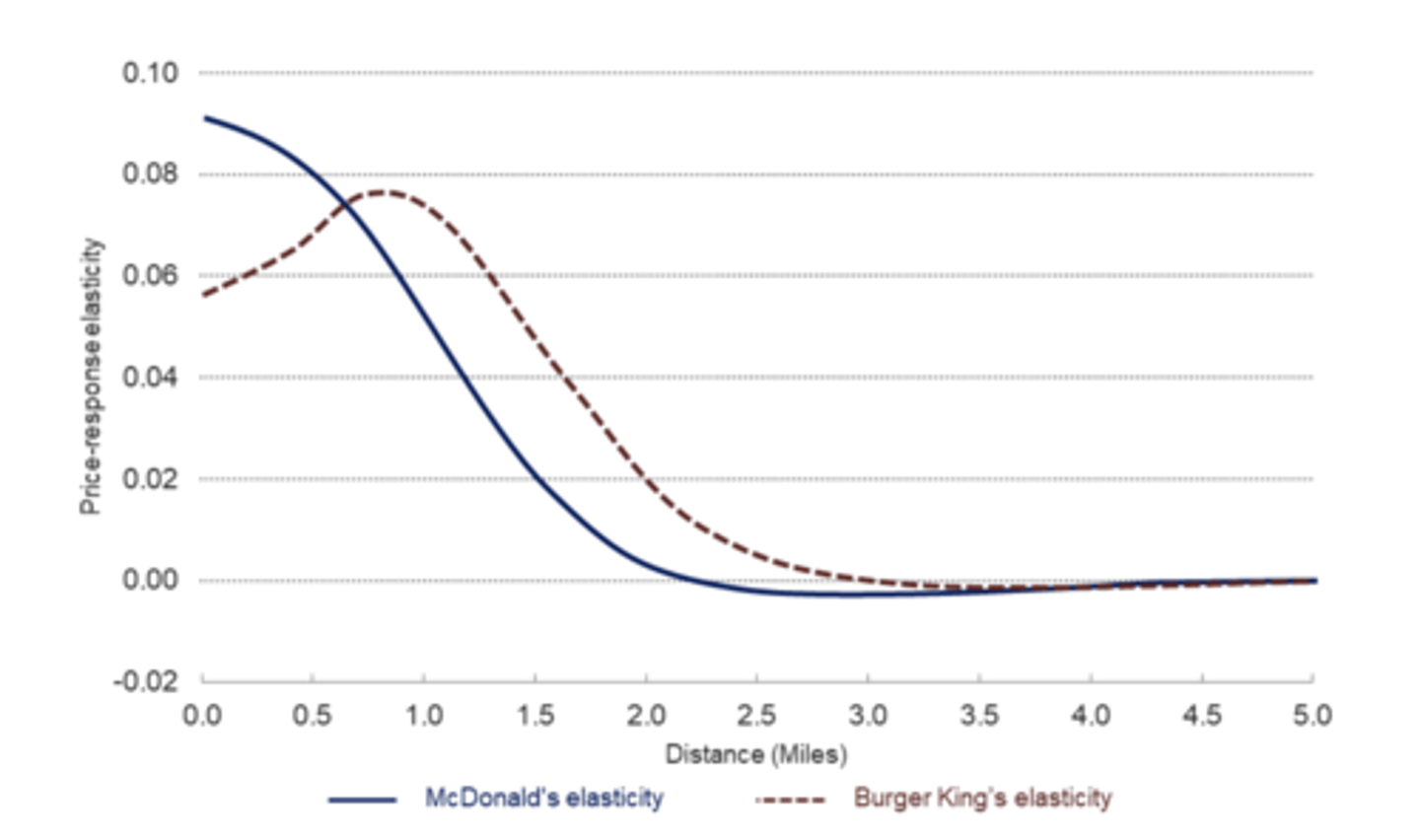
Price response elasticity : ratio of the percentage change in one firm's price to the percentage change in the other's price
How is the PRE for both firms ?
Not paralleled due to asymmetry of firms
• 0−2.5 miles: McDonald's PRE monotonically decreases with distance
• More than 2.5 miles: McDonald's PRE stops responding to distance
• 0−1 mile: Burger King's PRE increases monotonically with distance
• 1−3 miles: Burger King's PRE monotonically decreases with distance
• More than 3 miles: Burger King's PRE stops responding to distance
McDonalds and Burger King locations ?
- In small markets McDonald's has a strong propensity for the center, regardless of whether Burger King moves first or not and regardless of where Burger King is located; in large markets, McDonald's propensity for the center decreases, and intends to differentiate from Burger King.
- Burger King never takes the center even if it moves first and has the opportunity to do so. Burger King is always on the opposite side and moves toward the center, only if McDonald's moves away
What are the location patterns due to ?
Asymmetries of the two firms, McDo is dominant
> Location equilibrium where F1 and F2 are in the center does not exist
Why is it interesting for McDo to stay in the center in small markets ?
- Can drive BurgerKing out due to competitive pricing
- Increase the consumer surplus without changing the producer surplus