Brain, Mind, and Behavior: Exam 1 Diagram
 Call Kai
 Learn
Learn Practice Test
 Spaced Repetition
 Match
Match Flashcards
 Knowt Play
1/219

There's no tags or description
Looks like no tags are added yet.
Name | Mastery | Learn | Test | Matching | Spaced | Call with Kai | Chat |
|---|
No analytics yet
Send a link to your students to track their progress
220 Terms
Neuron
receive, integrate, and transmit processed information electrically and chemically; regulate sensory, motor, and cognitive functions, 80-90 billion in humans
dendrite
primary input structure, recieve information from other cells
cell body/soma
nucleus
Myelin sheath
node of ranvier
axon
usually, but not always, insulated with myelin
axon terminals
the primary output structure(s), release neurotransmitter sending signals to other cells
axon hillock
where the action potential is initiated
Synapse
Information is transmitted from neuron to neuron here
Information flow in a neuron
dendrite -> soma (cell body) -> axon hillock -> axon -> axon terminal, neurotransmitter is released (connects to another neuron and repeats process)
Presynaptic neuron
neuron sending info
postsynaptic neuron
receiving info
what is 1
mitochondria

what is 2
synaptic vesicle full of neurotransmitter
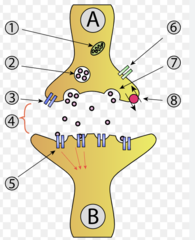
what is 4
synaptic cleft
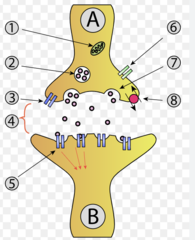
what is 5
neurotransmitter receptor

what is 7
fused vesicle releasing neurotransmitter
how do neurons communicate
they propagate current in one direction and communication between neurons is electrochemical
electrical signal
sent down the axon
chemical signal
when the electrical signal releases chemicals (neurotransmitters) from the presynaptic membrane to the postsynaptic membrane
classifying neurons
structure, shape, size, function (motor, sensory, etc.), connections, gene expression
shape classification of neurons
multipolar, bipolar, monopolar, interneurons
Multipolar neurons
one axon, many dendrites, most common

bipolar neurons
one axon, one dendrite

monopolar/unipolar neurons
a single body extention, branching in two directions: dendrites and axon

interneurons
cell body and dendrites like multipolar, but only a very very short axon or none at all

Classification of Motor neurons
axon terminals terminate at muscle or glands
Classification of Sensory neurons
receive signals from receptor cells (skin cells, olfactory, gut receptors, etc.)
Classification of interneurons
receive input and send input to other neurons, they only form connections with other neurons
Types of glial cells
astrocytes, microglia, oligodendrocytes, schwann cells
Function of Glial cells
support neuronal activity
Myelin producers
oligodendrocytes and schwann cells
Myelination
the process in which glial cells wrap axons with a fatty sheath of myelin to insulate and speed conduction
Oliodendrocytes
produce myelin in CNS (brain and spinal cord)
Schwann cells
produce myelin in PNS (neurons outside the brain and spinal cord)
Nodes of ranvier
gaps between sections of myelin where the axon is exposed
Gray matter
unmylinated parts of neurons/glia
White matter
myelinated parts of neruons/glia
Microglia
resident immune cells that help with synaptic pruning, clearing dead neurons and interact with multiple CNS cell types in health and disease by removing and destroying a virus
Astrocytes
regulate synapse formation, elimination, and function determining if a synapse is inactive and if so it might prune it, builds the blood brain barrier (endfeed that ensheath vasculature), metabolic support regulating circuit function, connections with nodes of ranvier, interact with other glia
Neural threesome
astrocytes wrap around synapses of neurons and take up transmitters released by the neurons as well as release neurotransmitters of their own enhancing or inhibiting synaptic activity
the nervous system
CNS, PNS - somatic, autonomic - sympathetic, parasympathetic
Central nervous system
brain and spinal cord
Peripheral nervous system
everything else, somatic and autonomic nervous system
Somatic nervous system
nerves that interconnect CNS and major muscles and sensory systmes of the body (cranial nerves + spinal nerves)
Autonomic nervous system
primarily controls glands and internal organs (sympathetic + parasympathetic)
Cranial nerves
12 pairs
Olfactory
sensory + smell
Optic
sensory + vision
oculomotor, trochlear, abducens
motor + eye movement
trigeminal
BOTH + sensory: face, sinuses, teeth ; motor: jaw muscles
facial
BOTH + sensory: tongue, soft palate ; motor: facial muscles, salivary glandes, tear glandes
vestibulochlear
sensory + inner ear: hearing and balance
glossopharyngeal
BOTH + sensory: taste and other mouth sensations ; motor: throat muscles
vagus
BOTH + sensory: information from internal organs ; motor: internal organs
spinal accessory
motor + neck muscles
hypoglossal
motor + tongue muscles
Spinal nerves
connected to the spinal cord, communicating with the body via the spinal nerves (PNS); 31 pairs; exits the cord through notches between each vertebrate; each spinal nerve attaches to the spinal cord via two branches
Dorsal
carries sensory information from the body to the spinal cord
ventral
carries motor information from the spinal cord to the muscles
autonomic nervous system
primarily controls glands and internal organs
parasympathetic
rest + digest, exists brain at base of spinal cord, slower heart rate, stimulates digestion, constricts airways, stimulates salivation, releases acetylcholine
sympathetic nervous system
fight or flight, exits middle of spinal cord, increasted heart rate and blood pressure, relaxes airways (more o2), stimulates glucose production, inhibits salivation, digestion, releases norepinephrine
Dorsal
towards the back/top
medial
towards the middle
lateral
towards the sides
ipsilateral
same side
contralateral
opposite side
superior
above
inferior
below
Basal
towards the bottom
Anterior/Rostal
head end
Posterior/caudal
tail end
proximal
near the center, close
distal
towards the periphery, far
ventral
towards the belly, bottom
Horizontal plane
cut laterally

Sagittal plane
cut down the center line

Coronal plane
slicing your face

cerebral cortex
outermost layer of the brain, different regions control specific functions
gyri
ridges
sulci
valleys
corpus callosum
bundle of axons that connects the two hemispheres of the cerebral cortex
ventricular system
a series of chambers filled with CSF that brings nutrients and chemicals to the brain, and takes waste away from the brain
what is 1
Spinal Canal

what is 2
fourth ventricle

what is 3
cerebral aqueduct

what is 4
third ventricle

what is 5
lateral ventricle

what is 1
temporal lobe
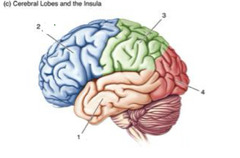
what is 2
frontal lobe

what is 3
parietal lobe

what is 4
occipital lobe

frontal lobe
primary motor cortex, complex cognitive processes: language, execuative function, attention, memory, impulsivity, planning, inhabition to obtain goals and rewards
temporal lobe
primary auditory cortex, learning + memory
parietal lobe
primary somatic sensory areas (touch, temperature, limb position, pain)
occipital lobe
primary visual cortex, other visual areas
motor cortex
movement of specific body parts is regulated by distinct regions in this and the somatosensory cortex
central sulcus
what primary motor and sensory cortices are speperated by