Vygotsky and Social Development
 Call Kai
 Learn
Learn Practice Test
 Spaced Repetition
 Match
Match Flashcards
 Knowt Play
1/62

Earn XP
Description and Tags
Vygotsky's contribution to development, comparison with Piaget, SLT, attachment theory (Bowlby and Ainsworth)
Name | Mastery | Learn | Test | Matching | Spaced | Call with Kai | Chat |
|---|
No analytics yet
Send a link to your students to track their progress
63 Terms
How is Vygotsky relevant to developmental psychology?
Social contributions to child development
Important role for language + cultural tools
Initial ideas elaborated by subsequent followers
Focused on external/social forces + influences
Compare Vygotsky and Piaget’s approaches to developmental psychology
Child-external versus child-internal processes.
Culturally variable development vs. Universal pattern
Both focused on learning (not innate knowledge) → empiricist theories + experiential learning
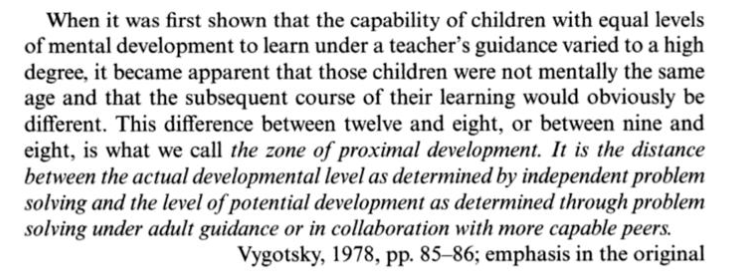
What is Vygotsky’s zone of proximal development?
Actual level of learning vs potential learning when in collaboration with peers + adults
Namely
Area of the nursery where children learn about space
How children learn when they’re next to people
Amount that children can develop under social guidance
Maximum range of representations, processes, skills, that a child is capable of mastering at a point in time
Interactions with adults (or advanced peers) lead to development at the top of this range
Working alone leads to slower development
How to adults and peers actively work to maximise a child’s learning and development?
Explicit + implicit scaffolding (e.g. baby talk to introduce them into language)
What did Vygotsky argue about the cultural context of development?
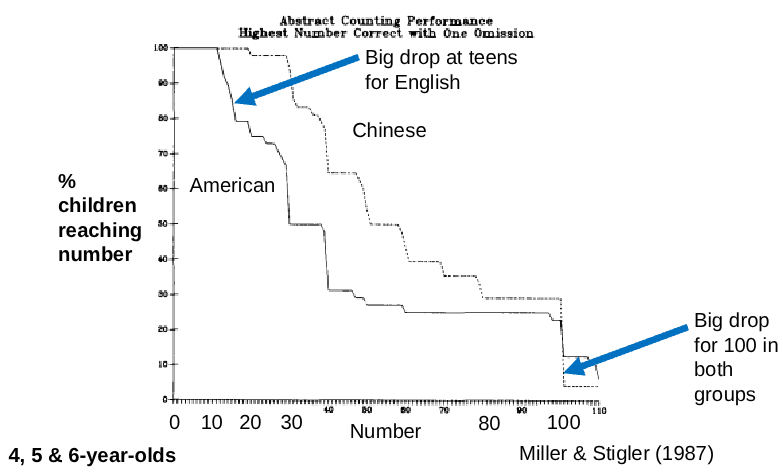
It affects the rate at which you develop + are able to master things (e.g. learning numbers + numerical development)
How would Vygotsky explain Korean children’s ability to learn to count to 20 earlier than Norwegian children?
Korean children have a higher IQ
The Korean number system is more transparent
Korean parents make more effort to scaffold their children’s math abilities
What is some evidence for Vygotsky’s theory about cultural context and learning?
What is social cognition? How does this concept relate to development?
Processes by which people come to understand others
Infants understand others as being motivated by intentions + goals (recognise intentionality) → see behaviour as being logical → surprised when adults act erratically
See actions as being directed towards achieving an intentional goal that required evaluating the constraints of the situation
Briefly describe the process of learning
More than trial + error → actively observe + copy behaviour from models (e.g. bobo doll study)
What is vicarious punishment?
Tendency not to repeat behaviours that we observe others being punished for
What is selective imitation?
Model older, more competent individuals
What is some evidence for selective imitation?
Koenig et al (2004) → children as young as 3 repeat the words of people who speak in the same way as they do
Meltzoff + Moore (1977) + Meltzoff (1988)
Gergely et al (2002) → imitation isn't blind + infants account for why an action is performed (rational imitation -> believe there is some reason for that action)
What is pedagogy?
The transfer of knowledge primarily for the purpose of teaching (requires attentive infants + receptive adults)
Provides a useful framework when considering what behaviours are best adapted for early social interaction (Csibra and Gergely, 2006)
What is overimitation caused by?
Assumption that all actions performed by adults are a form of scaffolding/pedagogy → all actions are relevant to the task at hand (pedagogically important)
According to Yarrow (1973), when are preschoolers more likely to model the behaviours of adults?
When they display prosocial behaviour (vs adults who are cold + distant)
What did Cristine Legare argue about blind imitation in children?
It’s the precursor of later adult rituals → activities with symbolic significance that demonstrate that members of a group have shared values that bind them together (Legare + Herrmann, 2013)
According to SLT, when do imitative skills develop?
Early → by 14 months can imitate complex actions + do so by reference to the pragmatics of the situation
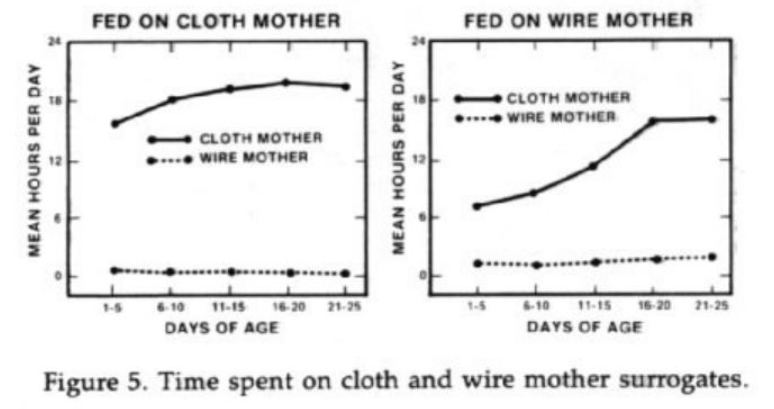
What were the findings of Harlow’s research?
Being reared in isolation at early ages leads to life-long developmental issues
Baby preference for type of caregiver
Social relationships are important for development
Early preference for particular social experiences
BUT doesn’t say anything about the type of social relationship
What does attachment theory suggest about infants and security?
They act to gain security from their caregiver → e.g. crying, following, clinging, smiling (instinctual behaviours designed to bind caregiver to child)
AFs support exploration
What approach to attachment did Bowlby have?
Ethological approach
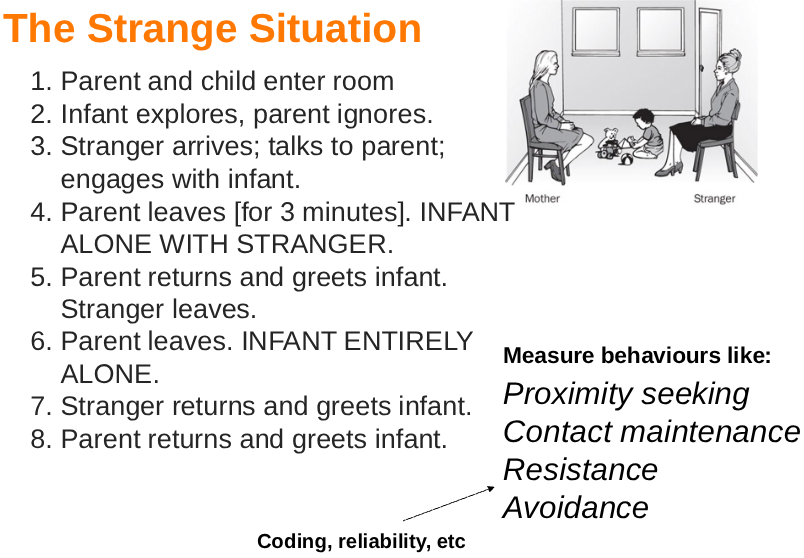
How did Ainsworth’s strange situation come about as a method of measuring attachment relations?
Wanted a procedure that elicits behaviours indicative of attachment type (construct validity) + elicits the same behaviours from the same children (reliability)
Which behaviours were used as measures of attachment relations in Ainsworth’s strange situation?
Proximity seeking
Contact maintenance
Resistance
Avoidance
Name and describe the attachment styles
Secure → may display separation anxiety, quickly calmed by return
Better life outcomes
Avoidant → no separation anxiety, uninterested by return
Ambivalent → may display separation anxiety, not calmed by return
Disorganised
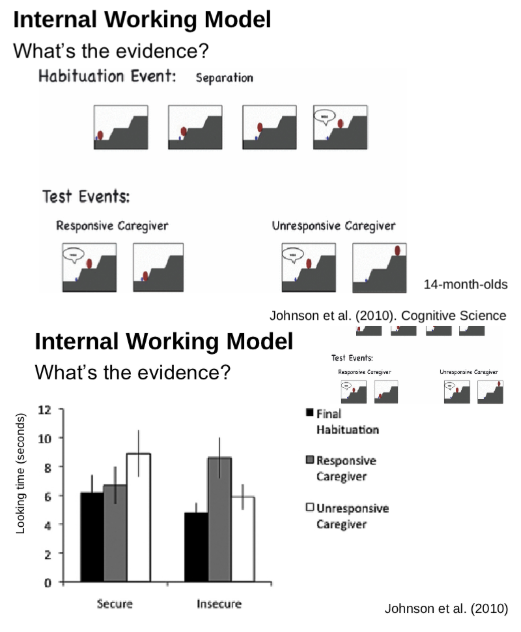
What is the internal working model?
Child's expectations about how a caregiver will respond to them → child's intuitive theory of caregiver behaviour
Reflected in other aspects of their behaviour
Evidence
Attachment style predicted by parenting style (e.g. responsive mothers -> securely attached infants)
BUT circular
What do humans spend the longest portion of their lives being reared as? What do this suggest about humans and learning?
Children → evolved to learn from others + our extended childhood reflects this process of socialisation
What does entering society involve?
Conforming to social norms + moral principles
What did René Spitz argue about social interaction?
Infants can develop psychological problems because of lack of social interaction
What is some evidence that human development depends on social interaction?
René Spitz → infants can develop psychological problems because of lack of social interaction
Skeels (1966) → orphans moved to socially enriched environment had better education attainment as adults
Suggests that, without this early exposure, it becomes increasingly difficult to compensate for this early loss
Who inspired Mark Johnson to investigate whether animal attachment behaviours exist in newborns?
Lorenz
What did Mark Johnson discover about attachment in newborns?
Choice to look at a shape that had facial features, scrambled facial features or no facial features
When the shape was moved across their fields of vision, the newborns tracked the movement with their eyes BUT tracked the moving shape that had facial features longer than they tracked either of the others → preference for faces
Born with conspec (John Morton + Mark Johnson)
Supported by ultrasound studies of foetuses tracking face-like stimuli in the womb during 3rd trimester (Reid et al, 2017)
What is conspec?
System that orients the infant towards face-like structures
Supported by mature subcortical brain mechanisms
Present at birth (nativist)
What is conlearn?
System largely supported by maturing cortical brain mechanisms that learns about specific faces
Describe the process of infants learning to recognise faces
Born → visual + cortical systems mature → more efficient at encoding specific face + unique features → conlearn
What evidence supports Mark Johnson’s conclusions about facial recognition in infants?
Sugita (2008) → inbuilt preference for faces + that experience shapes face processing to become more selective
Newborns imitating the facial expression of adults even though they had never seen their own face → early mapping of infant's representation of their own face with that of another human
According to Dunham and Moore (1995), what occurs as infants reach their first birthday?
Increased ability to interact with adults + share attention directed towards objects of interest (joint attention)
What is joint attention?
Capacity to coordinate the social interaction with attention direction towards objects of mutual interest (e.g. established through following each other's gaze, social smiling, pointing)
According to Dunham and Moore (1995), what occurs in children by 4 years old?
Children can reliably read another’s direction of gaze not only as an indicator of where their attention is focused, but also as an indicator of what they are thinking
How does Wörmann (2012) support joint attention?
At age 6 weeks, German + Cameroonian mothers/babies were found to enjoy the same amount of social smiling + imitation
BUT by 12 weeks, these types of social interactions are more frequent in the European households compared to those in Central Africa
What is contingent behaviour?
Synchronised responding from an adult (powerful social cue for interaction)
A 5-month-old placed in a baby walker is more likely to approach a stranger who has responded contingently than one who maintained a close distance to the infant but did not respond to attempts to interact (Roedell and Slaby, 1977)
What does early social exchange shared by infants and primary caregivers depend on?
The nature of their relationship
E.g. influence of post-natal depression → either more or less interaction
What is a dyadic relationship?
The focus of interest is between 2 individuals
What is a driadic relationship?
Attention is directed between 2 individuals + a 3rd potential source
How does joint attention facilitate language learning?
When an adult labels an object with a new word, they usually look at or point to the object at the same time (Baldwin, 1991)
The younger the age at which an infant demonstrates proficient joint attention, the faster their subsequent language acquisition (Carpenter et al., 1998)
What is social referencing?
Looking at carers to gauge their reactions in unfamiliar or threatening circumstances (Campos and Stenberg, 1981)
If the carer looks concerned, infants hesitate + are wary BUT if the carer smiles, they’re much more relaxed (Walden and Baxter, 1989)
Infants’ reactions to unexpected events (like a jack-in-the-box toy) are strongly influenced by how their mothers respond (Hornik et al., 1987)
What are the 2 types of pointing?
Protoimperative = direct another’s attention to obtain a particular goal
Protodeclarative = direct another’s attention to an object or event of interest (uniquely human)
Liskowski et al (2004) → examined the relationship between joint attention + protodeclarative pointing in 1-year-olds → pointing was more prevalent during joint attention condition
What are 3 key features of attachment?
Proximity seeking → the attached child will stay close to the primary carer
Secure base → the primary carer provides a secure base from which the attached child can explore the world as if tied by invisible elastic
Separation protest → attached children will be distressed and cry if separated from the primary carer
What are Bowlby’s phases of attachment?
Pre-attachment
2nd phase of attachment
Final phase of attachment
When does Bowlby’s pre-attachment phase occur?
Up to 2 months
What is Bowlby’s pre-attachment phase?
Send "come-hither" signals to anyone within range to receive these
Next 4 months → keep mental tally of who response most often + quickly (target signals to primary caregiver → emotional centre)
When does Bowlby’s second phase of attachment occur?
Around 7 months
What occurs in Bowlby’s second phase of attachment?
Stranger anxiety
When does Bowlby’s final phase of attachment occur?
End of infancy (2 years)
What occurs in Bowlby’s final phase of attachment?
Goal-directed partnership between the child and carer → child is increasingly confident at exploratory forays further away from the adult (secure base)
What is a weakness of Bowlby’s phases of attachment?
Failed to take in account individual differences in attachment styles
Ainsworth → strange situation (behavioural test used to determine a child’s attachment style)
Attachment relationship is seen as a balance between exploratory behaviour of the environment and safety provided by the primary carer → securely attached children have the ‘correct’ balance
What is the grandmother hyppothesis?
Explains the evolutionary value of assisted child-rearing by related female humans, namely grandmothers, who live on well past menopause (Hawkes et al., 1997)
Provide the resources to raise their grandchildren
Prevalence of supportive grandmothers increased human life expectancy and enabled the human life span to double from 25 years to 50 in less than 60,000 years, thereby increasing the opportunity for longer periods of child development (Kim et al., 2012)
What is parental sensitivity?
Consistent attentiveness to the infant’s emotional wellbeing
How does parental sensitivity relate to attachment styles?
Secure → infants seem to be certain that their primary carer will respond
Avoidant → infants seem to be certain that their primary carer will not respond
Ambivalent → infants seem to be uncertain about whether their primary carer will respond
Disorganised → infants seem to be confused about their carers
Speculated that this classification characterises abused children
What is temperament?
Characteristic pattern of emotional reactivity (largely do to genetics)
Very young children vary in their tendency towards fearfulness, irritability, activity, positive affect and other emotional traits (Rothbart and Bates, 1998)
What is an inhibited temperament?
Emotional reactivity → behavioural inhibition
Children who avoid novelty
Adults who are quiet, cautious + shy
What is behavioural inhibition?
Tendency towards shyness + fear of novelty
What is an uninhibited temperament?
Children eager to jump into new situations + lack stranger anxiety
What is Thomas and Chess’ goodness of fit
The extent to which the child’s environment is compatible with their temperament (must adapt to temperament)
Differences in carers' response is largely due to ability to read infant's emotional state
What is a weakness of attachment styles?
May be correlated with later success only because both are caused by the same environment