Helminths — Introduction
 Call Kai
 Learn
Learn Practice Test
 Spaced Repetition
 Match
Match Flashcards
 Knowt Play
1/104

There's no tags or description
Looks like no tags are added yet.
Name | Mastery | Learn | Test | Matching | Spaced | Call with Kai | Chat |
|---|
No analytics yet
Send a link to your students to track their progress
105 Terms
What are helminths?
Helminths are Parasitic Worms!
Invertebrates — many are parasites of veterinary and public-health importance
What are Macroparasites
— they ”generally” do not multiply inside the animal, so the burden reflects what it picked up
What kind of worm is Elongated
(roundworms)
What kind of worm is flat and segmented
(tapeworms)
What kind of work is leaf like
(flukes)
Which kind of worm is elongated with a thorny head
(Acanthocephalans)
We mentioned that macroparistes don’t multiply but what do they do instead
its more so how many larve they get ingested or how many eggs they ingest
Can you give me the basic lifestyle of a helminth
All develop through egg → larval (juvenile) stages → adult
What are the phylums of helminths
nematoda
platyhelminthes
acanthocephala
What is an example of a Nematoda
round worms
What is an example of platyhelminthes
flatworms
What is an example of acanthocephala
thorny headed worms
What is the order for a nematoda
ascaridida
strongylida
spiruirda
rhabditida
trichinellida
What are the families of a nematoda
ascarididae
toxocaridae
anisakidae
strongylidae
trichostrongylidae
metastrongylidae
trichinellidae
Which worm is the most abundant animal on earth
nematodes
Most of the helminths that matter in practice are
nematodes
What does Pseudocoelomate mean
the body cavity holds fluid under pressure, and that turgor is the worm's skeleton
Describe the body of the neatodes
Body covered by a tough non-cellular cuticle, shed at each of four molts
Do nematodes have a digestive system?
yes, Complete digestive system — an anterior mouth and a posterior anus
Nerve function is essential to a nematode's survival — why is that
and it is the target of many anthelmintics you will prescribe.
Most nematodes shed
shed eggs, but some shed L1 in the feces, and a few shed in urine
For most GI nematodes, L3 is the infective or effective
infective stage, for a very few L1 is infective
Where does L3 → L4 → L5 occur
happens inside the definitive host
Maturing larvae may migrate through
organs before the adults settle in their preferred site — which is why the damage is often nowhere near where the worm ends up
What does Hypobiosis mean
many nematodes can arrest development in the mucosa and wait for appropriate condition/environment to resume development. It is an adaptation, not a failure.
When will hypobiosis
many nematodes can arrest development in the mucosa and wait for appropriate condition/environment to resume development. It is an adaptation, not a failure.
In Hypobiosis can we get a false negaive yes or no?
for the most start we might get false negatives or not, we might not get any fecal egg count, but the animal has parasites in the hyperbiotic states and we might still se the disease any exposure and we might not it depends
Why is it a challenge when we try to medicate nematodes in hypopbiosis
challenging to use the drugs because they may not be effective, especially when larvae is in hyperbiotic state
Describe the general nematodes shape and size
Round, unsegmented, tapered at both ends. Typical range: 2 mm to 40 cm.
We already mentioned a description about whip worms but what else do they look like
whip-like shape, and have thick backside
What are some anterior end/mouth parts of an adult nematodes
§ Buccal cavity
§ Teeth, hooks, cutting plates
§ Lips
Hookworms – Ancylostoma can you describe the mouth parts
Buccal Cavity + hooks

What are the parts of the mouth of a hook work - uncinaria
Cutting plates

Ascarids Toxocara describe the mouth
3 fleshy lips
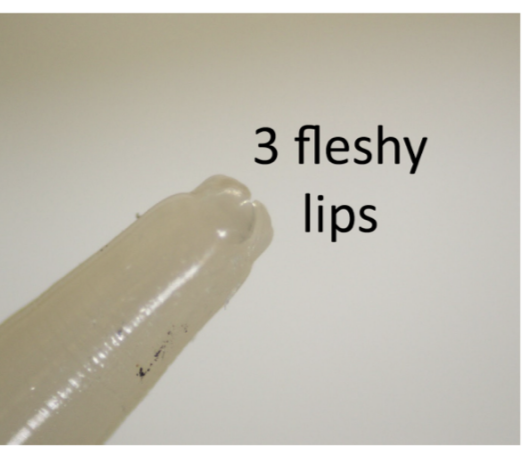
Hook worms and stoma have what kind of mouth
they have hooks
What are the parts of the posterior and tail parts of the adult nematodes
§ Bursa
§ Spicules
§ Tail length/shape
if the tail end has a bursa is it a male or female strongyle
Male Strongyles
If the tail end does not have a bursa is it a male or femal ascarides
Male Ascarids
If it has a simple pointed tail is it a female or male nematodes
most female nematodes
Nematodes release their offspring in three ways what are they
oviparous
ovoviviparous
viviparous
What is a viviparous:
live larvae, released straight into feces, blood or tissue.
What is a ovoviviparous:
release eggs containing fully formed live larvae (larvated eggs)
What is oviparous:
release eggs with a single-cell embryo (most of them)
Can you describe the ascarid egg
§ round, thick rough shell, one cell inside. Tough, survives in soil for years.
Can you describe Strongyle egg
§ Thin, smooth egg shell. Oval with ball of cells inside
Can you describe Trichurid / capillarid type
barrel-shaped with a plug at each pole.
Can you describe strongyles in the egg or larvae form
larvae with pointed tail
most lungworms
kinked tail
Can you describe the Spirurid egg/ larvated!
slightly flattened to one side and some auxillary they have larvae already inside and some do not
The order/group is srongylida what are some examples
hook works
trichostrongyles
strongyles
most lungworms
The order is Strongylida how do we recognize it
Well-developed buccal capsule
often with teeth;
Male with a copulatory bursa
What is a lifecyel for Strongylida
Mostly direct. Strongyle-type egg — thin, oval, morulate, and near-identical across the whole group
The order is a Rhabditida what is an example
Threadworms
How do we recgonize Rhabditida
Esophagus with a bulb — “rhabditiform”
What is the life cycle of Rhabditida
Facultative — alternates parasitic and free- living generations. Transmammary transmission
The order is Ascaridida give me an example
The large roundworms of dogs, cats, pigs and horses
How do we recognize Ascaridida
Large, stout worms with three prominent lips
What is the life cycle of a ascaridida
Mostly direct, may use paratenic hosts.
Larval migration through liver and lung.
Thick, rough, pitted egg
The order is Oxyurida what is an example
Pinworms
How do we reconigze Oxyurida
Long tapering tail; bulb on the esophagus
What is the life cycle of oxyurida
Direct; large intestine only, and highly host- specific. Eggs laid on the perineum
The order is Spirurida what are examples of them
Heartworm and the other filariae, eyeworms, stomach worms
How do we recognize spiruirda
A varied group; includes the blood and tissue worms
WHat is the life cycle of a spiruirida
Always indirect — an arthropod intermediate host, often paratenic hosts too. Thick-walled larvated egg
What are examples of Adenophorea
Whipworms, the trichina worm, hair worms and the kdiney worm
How do we recognize Adenophorea
Stichosome esophagus — a single column of gland cells
What is the life cycle of an adenophorea
Gut, kidney, nose, muscle. Bipolar-plugged eggs — except the trichina worm, which lays none at all
Do cestodes have a GI system
§ No gut at all, everything is absorbed across the tegument
What are the three body parts of a cestodes
§ scolex (holds on — suckers ± hooks)
§ neck (the growth zone)
§ strobila (chain of proglottids)
Most proglottids contain both
male and female reproductive organs (hermaphrodite); fertilization may occur within or
between proglottids.
Gravid proglottids seen in
feces
this is towards the end of the body
What is the drug of cestodes
Praziquantel is the drug of choice.
It disrupts calcium homeostasis and damages the tegument.
Cestodes — general life cycle have how many cycles that are indirect
2 or 3 hosts
Which stage in the life cycle of Cestodes where is it more pathogenic stage
The larval form (metacestode) in the intermediate hosts are the most pathogenic stage, not the adult.
Definitive-host feces can expose
people and livestock to infective eggs in selected zoonotic cycles.
Do vet care about Cyclophyllidean tapeworms
Most tapeworms of veterinary importance
How many hosts do Cyclophyllidean tapeworms affect
Generally, one intermediate host – on land
What are examples of Cyclophyllidean tapeworms
The taeniids, and the flea tapeworm of dogs and cats
Where do Cyclophyllidean tapeworms attach to
Organ of attachment: Suckers – often with hooks!
Cyclophyllidean tapeworms produce eggs
Eggs: Not operculate
Do vets care about Pseudophyllidean tapeworms
Only a few genera of veterinary importance
How many hosts do Pseudophyllidean tapeworms
Mostly two intermediate hosts – both aquatic!
What are examples of Pseudophyllidean tapeworms
The fish tapeworm, and its relative in dogs, cats and wild carnivores
Where do Pseudophyllidean tapeworms attach to
Organ of attachment: Bothria — slit-like grooves, no hooks!
Do Pseudophyllidean tapeworms have eggs
Eggs: Operculate
Describe Trematodes — the flukes!
Flatworms, but a single leaf-shaped body — no chain of segments, no strobila
Do trematodes have a gut?
Yes, They have a gut — a mouth and two blind-endingbranches. Unlike tapeworms, flukes actually eat
Do trmatodes have suckers?
Two suckers hold them on — one around the mouth, one on the belly surface
What kind of meds would we use for trematodes
Same tegument as tapeworms — absorptive, and the reason praziquantel works on both
How do trematode reproduce
§ Most are hermaphrodite — one worm can reproduce alone. Blood flukes are the exception, with separate sexes
What is the first step of the general life cycle of trematodes
Always more than one host — and the first one is always a snail. No snail, no fluke
What is the order for a trematodes life cycle
egg → miracidium → snail amplifcation → cercaria
what leaves the snail
cercaria
How does the cercaria (from the trematodes multiply)
The parasite multiplies asexually inside the snail — one egg can become hundreds of cercariae. Nothing else we study does this
The cercaria encysts as a
metacercaria — on grass, in a fish, in an ant, in a crustacean
What is the last step of the trematodes
The final host gets infected by eating it — except blood flukes, where the cercaria burrows
through skin
Are adults easy to diagnnose of trematodes
Adults are easy to identify – flat, soft, leaf-shaped, a few mm to a few cm. Distinct from roundworms and tapeworms
Whats is another way we diagnose tramtodes
Eggs are also characteristic: big, golden-brown with a lid on one end (operculum) – much larger than nematode and cestode eggs [Exception blood fluke]
Often poorly recovered by routine flotation.
Which exception of Tramtodes can float
Alaria – floats!
Are Acanthocephalans common
§ A distinct phylum of specialized parasites, less commonly encountered in routine domestic-animal practice.
Describe the Acanthocephalans
A retractable, spiny attachment organ — the proboscis, the thorny head. The proboscis may deeply penetrate the intestinal wall; inflammation, ulceration, obstruction, and, in severe cases, perforation/peritonitis can occur.