Module 6 need to know
 Call Kai
 Learn
Learn Practice Test
 Spaced Repetition
 Match
Match Flashcards
 Knowt Play
1/29

There's no tags or description
Looks like no tags are added yet.
Name | Mastery | Learn | Test | Matching | Spaced | Call with Kai | Chat |
|---|
No analytics yet
Send a link to your students to track their progress
30 Terms
Key terms
Solution – homogeneous mixture
Solvent – substance present in largest amount
Solutes – other substances in the solution
When ionic compounds (solutes) dissolve in water:
The strong ionic forces that hold the ionic compound crystal together are overcome by the strong attractions between the ions and the polar water molecules
Each polar water molecule orient itself in a way to maximize its attraction with an ion
The strong ionic forces holding the positive and negative ions in the solid are replaced by strong water–ion interactions, and the solid dissolves (the ions disperse)
Looking at what happens to non-ionic compounds (solutes) when they dissolve in water:
Contains polar O-H groups that can form hydrogen bonding with water
The hydrogen bonding interaction with water is very strong and solubilizes the compound
Substances insoluble in water
Nonpolar oil does not interact with polar water
Water-water hydrogen bonds keep the water from mixing with the nonpolar molecules
How Substances Dissolve
“like dissolves like”
Water (polar) dissolves polar substances
Nonpolar solvents dissolve nonpolar solutes
The solubility of a solute is limited
Saturated solution – contains as much solute as will dissolve at that temperature
Unsaturated solution – has not reached the limit of solute that will dissolve. When more solute is added to an unsaturated solution, it dissolves
variation in substances (solutes) amounts present in different solutions
A relatively large amount of solute is dissolved in a concentrated solution
A relatively small amount of solute is dissolved in a dilute solution
Mass percent
Describing the composition of a solution means specifying the amount of solute present in a given quantity of the solution

Concentration
- defined as the amount of solute in a given volume of solution
expressed as molarity (M)
Molarity
Describes the amount of solute in moles and the volume of the solution in litres. (Molarity is the number of moles of solute per volume of solution in litres.)
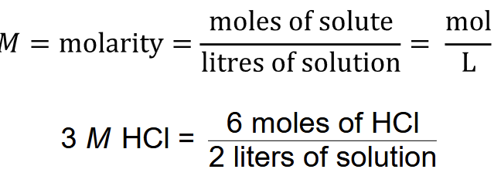
To find the solution that contains the greatest number of moles of ions/solutes
Think about relative numbers of ions/solutes
How many moles of solute or each ion are in each solution?
The solution with the greatest number of ions is not necessarily the 1 in which:
the volume of the solution is the largest
the formula unit has the greatest number of ions
Dilution
- The process of adding water to a concentrated or stock solution to achieve the molarity desired for a particular solution
A dilute solution contains the same amount of solute in the concentrated solution it is made from. A dilute solution contains more water than the concentrated solution
Dilution calculation
A typical dilution calculation involves determining how much water must be added to an amount of stock solution to achieve a solution of the desired concentration

Steps for Solving Stoichiometric Problems Involving Solutions
Write the balanced equation for the reaction. For reactions involving ions, it is best to write the net ionic equation
Calculate the moles of reactants
Determine which reactant is limiting
Calculate the moles of other reactants or products, as required
Convert to grams or other units, if required
Neutralization reaction
- An acid-base reaction
A strong acid, such as hydrochloric acid, HCl, dissociates (ionizes) completely in water
HCl(aq) → H+ (aq) + Cl−(aq)
Strong bases are water-soluble metal hydroxides, which are completely dissociated in water
NaOH(aq) → Na+(aq) + OH−(aq)
When a strong acid and a strong base react, the net ionic equation is
𝐇+ (𝐚𝐪) + 𝐎𝐇− (𝐚𝐪) → 𝐇𝟐𝐎 (𝐥)
Characterization of acids and bases
Acids are characterized by their sour taste. E.g. acetic acid in vinegar, and citric acid in lemons
Bases are characterized by their bitter taste and slippery feel. E.g. hand soaps
Arrhenius:
• Acids produce H+ ions in solution, bases produce OH– ions
This concept is limited because it allows for only 1 kind of base—the hydroxide ion
Brønsted–Lowry
• Acids are proton (H+) donors, bases are proton acceptors
– an acid (HA) donates a proton to a water molecule to form a new acid (the conjugate acid) and a new base (the conjugate base)
A conjugate acid-base pair consists of 2 substances related to each other by the donating and accepting of a single proton (H+)
A Brønsted–Lowry acid is a proton donor while a Brønsted–Lowry base is a proton acceptor
The difference between a conjugate base and its acid, and a conjugate acid and its base is a single proton (H+)
Strong acid
completely ionized or completely dissociated in an aqueous solution
HA(aq) + H2O(l) → H3O+ (aq) + A− (aq)
• is one in which the forward reaction predominates
• HA (aq) completely ionizes (dissociates) into its constituent ions (H+ or H3O+ plus an anion).
• Examples: HCl, HNO3 and H2SO4
• A strong acid contains a relatively weak conjugate base, A−
• Excellent conductor of electricity
Weak acid
dissociates (ionizes) only to a very small extent in an aqueous solution
HA(aq) + H2O(l) → H3O+(aq) + A− (aq)
The reverse reaction predominates:
H3O+ (aq) + A− (aq) → HA(aq) + H2O(l)
• When placed in water, almost all the acid molecules remain intact (undissociated)
· Example: acetic acid (CH3COOH)
• A weak acid contains a relatively strong conjugate base, A−
· Conducts electric current weakly
The relationship of acid strength and conjugate base strength for the dissociation reaction:
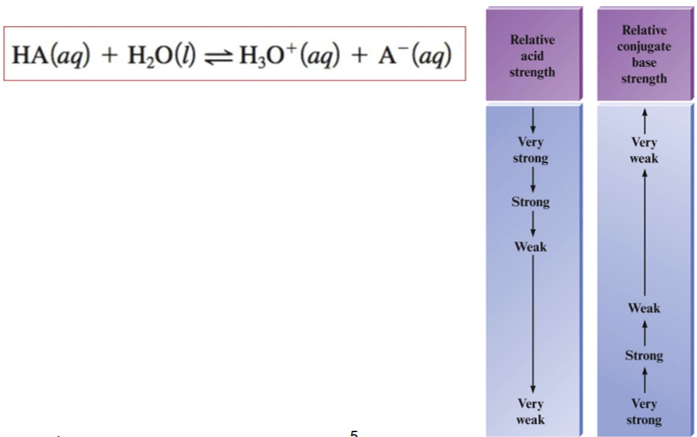
Ways to decribe acid strength

Water as an acid and base
Water is an amphoteric substance which means it can behave either as an acid or a base
(water behaving as an acid)
Ionization equilibrium of water shows that the forward reaction does not occur to a great extent:
Therefore, there are only small amounts of ions at 25 °C:
The ion-product constant, Kw at 25 °C can be obtained by multiplying the concentrations of H3O+ and OH–
Or,
No matter what the solution contains, the product of [H+] and [OH–] must always equal 1.0 × 10⁻¹⁴ at 25°C
Since Kw is a constant, when [H+] increases, [OH–] decreases, and vice versa
3 Possible Situations:
• In a neutral solution, [H+] = [OH–]
• In a acidic solution, [H+] > [OH–]
• In a basic solution, [H+] < [OH–]
In each case, however,
Kw = [H+][OH–] = 1.0 × 10⁻¹⁴
pH scale
Because the [H+] in an aqueous solution is typically quite small, the pH scale provides a convenient way to represent solution acidity
pH = -log[H+]
To represent pH of the appropriate number of significant numbers, you need to know the following rule for logarithms: the number of decimal places for a log must be equal to the number of significant figures in the original number
pH decreases as [H+] increases
![<p>Because the <span style="color: windowtext;">[H<sup>+</sup>] </span>in an <span style="color: windowtext;">aqueous solution </span>is <u>typically</u> quite <span style="color: windowtext;">small</span>, the <span style="color: windowtext;">pH scale </span>provides a <span style="color: windowtext;">convenient </span><u>way</u> to <u>represent</u> <span style="color: windowtext;">solution acidity</span></p><p class="MsoNormal"></p><p class="MsoNormal"> pH = -log[H+]</p><p class="MsoNormal"> </p><p class="MsoNormal"> </p><p class="MsoNormal">To <u>represent</u> <span style="color: windowtext;">pH </span>of the appropriate <span style="color: windowtext;">number </span>of <span style="color: windowtext;">significant numbers</span>, you need to know the following <u>rule</u> for <span style="color: windowtext;">logarithms</span>: the <u>number</u> of <span style="color: windowtext;">decimal places</span> for a <span style="color: windowtext;">log </span>must be <u>equal</u> to the <span style="color: windowtext;">number </span>of <span style="color: windowtext;">significant figures </span>in the <span style="color: windowtext;">original number</span></p><p class="MsoNormal"> </p><p class="MsoNormal"><span style="color: windowtext;">pH</span> <u>decreases</u> as <span style="color: windowtext;">[H<sup>+</sup>] </span><u>increases</u></p>](https://assets.knowt.com/user-attachments/1ce8eda8-2d7b-42b1-9a2c-d82e798dd9f3.png)
A convenient relationship between pH and pOH can be derived from Kw
pH + pOH = 14.00
Calculating the pH of strong acid solutions
A strong acid is completely ionized or completely dissociated in an aqueous solution
Even though the label on the bottle says 1.0 M HCl, the solution contains virtually no HCl molecules!
A 1.0 M HCl solution contains 1.0 M H+ and 1.0 M Cl− ions rather than HCl molecules
We can do stoichiometric calculations for strong acids
A buffer solution is one which resists pH change when either an acidic or a basic solution is added to it
A buffer solution is made up of a weak acid (e.g acetic acid, CH3COOH) and the conjugate base (e.g acetate, CH3COO–) of the weak acid
How does a buffered solution work?
Any added strong acid, H+ reacts with the base A–.
H+(aq) + A–(aq) → HA(aq)
Any added strong base, OH– reacts with the weak acid HA.
OH–(aq) + HA(aq) → H2O(l) + A–(aq)
The Characteristics of a Buffer
The solution contains a weak acid HA and its conjugate base A–
The buffer resists changes in pH by reacting with any added H+ or OH– so that these ions do not accumulate
Any added H+ reacts with the base A– H+(aq) + A–(aq) → HA(aq)
Any added OH– reacts with the weak acid HA OH–(aq) + HA(aq) → H2O(l) + A–(aq)