Unit I - Embryology, Histology, General Anatomy
 Call Kai
 Learn
Learn Practice Test
 Spaced Repetition
 Match
Match Flashcards
 Knowt Play
1/102

Earn XP
Description and Tags
Lectures 3-10
Name | Mastery | Learn | Test | Matching | Spaced | Call with Kai | Chat |
|---|
No analytics yet
Send a link to your students to track their progress
103 Terms
What are the two major abilities of living cells?
Survival (maintain structure, consume energy) and reproduction (grow and divide).
What three structures are common to almost all cells?
Plasma membrane, cytoplasm, nucleus (DNA-containing region in eukaryotes).
What are the functions of the plasma membrane?
Protects the cell, separates intracellular from extracellular environments, regulates transport.
What is the cytoplasm?
Everything inside the plasma membrane outside the nucleus; contains organelles, cytosol, and cytoskeleton.
What is the nucleus?
Membrane-bound organelle that stores DNA and regulates cellular activities.
What distinguishes prokaryotic cells from eukaryotic cells?
Prokaryotes lack membrane-bound organelles and a nucleus; eukaryotes possess both.
Average size of prokaryotic cells?
1–3 μm.
Average size of eukaryotic cells?
Greater than 10 μm.
Which organelle exists in both prokaryotes and eukaryotes?
Ribosomes.
Which structures are absent in prokaryotes?
Nucleus, ER, Golgi apparatus, mitochondria, lysosomes.
What is the plasma membrane composed of?
A phospholipid bilayer.
Why are phospholipids called amphiphilic?
They have hydrophilic heads and hydrophobic tails.
Primary function of the phospholipid bilayer?
Acts as a selective barrier.
Why do the inner and outer membrane leaflets differ?
Different types of lipids in the inner and outer leaflets allow each side of the membrane to perform specialized functions and helps maintain membrane curvature.
What are membrane transporters?
Proteins that move substances across membranes.
What substances cross by simple diffusion?
Oxygen, carbon dioxide, steroid hormones.
Which molecules require transport proteins?
Glucose, amino acids, ions.
What are membrane receptors?
Proteins that bind signaling molecules and initiate intracellular signaling.
What happens when insulin binds its receptor?
Cellular signaling increases glucose transporter production.
Function of the nucleus?
Stores DNA and regulates gene expression.
What surrounds the nucleus?
A double membrane called the nuclear envelope.
What allows transport into and out of the nucleus?
Nuclear pores.
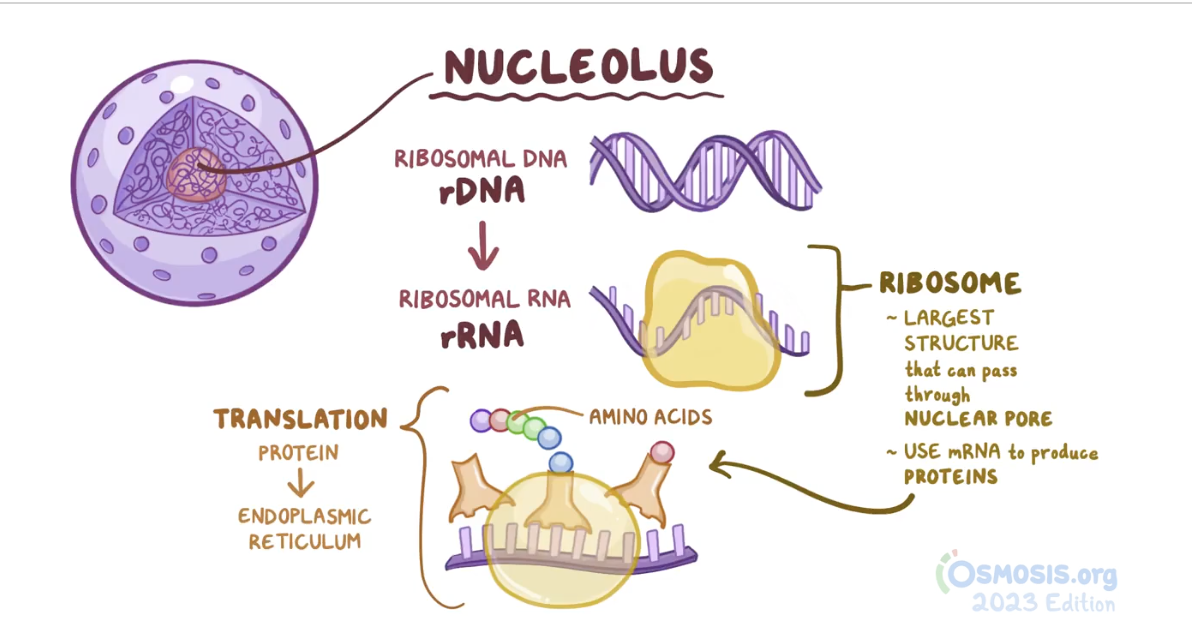
What is the nucleolus?
Region where ribosomes are made.
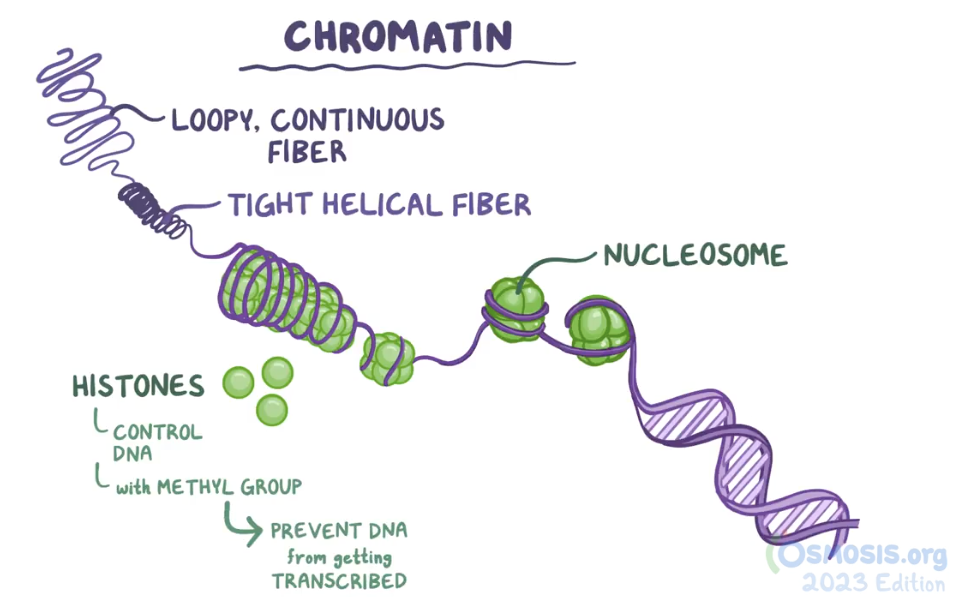
What is chromatin?
DNA wrapped around histone proteins.
Why don't mature red blood cells have nuclei?
To maximize space for hemoglobin.
Function of ribosomes?
Protein synthesis (translation).
Are ribosomes membrane-bound?
No.
Where can translation occur?
Inside ribosomes in cytoplasm or rough ER.
Ribosome size in prokaryotes?
70S
Ribosome size in eukaryotes?
80S
Why do antibiotics often target bacterial ribosomes?
Bacterial ribosomes are smaller and structurally different from human ribosomes.
Major function of the ER?
Protein and lipid synthesis.
Rough ER function?
Synthesizes membrane and secreted proteins.
Why is rough ER "rough"?
Ribosomes are attached.
Smooth ER functions?
Lipid synthesis, steroid synthesis, carbohydrate metabolism, calcium storage.
Function of the Golgi apparatus?
Modifies, packages, and ships proteins and lipids.
Which side of the Golgi receives proteins?
Cis face (nucleus facing)
Which side exports proteins?
Trans face (outer membrane facing)
Function of lysosomes?
Intracellular digestion and recycling.
Why are lysosomes acidic?
Acid activates digestive enzymes.
Approximate lysosomal pH?
About 5
Main function of mitochondria?
ATP production through cellular respiration
Why do mitochondria have two membranes?
They compartmentalize respiration.
What are cristae?
Folds of the inner membrane that increase surface area.
What does the mitochondrial matrix contain?
mtDNA, ribosomes, enzymes for the TCA cycle.
mtDNA = mitochondria dna
Evidence mitochondria evolved from bacteria?
Own DNA and ribosomes.
Secretory protein pathway?
Rough ER → Golgi → Secretory vesicle → Plasma membrane.
Three cytoskeletal components?
Intermediate filaments, microtubules, actin filaments.
Function of intermediate filaments?
Mechanical strength and resistance to stretching.
Nuclear intermediate filaments are called?
Nuclear lamins.
Composition of microtubules?
Tubulin proteins.
Functions of microtubules?
Intracellular transport, mitotic spindle, cilia, flagella.
Which cytoskeletal component forms the mitotic spindle?
Microtubules
Other name for actin?
Microfilaments
Functions of actin?
Cell movement, muscle contraction, cytokinesis, shape changes.
Four major phases of cell cycle?
G1, S, G2, M.
Which phases make up interphase?
G1, S, G2.
What occurs during G1?
Cell growth and organelle duplication.
What occurs during S phase?
DNA replication and centrosome duplication.
What occurs during G2?
Preparation for mitosis and DNA repair.
What occurs during M phase?
Mitosis and cytokinesis.
What is G0?
Non-dividing resting state.
Occurs after G1 if dividing needs not met
G1 checkpoint checks?
Nutrients and DNA damage.
S checkpoint checks?
DNA replication errors.
G2 checkpoint checks?
DNA fully replicated and undamaged.
M checkpoint checks?
Chromosomes attached correctly to spindle.
Function of CDKs?
Phosphorylate proteins that drive the cell cycle.
Why can't CDKs function alone?
They require cyclins.
Cyclin levels during the cell cycle?
Rise and fall cyclically.
G1-Cdk function?
Pushes cell toward S phase.
S-Cdk function?
Initiates DNA replication.
M-Cdk function?
Initiates mitosis
How are cyclins removed?
Ubiquitination followed by proteasome degradation.
What is APC?
Anaphase-promoting complex that tags cyclins with ubiquitin.
Function of the proteasome?
Degrades ubiquitinated proteins.
What activates cyclin-CDK complexes?
Cdc25 phosphatase.
What inhibits cyclin-CDK complexes?
p21
Which protein activates p21?
p53
What are mitogens?
Extracellular signals that stimulate G1 → S progression.
How do mitogens promote S phase?
MAP kinase → G1-Cdk activation → Rb phosphorylation → E2F release
Function of Rb protein?
Prevents S-phase gene transcription until phosphorylated.
Function of E2F?
Activates S-phase genes.
Purpose of ORC?
Binds DNA replication origins.
Role of Cdc6?
Loads helicase during G1.
Why does DNA replicate only once per cycle?
Cdc6 is only present during G1, so helicase loads only once.
Function of p53?
Detects DNA damage and arrests the cell cycle or induces apoptosis.
Why is TP53 commonly mutated in cancer?
Loss of p53 allows damaged cells to continue dividing.
Function of BRCA1 and BRCA2?
DNA repair.
Adult stem cells?
Tissue-specific stem cells for maintenance and repair.
Embryonic stem cells?
Can become nearly any cell type.
Induced pluripotent stem cells?
Reprogrammed differentiated cells. Lab-made.
Five stages of mitosis?
Prophase, Prometaphase, Metaphase, Anaphase, Telophase.
Key events of prophase?
Chromosomes condense, spindle begins forming, centrosomes separate.
Key events of prometaphase?
Nuclear envelope breaks down; spindle attaches to kinetochores.
Key event of metaphase?
Chromosomes align at the metaphase plate.
Key event of anaphase?
Sister chromatids separate and move to opposite poles.
Key events of telophase?
Nuclear envelopes reform, chromosomes decondense.
What divides the cytoplasm?
Contractile ring made of actin and myosin.
Rough ER vs Smooth ER?
Rough ER makes proteins; Smooth ER makes lipids and stores calcium.
Golgi vs Lysosome?
Golgi packages proteins; Lysosome digests molecules.