Ch 3 Cell Structure and Genetic Control - Lecture cards.
 Call Kai
 Learn
Learn Practice Test
 Spaced Repetition
 Match
Match Flashcards
 Knowt Play
1/103

There's no tags or description
Looks like no tags are added yet.
Name | Mastery | Learn | Test | Matching | Spaced | Call with Kai | Chat |
|---|
No analytics yet
Send a link to your students to track their progress
104 Terms
What is the cell?
The basic unit of structure and function in the body; a highly organized molecular factory.
What type of cell is the human cell?
Eukaryotic.
What are the 3 common features shared by all human cells?
Plasma membrane, cytoplasm, and nucleus.
Why is "nucleus" qualified with "not all mature cells"?
Some mature cells lose their nucleus (e.g., RBCs); the nucleus is present in most but not all cells.
What is the basic structural component of the plasma membrane?
Phospholipids — arranged in a bilayer (two layers).
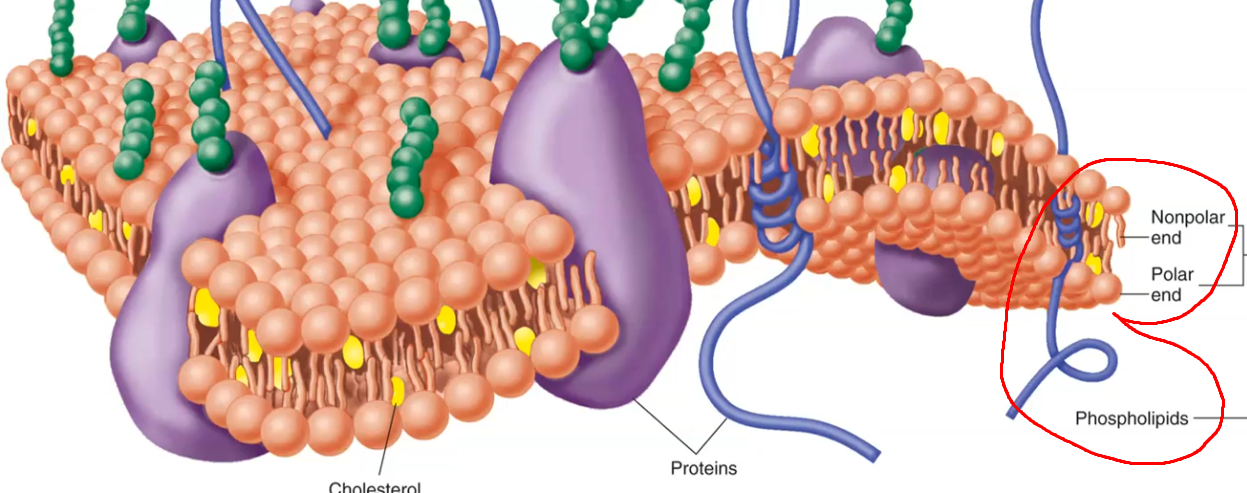
What does amphiphilic mean, and how does it apply to phospholipids?
Amphiphilic = both hydrophobic and hydrophilic.
The phosphate head is hydrophilic = water loving
The fatty acid tails are hydrophobic. = scared of water
Do all mature human cells have a nucleus?
No — some mature cells lack a nucleus (e.g., RBCs).
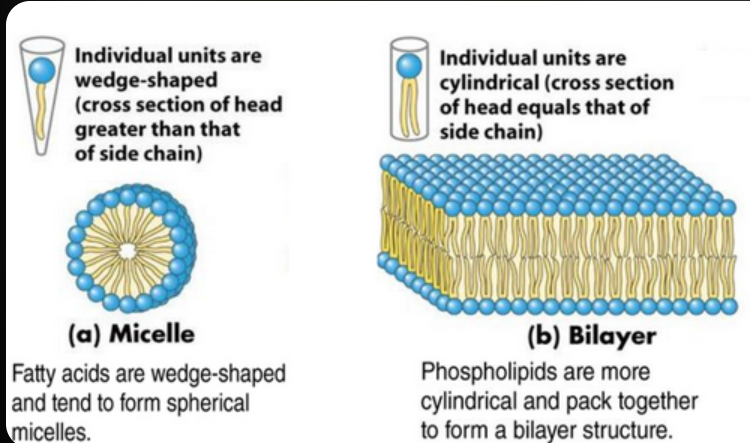
Why is the plasma membrane a bilayer and not a micelle?
The plasma membrane is a lipid bilayer rather than a micelle because both the interior (cytoplasm) and exterior of a cell are aqueous environments. Phospholipids are amphipathic molecules with hydrophilic heads and hydrophobic tails.
In a micelle, the hydrophobic tails would be trapped in a small core, which is unstable if the interior contains water.
Hydrophilic heads → face the water
Hydrophobic tails → face each other away from water
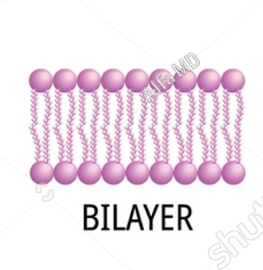
In the phospholipid bilayer, where are the heads and tails oriented?
Heads face outward (toward water on both sides); tails face inward toward each other, creating a hydrophobic center.
Tails are made of a fatty acid and make a fatty acid layer.
What are the two types of membrane proteins?
Integral proteins and peripheral proteins.
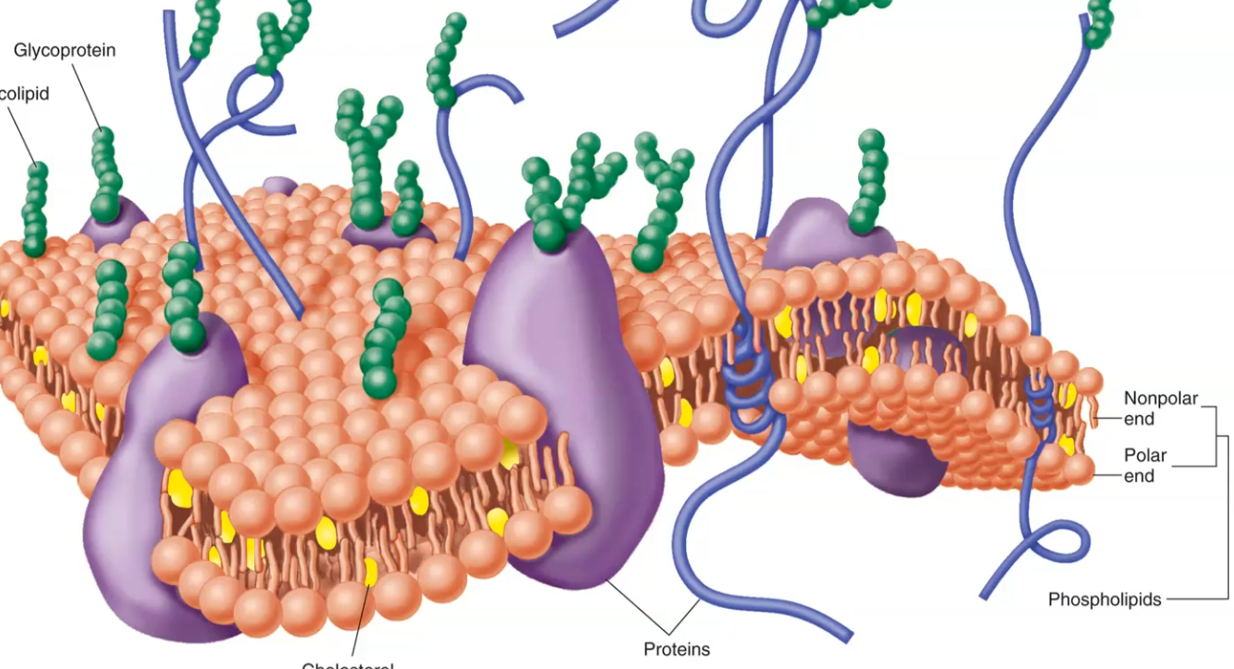
What defines an integral protein?
Any protein that interacts with the fatty acid tails of the plasma membrane, regardless of whether it spans the entire membrane.
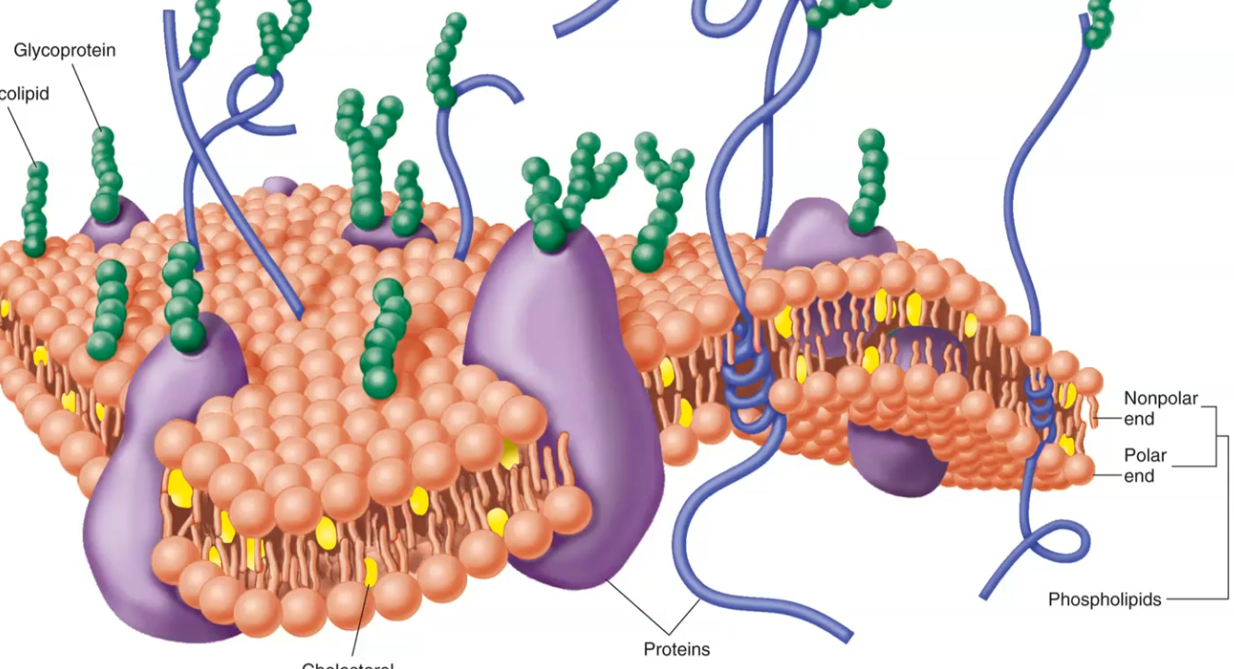
What is a transmembrane protein?
A type of integral protein that spans across the entire membrane (from one side to the other).
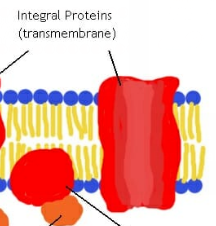
What defines a peripheral protein?
Embedded on only one side of the membrane (outside or inside); never touches the fatty acid tails.
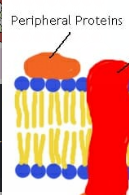
What is the role of cholesterol in the plasma membrane?
Adds rigidity to the fluid membrane — prevents it from moving too much and breaking apart.
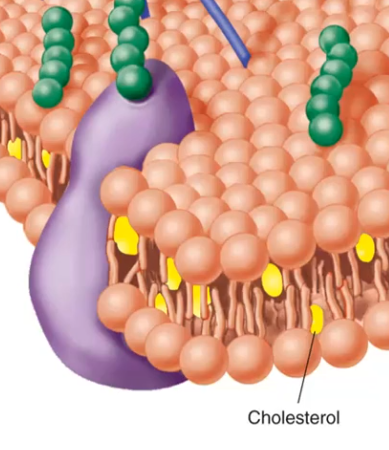
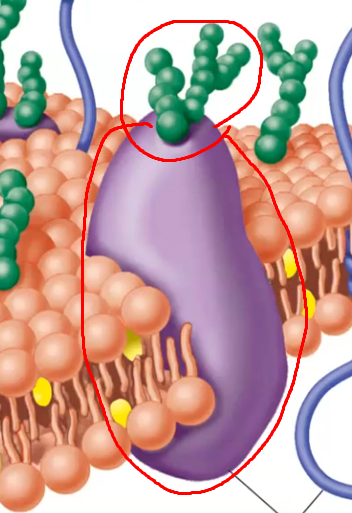
What is a glycoprotein?
A membrane protein with a sugar (carbohydrate) attachment.
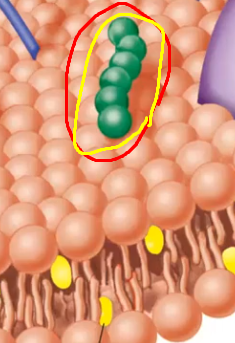
What is a glycolipid?
A membrane lipid with a carbohydrate attachment.
What are the 5 functions of membrane proteins?
Structural support
Transport
Enzymatic control of cell processes
Receptors for hormones and other molecules'
“Self" markers for the immune system.
What is the function of "self" marker proteins on the plasma membrane?
They signal the immune system that the cell belongs there — preventing it from being destroyed.
What are enzymes (basic definition)?
Proteins that participate in chemical reactions by breaking or making something.
What is bulk transport?
The mechanism by which the plasma membrane moves large molecules and particles into or out of the cell.
What is phagocytosis?
Cell eating — brings in large materials such as bacteria.
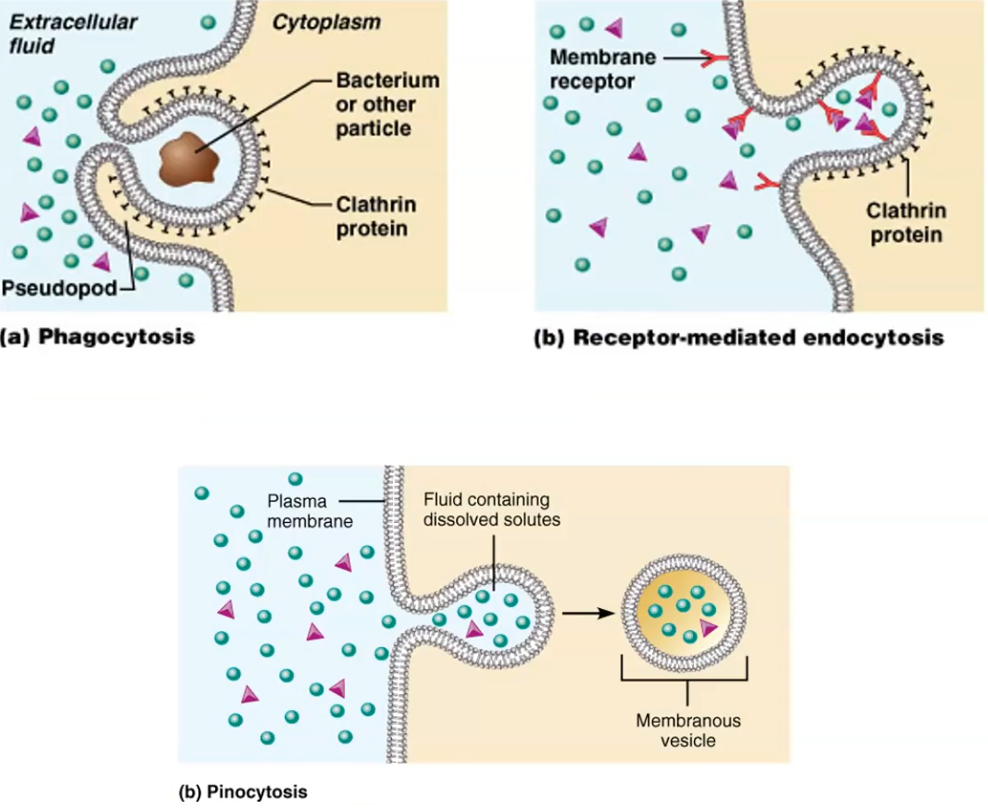
What is endocytosis and what are its three types?
Three distinct types:
Phagocytosis — "cell eating," engulfs large particles/pathogens
Pinocytosis — "cell drinking," takes in fluid and dissolved solutes
Receptor-mediated endocytosis — requires a specific ligand to bind a receptor before uptake occurs
What is the difference between pinocytosis and receptor-mediated endocytosis?
Pinocytosis is nonspecific — brings in extracellular fluid and whatever is dissolved in it.
Receptor-mediated endocytosis is specific — a receptor must be triggered by its specific molecule before material is allowed to enter.
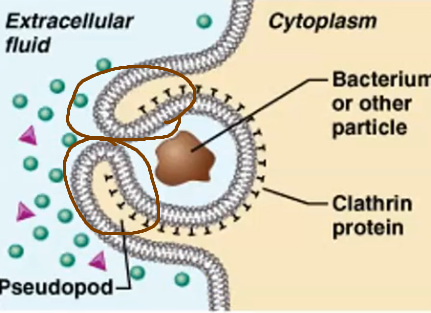
What is a pseudopod and which process uses it?
A leg-like extension of the plasma membrane used in phagocytosis to surround and engulf large particles like bacteria.
What happens to the plasma membrane at the end of phagocytosis, pinocytosis, and receptor-mediated endocytosis?
In all three, the plasma membrane fuses with itself to form a vesicle containing the ingested material.
How do the 3 bulk transport import mechanisms bring material into the cell?
Phagocytosis — membrane extends outward via pseudopods to surround large particles.
—
Pinocytosis — membrane folds inward to pocket extracellular fluid and dissolved solutes.
—
Receptor-mediated endocytosis — same as pinocytosis but a receptor must first be triggered.
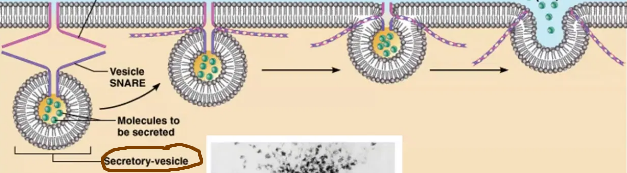
What is exocytosis?
Endocytosis in reverse — a secretory vesicle containing material fuses with the plasma membrane and releases its contents into the extracellular fluid (ECF).
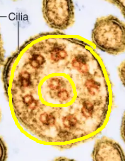
What are cilia and what is their function?
Hair-like projections on some epithelial cells that beat in unison to move material in one direction (e.g., respiratory and reproductive tracts).
What is the internal arrangement of microtubules in cilia?
9+2 arrangement — 9 microtubules on the outside, 2 in the middle.
What are microvilli and what is their function?
Finger-like projections on some epithelial cells that increase surface area to optimize the cell for absorption or secretion.
What does increased surface area on a cell tell you about its function?
The cell is optimized for moving material in or out (absorption or secretion).
What is the cytoplasm?
Everything inside the cell except the nucleus — includes organelles, cytosol, and cytoskeleton.
What are the 3 components of the cytoskeleton?
Intermediate filaments
Microfilaments
Microtubules
What protein makes up microfilaments and what are their functions?
Actin. Functions: form microvilli, change plasma membrane shape, and muscle contraction.
What protein makes up microtubules and what is their function?
Tubulin. Function: act as railroad tracks/highway system to transport organelles and material around the cell.
What are lysosomes?
Vesicle-like organelles containing digestive enzymes that break down material inside the cell.
What are the two functions of lysosomes?
Recycling cell components and programmed cell death (apoptosis).
What is apoptosis?
Programmed cell death — a cell self-destructs using its own lysosomal enzymes.
What are peroxisomes?
Vesicle-like organelles containing oxidative enzymes involved in detoxification and breaking down hydrogen peroxide.
Where are peroxisomes most abundant and why?
The liver — because of its major role in detoxification.
What is the function of mitochondria?
Produce ATP (energy) for the cell — known as the powerhouse of the cell.
What is the energy currency of the body?
ATP (Adenosine triphosphate).
What are the two membranes of the mitochondria?
Inner mitochondrial membrane (believed to be the original bacteria) and outer mitochondrial membrane (believed to result from phagocytosis bringing the bacteria into the cell).
What are the two lines of evidence that mitochondria originated from symbiotic bacteria?
1) It has two membranes (inner = original bacteria, outer = from phagocytosis).
2) It has its own DNA (mitochondrial DNA) separate from nuclear/genomic DNA.
What is the difference between genomic DNA and mitochondrial DNA?
Genomic DNA is found in the nucleus.
Mitochondrial DNA is found in the mitochondria. Both are unique to each individual.
What are ribosomes and what is their function?
Organelles composed of 2 protein subunits + rRNA.
Function: make proteins (translation).
RNA polymerase makes an mRNA copy from DNA, and the ribosome uses that mRNA to build a protein.
What makes rough ER "rough" and what is its function?
It has ribosomes on its surface — supports protein synthesis.
What makes smooth ER "smooth" and what are its functions?
No ribosomes.
Functions: synthesis and inactivation of steroids/lipids; in muscle cells, stores, releases, and reabsorbs calcium for muscle contraction.
What is the Golgi apparatus and what is its function?
A stack of flattened sacs that receives proteins from the rough ER, modifies and sorts them, then packages and ships them to their destination — known as the "post office of the cell."
What is the pathway of a protein from synthesis to secretion?
Ribosome makes protein → released into rough ER → packaged into transport vesicle → fuses with Golgi → Golgi modifies, sorts, repackages → shipped via secretory vesicle → exocytosis out of cell.
How are lysosomes and peroxisomes formed?
The Golgi packages specific proteins:
Digestive enzymes → lysosome.
Oxidase enzymes → peroxisome into vesicles that become those organelles.
What is the main function of the nucleus?
To house and protect the cell's DNA.
Remember:
DNA: Stores all your genetic instructions and traits.
Nucleus: Acts as the safe control center that holds and protects the DNA.
Nucleolus: A dense structure inside the nucleus that builds and assembles ribosomes.
Ribosomes: Tiny factories that leave the nucleus to build proteins for the cell.
What is the nuclear envelope and what is it studded with?
A double membrane enclosing the nucleus, studded with nuclear pores (pore complexes) — transmembrane proteins that act as selective channels for material entering/exiting the nucleus.
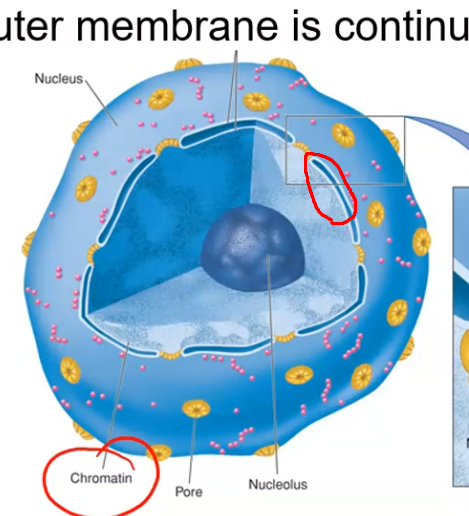
Why are nuclear pores so selective about what enters or exits the nucleus?
Because the nucleus houses DNA, and anything entering must not risk damaging it.
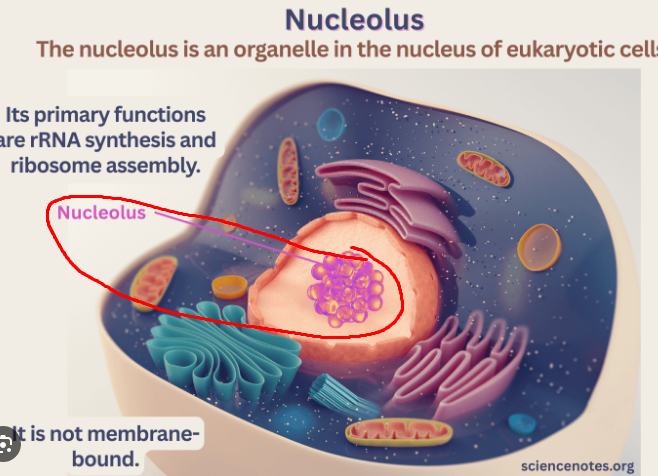
What is the nucleolus and what happens there?
A dense structure inside the nucleus where RNA is made and ribosome assembly takes place. (Not the same as the nucleus.)
What is chromatin?
DNA in its slightly condensed, organized form as it's stored in the nucleus.
What is chromatin made of?
DNA and its associated proteins, it wraps around histone proteins.
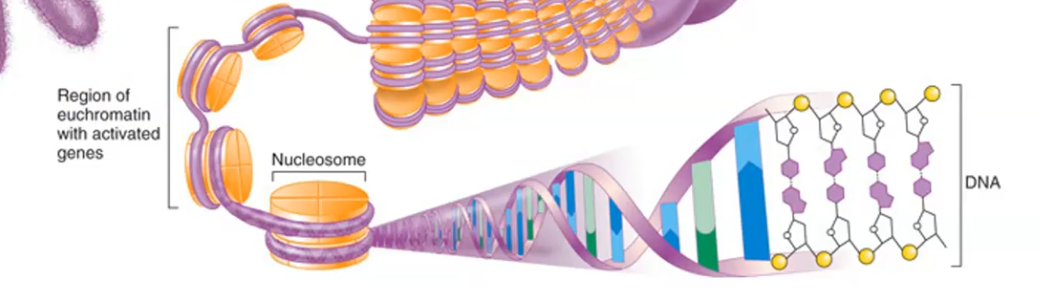
Why does DNA wrap around histones?
Similar to string wrapped around a spool, preventing tangling of the 46 long DNA strands.
What is a nucleosome?
Nucleosome is when chromatin is wrapped around histone

What is the relationship between chromatin and chromosomes?
Chromatin is DNA wrapped around histones (slightly condensed).
=
When chromatin further condenses, it forms a chromosome.
When does chromatin further condense into chromosomes?
During mitosis (cell division).
What is euchromatin?
The lightly condensed, active part of chromatin that is currently being used for transcription (protein synthesis).
What is heterochromatin?
The highly condensed region of chromatin where genes are permanently inactivated.
Why does DNA's code matter to the body's "blueprint"?
The order of nucleotide bases (A, G, C, T) codes for proteins, including enzymes that build or break down substances — so DNA indirectly determines what the cell makes or does.
Why don't all cells look or function the same if they have the same DNA?
Cells do not look or function the same because they use different parts of the same DNA blueprint.
What is gene expression?
A process by which the genes in our DNA are converted into a protein.
What is a gene?
A length of DNA that codes for a protein.
What are the 2 stages of gene expression?
Transcription and translation.
What is transcription?
The process where a DNA sequence in a gene is copied (turned) into an mRNA sequence.
What is translation?
The process where an mRNA sequence is used to make a protein.
Translation is when a ribosome grabs the mRNA sequence that was made during transcription and uses it to make proteins.
Where does transcription occur, and why?
Inside the nucleus — because DNA never exits the nucleus (it must be protected from enzymes, bacteria, and other things in the cytoplasm that could damage it).
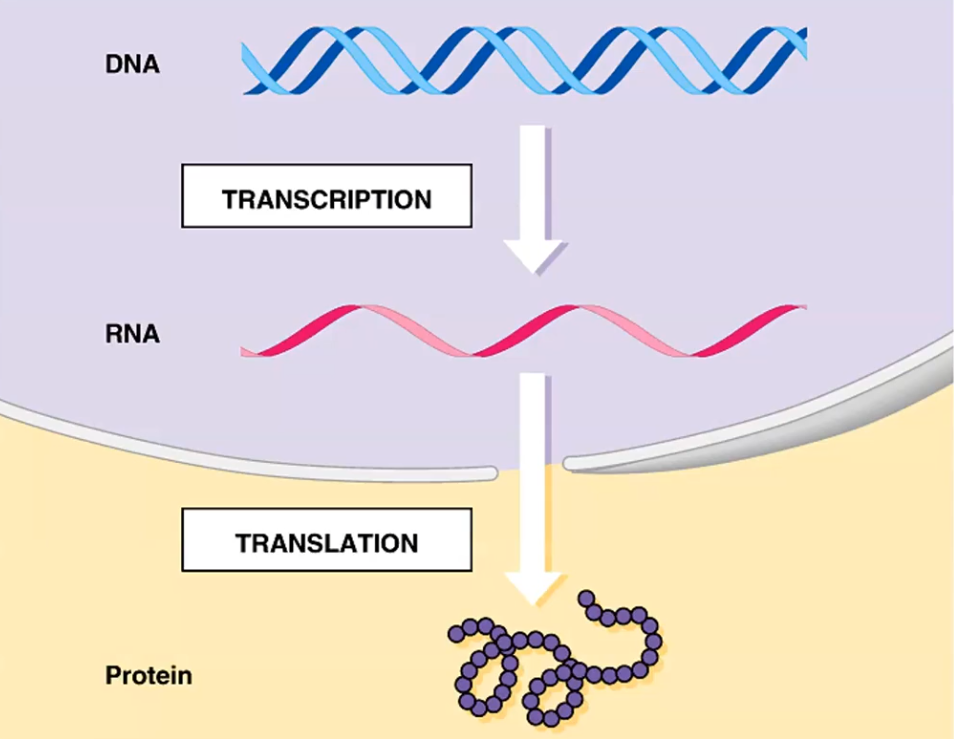
What happens after mRNA is made?
It exits the nucleus, and translation occurs — a ribosome grabs the mRNA, reads the code, and makes a protein from it.
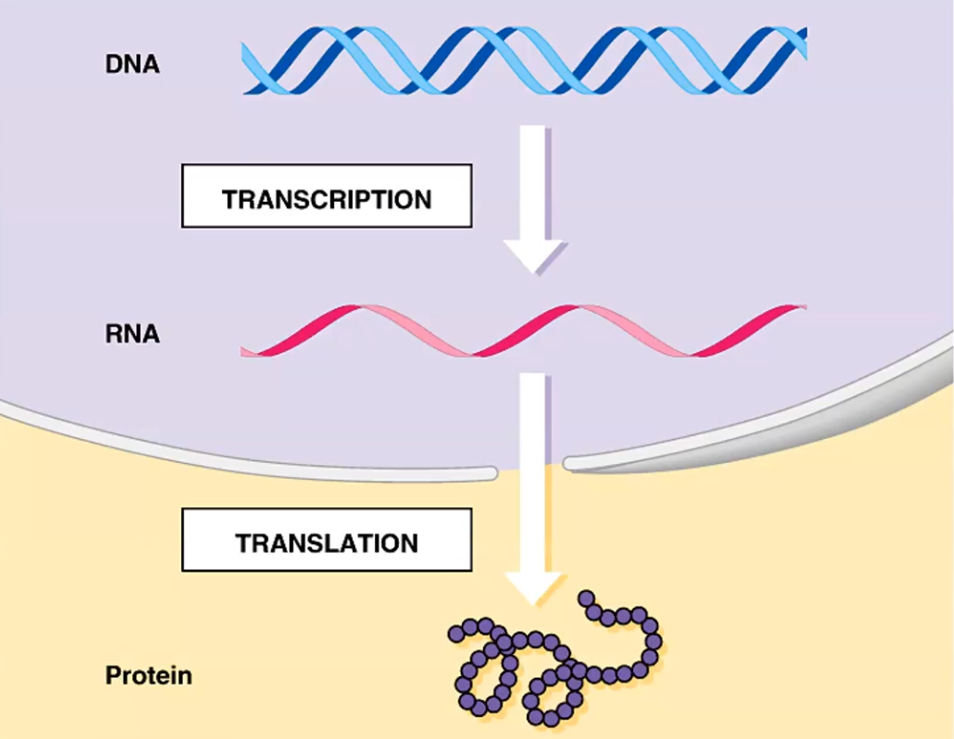
What is the overall flow of gene expression (DNA to protein)?
DNA → (transcription, in the nucleus, makes pre-mRNA →
—
Splicing is a process where introns are removed exons are joined simultaneously →
—
Becomes mature mRNA) → mRNA exits nucleus → (translation, in the cytoplasm) → Protein.
What enzyme carries out transcription, and what does it do?
RNA polymerase — attaches to one strand of DNA, reads the code, and builds a complementary mRNA strand through base pair complementation.
Why must DNA "unzip" before transcription?
DNA is double-stranded; the two strands must separate so RNA polymerase can read and copy one of them.
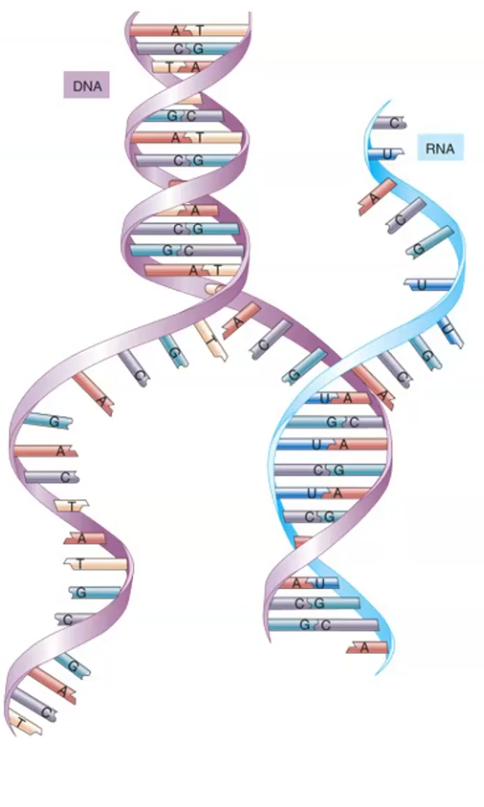
What are the base pairing rules for transcription (DNA → RNA)?
DNA → RNA pairing
Memory trick: "No T, use U" — pair like normal DNA rules, except wherever you'd write T, write U instead.
DNA SIDE ←→ RNA SIDE
A ←→ U
T ←→ A
C ←→ G
G ←→ C
Which strand of DNA is copied during transcription?
Only one of the two strands (called the sense strand) — which one isn't important for physiology.
When does the ribosome detach from mRNA?
When it hits a "stop" sequence/codon.
Can you transcribe this DNA strand to mRNA? T A C G G A T C C
T → A
A → U
C → G
G → C
G → C
A → U
T → A
C → G
C → G
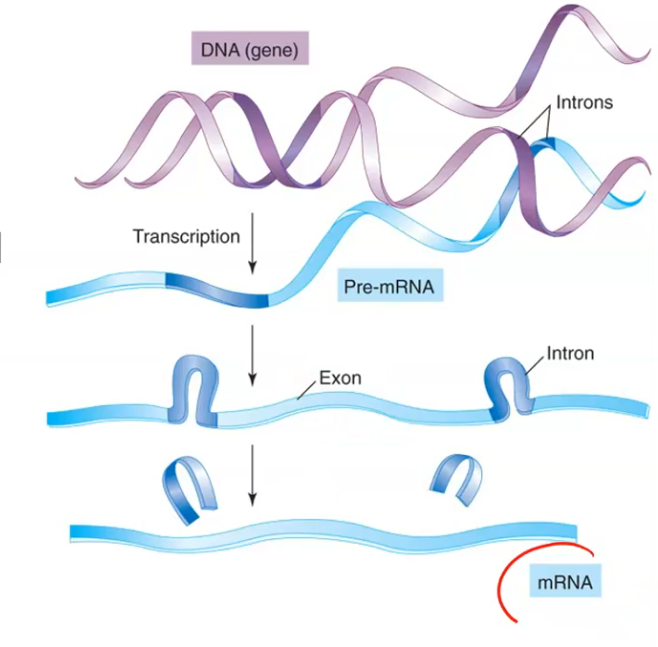
What is pre-mRNA?
A non-mature mRNA (can’t be decoded with introns attached).
—
The initial RNA copy made during transcription, before processing — much larger than the final mRNA, containing both introns and exons.
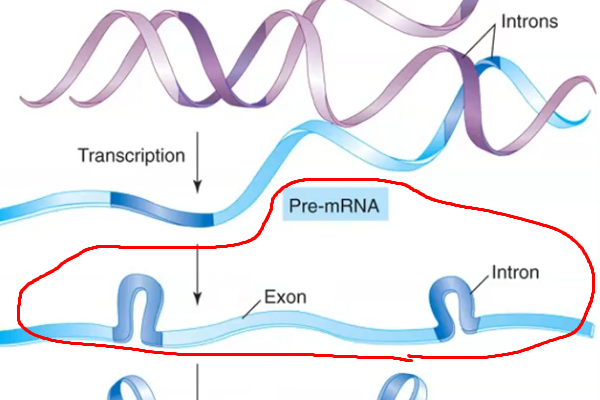
What are introns and exons?
Introns = non-coding regions of pre-mRNA (removed during processing).
—
Exons = coding regions of pre-mRNA (spliced together into the final mRNA).
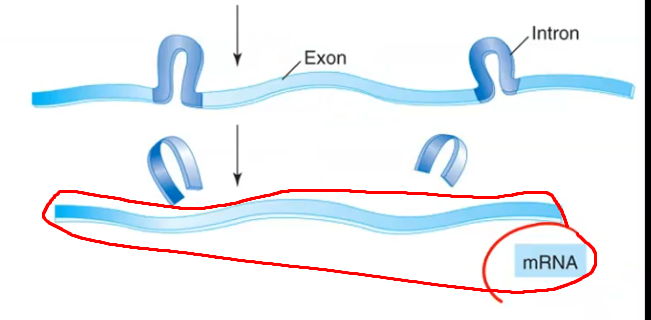
What is splicing?
Simultaneous process of removing introns and joining exons.
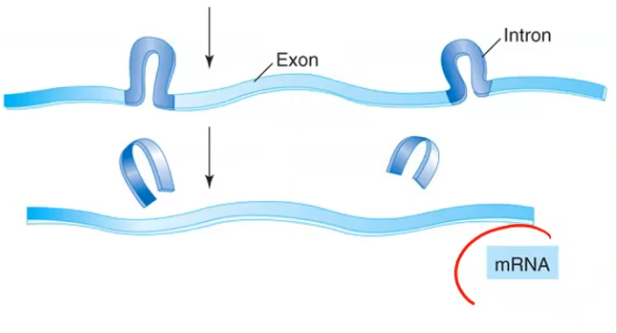
Why can the human body make over 100,000 proteins with only ~25,000 genes?
Alternative splicing: One gene can produce multiple mRNAs and proteins by combining exons in different ways.
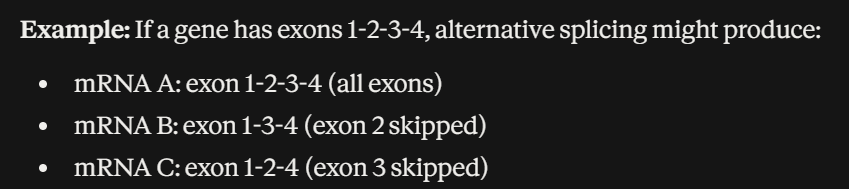
What is alternative splicing?
Different exon orders = can produce more different proteins
Double check this card w professor
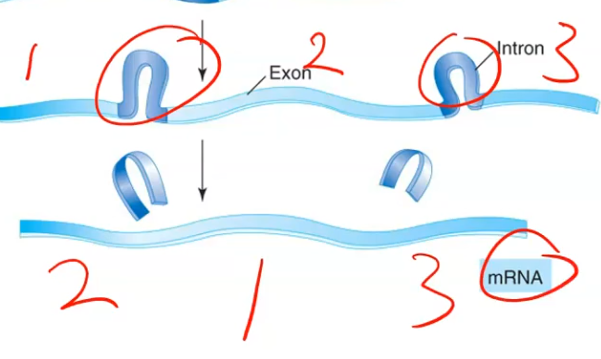
On average, how many different proteins can one gene code for?
About 3 different proteins.
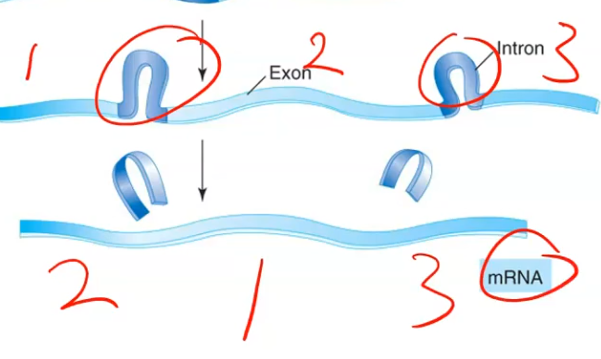
Where does translation occur, and what attaches to mRNA there?
In the cytoplasm — ribosomes attach to the mRNA.
How does translation/protein synthesis proceed?
A ribosome reads 1 amino acid at a time (3 letters) but doesn’t start coding proteins until it hits AUG.
Can multiple ribosomes translate the same mRNA at once?
Yes — many ribosomes can attach to and read the same mRNA simultaneously, each producing its own growing protein.
What is a codon?
A triplet of 3 mRNA bases, read by the ribosome, that specifies one amino acid.
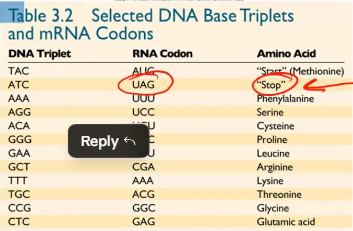
What is the start codon and what does it signal?
Does the ribosome make proteins before reaching a start codon Y/N?
AUG — signals the ribosome to begin reading codon-by-codon, and codes for methionine (the first amino acid in every protein).
No, it does not.
What happens when a ribosome reaches a stop codon?
It does not add an amino acid; instead, the protein is released onto the rough ER and the ribosome detaches from the mRNA.
Do all stop codons code for an amino acid?
No — there are multiple stop codons (UAG), and none of them code for an amino acid.
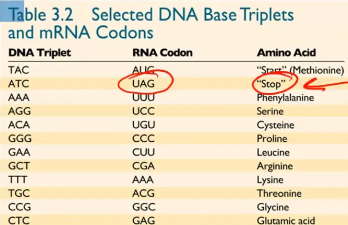
What does the codon AUG code for?
Methionine — the first amino acid in every protein / the start codon.
What are the 3 stop codons?
UAA, UAG, UGA — none code for an amino acid; they signal the ribosome to release the protein and detach from the mRNA.

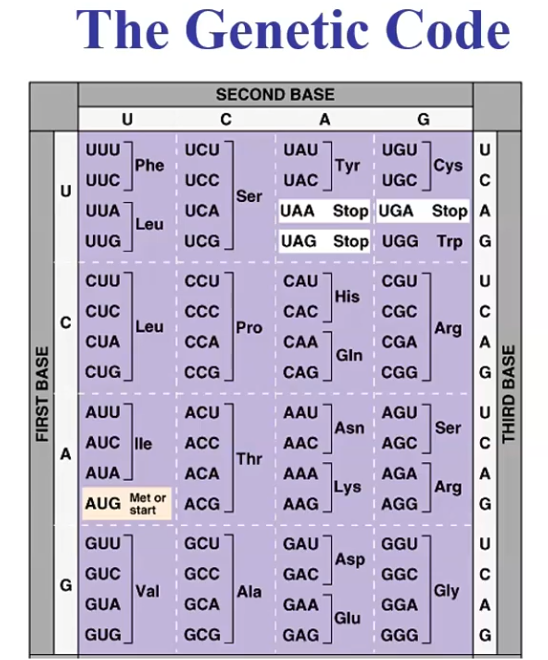
Can you decode using this table? A U G C C C G A G A A A U G A
AUG → Met (start)
CCC → Pro
GAG → Glu
AAA → Lys
UGA → Stop
Protein: Met-Pro-Glu-Lys
Walk through the complete process of gene expression from DNA to protein.
DNA is transcribed in the nucleus by RNA polymerase → pre-mRNA is made → introns removed, exons spliced together → mature mRNA exits nucleus → ribosome attaches in cytoplasm → reads one base at a time until AUG (start) → switches to reading one codon (3 bases) at a time → each codon adds a specific amino acid → continues until stop codon (UAA, UAG, UGA) → ribosome releases finished protein to rough ER and detaches from mRNA.
What are the 3 types of RNA involved in protein synthesis?
mRNA (messenger RNA — carries the code from DNA).
rRNA (ribosomal RNA — part of ribosomes).
tRNA (transfer RNA — carries amino acids to the ribosome).
What is tRNA and what is its function?
Transfer RNA — carries amino acids to the ribosome. If the tRNA's anticodon matches the mRNA codon, the ribosome adds that amino acid to the growing protein.
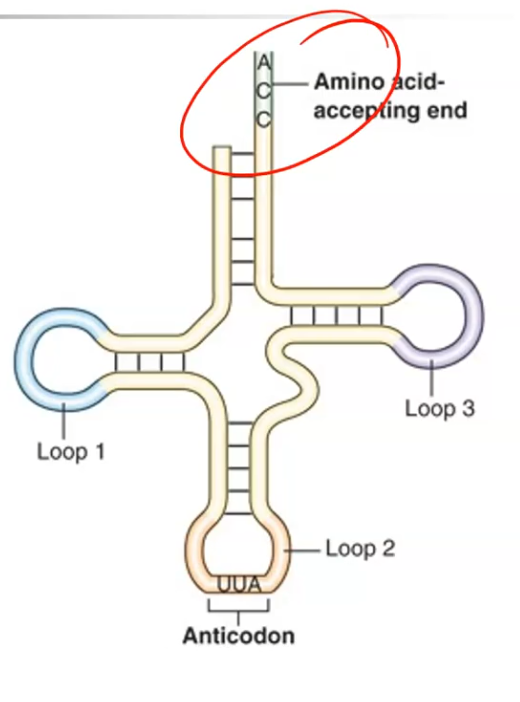
What is an anticodon?
The region of tRNA that contains the complementary sequence to a specific mRNA codon — allows the correct amino acid to be delivered to the ribosome.
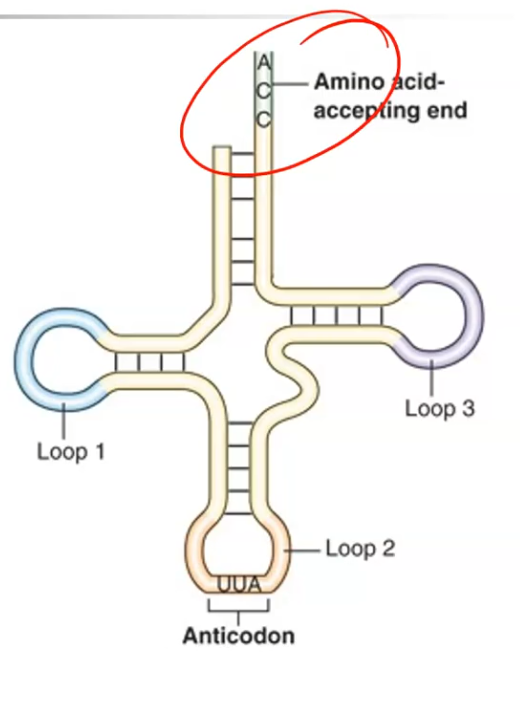
What is an organelle?
A small structure within the cell that performs a specialized function to help the cell survive — analogous to organs of the body.