Water and Bonds
 Call Kai
 Learn
Learn Practice Test
 Spaced Repetition
 Match
Match Flashcards
 Knowt Play
1/20

There's no tags or description
Looks like no tags are added yet.
Name | Mastery | Learn | Test | Matching | Spaced | Call with Kai | Chat |
|---|
No analytics yet
Send a link to your students to track their progress
21 Terms
What is a hypothesis, and how does it differ from a theory?
A hypothesis is a testable educated guess whereas a theory is an explanation that is well-supported by multiple lines of evidence and so has a high level of certainty.
Why does biology rely primarily on theories rather than laws?
Biologists are reluctant to use laws as a law makes an assertion without explaining what happens. Biology mainly use theories as they explain why things happen and serve as a foundation to help us understand how life works.
Also theories are more suited to biology as life is complex and we constantly find exceptions to what we know.
State the three classical tenets of the cell theory.
1. All living organisms are composed of cells
2. Cells are the smallest living unit of all organisms
3. Cells only arise from pre-existing cells
What essential functions must a cell be able to perform to be considered "alive"?
Reproduce themselves
Store and transmit information (e.g. DNA)
Separate self from world
Membranes (e.g. to move nutrients in and waste out of cell)
Capture and transform energy
Through chemical reactions
Are viruses classified as alive or not alive, and why?
A virus is not alive. Viruses rely on host cells to function.
Viruses cannot reproduce themselves; they need a host cell to use or copy their genetic material
Viruses have a membrane but don’t move anything across it
Viruses need a host cell to capture and use energy

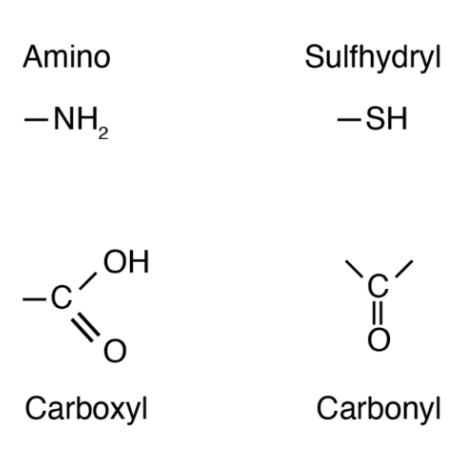
Recall these functional groups
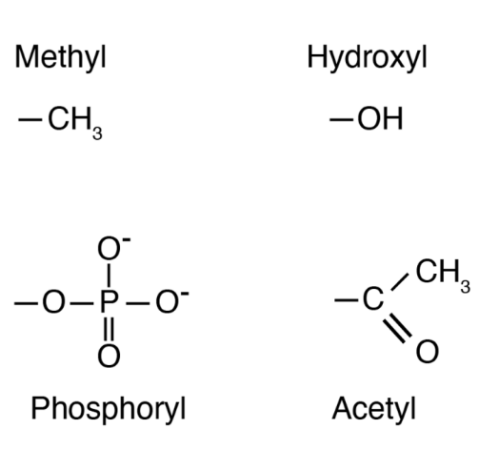
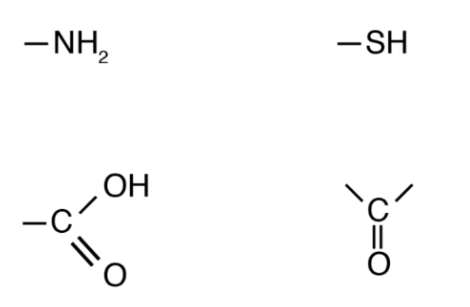
Recall these functional groups
Compare and contrast covalent and noncovalent bonds.
Covalent bond: Two atoms share electrons
Noncovalent bond: Two interacting atoms do not share electrons

What charge state drives an ionic bond?
Ionic bonds are full charge-full charge interactions; a full positive charge with a full negative charge. They are formed when one atom loses an electron and another atom gains an electron.
How are ionic bonds biologically useful in biological interactions?
Ionic bonds are biologically useful as they are the strongest non-covalent bond and are very specific as negative charge only attracts positive charge
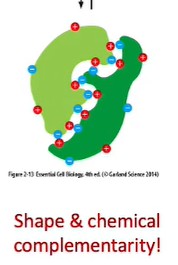
Biological example:
A macromolecule surface has specific charge distribution (e.g. positive charge) that interacts with complementary charge (e.g. negative charge) on another macromolecule surface
What is the general “house rule” for electronegativity?
House rule order for electronegativity (ability of an atom to attract electrons):
O > N >> S > C ≈ H ≈ P
Oxygen (O) has the greatest pull on shared electrons in a covalent bond. Then nitrogen (N) has the second greatest pull, followed by sulfur (S), and finally carbon (C), hydrogen (H), and phosphorus (P) pull roughly the same
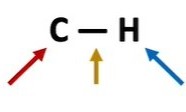
What is a non-polar covalent bond? In the diagram, what arrow represents where electron pair would be located in the bond?
A non-polar covalent bond is where electrons are shared equally between two atoms. In diagram, the electron pair is in the middle of the bond (yellow arrow) as C and H have similar electronegativities/pull for electrons.

What is a polar covalent bond?
A polar covalent bond involves unequal sharing of electrons between two atoms resulting in partial charges.
Example with O-H: The more electronegative atom oxygen (O) pulls on electrons more strongly and electrons move closer to O and further away from hydrogen (H); O gains a partial negative charge while H gains a partial positive charge.

How do partial charges allow hydrogen bonds to form?
A partial positive charge on H of one molecule is attracted to a partial negative charge on an electronegative atom (e.g. O, N, S) of another molecule leading to a non-covalent hydrogen bond
Example: H2O
A polar covalent bond occurs between H and O atoms of one water molecule
A hydrogen bond occurs between H and O atoms of two different water molecules

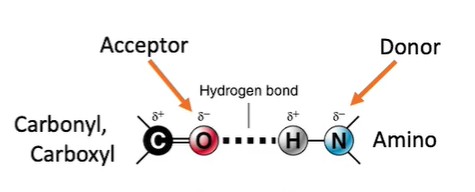
Describe the "hydrogen sandwich" concept, defining the roles of the H-bond donor and acceptor.
“Hydrogen sandwich”: a hydrogen bond happens when H gets caught between electronegative atoms
Hydrogen bond donor: a molecule that is covalently attached to H, so donates H to sandwich
Hydrogen bond acceptor: a nearby atom with a partial negative charge that can accept the weak attractions from the H
Why is water so uniquely cool when it freezes? What happens to H-bonds as water transitions between liquid and solid?
When water freezes, the water molecules are held in a rigid fixed state by hydrogen bonds. This ordered structure spaces water molecules out making ice less dense than liquid water.
When water turns from solid to liquid, the water molecules are not held far apart in fixed hydrogen bonds, instead the hydrogen bonds continually break and form as water molecules move.
Why is it crucial for life that liquid water is denser than solid water?
The ordered hydrogen bonds in solid water (i.e. ice) makes it float. Ice can form an insulating layer on top, allowing life to stay alive in liquid water underneath.
Compare and contrast cohesion and adhesion.
Cohesion: Water molecules form hydrogen bonds with other water molecules, allowing water molecules to stick to one another. E.g. important for surface tension.
Adhesion: Water molecules form hydrogen bonds with polar molecules, causing water molecules to stick to other polar molecules. E.g. important for capillary action.

Explain the hydrophobic effect. How does this lead to van der Waals (vdW) interactions?
Hydrophobic effect: Polar molecules (e.g. water) exclude non-polar molecules causing non-polar molecules to be forced close together.
The hydrophobic effect leads to many atoms being brought close together which can lead to van der Waals interactions which are weak non-covalent interactions between nearby atoms. Each individual reaction is weak but if there are many atoms interacting this can provide stability.


Why does life rely on weak noncovalent interactions rather than strong covalent bonds to build structures and respond to the environment?
Non-covalent interactions are weak enough to be easily broken and reformed without investing large amounts of energy. This is important for life because cells need to change rapidly to the environment – the faster a cell can respond using the least energy needed, the more fit the organism is to survive.
Life is dependent on weak noncovalent interactions to build structures and respond to the environment. Relate this to "shape and chemical complementarity"
Shape and chemical complementarity – the variety of non-covalent interactions between macromolecules makes the interaction very specific
For example:
ionic bond: requires full positive charge with full negative charge
hydrogen bond: hydrogen bond donor with hydrogen bond acceptor
van der Waals interactions: often non-polar with non-polar
