Chapter 6iii - Organic chemistry 1 (halogenoalkanes and alcohols)
 Call Kai
 Learn
Learn Practice Test
 Spaced Repetition
 Match
Match Flashcards
 Knowt Play
1/35

There's no tags or description
Looks like no tags are added yet.
36 Terms
What is a halogenoalkane?
Alkanes attached to one or more halogen atoms in place of a hydrogen atom.

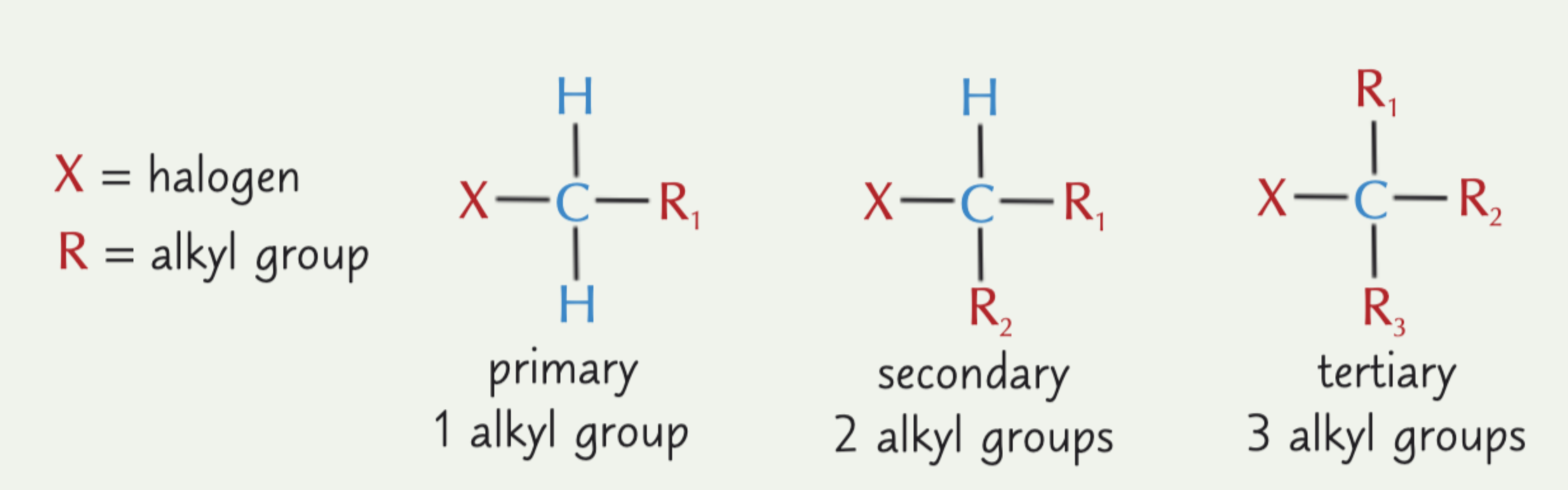
What is the difference between a primary, secondary and tertiary halogenoalkane?
On the carbon with the halogen attached:
A primary halogenoalkane has two hydrogen atoms and just one alkyl group.
A secondary halogenoalkane has just one hydrogen atom and two alkyl groups.
A tertiary halogenoalkane has no hydrogen atoms and three alkyl groups.
What prefixes are used to name the halogenoalkanes?
Fluoro for fluorine
Chloro for chlorine
Bromo for bromine
Iodo for iodine
The name of the halogenoalkane is based on the origonal alkane
So CH3CH2CH2Br would be 1-bromopropane
The position of the halogen atom must be taken into account
So CH3CH(Br)CH3 would be 2-bromopropane
Finally the substituents are listed alphabetically
So CH3CH(Cl)CH2Br would be 1-bromo-2-chloropropane
What is a nucleophile?
A nucleophile is an electron-rich species that can donate a pair of electrons
‘Nucleophile’ means ‘nucleus / positive charge loving’ as nucleophiles are attracted to positively charged species
Nucleophilic refers to reactions that involve a nucleophile
What are the most common reactions that halogenoalkanes are involved in?
Halogenoalkanes commonly undergo substitution reactions, where the halogen is replaced by another atom or group.
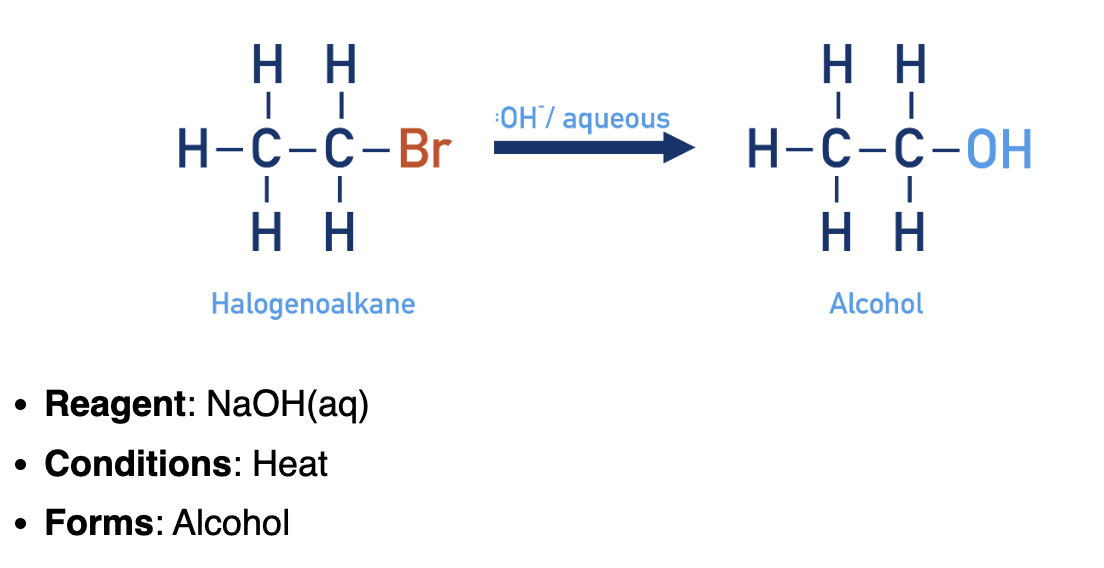
Describe the reaction between halogenoalkane and aqueous potassium hydroxide to produce alcohols
The nucleophile in this reaction is the hydroxide ion, OH-
An aqueous solution of sodium hydroxide (NaOH) or potassium hydroxide (KOH) with ethanol is used to form an alcohol
This reaction is very slow at room temperature, so the reaction mixture is warmed
This is an example of a hydrolysis reaction and the product is an alcohol

The halogen is replaced by the nucleophile, OH-
This reaction could also be done with water as the nucleophile, but it is very slow
The hydroxide ion is a better nucleophile than water as it carries a full negative charge
In water, the oxygen atom only carries a partial charge

A hydroxide ion is a better nucleophile as it has a full formal negative charge whereas the oxygen atom in water only carries a partial negative charge; this causes the nucleophilic substitution reaction with water to be much slower than the aqueous alkali
Describe the reaction between halogenoalkane and aqueous silver nitrate in ethanol
The water molecule is a weak nucleophile, but it will eventually substitute for the halogen
This occurs much more slowly compared to when warm aqueous sodium hydroxide is used
An alcohol is produced
RX + H2O → ROH + H+ + X-
CH3CH2Br + H2O → CH3CH2OH + H+ + Br-
If silver nitrate solution in ethanol is added to the solution, the silver ions will react with the halide ions as soon as they form, giving a silver halide precipitate
Ag+ (aq) + X- (aq) → AgX (s)
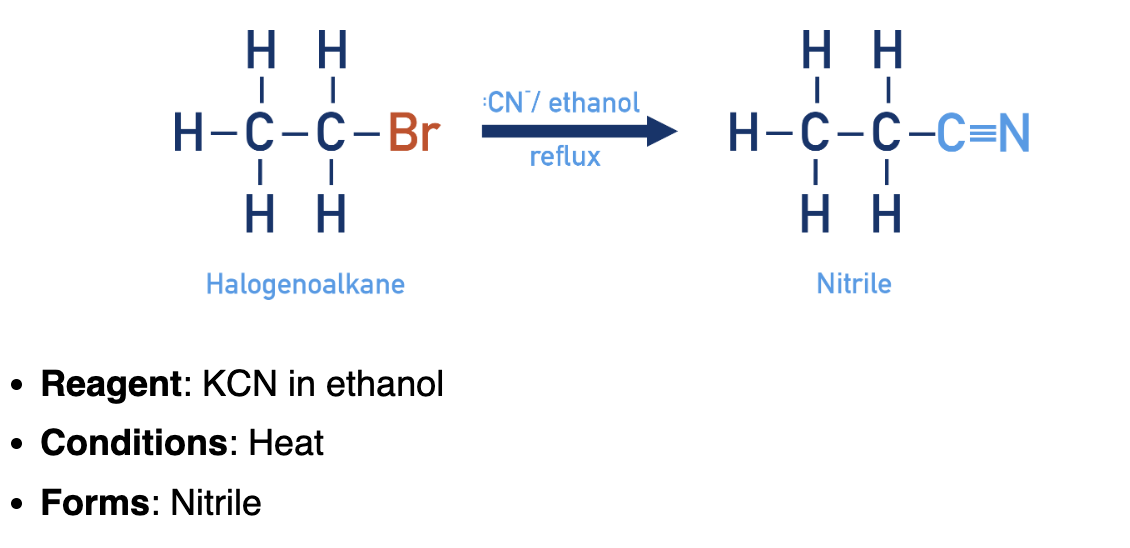
Describe the reaction between halogenoalkane and potassium cyanide to produce nitriles
The nucleophile in this reaction is the cyanide ion, CN-
An ethanolic solution of potassium cyanide (KCN in ethanol) is heated under reflux with the halogenoalkane
The product is a nitrile
E.g. bromoethane is heated under reflux with ethanolic potassium cyanide to form propanenitrile

The halogen is replaced by a cyanide group, CN -
The nucleophilic substitution of halogenoalkanes with KCN extends the carbon chain by adding an extra carbon atom
This reaction can therefore be used by chemists to make a compound with one more carbon atom than the best available organic starting material
Describe the reaction between halogenoalkane and ammonia to produce primary amines
The nucleophile in this reaction is the ammonia molecule, NH3
An ethanolic solution of excess ammonia (NH3 in ethanol) is heated under pressure with a primary halogenoalkane
An excess of ammonia is used because the product is more reactive than ammonia so further substitution reactions could occur
The product is a primary amine
E.g. bromoethane reacts with excess ethanolic ammonia when heated under pressure to form ethylamine

The halogen is replaced by an amine group, NH2

Describe the reaction between halogenoalkane and ethanolic potassium hydroxide to produce alkenes
This is an elimination reaction
The hydroxide ions are acting as a base to remove the H+ ion from the halogenoalkane
The halogenoalkanes are heated under reflux with ethanolic sodium hydroxide causing the C-X bond to break heterolytically, forming an X- ion and leaving an alkene as an organic product
E.g. bromoethane is heated under reflux with ethanolic sodium hydroxide to form ethene

Production of an alkene from a halogenoalkane by reacting it with ethanolic sodium hydroxide and heating it

Hydrogen bromide is eliminated to form ethene
What is the reaction mechanism for a nucleophilic substitution of a halogenoalkane?

What is the reaction mechanism for the reaction of halogenoalkanes that forms alcohols?
Reaction with OH− (Hydrolysis to Alcohols)
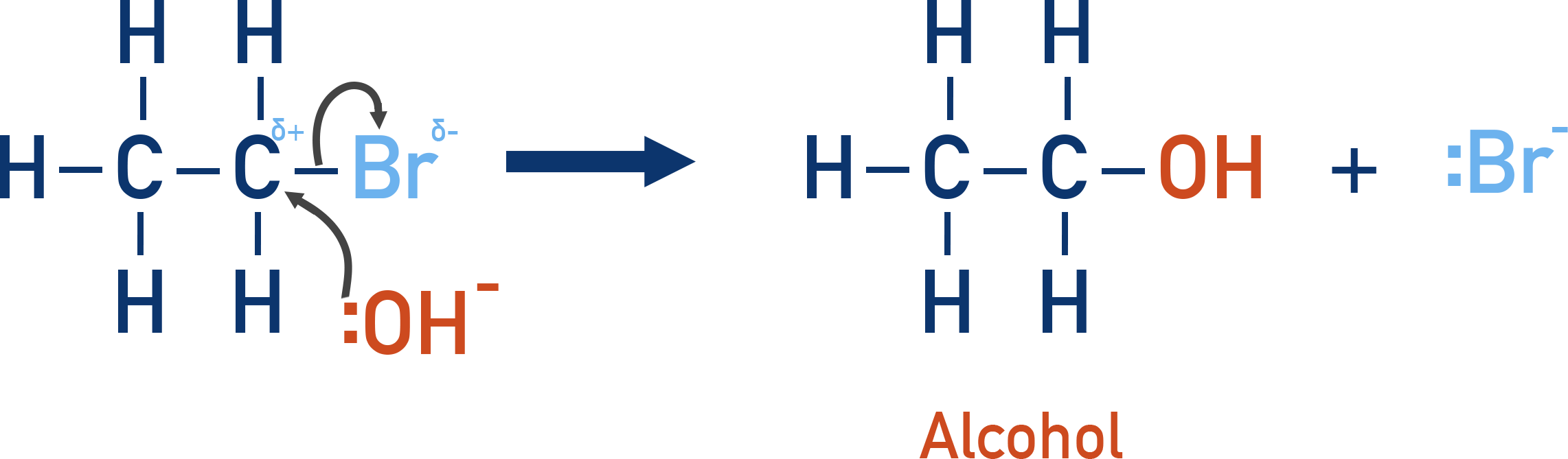
Reagent: Aqueous NaOH/KOH.
Conditions: Warm, reflux.
What is the reaction mechanism for the reaction of halogenoalkanes that forms primary amines?
Reaction with NH3 (Formation of Amines)
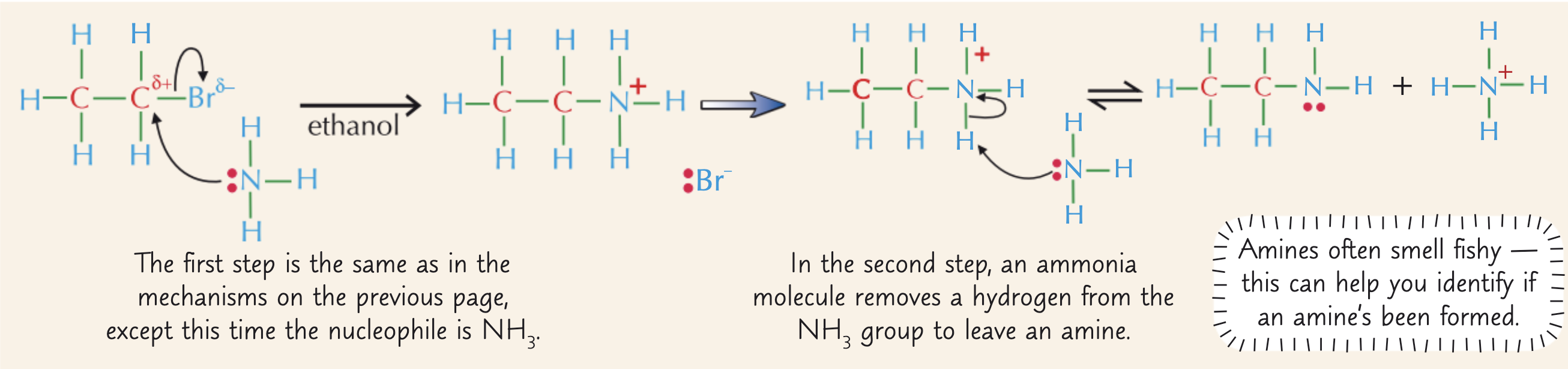
The diagram shoes Br- as a product in step 2 but don’t forget that it is a product
Reagent: Excess NH3 in ethanol.
Conditions: Sealed tube, pressure.
How can you compare the reactivities of halogenoalkanes?

Bromine has a creme precipitate
Iodine is pale yellow
Chlorine is white
You can do this same experiment with primary, secondary and tertiary halogenoalkanes
Which types of halogenoalkanes are most reactive?
The tertiary halogenoalkanes is the MOST reactive and the primary haloganoalkanes is the LEAST reactive
Iodine haloganoalkanes are the MOST reactive and fluorine haloganoalkanes are the LEAST reactive.
What is an Sn1 reaction and what is an Sn2 reaction?
In tertiary halogenoalkanes, the carbon that is attached to the halogen is also bonded to three alkyl groups
These halogenoalkanes undergo nucleophilic substitution by an SN1 mechanism
‘S’ stands for ‘substitution’
‘N’ stands for ‘nucleophilic’
‘1’ means that the rate of the reaction (which is determined by the slowest step of the reaction) depends on the concentration of only one reagent, the halogenoalkane
The SN1 mechanism is a two-step reaction
In the first step, the C-X bond breaks heterolytically and the halogen leaves the halogenoalkane as an X- ion (this is the slow and rate-determining step)
This forms a tertiary carbocation (which is a tertiary carbon atom with a positive charge)
In the second step, the tertiary carbocation is attacked by the nucleophile
For example, the nucleophilic substitution of 2-bromo-2-methylpropane by hydroxide ions to form 2-methyl-2-propanol

The mechanism of nucleophilic substitution in 2-bromo-2-methylpropane which is a tertiary halogenoalkane
SN2 reactions
In primary halogenoalkanes, the carbon that is attached to the halogen is bonded to one alkyl group
These halogenoalkanes undergo nucleophilic substitution by an SN2 mechanism
‘S’ stands for ‘substitution’
‘N’ stands for ‘nucleophilic’
‘2’ means that the rate of the reaction (which is determined by the slowest step of the reaction) depends on the concentration of both the halogenoalkane and the nucleophile ions
The SN2 mechanism is a one-step reaction
The nucleophile donates a pair of electrons to the δ+ carbon atom of the halogenoalkane to form a new bond
At the same time, the C-X bond is breaking and the halogen (X) takes both electrons in the bond
The halogen leaves the halogenoalkane as an X- ion
For example, the nucleophilic substitution of bromoethane by hydroxide ions to form ethanol

The SN2 mechanism of bromoethane with hydroxide causing an inversion of configuration
Why is iodine the most reactive?
In order to hydrolyse a halogenoalkane, you have to break the carbon-halogen bond.
How quickly different halogenoalkanes are hydrolysed depends on the carbon-halogen bond enthalpy
Weaker carbon-halogen bonds break more easily — so they react faster.
Bond enthalpy depends on the size of the halogen — the larger the halogen, the longer the C-X bond, and the lower the bond enthalpy.
The size of the halogen increases down Group 7, so iodoalkanes have the weakest bonds, and are hydrolysed the fastest. Fluoroalkanes have the strongest bonds, so they're the slowest at hydrolysing.
You can compare the reactivity of chloroalkanes, bromoalkanes and iodoalkanes using an experiment like the one on the previous page.
bond | bond enthalpy / kJ mol-1 |
C-F | 467 |
C-Cl | 346 |
C-Br | 290 |
C-I | 228 |
There is faster hydrolysis as bond enthalpy decreases (the bonds get weaker).
What is an alcohol?
Alcohols are a family of molecules that contain the hydroxyl functional group, -OH
Their general formula is CnH2n+1OH
The nomenclature of alcohols follows the pattern alkan + ol
If there are two -OH groups present the molecule is called a diol
How can alcohols be classed?
Alcohols are classified as primary, secondary or tertiary depending on the number of carbons attached to the functional group carbon
Primary alcohols are alcohols in which the carbon atom bonded to the -OH group is attached to one other carbon atom (or alkyl group)
Secondary alcohols are alcohols in which the carbon atom bonded to the -OH group is attached to two other carbon atoms (or alkyl groups)
Tertiary alcohols are alcohols in which the carbon atom bonded to the -OH group is attached to three other carbon atoms (or alkyl groups)

Classifying primary, secondary and tertiary alcohols and alcohols with more than one alcohol group
Describe the combustion of alcohols?
Alcohols burn in oxygen to produce carbon dioxide and water.
General equation:
CnH2n+1OH + O2 → CO2 + H2O
All alcohols release energy on combustion, making them useful fuels. Complete combustion occurs with excess oxygen; incomplete combustion produces CO or C.
Describe the reaction between alcohols and PCl5?

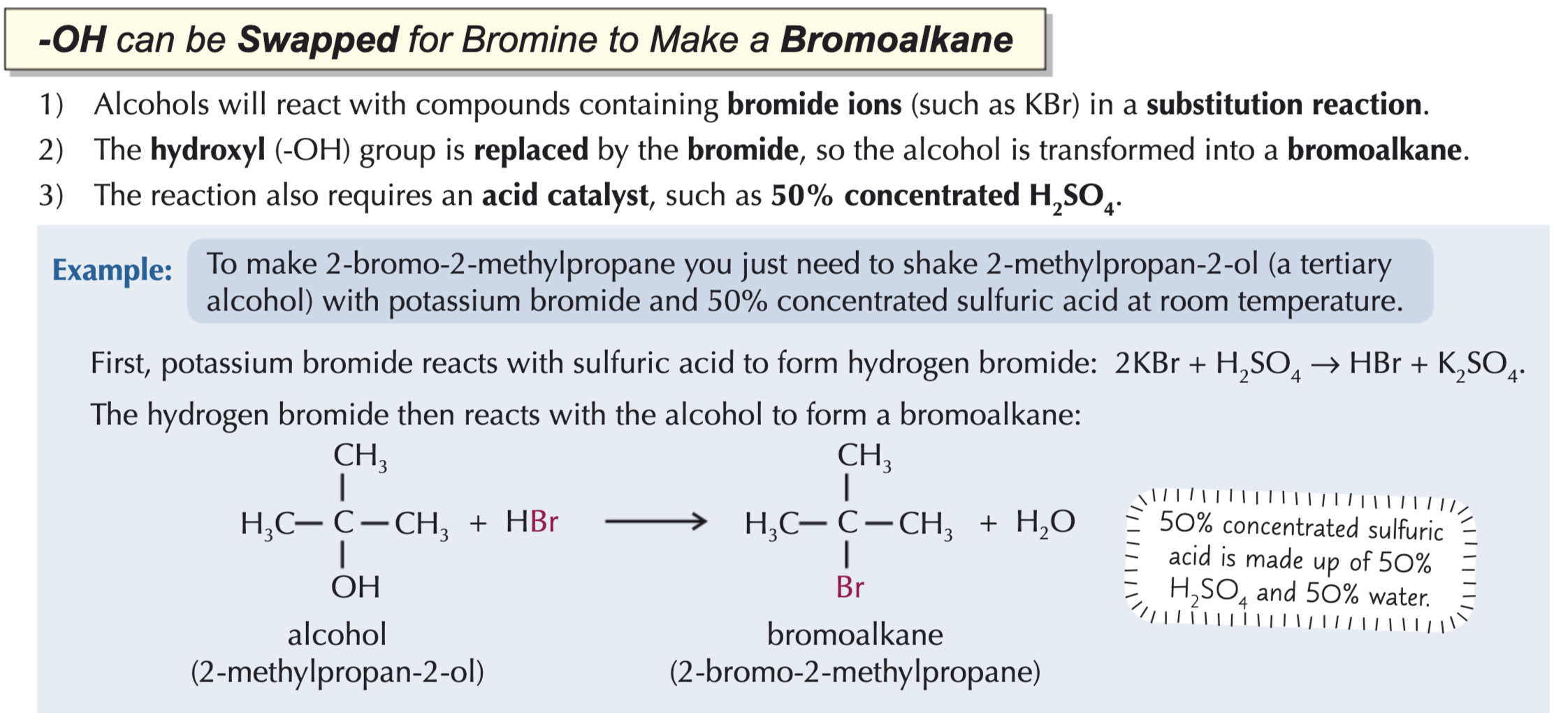
Describe the reaction between alcohols and 50% concentrated sulfuric acid and potassium bromide?
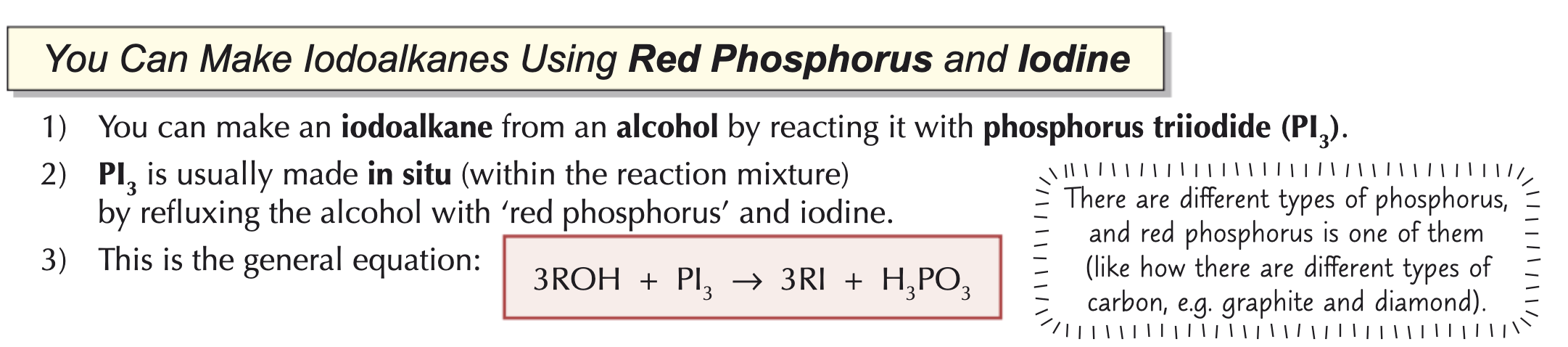
Describe the reaction between alcohols and red phosphorus and iodine?
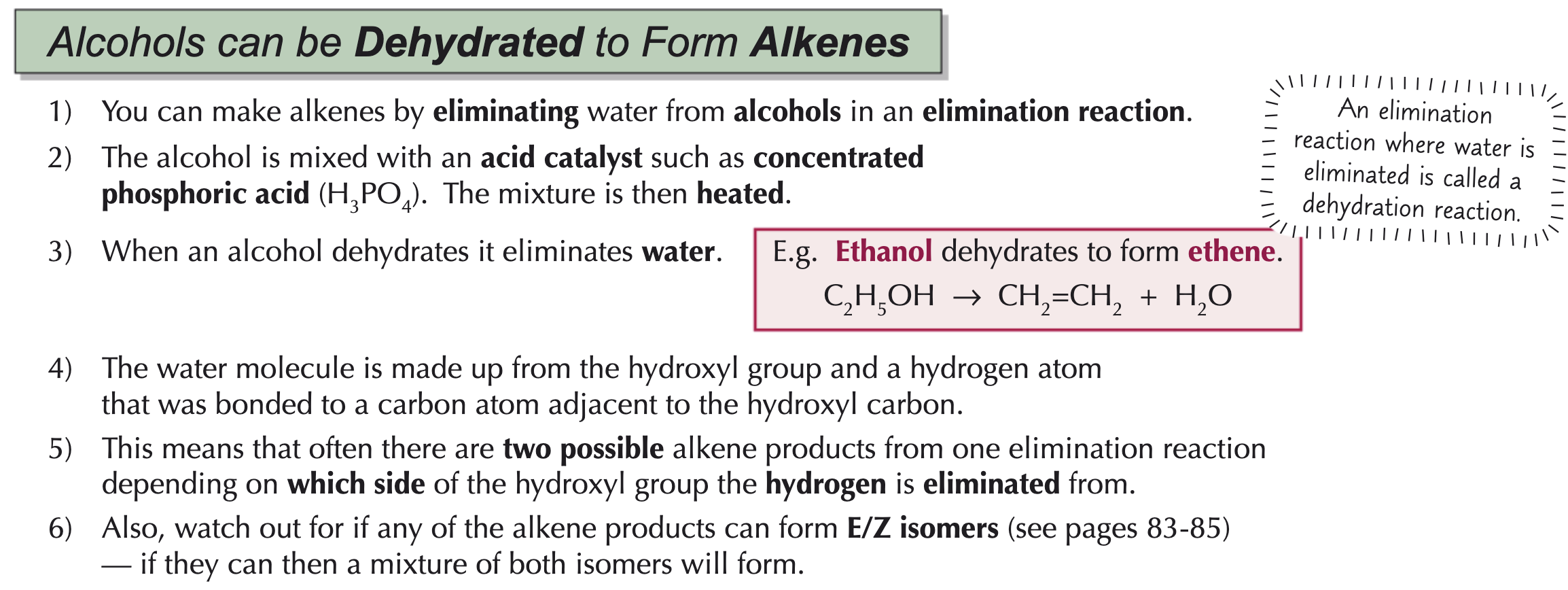
Describe the reaction of alcohols with concentrated phosphoric acid to form alkenes by elimination
What types of alcohols can be oxidised?
Primary alcohols can be oxidised to form aldehydes which can undergo further oxidation to form carboxylic acids
Secondary alcohols can be oxidised to form ketones only
Tertiary alcohols do not undergo oxidation
For alcohol oxidation, the oxidising agent is usually acidified potassium dichromate(VI), K2Cr2O7 + H2SO4. It changes from orange to green when reduced.
What are aldehydes and ketones?
Thy are both carbonyl compounds — they have the functional group C=O. Their general formula is C„H,nO.

How do you test for aldehydes and keytones?
You can test whether a compound is an aldehyde or a ketone using Benedict's solution. This is a blue solution of complexed copper(II) ions dissolved in sodium carbonate.
If it's heated with an aldehyde the blue copper(II) ions are reduced to a brick-red precipitate of copper(I) oxide.
If it's heated with a ketone, nothing happens as ketones can't be easily oxidised.
This test can also be done using Fehling's solution, which contains copper (II) ions dissolved in sodium hydroxide. The colour change from blue to red in the presence of an aldehyde is the same. Again, nothing happens with a ketone.

How are primary alcohols oxidised?
They can be oxdisied twice- once to form an aldehyde and the again to form a carboxylic acid.
You would see the orange Cr2O72− (dichromate) turn green (Cr3+ formed).

1. Formation of Aldehyde (Distillation):
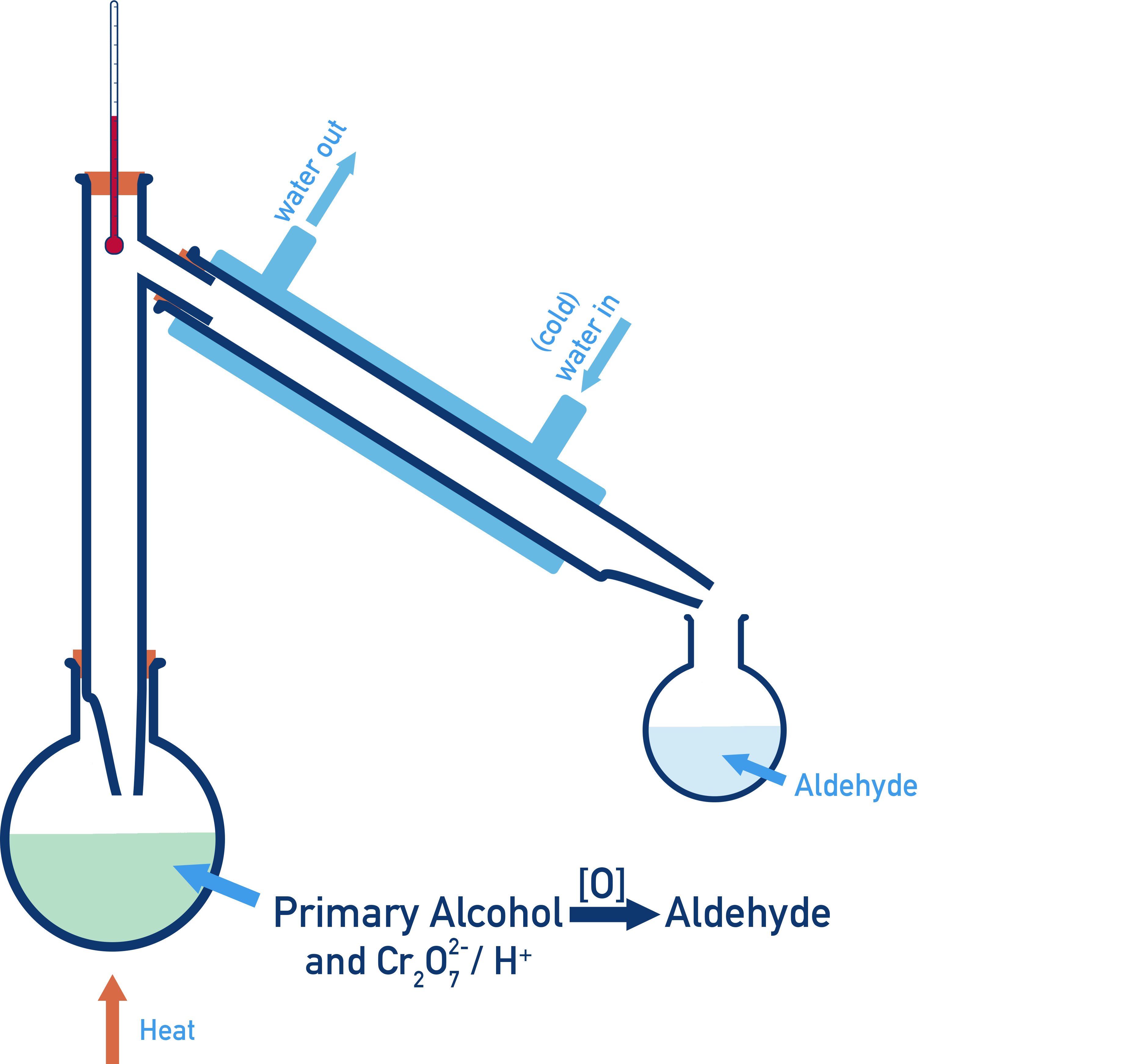
Distillation is needed to obtain the aldehyde because the aldehyde has a low boiling point and will easily evaporate once formed, leaving the reaction mixture as a vapour.
2. Formation of Carboxylic Acid (Reflux):
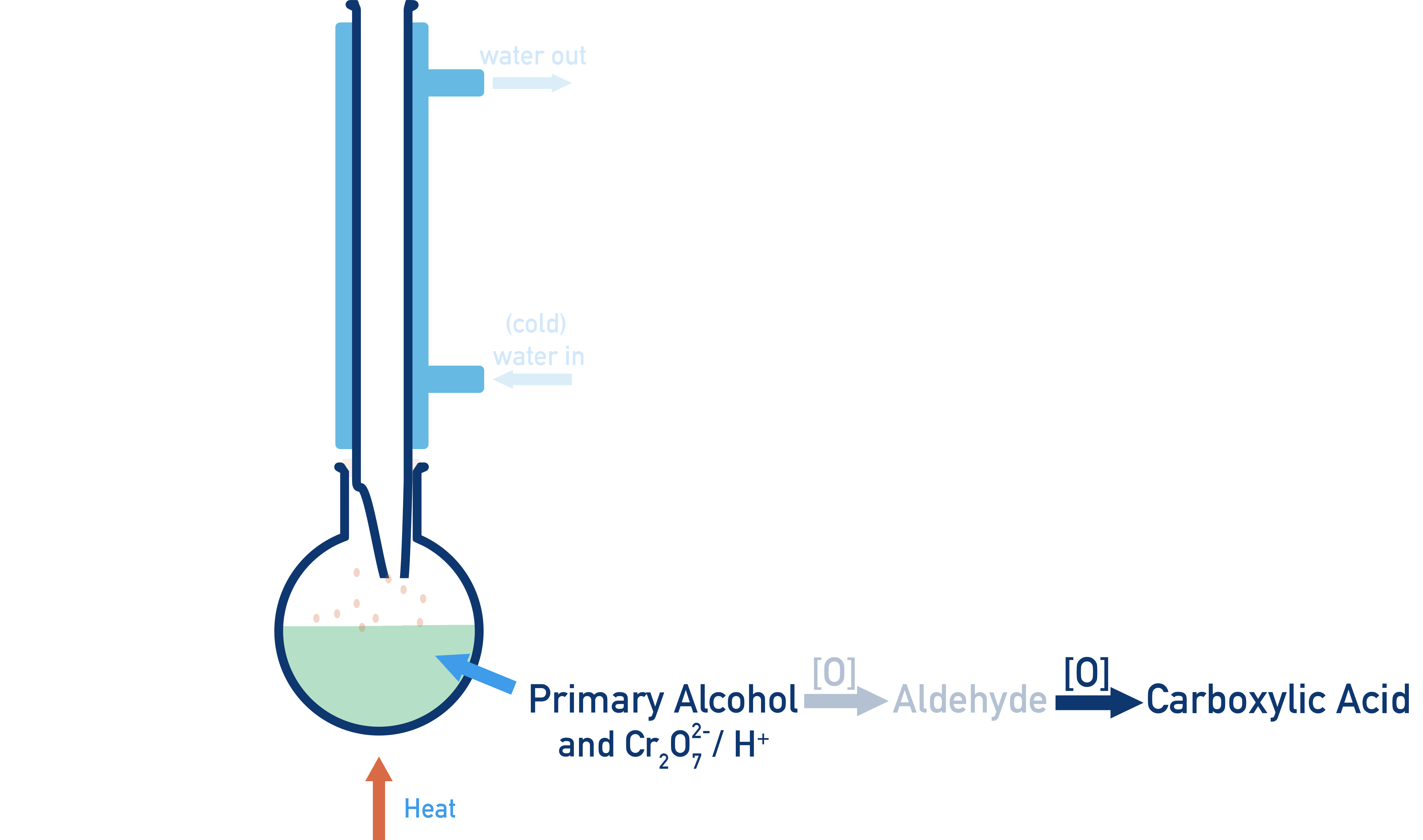
Reflux is needed to obtain the carboxylic acid because the aldehyde must be continually condensed and forced to re-enter the reaction mixture, enabling it to be further oxidised.
How can you control how far a primary alcohol is oxidised?
You can control how far the alcohol is oxidised by controlling the reaction conditions. For example...
Gently heating ethanol with potassium dichromate(VI) solution and sulfuric acid in a test tube should produce "apple" smelling ethanal (an aldehyde). However, it's really tricky to control the amount of heat and the aldehyde is usually oxidised to form "vinegar" smelling ethanoic acid.
To get just the aldehyde, you need to get it out of the oxidising solution as soon as it's formed. You can do this by gently heating excess alcohol with a controlled amount of oxidising agent in distillation apparatus, so the aldehyde (which boils at a lower temperature than the alcohol) is distilled off immediately.
To produce the carboxylic acid, the alcohol has to be vigorously oxidised. The alcohol is mixed with excess oxidising agent and heated under reflux.
1. Formation of Aldehyde (Distillation):
2. Formation of Carboxylic Acid (Reflux):
How are secondary alcohols oxidised?
Refluxing a secondary alcohol, e.g. propan-2-ol, with acidified dichromate(VI) will produce a ketone.
Ketones can't be oxidised easily, so even prolonged refluxing won't produce anything more.
You would see the orange Cr2O72− (dichromate) turn green (Cr3+ formed).

How are tertiary alcohols oxidised?
They can’t be oxidised by potassium dichromate at all so the solution stays orange. The only way to oxide them is the combust them.
What is refluxing and why is this used?
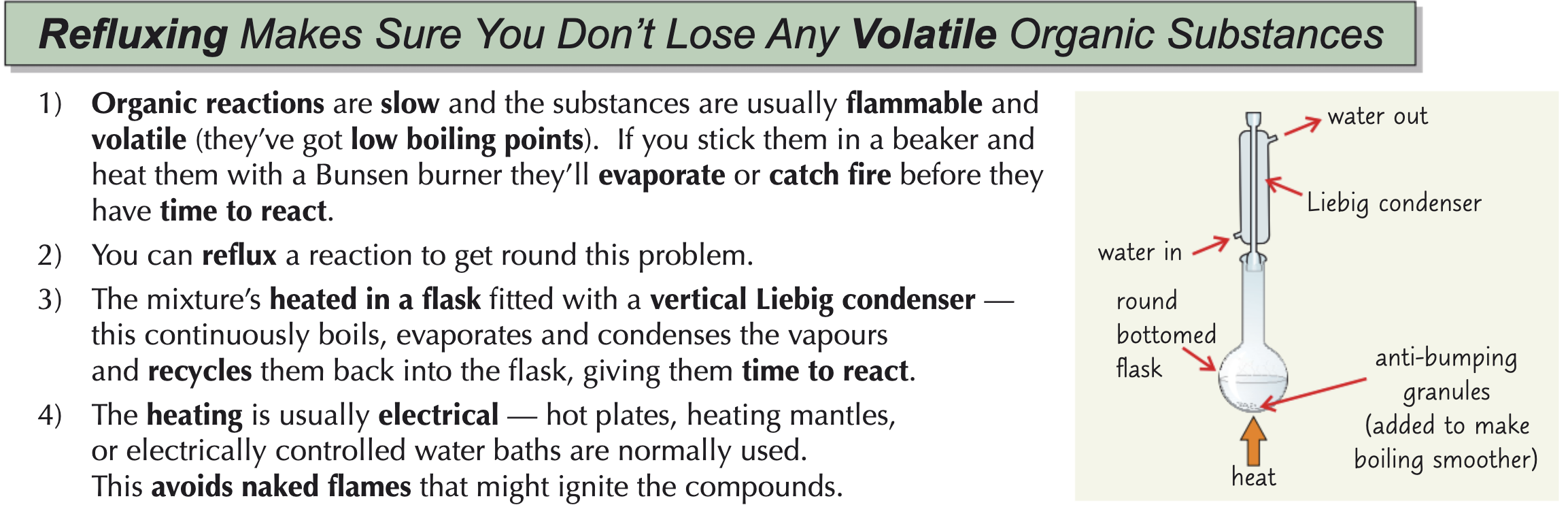
The top of reflux is open (not stoppered) so there isn’t a dangerous build up of pressure
What is distillation and why is it used?

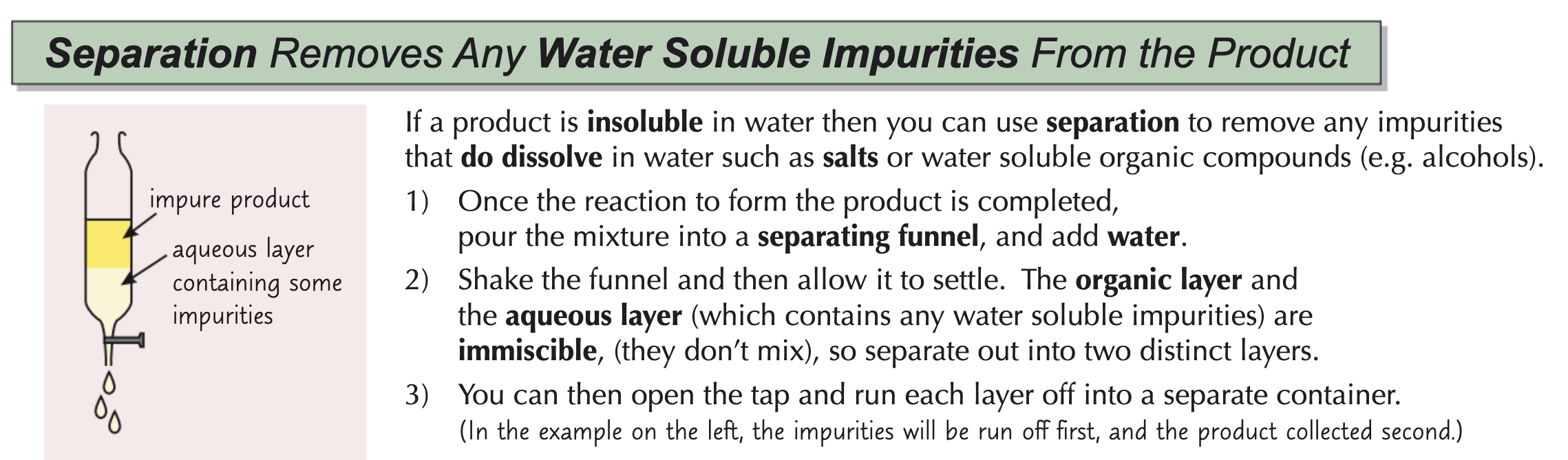
What is separation and why is it used?
Why is using anhydrous salts useful?

Why is determining boiling points useful?
