Chapter 1: Introduction to the Chemistry of Life
 Call Kai
 Learn
Learn Practice Test
 Spaced Repetition
 Match
Match Flashcards
 Knowt Play
1/45

There's no tags or description
Looks like no tags are added yet.
Name | Mastery | Learn | Test | Matching | Spaced | Call with Kai | Chat |
|---|
No analytics yet
Send a link to your students to track their progress
46 Terms
carnosine
beta-alanine + histidine
found in heart, muscle, and brain
antioxidant, helps stop cell damage

anserine
Beta alanine + 3-methyl-L-histidine
found in skeletal muscle and brain
antioxidant, pH buffer

capsaicin
lipophilic, odorless
triggers burning sensation by binding to the TRPV1 ion channel in sensory neurons

carnitine
quaternary ammonium ion needed for cell energy production
essential shuttle for long-chain fatty acids into mitochondrial matrix — so they can be beta-oxidized into ATP

Biochemist’s periodic table
necessary for all life
CHNOPS
Cl-, Na+, K+
Mg2+, Ca2+
B, F, Si, As, Se, Br, I, Sn
V, Cr, Mn, Mo, Fe, Co, Ni, Cu, Zn
What defines a living organism?
complex and organized
has metabolism, replicates/reproduces, acclimates to environment
take up nutrients, release waste products, generate work and heat, are open systems (never @ equilibrium)
4 main classes of biomolecules
proteins
lipids
nucleic acids
carbohydrates
Eukaryotes
have a nucleus
E.R.: site of cell component synthesis
aerobic metabolism in mitochondria
Central Dogma of Molecular Bio
DNA —> RNA —> protein
compartmentalization
division of cell into smaller, functionally discrete systems
energy transduction
helps regulate transport
helps organize (localization) —> stores DNA
allows efficiency
protection
size of e.coli vs size of normal animal cell
e.coli ~4 micrometers
animal cell ~10-100micrometers
3 domains
Bacteria 16s RNA
Archaea = 16s RNA
Eukarya = 18s RNA
endosymbiosis
horizontal gene transfer
usually prokaryotes
contributes to antibiotic resistance and is a quick evolution
transformation of loose pieces of DNA
conjugation - pieces of dna exchanged during physical contact (plasmid)
transduction - virus that infects bacteria (bacteriophage) accidentally carries genetic material from one host cell and injects it into a new on
Biological evolution
variation in heritable traits of populations over successive generations
Natural selection mechanism
random variation — mutations in heritable traits
not random selection of traits that confer reproductive advantage
genetic drift: random mutations
outcomes of biological evolution
adaptation, speciation, biodiversity, extinction, coevolution, convergence, artificial selection
unit of heat, energy, work
Joule
kg*m2/s2
or C*V
electric potential
volt (V)
J/C
angstrom
10-10 m
0.1 nm
100pm
Thermodynamics
study of energy and its effects on matter
1st law of thermodynamics
energy is conserved
total energy of universe is constant and can neither by created nor destroyed during any physical or chemical process
enthalpy is ΔH
ΔE = q+w
q= sum of heat transferred
w=work done
2nd law of thermodynamics
entropy (S) of the universe must increase for any spontaneous process
entropy = degree of randomness in a system
entropy increases in bottom picture as their are more possible arrangements

Gibbs (free) energy
indicative of spontaneity
ΔG<0 —> spontaneous
ΔG>0 —> not spontaneous
ΔG=equilibrium
ΔG = ΔH - TΔS
ΔG depends on the concentration of substrates and products
aA + bB —> cC + dD
ΔG’ = ΔG*’ + RTln (([C]c[D]d)/([A]a[B]b))
enthalpically favored: exothermic or endothermic?
exothermic
living systems are characterized by being in _________ steady state
non-equilibrium steady state
in homeostasis, flex is constant but concentrations are far from equilibrium
Carboxylic Acid-Amine Reactions: Hydrolysis
water is added to cleave the peptide bond
Endopeptidases break peptide bonds (amides) inside protein chains — use water to split the bond between a carboxylic acid carbonyl carbon and an amine nitrogen, turning the amide back into separate carboxylic acid and amine groups
Carboxylic Acid-Amine Reactions: Condensation
Water is removed to create a peptide bond
R—COOH + NH2—R’ —> R—COO—NH—R’
Cat. by ribosomes — ribosome facilitates linking peptides to build proteins, bypassing the high energy barriers of direct thermal reactions
lipid formation — esterification
Carboxylic Acid + Alcohol ⇌ Ester + Water
Catalyst: Requires an acid catalyst, such as concentrated sulfuric acid (H₂SO₄) or p-toluenesulfonic acid, to speed up the reaction.
Equilibrium: The reaction is reversible, meaning it reaches a balance point between reactants and products.
Driving the Reaction: To get more ester, scientists use extra alcohol or remove the water as it forms (LeChatelier’s)

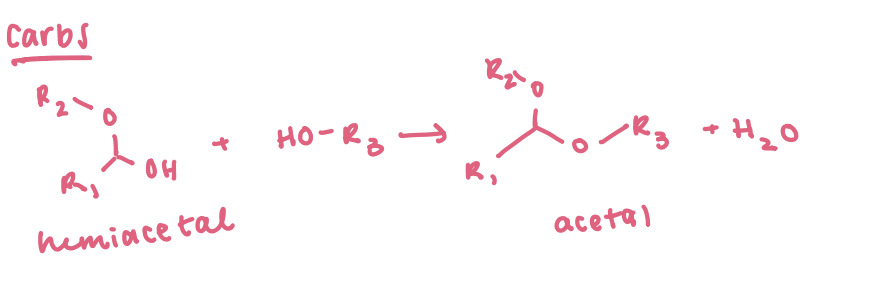
Carb formation
Protonation: The acid protonates the hemiacetal hydroxyl group (-OH).
Leaving Group Loss: Water (-H₂O) departs from the molecule.
Carbocation Formation: A resonance-stabilized oxonium ion (carbon-oxygen π bond with a positive charge on oxygen) forms.
Nucleophilic Attack: An alcohol molecule attacks the electrophilic carbon.
Deprotonation: Loss of a proton yields the neutral acetal.
Amine

alcohol
ROH
-OH hydroxyl group
Thiol
RSH
-SH sulfhydryl group
ether
ROR
—O— (ether linkage)
aldehyde

ketone

Carboxylic acid

ester

thioester

Amide

Imine (Schiff base)

disulfide
R—S—S—R
features disulfide linkage
phosphate ester

diphosphate ester
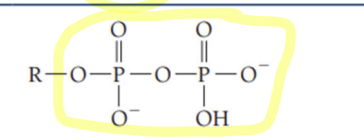
phosphoanhydride group

phosphate diester
