NEURO2020 LEC 8
 Call Kai
 Learn
Learn Practice Test
 Spaced Repetition
 Match
Match Flashcards
 Knowt Play
1/16

There's no tags or description
Looks like no tags are added yet.
Name | Mastery | Learn | Test | Matching | Spaced | Call with Kai | Chat |
|---|
No analytics yet
Send a link to your students to track their progress
17 Terms
ATTENTION
Processes enabling the recruitment of resources for processing selected aspects of incoming sensory information more fully than non-selected aspects.
ATTENTION COMPONENTS
Recruitment of resources
Focussing them on selected aspects of sensory inputs
ATTENTION CONCEPTS
Selectivity (spatial, auditory, timing)
Capacity
Expectation
Switching
CAPACITY
Is the amount of perceptual resources that are available for a given task or process
Varies with task and individual
SELECTIVITY
The fixed perceptual resources can be allocated to different subsets of information in a flexible way
Is not selective in terms of what gets processed and what does not
Ex. Overt attention (where your eyes are looking), covert attention (where you are attending to)
VISUAL SPATIAL ATTENTION - SHIFTING ATTENTION
Disengagement
to move attention, it must first disengage from its current target
Damage to the parietal lobe results in deficits
Movement
Once disengaged, attention is free to move and must be directed to the new target
Damage to the superior colliculus results in deficits
Engagement
After reaching the target, attention must be reengaged on the new object
Damage to regions in the thalamus results in deficits
VISUAL SPATIAL ATTENTION - SPOTLIGHT + ZOOM LENS
Spotlight
Illuminates objects in its focus region
Increased speed of attention if cued
Concentrate resources on selected regions of space
Zoom lens
Focus = narrow field = finer resolution = better attention
ENDOGENEOUS + EXOGENEOUS CUES
Endogenous cues
Attention must be voluntarily pushed from central cue to cued location
Operates over longer time course
Attention lasts longer
Exogeneous cues
Attention is drawn to the location of the cue
Usually a flash or movement
Can't be ignored (involuntary)
Brief attention
DISTRIBUTED ATTENTION
Features parallel processing and visual 'pop out'
Visual processing occurs simultaneously over the whole visual field
Quicker reaction
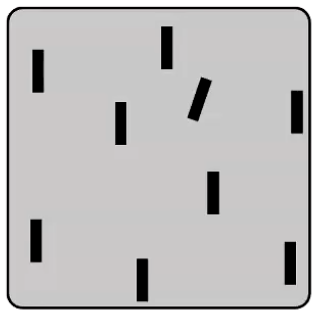
FOCUSED ATTENTION
Features serial processing
Visual processing is a series of attentional 'fixations' each covering a different region of the visual field
Slower reaction (more distractors)
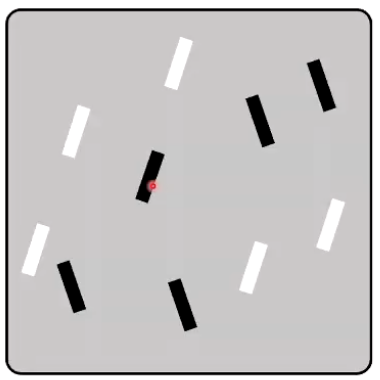
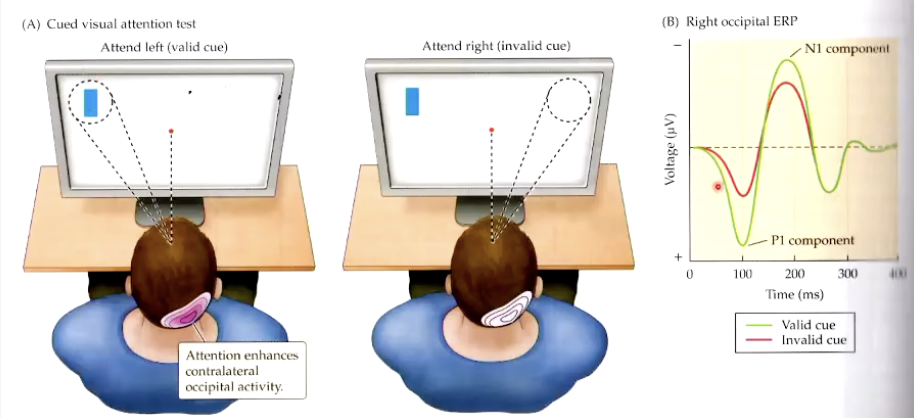
NEUROLOGICAL RESEARCH ON VISUAL ATTENTION
Enhancement of processing/amplification of signal from a region of space when attention is deployed there
FUSIFORM FACE AREA
In ventral stream of visual pathway
Process faces
PARAHIPPOCAMPAL PLACE AREA
Close to the hippocampus
Responds to places and locations
HEMI-SPATIAL NEGLECT
Line bi-section test
Clock drawing
Eye movements
Cancellation task
Neglect
fail to report left field objects
Visual experience is normal
Brain fills in visual field that’s missing
Extension
Inability to disengage attention from particular target
HEMI SPATIAL NEGLECT PET STUDY
right hemisphere damage = hemi-spatial neglect in left visual field
left hemisphere damage = the right parietal lobe does double duty. It deploys attention to left and right visual fields.
Therefore, damage to the right hemisphere is more inhibitive than damage to right
POSNER CUING PARADIGM
Measures covert spatial attention:
Valid = The cue correctly points to the location where the target appears. (fastest)
Invalid = The cue points to the wrong location. (slower)
Neutral = The cue gives no directional information.
MACK AND ROCK SHOWING UNATTENDED PROCESSING ALLOWS PERCEPTION OF:
Colour and location