L13 - Oxidative Phosphorylation
 Call Kai
 Learn
Learn Practice Test
 Spaced Repetition
 Match
Match Flashcards
 Knowt Play
1/25

There's no tags or description
Looks like no tags are added yet.
Name | Mastery | Learn | Test | Matching | Spaced | Call with Kai | Chat |
|---|
No analytics yet
Send a link to your students to track their progress
26 Terms
Oxidative phosphorylation is how ___ is produced
ATP
Chemiosmotic theory: the synthesis of ATP is coupled to
electron transport, energy rich proton gradient, hydrogen ions diffuse back via the ATP synthase complex, energy from proton gradient is used to drive the conversion of ADP to ATP

Experimental design showed that we need ________ for ATP synthesis
e- transport
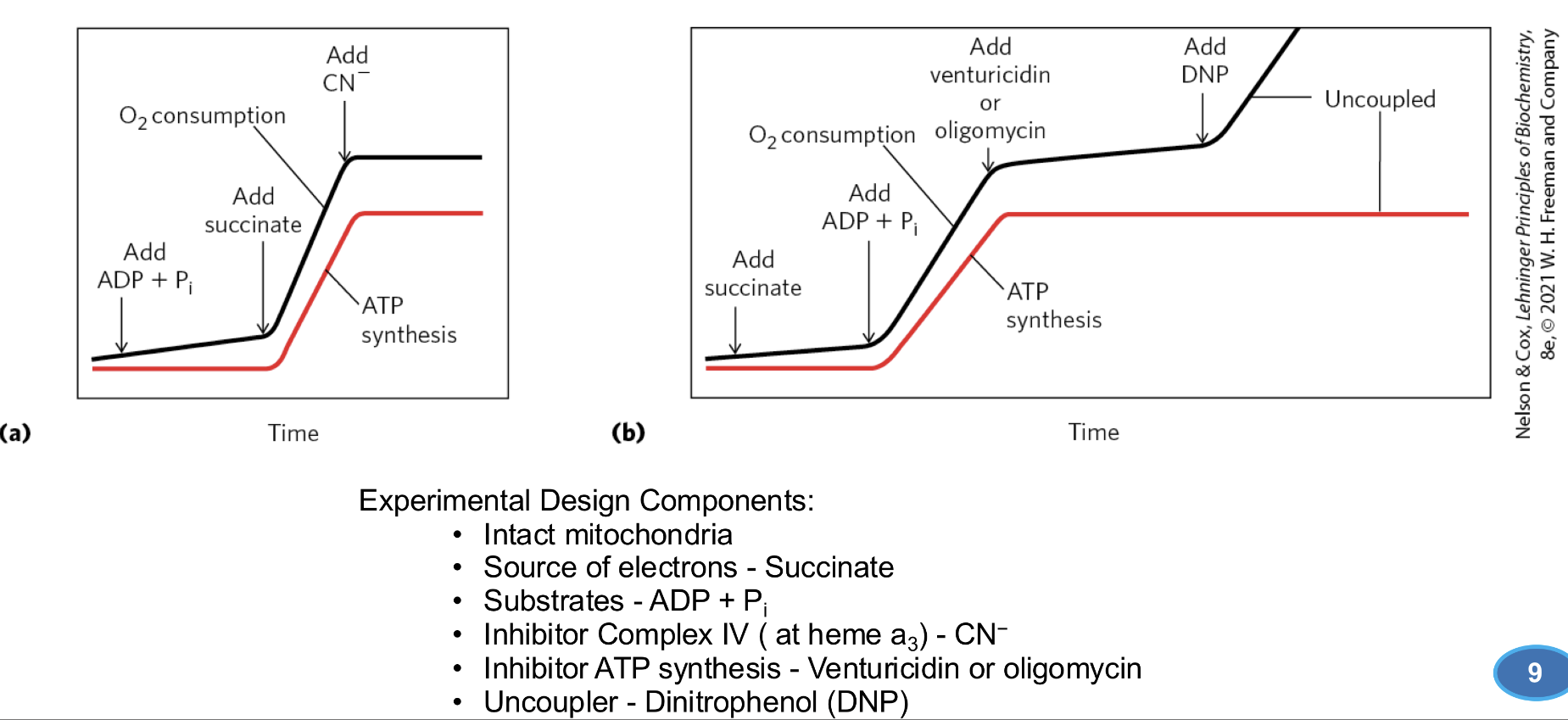
Experimental design showed that uncoupling e- transport and atp synthesis showed that electron transport can
occur without atp synthesis by dissipating the proton gradient
At equilibrium of proton gradient, there is no
ATP synthesis; Equilibrium of H+ and charge
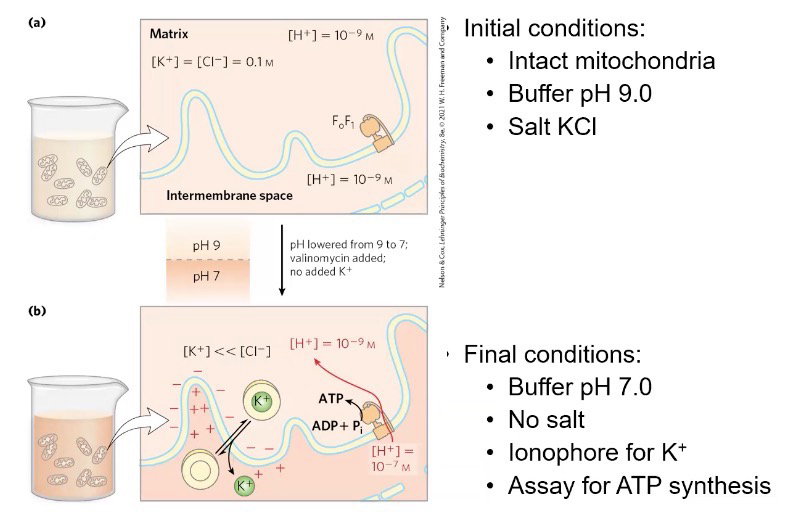
By changing the proton concentration, there is a proton gradient that drives
ATP synthesis even without oxygen consumption. Potential difference drives ATP synthesis.
Less H+ going in than out.

ATP synthase is Fo membrane embedded in the ___________ and F1 is present in the ____
inner membrane; matrix (N)
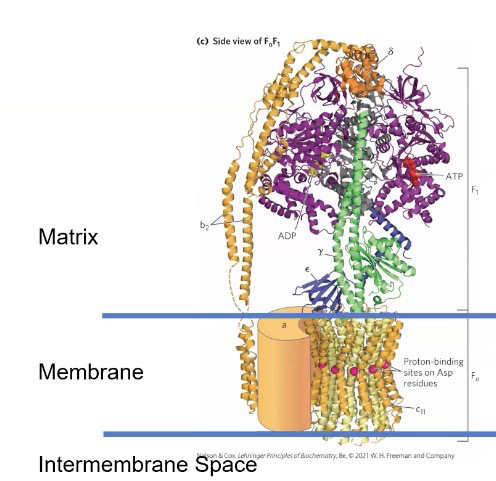
______________ has the proton gradient
Intermembrane space (P)
F1 complex has 3 alpha and 3 beta subunits that are arranged
alternating which makes 3 dimers of alpha and betas attached to a gamma shaft
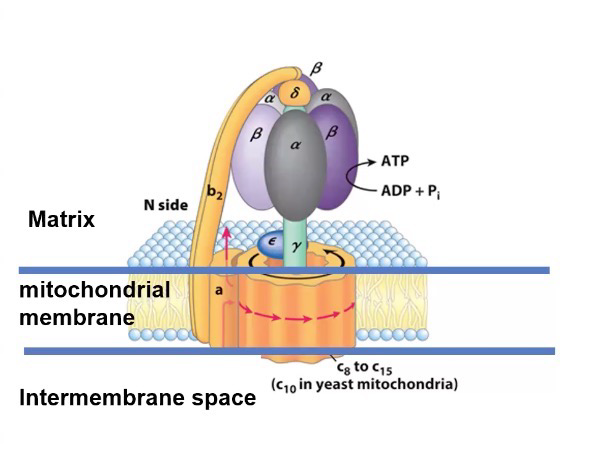
F1 is the site of
atp synthesis
ATP is synthesized at the
interface between alpha-beta dimers
Alpha-beta dimers do not rotate but they
adopt different conformations as the gamma shaft rotate
Conformational process of F1 complex
ADP + Pi enters alpha beta, gamma shaft rotates 120 degrees, causing a conformational change, ADP+Pi -> ATP, gamma shaft 120 degrees, causing a conformational change, ATP released
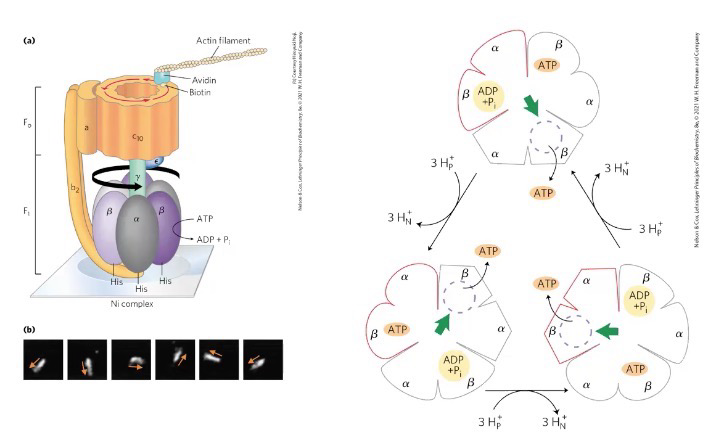
______ is the driving force of the rotation of the gamma shaft. Rotation is driven by proton gradient
Fo complex
Fo has a half channel on the _____ side and a half channel on the _____ side
positive; negative
Fo is made up of
an a, b, and c ring (8-15)
C subunits on Fo complex in the c ring formation will rotate as a
unit which allows protons to be released to the negative side from the positive side
C ring on Fo complex is like a
ferris wheel that carries protons; Once all spots are filled, the first H+ will exit on the other side of membrane (N) to allows another H+ from P side to enter
ADP enters the matrix by
adenine nucleotide translocase (antiporter) as ATP exits the matrix
Phosphate groups enters the matrix via the
phosphate translocase (symporter) with H+ protons
Phosphate translocase is/ is not coupled with ATP synthesis
IS NOT even though it transports H+ protons; it just needs the energy from gradient (Not ATP)
NADH created in glycolysis needs to be transported from the cytosol to
the mitochondrial matrix
NADH needs to go through electron exchange to enter the mitochondrial matrix:
Oxaloacetate -> Malate which oxidizes NADH, malate is transported to matrix by malate-akg transporter, malate -> oxaloacetate which reduces NAD+ to NADH

glycerol 3-phosphate shuttle is an alternative way of moving
reducing equivalents from the cytosol to the respiratory chain, and operates in skeletal muscles in the brain.
Glycerol 3-phosphate is not as efficient but is _____; Why?
rapid; FADH2 is not as energy efficient as NADH
Glycerol 3-phosphate pathway
NADH + H+ from glycolysis is oxidized via cytosolic glycerol 3-phosphate dehydrogenase.
At the same time, it reduces Dihydroxyacetone phosphate to glycerol 3-phosphate.
This is then oxidized by mitochondrial glycerol 3-phosphate dehydrogenase to reduce FAD to FADH2, which can then be transferred to Ubiquinone and then complex III in the ETC.
Dihydroxyacetone phosphate is recovered during oxidation.
