Comprehensive Study Flashcards for Math Foundations: Key Concepts and Formulas
 Call Kai
 Learn
Learn Practice Test
 Spaced Repetition
 Match
Match Flashcards
 Knowt Play
1/110

There's no tags or description
Looks like no tags are added yet.
Name | Mastery | Learn | Test | Matching | Spaced | Call with Kai | Chat |
|---|
No analytics yet
Send a link to your students to track their progress
111 Terms
# of Integers in an Interval
Last number - first number + 1
Sum of integers in an interval
n(a+l)/2 where n=# of terms, a=first term and l=last term
# of multiples in an interval
(Last multiple-first multiple/multiple in question) + 1
EX: # of multiples of 3 from 29-112
(111-30/3) + 1 = 28
Sum of multiples in an interval
Find the median and multiply the number of multiples in the interval
Prime numbers up to 50
2, 3, 5, 7, 11, 13, 17, 19, 23, 29, 31, 37, 41, 43, 47
Non-factors of factorials
For an integer n, prime numbers greater than n cannot be factors of n!. The same applies to multiples of these prime numbers.
EX: 11, 22, and 33 cannot be factors of 8!
Prime number trick (# of factors)
• first prime factories the integer (ex: 3000 = 2^3 x 3 x 5^3)
• add 1 to each exponent if the prime factorization (4, 2, 4)
• multiply the result (4 x 2 x 4 = 32)
Prime number trick (odd factors)
• Prime factor the number
• take ONLY the odd factors in the integer
• find the number of factors amongst the odd factors
Prime number trick (GCF)
Prime factorize both integers and take what's in common with both
Prime number trick (LCM)
Prime factorizas both then take the GREATEST power of each prime and multiply.
Prime number trick (even factors)
Total # of factors - number of odd factors = number of even factors
Exponent unit digit pattern
0: always 0
1: always 1
2: 2,4,8,6,2,4,8,6...
3: 3,9,7,1,3,9,7,1...
4: 4,6,4,6....
5: always 5
6: always 6
7: 7,9,3,1,7,9,3,1...
8: 8,4,2,6....
9: 9,1,9,1...
Converting Terminating Decimals to Fractions
Just write it as a fraction with the denominator a power of 10 and simplify:
0.125 = 125/1000 = 1/8
Converting Repeating Decimals to Fractions
Put the repeating part over the correct number of 9s:
0.3... = 3/9
0.32... = 32/99
0.111.... = 111/999
Exponent Rules 1
• If x^p=x^q and x doesn't = 0, then p = q
• a^-n = 1/a^n
• x^a • x^b = x^a+b
• x^a/x^b = x^a-b
• a^0 = 1 when a doesn't = 0
Exponent Rules 2
• a^m • b^m = (ab)^m
• (a/b)^m = a^m/b^m
• (a^m)^n = a^mn
• in general, a(^p^q) doesn't = (a^p)^q
Roots as Exponents
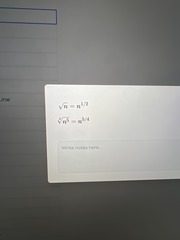
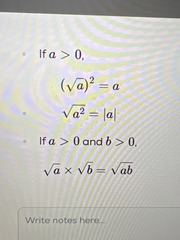
Operation on Roots 1
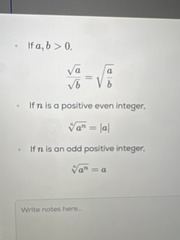
Operation on Roots 2
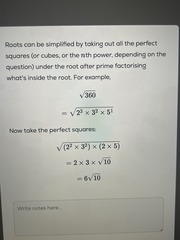
"Pulling Out" Perfect Squares
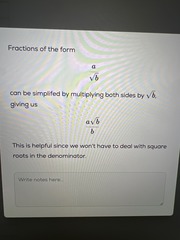
Rationalizing Denominators 1
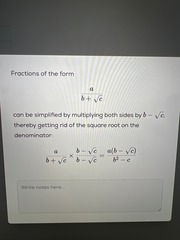
Rationalizing Denominators 2
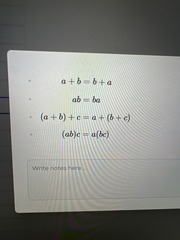
Real Number Properties 1
Real number properties 2
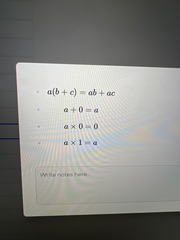
Real Number Properties 3
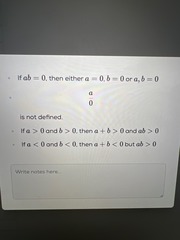
Real Number Properties 4
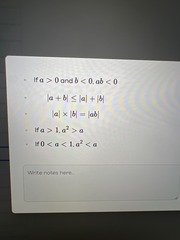
Percent Increase
(Difference)/(smaller number)
Percent Decrease
(Difference)/(larger number)
% of versus % more
• b is 200% of a means that b=2a
• b is 200% MORE than a means that b=3a
Quadratic Formula
x = -b ± √(b² - 4ac)/2a
Quadratic Equations
a function in the form: f(x) = ax² + bx + c = 0, a≠0.
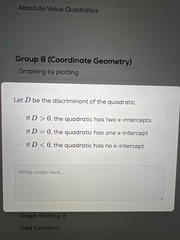
Discriminant
D= b²-4ac
• D>0 = 2 solutions
• D=0 = one solution
• D
Linear and Quadratic Polynomials
Linear = degree 1
Quadratic = degree 2
Polynomial Degree
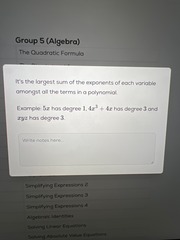
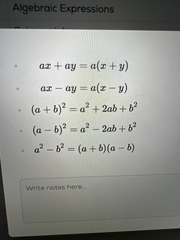
Algebraic Identities
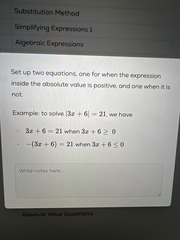
Solving Absolute Value Equations
1. Isolate absolute value
2. set up two equations
3. solve each equation
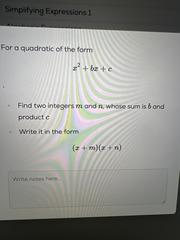
Factoring a Quadratic
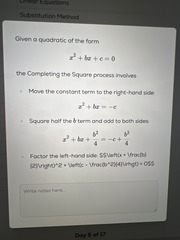
Completing the Square
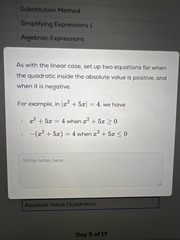
Absolute Value Quadratics
Distance Formula
d=rt
Relative Speed
• Toward each other? Add the speeds.
• Opposite directions? Add the speeds.
• Catching up? Subtract the speeds.
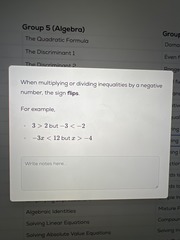
Solving inequalities
when you multiply or divide by a negative flip the sign
Words to Algebra
• +: addition, plus, sum, more, added to
• -: minus, difference, decrease, less than, under, remaining
• x: times, product, twice, quadruple, into, increase by a factor of
• \: divided by, over, ratio, slices, halve, quarter, decreased by a factor of
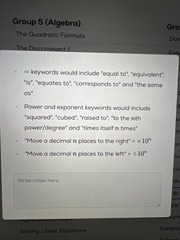
Words to Algebra 2
Simple Interest Formula
I=PRT (Interest = Principal x Rate x Time)
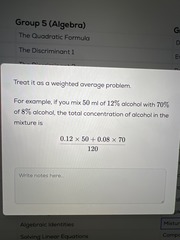
Mixture problems
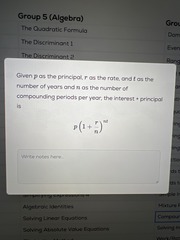
Compound Interest
Work/Rate Problems
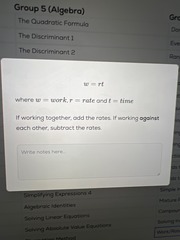
w = rt
Slope
(y₂- y₁) / (x₂- x₁)
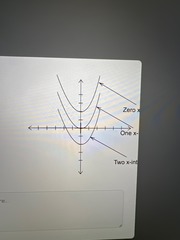
Quadratics Graphed
slope-intercept form
y = mx + b
•x and y are the x and y intercepts of the line
•m is the slope
•b is the y intercept
Distance formula on a coordinate plane
d = √[( x₂ - x₁)² + (y₂ - y₁)²]
Discriminants and the plane
sum of exterior angles of any polygon
360
Sum of interior angles
180(n-2) n=number of sides
angles of regular polygon
(n-2)180/n
Angle versus side length
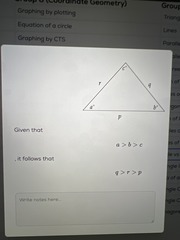
Triangle Inequality Theorem
The sum of the lengths of any two sides of a triangle is greater than the length of the third side.
Area of a triangle
A= 1/2 bh
Pythagorean Theorem
a²+b²=c²
Area of a rectangle
A=lw
Area of a trapezoid
A=1/2(b1+b2)h
Area of a regular hexagon
Let the side of the hexagon be x. Area is just finding the area of the 6 equilateral triangles of side length x
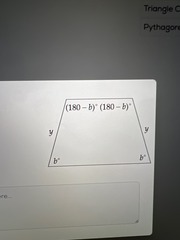
isosceles trapezoid
Pythagorean Triplets
3,4,5
5,12,13
8,15,17
7,24,25
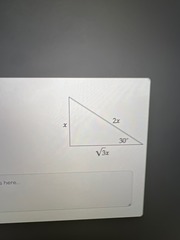
30-60-90 Triangle
x, x√3, 2x
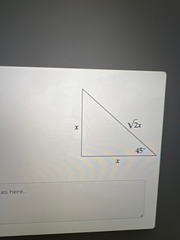
45-45-90 triangle
x, x, x√2
Area of an equilateral triangle
A=(s²√3)/4 s=side
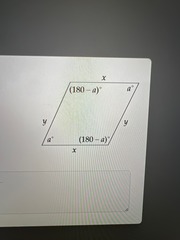
Parallelogram
Area of a regular polygon
Divide the polygon with n sides into n congruent triangles. Find the area of one and multiply by the number of sides
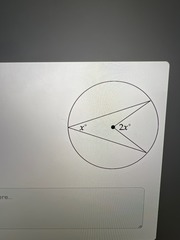
Central Angle Theorem
Circumference of a circle
2πr
length of an arc of a circle
ϴ/360 × circumference of full circle let ϴ = the central angle
Area of a circle
A=πr² or A=πd
Area of a sector
Area of a Sector = (central angle/360) x πr²
Volume of a cube
V=s³
Surface area of a cuboid
2(bh+bl+hl)
Surface area of a cube
6s²
Volume of a cuboid
length x width x height
Volume of a right cylinder
V=πr²h
Surface area and volume relation
The surface area of a 3D figure is usually greater than it's volume when the figure is small but the opposite when it's large
Diagonal of a cuboid
√l² + b² + h²
Surface Area of a Right Cylinder
SA=2πr²+2πrh
Diagonal of a cube
Diagonal = side√3
D=s√3
When mean = median
•evenly spaced set
•symmetrical set
Interquartile Range (IQR)
Q3-Q1
Three overlapping sets
Total = a + b + c - exactly two -2(all three)
overlapping sets formula
Total = Group 1 + Group 2 - Both + Neither
Inclusion/Exclusion Formula
Total = a + b - both
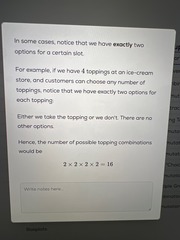
Yes or no
Converting to Letters/Words
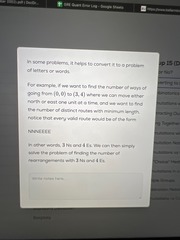
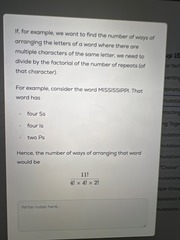
Permutations with Repeats
Permutation Formula
nPr = n!/(n-r)!
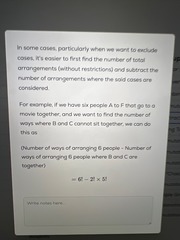
Subtracting Out
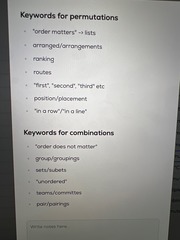
Permutations vs. Combinations
Questions to Ask:
1. Is Order Important? Yes = Permutation
2. Does it matter which object is chosent first, second, third, etc.? Yes = Permutation
3. Can they be chosen in any order? Yes = Combination
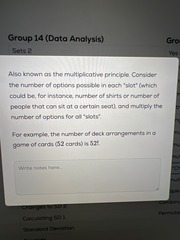
The "Choice" method
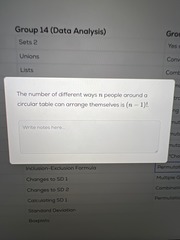
Permutations in a Circle
(n-1)!
Multiple Groups
Find the number of combinations for each group separately and then multiply together
Combination Formula
nCr = n!/r!(n-r)!
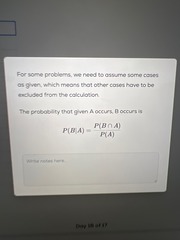
Conditional Probability Formula
P(B|A) = P(A and B) / P(A)