Week 1a: Evidence, Science & Research in Physical Therapy
 Call Kai
 Learn
Learn Practice Test
 Spaced Repetition
 Match
Match Flashcards
 Knowt Play
1/12

Earn XP
Description and Tags
Foundational concepts covering the definitions of evidence, science, the EBPT process, and levels of measurement data.
Name | Mastery | Learn | Test | Matching | Spaced | Call with Kai | Chat |
|---|
No analytics yet
Send a link to your students to track their progress
13 Terms
Evidence
Any empirical observation about the apparent relation between events, used to support or refute a hypothesis.
Evidence Based Physical Therapy (EBPT) Practice
Open and thoughtful clinical decision making about the management of a patient/client that integrates the best available evidence WITH clinical judgment and the patient/client’s preferences and values, considering the larger social context.
Process of EBPT
Five steps: 1) Question formation; 2) Search for relevant evidence; 3) Critical appraisal of evidence; 4) Determination of applicability; 5) Consideration of evidence in combination with expertise and values.
Content Criterion
General characteristic of desirable evidence where the study addresses the clinical question of interest and subjects are similar to the patient/client.
describe the hierarchy of evidence in practice
A ranking system that categorizes research studies based on the strength and reliability of the evidence they provide, often using levels such as systematic reviews, randomized control trials, cohort studies, and expert opinions. see image attached
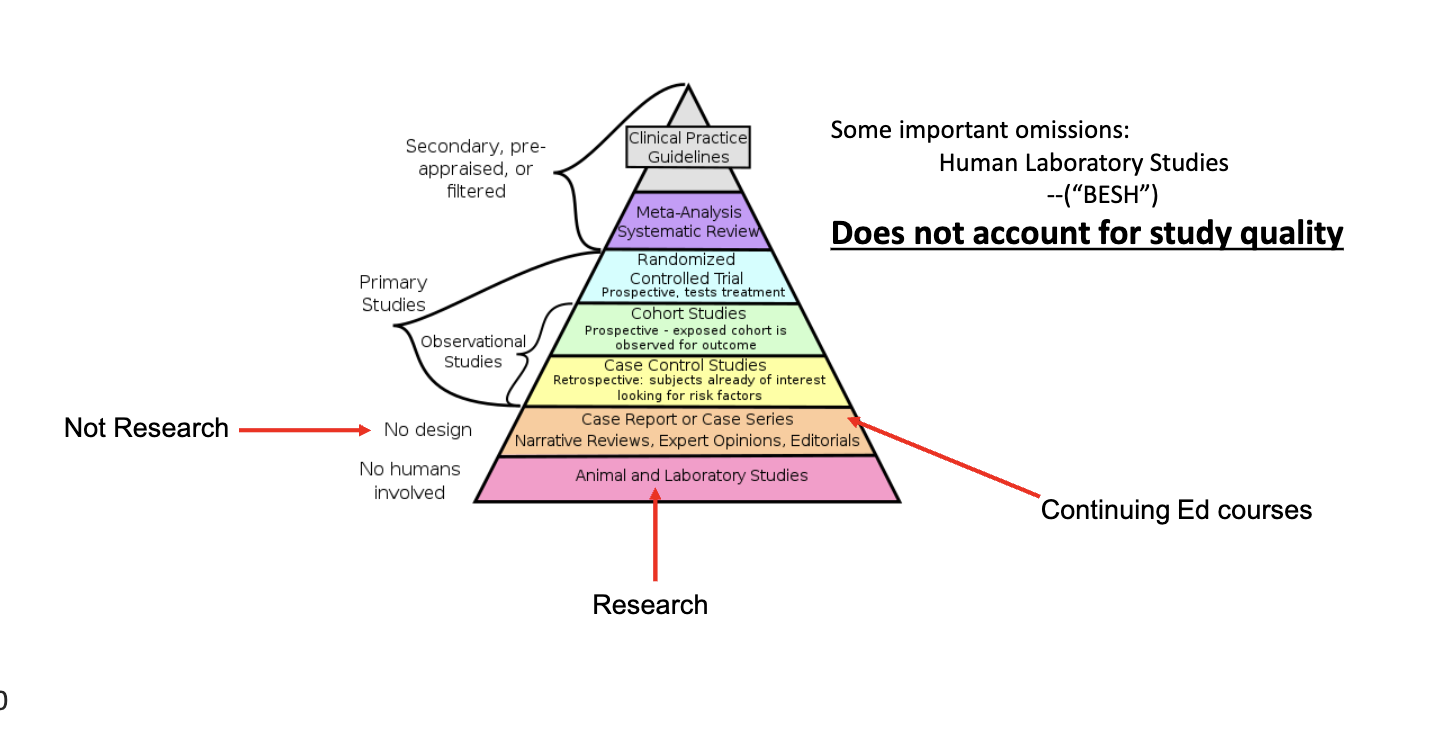
why are case reports or case series not considered research according to Dr Russ?
they do not have a design
what is scientific research?
the gathering of information that has rigorous rules and follows the scientific method, requires testability, and is problematic for certain theories (like the string theory or the intelligent design)
Data (Variables)
The generic term for measurement of tests, diagnoses, treatments, effects of interest, characteristics of individuals, objects, or environmental conditions.
Operational Definition
A specific definition often needed to characterize an observed variable that may have more than one value, such as Fatigue or Quality of Life.
Ratio Level of Data
Data with equal measurement intervals and a "true zero," possessing all mathematical properties for manipulation. examples include height, weight, circumference, BP, speed, and distance
Interval Level of Data
Quantitative values with equal measurement intervals. examples include temperature, calendar year
Ordinal Level of Data
Directional values with unknown measurement intervals and typically no mathematical value. examples include weight bearing status, level of assistance required, MMT grades, patient satisfaction
Nominal Level of Data
Categories without directionality or mathematical value, often created by "binning" continuous variables (e.g., Race/Ethnicity, gender, religious affiliation).