43 Disorders of the Adrenals I
 Call Kai
 Learn
Learn Practice Test
 Spaced Repetition
 Match
Match Flashcards
 Knowt Play
1/64

There's no tags or description
Looks like no tags are added yet.
Name | Mastery | Learn | Test | Matching | Spaced | Call with Kai | Chat |
|---|
No analytics yet
Send a link to your students to track their progress
65 Terms
The hypothalamus is triggered to release CRH. CRH triggers the ANTERIOR pituitary to release ACTH (adrenocorticotropic hormone). ACTH then acts on the Adrenal cortex which releases cortisol. Cortisol has a negative feedback loop on both the hypothalamus and the anterior pituitary to stop its' release.
Describe the relationship of hypothalamus and adrenal medulla for ACTH and the feedback loop
1. OUTERMOST: Glomerulosa (salt)
2. Fasciculata (sugar)
3. Reticularis (sex)
4. INNERMOST: Medulla
AKA "GFR" from outside to inside
Name the layers of the adrenal gland
Mineralocorticoids (aldosterone) aka "salt" (which regulates salt and water balance)
What does the zona glomerulosa of the adrenal gland release?
Glucocorticoids (cortisol) aka "sugar" (which regulates blood sugar and metabolism)
What does the zona fasciculata of the adrenal gland release?
Androgen Precursors (DHEA, androstendione) aka "sex" (which contributes to sexual development and function)
What does the zona reticularis of the adrenal gland release?
Catecholamines
What does the medulla of the adrenal gland release?
INHIBIT
Does dopamine *stimulate or inhibit* cortisol secretion?
Cortisol increases blood glucose, enhances glucagon, increases insulin resistance and increases caloric intake
How is cortisol related to glucose?
Increases GFR, decreases ADH action
How is cortisol related to the kidney and water balance?
STRESS LEUKOGRAM: "SMILED"
Segmented neutrophils
Monocytes
Increase
Lymphocytes
Eosinophils
Decrease
What kind of effect does cortisol have on WBC (like with hyperadrenocorticism)?
Elevated levels of circulating cortisol
What hormone is abnormal to cause hyperadrenocorticism (Cushing's)?
1. pituitary dependent (PDH)
2. adrenocortical dependent (ADH) aka an adrenal tumor
3. iatrogenic
Hyperadrenocorticism (Cushing's) can be classified in what 3 ways (what 3 causes)?
Pituitary dependent hyperadrenocorticism
What accounts for MAJORITY of spontaneous hyperadrenocorticism, like 80-85%?
Functional ACTH producing adenoma
What tumor commonly causes pituitary dependent hyperadrenocorticism?
Bilateral adrenal hyperplasia
note: remember the pituitary makes ACTH that triggers the adrenals. so if the pituitary is releasing in excess, both of the adrenals will respond
Do the functional pituitary ACTH adenomas (PDH) that cause hyperadrenocorticism cause *unilateral or bilateral* adrenal hyperplasia?
Unilateral enlargement, contralateral atrophy of the adrenals
What will the adrenal glands look like with adrenal tumors causing hyperadrenocorticism?
CRH produced by the hypothalamus and ACTH released by the pituitary will be decreased because of the negative feedback loop
Adrenal tumors will elevate cortisol because one adrenal is massive and producing a lot of excess cortisol. What does that mean for the other hormones in that pathway?
There are a lot of exogenous steroids being administered, so the pituitary gland will decrease production of ACTH, leading to adrenal atrophy and decreased circulating cortisol
What does it mean to have iatrogenic hyperadrenocorticism?
Older (over 6 years)
Spontaneous hyperadrenocorticism (Cushing's) occurs in *younger or older* dogs more commonly
Hyperadrenocorticism aka Cushing's
A dog presents with PU/PD, panting, abdominal enlargement, muscle weakness, dermatitis, alopecia symmetrically and bilaterally in the truncal flank, and hyperpigmentation. Thoughts?
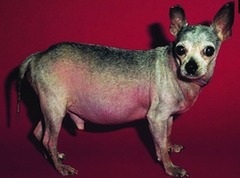
Hyperadrenocorticism
What is Cushing's another name for?
Systemic hypertension, urinary tract infections and just infections in general, proteinuria, muscle weakness, peripheral neuropathy, calculi, dystrophic calcification, diabetes mellitus
What potential medical complications come with hyperadrenocorticism (Cushing's)?
Excessive glucocorticoids can increase risk of insulin resistance in and of itself, but it also increases glucose production and blood sugar levels
Why is diabetes mellitus considered a complication of hyperadrenocorticism?
Biliary mucocele
What complication can hyperadrenocorticism cause with the gall bladder?
Thromboembolism
What vascular complication is common in dogs with hyperadrenocorticism (Cushing's)?
Calcinosis cutis
What is the complication of hyperadrenocorticism where there is inappropriate calcification of the skin/tissues?
proteinuria because cortisol increases GFR which can overwhelm the kidneys and allows more protein to pass thru + it has effects on glomerular permeability and systemic hypertension makes it all worse
Why is proteinuria a complication of hyperadrenocorticism?
Calcium oxalate
Which calculi is a common complication of hyperadrenocorticism and its' dystrophic calcification?
systemic hypertension because cortisol constricts blood vessels
Why is systemic hypertension a complication of hyperadrenocorticism?
Hyperadrenocorticism
A cat with WHICH endocrine problem presents with potbelly, hepatomegaly, thin skin and easy bruising, and alopecia with unkempt hair coat?
DOGS ONLY: SAP will be increased (steroid-induced ALP)
DOGS AND CATS: stress leukogram, hyposthenuria, hypercholesterol, hyperglycemia
note: hyposthenuria means low specific urine gravity and dilute urine. this is from cortisol decreasing ADH (whose job is to resorb water from urine to concentrate it), and if ADH doesn't work, water isn't pulled from the urine = dilute
What will be elevated on clinical pathology with hyperadrenocorticism?
b. low-dose dexamethasone suppression test
c. ACTH stimulation test
e. urine cortisol-creatinine ratio
Select the diagnostic tests for hyperadrenocorticism:
a. abdominal ultrasound
b. low-dose dexamethasone suppression test
c. ACTH stimulation test
d. endogenous ACTH level
e. urine cortisol-creatinine ratio
f. high-dose dexamethasone suppression test
a. abdominal ultrasound
d. endogenous ACTH level
f. high-dose dexamethasone suppression test
Select the differentiation tests for hyperadrenocorticism:
a. abdominal ultrasound
b. low-dose dexamethasone suppression test
c. ACTH stimulation test
d. endogenous ACTH level
e. urine cortisol-creatinine ratio
f. high-dose dexamethasone suppression test
SNOUT: SENSITIVITY: ability to rule OUT a disease if the test is negative = they DONT HAVE IT
SPIN: SPECIFICITY: ability to rule IN a disease if the test is positive = they HAVE IT
What is the difference between sensitivity and specificity?
SENSITIVE = meaning if it is negative, the animal does NOT have Cushing's. this test cannot tell you if the animal does have Cushing's only if they DON'T
Urine cortisol-creatinine ratio for hyperadrenocorticism is a better *specific or sensitive* test.
SENSITIVE = meaning if it is negative the animal does NOT have Cushing's.
Low-dose dexamethasone suppression test is a better *specific or sensitive* test.
Cortisol ONLY
What hormone is the low/high-dose dexamethasone suppression test looking at?
Dexamethasone decreases cortisol when administered thru negative feedback
How is dexamethasone a good test for testing Cushing's? How is dex. related?
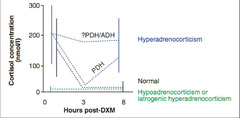
If you give Dex and cortisol in the blood goes down at 4 hours post dex and stays down at 8 hours post, that is normal.
Tell me what will happen in a dog with NORMAL adrenal glands in the low/high-dose dexamethasone suppression test?
Cortisol will either:
1. not hardly decrease at all 4 hours post dex and be right back to where it was 8 hours post (with PDH or ADH)
2. decrease to normal at 4 hours post dex but be right back to the elevated level at 8 hours post dex (PDH)
Tell me what will happen in a dog with hyperadrenocorticism (Cushing's) in the low-dose dexamethasone suppression test?
Because with pituitary dependent, there is excess of ACTH triggering adrenals to release cortisol.
The pituitary is only partially resistant to negative feedback. As the pituitary responds, there is still a decrease for a short period of time as it responds to dexamethasone and slows ACTH which causes the adrenals to slow cortisol production. But because of the abnormality, cortisol increases back up again shortly.
If there were an adrenal dependent problem, the adrenal glands would produce cortisol independently, and therefore be unresponsive to any decrease in pituitary ACTH = no/minimal decrease.
Why is it more likely to be PDH (pituitary dependent hyperadrenocorticism) and not ADH (adrenocortical dependent hyperadrenocorticism) if you do the high-dose dexamethasone suppression test and the cortisol decreases 4 hours post dex., but bounces right back to elevated by hour 8 post?
Low dose dexamethasone suppression
What is the screening (diagnostic) test of choice if you suspect hyperadrenocorticism (Cushing's)?
SPECIFIC = meaning if it is positive the animal DOES have Cushing's.
ACTH stimulation test is a better *specific or sensitive* test.
You check baseline cortisol then give exogenous ACTH (hormone produced by pituitary to trigger adrenals). Within 1 hour, if the post circulating cortisol is WAAAY too high = hyperadrenocorticism definitively (although stress can cause false positive).
However, if the test is low-normal, it still does not give you the ability to rule out hyperadrenocorticism.
How does the ACTH stimulation test work in terms of ruling in Cushing's?
Bilateral adrenomegaly = pituitary dependent hyperadrenocorticism
Adrenal mass with small contralateral adrenal gland = adrenocortical dependent/adrenal tumor
How does ultrasound help you differentiate between different causes of hyperadrenocorticism?
xx
note: the low dose and high dose dexamethasone suppression tests are essentially the same test, just with different levels of dex. So why is one screening (low) and the other differentiating (high)?
Occasionally, with the pituitary form of Cushing's disease, the low-dose dexamethasone test shows no suppression of blood cortisol levels, because the negative feedback loop is more resistant to the effects of the synthetic cortisol. In these cases, a higher dosage of dexamethasone may be required to overcome this resistance and demonstrate the negative feedback mechanism.
The pituitary produces ACTH. This triggers the adrenals to release cortisol.
So, if you test an animal's ACTH and it is high, this means the pituitary has a problem. If you test an animal's ACTH and it is low, this means the adrenal has a problem.
How will endogenous ACTH help you differentiate causes of hyperadrenocorticism (Cushing's)?
Trilostane (Vetoryl)
What is the most widely used drug to control hyperadrenocorticism (Cushing's)?
TRILOSTANE: competitive inhibitor to block production of aldosterone and cortisol
o'p-DDD: adrenocorticolytic to induce necrosis of zona fasciculata
What is the difference between the MOA of Trilostane (Vetoryl) and o,p-DDD (Lysodren) to treat hyperadrenocorticism (Cushing's)?
a. Trilostane (Vetoryl)
Which drug to treat hyperadrenocorticism is a competitive inhibitor to block production of aldosterone and cortisol:
a. Trilostane (Vetoryl)
b. o'p-DDD (Mitotane, Lysodren)
b. o'p-DDD (Lysodren)
Which drug to treat hyperadrenocorticism is an adrenocorticolytic to induce necrosis of zona fasciculata:
a. Trilostane (Vetoryl)
b. o'p-DDD (Lysodren)
Twice daily with lower dosing is safer and more effective
What is the safer dosing like for Trilostane to treat hyperadrenocorticism?
Post cortisol should be collected 4 hours after Trilostane dose and be 2-5 micrograms/dL (normal cortisol is NOT actually normal) and ACTH stim 10-14 days following initiation of Trilostane
note: "normal cortisol is not normal" when giving trilostane because the goal is to have suppressed but detectable cortisol levels in a hyperadrenocorticism patient since trilostane intentionally inhibits cortisol
What is critical in terms of timing Trilostane for hyperadrenocorticism treatment?
Transient hypocortisolism. If vomiting, diarrhea, not eating, or weak on top of this, DISCONTINUE
What adverse effect may you see in a dog on Trilostane?
1. induction: daily doses twice a day with meals for 5-10 days
2. maintenance: induction dose is now given over the course of a week instead of daily
What are the two phases of giving o,p-DDD to treat hyperadrenocorticism?
owner discontinues if reduction in appetite, if polydipsic dog drinks less than 60 mL/kg/day, vomiting, or lethargy
When should you tell the owner to discontinue o,p-DDD hyperadrenocorticism drug treatment?
Adrenalectomy (esp. for adrenal tumors)
What is the surgical treatment for hyperadrenocorticism?
Radiation
What is the stereotactic radioablation treatment option for dogs with pituitary macrotumor (hyperadrenocorticism) disease?
Because glucocorticoids suppress the immune system, though anti-inflammatory effects of steroids may mask symptoms of these infections
Why do dogs with hyperadrenocorticism often have complications that involve infection, like pyoderma, otitis, pyelonephritis, and bacterial cystitis?
Blood pressure every 3-6 mo., urine culture every 6 mo., urine protein creatinine ratio every 6 mo.
What tests should you perform on a regular basis in animals to monitor hyperadrenocorticism (Cushing's)?
Pheochromocytoma
What is the term for the tumor of the adrenal medulla's chromaffin cells?
Inc. epinephrine
Pheochromocytoma causes a change in what hormones?
To skeletal muscle, away from GI, skin, and kidneys
Where does epinephrine cause blood to be redistributed to?
Pheochromocytoma
An animal presents with intermittent weakness, collapse, panting, tachypnea, and anxious behavior, but persistent hypertension. Abdominal ultrasound shows a mass with a different echogenicity around the adrenal gland. Thoughts?
xx
For you to look at, dexamethasone suppression tests