Unit 2 - Neuroscience and Behavior
 Call Kai
 Learn
Learn Practice Test
 Spaced Repetition
 Match
Match Flashcards
 Knowt Play
1/93

There's no tags or description
Looks like no tags are added yet.
Name | Mastery | Learn | Test | Matching | Spaced | Call with Kai | Chat |
|---|
No analytics yet
Send a link to your students to track their progress
94 Terms
Neuron
a nerve cell; “building block” of the nervous system Icons of Science
Cell Body (Soma)
Life support center of the neuron.
Dendrites
Branching extensions at the cell body. Receives messages from other neurons.
Axon
Long single extension of a neuron, covered with myelin sheath to insulate and speed up messages through neurons.
Terminal Branches of axon
Branched ending of axons. Transmitting messages to other neurons
Synapse
the junction (space) between the axon of one neuron and the dendrite of another
Neurotransmitter
chemicals that carry messages across the synapse from one neuron to another
Action Potential
The “firing”
Resting Potential
the neuron is ready to fire (chilling waiting on orders)
Electrochemical Process
Electrical inside the neuron; chemical outside the neuron (neurotransmitters)
Excitatory
neurotransmitter effect that makes it more likely that the receiving neuron will generate an action potential or “fire”
Inhibitory
neurotransmitter effect that makes it less likely that the receiving neuron will generate an action potential or “fire”
Reuptake
Neurotransmitters in the synapse are reabsorbed into the sending neurons through the process of reuptake. This process applies brakes on neurotransmitter action.
Refractory Period
After a neuron has fired an action potential it pauses for a short period to recharge itself to fire again
Lock & Key Mechanism
Neurotransmitters bind to the receptors of the receiving neuron
Agonists
It excites; It is similar enough to the neurotransmitter molecule that it mimics the effects on the receiving neuron.
Antagonists
It inhibits; It has a similar enough structure to the neurotransmitter to occupy its receptor and block its action.
Acetylcholine (ACh)
vital role in movement and memory
too much – muscle contractions, convulsions
some spider venoms cause floods of ACh
too little – immobility, extreme lethargy
Botulin causes paralysis by blocking its release
Undersupply of ACh has been linked to Alzheimer’s disease
Dopamine
deals with movement, learning, attention & emotion
lack of dopamine has been linked to Parkinson’s Disease
too much has been linked to Schizophrenia
Many drugs cause our brain to flood with Dopamine
Serotonin
involved in mood control, hunger, sleep / arousal
lack of serotonin has been linked to clinical depression (Prozac and other antidepressants raise levels)
Endorphins
“endogenous morphine”
involved in pain control
most addictive drugs work with endorphins (opioids)
Glutamate
Major excitatory neurotransmitter. Involved in learning, memory, and brain development.
Oversupply can over stimulate the brain and cause seizures and migraines
GABA
Major inhibitory neurotransmitter Prevents a neuron from generating a nerve impulse.
Undersupply linked to seizures, tremors, and insomnia
Norepinephrine
Helps control alertness and arousal
Undersupply can depress mood
Substance P
Involved in pain perception and immune response
Oversupply can lead to chronic pain
Efferent (Motor) Neurons
info to body parts for movement
Interneurons
info within central nervous system
Afferent (Sensory) Neurons
info to CNS from body parts
Central Nervous System
brain and spinal cord
CNS
Receives Info from the peripheral and then tells it what to do
Peripheral Nervous System
ll nerves that are not encased in bone
everything but the brain and spinal cord
Divided into Somatic and Autonomic
Somatic Nervous System (Peripheral)
controls voluntary muscle movement
uses motor (efferent) neurons
Autonomic Nervous System (Peripheral)
controls the automatic functions of the body
Divided into sympathetic and parasympathetic
Sympathetic Nervous System
“Fight or Flight” response
automatically accelerates heart rate, breathing, dilates pupils, slows down digestion
Parasympathetic Nervous System
automatically calms the body down after a stressful event
heart rate and breathing slow down, pupils constrict, and digestion speeds up
think, “parachute”
Reflexes
normally, afferent neurons 🡪 spine 🡪 brain & brain sends orders for movement 🡪 efferent neurons
some reactions occur when sensory neurons reach just the spinal cord & spinal cord sends orders
Neural Networks
interconnected neurons
regular connections or routes of communication for different tasks, processes, etc.
body/brain “learns” networks over time
“muscle memory” in sports (“practice makes permanent”)
Brain
made up of…neurons, glial cells (or glia - support neural cells by insulating them, removing waste, etc.), connective tissues, cerebrospinal fluid
can be divided into three major sections: hindbrain, midbrain, forebrain
Glial Cells
They have four main functions: (1) to surround neurons and hold them in place; (2) to supply nutrients and oxygen to neurons; (3) to insulate one neuron from another; (4) to destroy pathogens and remove dead neurons.
Brain stem (hindbrain)
Midbrain: top
Pons: Middle
Medulla (Medulla Oblongata)
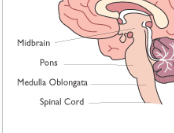
Midbrain
Involved in vision, hearing, eye movement, and body movement
Pons
Involved in sleep (REM), swallowing, facial expressions and sensations, bladder control
Medulla
Breathing, Heart Rate, Respiration
Limbic System
“The emotional center of the Brain”
Thalamus, Hypothalamus, Amygdala, and Hippocampus
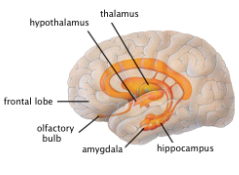
Thalamus
Switchboard for sensory information (except smell)
Receives sensory and motor information and sends them to appropriate areas of forebrain.
Auditory, visual, tactile, gustatory
Hypothalamus
Body temp, Hunger, Thirst, Sexual Arousal, Endocrine System (Pituitary Gland), Pleasure Center
Amygdala
Fear, Memory of fear, aggression and emotion
Hippocampus
Memory, Short to long, and learning
Ventromedial Hypothalamus (VMH)
Satiety Center: Ceases Hunger
Destruction: Obesity, Never feel full
Lateral Hypothalamus
Stimulates Hunger
Destruction: Skinny, always feel full, starvation
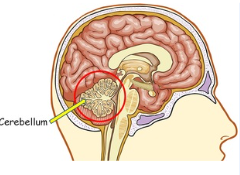
Cerebellum (Little Brain)
voluntary muscle movements, balance, coordination
Injury: Difficulty walking, keeping balance, shaking hands
Cerebral Cortex
Top layer of our brain.
Contains wrinkles called fissures.
The fissures increase surface area of our brain.
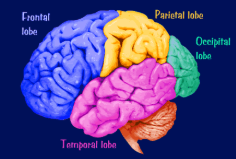
Divided into eight lobes, four in each hemisphere (frontal, parietal, occipital and temporal).
85% of the brains weight
20-23 million nerve cells
Linked by over 300 trillion synapses
Glial Cells (9 times as many): Feed and insulate nerve cells
Association Areas
Any area not dealing with our senses or muscle movements are called _______ (allows for complex mental functions)
More intelligent animals have increased “uncommitted” or _______ of the cortex. They integrate and form connections between sensory and motor areas
Frontal Lobe
Deals with planning, maintaining emotional control and abstract thought.
Weighing future consequences
Develops into the mid 20’s
Broca’s Area
In frontal cortex
Responsible for the production of language
Broca’s Aphasia
Destruction leads to difficulty producing language
Motor Cortex
In frontal lobe
planning, control, and execution of voluntary movements
Parietal Lobes
Located at the top of our head.
Contains the somatosensory cortex (processes touch, temperature, taste (helps))
Rest are association areas (intelligence!)
Occipital Lobes
n the back of our head.
Handles visual input from eyes.
Right half of each retina goes to left occipital lobe and vice versa.
Temporal Lobes
Process sound sensed by ears.
Not cross-wired.
Wernicke’s area
understanding language
Wernicke’s Aphasia
impairment of language understanding
Meaningless spoken language
Reticular Formation
network of nerve pathways in the brainstem connecting the spinal cord, cerebrum, and cerebellum
Help to maintain arousal and consciousness
Brain Plasticity
bility of our brains to form new connections (repair itself) after being damaged
the younger you are, the more “plastic” your brain is
Neurogenesis
Contrary to popular belief, we do grow new nerve cells
Mostly in the hippocampus
Hemispheres
Divided into a left and right hemisphere.
Contralateral controlled- left controls right side of body and vice versa.
Brain Lateralization
some neural functions, or cognitive processes tend to be more dominant in one hemisphere than the other.
Corpus Callosum
Attaches the two hemispheres of cerebral cortex.
Allows both sides to communicate
Split-Brain Patients
When the corpus callosum is removed (usually b/c of seizures)
Roger Sperry & Michael Gazzaniga
Non-Split Brains
People with intact brains also show left-right hemispheric differences in mental abilities
normal individuals tend to engage their right brain when they engage in a perceptual task, and left brain when carrying out a linguistic task
Ways to Study the Brain
Case Studies / Clinical Observation
-Accidents (i.e. – Phinneas Gage)
-Diseases / Disorders
Less Invasive Methods
Electroencephalogram (EEG)
Computerized Axial Tomography (CAT Scan / CT Scan)
Magnetic Resonance Imaging (MRI)
Positron Emission Tomography (PET)
Functional MRI (fMRI)
Electroencephalogram (EEG)
Detects brain waves through their electrical output
Used mainly in sleep research
Computerized Axial Tomography (CAT Scan/CT Scan)
3D x-ray of the brain
good for tumor locating
tells us nothing about function
Magnetic Resonance Imaging (MRI)
More detailed picture of the brain using magnetic field to knock electrons off axis
Takes many still pictures and turns images into a movie like production
Positron Emission Tomography (PET)
measures how much of a chemical the brain is using (radioactive glucose consumption)
Functional MRI (fMRI)
Combination of PET and MRI
It measures the change in blood oxygen to measure brain activity. When part of the brain is working, oxygenated blood rushes to the area
The Endocrine System
a system of glands that secrete hormones into the bloodstream
controlled by the hypothalamus
similar to nervous system, except hormones work a lot slower than neurotransmitters
the body’s “slow” chemical communication system. Communication is carried out by hormones synthesized by a set of glands
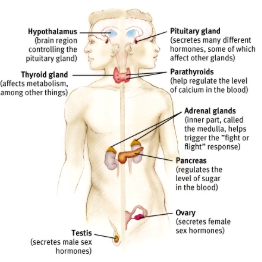
Hormones
chemicals synthesized by the endocrine glands and secreted in the bloodstream
affect the brain many other tissues of the body
Pituitary Gland
“master gland”
Anterior pituitary lobe
Releases hormones that regulate other glands
Posterior pituitary lobe
regulates water and salt balance
Evolutionary Psychology
Understanding Human Nature
why we as humans are alike. In particular it studies the evolution of behavior and mind using principles of natural selection.
Behavior Geneticists
study our differences and weigh the relative effects of heredity and environment
Twin Biology
To study the effects of heredity and environment two sets of twins, identical and fraternal, have come in handy
Twin and Procedures
Behavior geneticists study the effects of shared and unique environments on total or partial genetic makeup
Separated Twins
A number of studies have looked at identical twins raised separately from birth or close there after and have found a number of similarities
researchers point out that differences between fraternal twins are greater than identical twins.
Adoption Studies
suggest that adoptees (who may be biologically unrelated) tend to be different from their adoptive parents and siblings
Parenting
does have an effect on biologically related and unrelated children.
Heritability
refers to the extent to which the differences among people are attributable to genes
Nature and Nurture
Some human traits are fixed, like having two eyes, most psychological traits are liable to change with environmental experience.
So genes provide choices to the organism to change its form or traits when environmental variables change. Therefore genes are pliable or self-regulating
Gene-Environment Interaction
Genes ca influence traits which affect responses, and environment can affect gene activity
Molecular Genetics
branch extension of behavior genetics that asks the question, do genes influence behavior
trying to identify genes that put people at risk for disorders
studies why we as organisms are distinct.
Natural Selection
evolutionary process through which adaptive traits are passed on to ongoing generations because they lead animals to reproduce and survive
Artificial Selection
Any trait that is favored naturally or artificially
spreads to future generations