PSYC 2010
 Call Kai
 Learn
Learn Practice Test
 Spaced Repetition
 Match
Match Flashcards
 Knowt Play
1/114

There's no tags or description
Looks like no tags are added yet.
Name | Mastery | Learn | Test | Matching | Spaced | Call with Kai | Chat |
|---|
No analytics yet
Send a link to your students to track their progress
115 Terms
Sensory neurons
take signals from receptors and send them to brain
Motor neurons
take signals from brain and send them to muscles
Excitatory signals
Increase the likelihood that the neuron will fire an action potential
Inhibitory signals
Decrease the likelihood that the neuron will fire an action potential
Receptors
specialized structures that respond to certain types of neurotransmitters
Each receptor can be influenced
by only one type of neurotransmitter
Transmission phase
first phase; chemical signals are released from terminal buttons of a sending neuron and transmitted across the synapse to a receiving neuron
Reception phase
second phase; these neurotransmitters fit into specialized receptors in the dendrites of the postsynaptic neuron, which converts chemical signals to electrical signals
Conduction phase
fourth phase; if the combined signal is stimulating enough, an action potential is generated and carried away from the cell body down the axon to the terminal buttons where it causes the release of neurotransmitters into the synapse (at this point, it repeats at phase 1)
Integration phase
third phase; neurotransmitters have different effects on the postsynaptic neuron and these effects are integrated in the cell body to determine whether or not to generate an electrical impulse, or action potential
Primary function of Acetylcholine
Muscles
Primary function of Norepinephrine
Alertness
Primary function of Serotonin
Emotional states, impulsivity, dreams
Primary function of Dopamine
Reward/motivation/muscles (voluntary movement)
Primary function of GABA
Inhibition of action potentials, anxiety, alcohol intoxication
Primary function of Glutamate
Enhancement of action potentials, learning and memory
Primary function of Endorphins
Pain reduction, pleasure
Frontal
Primary Motor
PreMotor
PreFrontal
Parietal
Primary Somatosensory
Somatosensory Assoc.
Occipital
Primary Visual
Visual Assoc.
Temporal
Primary Auditory
Auditory Assoc.
Visual Assoc

What is 1?
Dendrites

What is 2?
Axon

What is 3?
Myelin sheath

What is 4?
Axon hillock

What is 5?
Soma (cell body)

What is 6?
Axon terminal

1?
Pre-motor cortex

2?
Primary motor cortex

3?
Primary somatosensory cortex
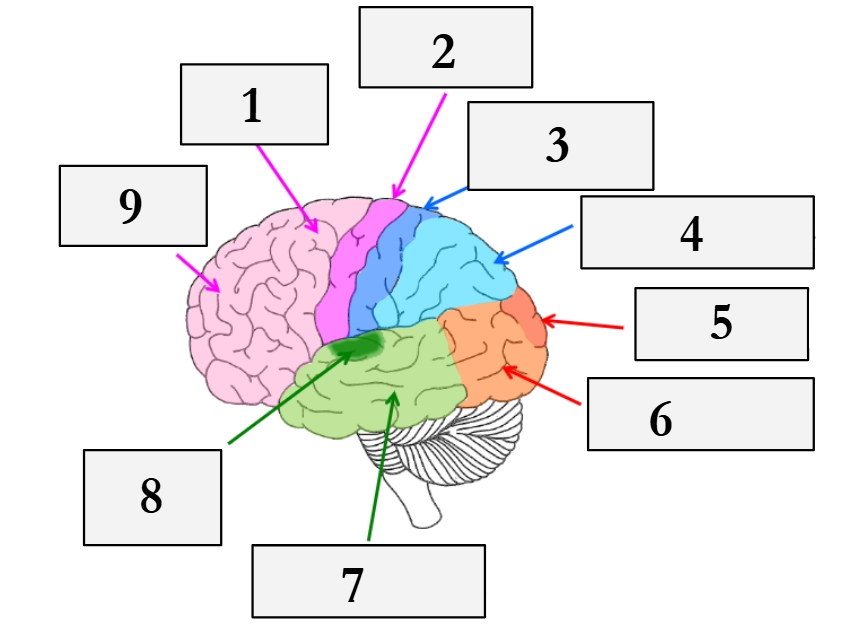
4?
Somatosensory Association Cortex

5?
Primary Visual Cortex

6?
Visual Association Cortex
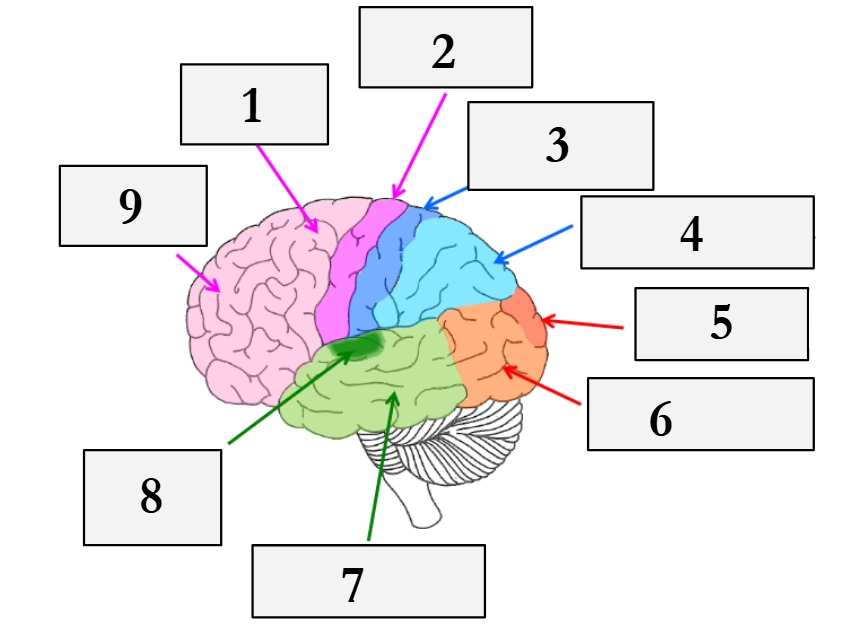
7?
Auditory/Visual Association Cortex
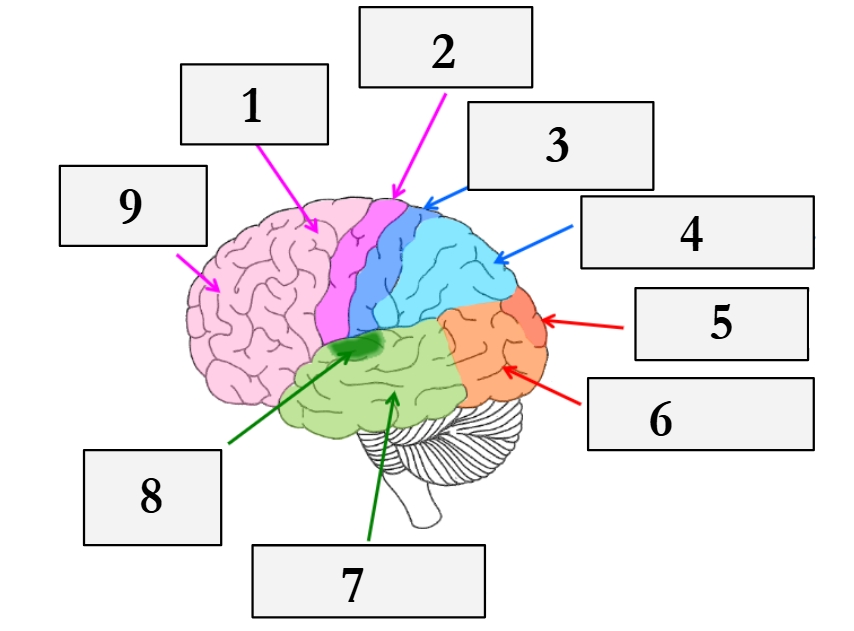
8?
Primary Auditory Cortex

9?
Pre-frontal cortex
Erikson’s first stage of development?
Trust vs. Mistrust (infancy, 0-2)
Erikson’s second stage of development?
Autonomy vs. shame/doubt (toddler, 2-3)
Erikson’s third stage of development?
Initiative vs. guilt (preschool, 4-6)
Erikson’s fourth stage of development?
Industry vs. inferiority (childhood, 7-12)
Erikson’s fifth stage of development?
Identity vs. role confusion (adolescence, 13-19)
Erikson’s sixth stage of development?
Intimacy vs. isolation (young adulthood, 20s)
Erikson’s seventh stage of development?
Generativity vs. stagnation (middle adulthood, 30s-50s)
Erikson’s eighth stage of development?
Integrity vs. despair (old age, 60s+)
Permissive parenting
less demanding, more responsive — wants to be cool, low expectations, avoiding confrontation, indulgent
Authoritative parenting
more demanding, more responsive — assertive, warm, high expectations, clear boundaries, source of comfort and guidance
Authoritarian parenting
more demanding, less responsive — critical, high expectations, strict consequences, less comforting and warm
Neglectful parenting
less demanding, less responsive — hands off, no clear boundaries and rules, no guidance, limited sense of comfort or communication
Mary Ainsworth’s contributions? Which other experiment explored this?
The Strange Situation: different styles of attachment, paradigm to measure said styles. Harlow’s Monkeys (nature vs. nurture idea) also explores this.
Secure attachment
nervous to leave parent, but parents offer safe home base to build confidence for exploration
Ambivalent/anxious attachment
separation anxiety, lacking trust, distraught when parent returns and is both desparate to receive comfort but also rejects it out of anger and mistrust
Avoidant attachment
completely comfortable without parent, neutral towards parents departure and return due to self-soothing adaptations from inconsistency and emotional unavailability
Components of dynamic development?
Individual differences, macro influences, and context
4 Main types of teratogens
• Drugs
• Infectious Agents
• Environmental Agents
• Health Factors
Preconventional moral development
self-interest
Conventional moral development
laws/social approval of others
Postconventional moral development
Complex, abstract reasoning, the greater good
Heinz dilemma
moral experiment developed by Kohlberg; steal the drug or let his wife die?
Assimilation
fitting new info into an existing schema
Accomadation
changing/creating new schema to fit new info into
Schema
a cognitive framework that we use to organize our understanding of the world
Sensorimotor stage (birth-2 years)
• Starts to mentally represent information in schemas based on sensory experiences
• Begins to act intentionally
• Achieves object permanence
Preoperational stage (2-7 years)
• Learns to use language by images & words
• Can use intuitive thought, but not logical
• Thinking is very egocentric
Concrete operational stage (7-12 years)
• Can think logically about objects & events
• Can understand operations
• Understands conservation
• Flexibly classifies objects by several features
• Can order them in a series along a single dimension
Concrete operational stage (12+ years)
• Can think logically about abstract thought
• Can use hypothetical-deductive reasoning to
test hypotheses systematically
• Becomes concerned with hypothetical issues,
the future, and ideological problems
RBD
REM Sleep Behavior Disorder; dreaming without muscle paralysis in REM so they act out their dreams
Sleepwalking
partially wakes up but not fully conscious, occurs during deep non-REM sleep
N1
first and lightest state of sleep
N2
still not deep sleep but transitioning; lasts the longest
N3
deep sleep transitioning to REM, third longest
REM
Rapid Eye Movement; final stage that repeats, most important for memory, health, and emotional regulation, vivid dreaming occurs
Insomnia
brain doesn’t produce enough GABA, cannot fall asleep
Obstructive sleep apnea
most common, throat muscles relax and tissue blocks airway
Sleep apnea
repeatedly stops/starts breathing causing brain micro-arousals and oxygen drops
Central sleep apnea
neurological, brain fails to send signals to muscles that control breathing
Complex sleep apnea
Combo of OSA and CSA
Narcolepsy
excessive sleepiness during the day, REM randomly occur
Narcolepsy treatment
stimulants, SSRIs
Insomnia treatment
CBT
Automatic processing
unintentional/subconscious actions
Presynaptic neuron
sending neuron
Postsynaptic neuron
receiving neuron
Step 1: Posterior
sends goals
Step 2: Pre-frontal
plans
Step 3: Pre-motor
sequences
Step 4: Primary motor
executes
Hypothalamus
Sleep, appetite, endocrine
Thalamus
Pain, sensory relay to and from cortex, alertness
Cerebellum
movement
Brainstem
neurotransmitter center
Spinal cord
pain
Amygdala
Fear, anxiety, pain
Hippocampus
memory, reexperiencing
Basal forebrain
Memory, alertness
Nucleus accumbens
Delusions, hallucinations, pleasure, libido, euphoria, reward
Prefrontal cortex functions
Attention, executive function, concentration, emotions, fatigue, obsessions, compulsions, etc.
Striatum
Movement, relay site from PFC
Stimulants (def., examples, neurotransmitters)
increased behavior and mental activity; meth, cocaine, nicotine, caffeine; dopamine, norepinephrine
Depressants (def., examples, neurotransmitters)
decreased behavior and mental activity; benzodiazepine, alcohol, anti-anxiety; GABA
Opiods
reduced pain and provides pleasure; heroin, morphine, oxycodone, fentanyl; endorphins