Section Two Soil Mechanics
 Call Kai
 Learn
Learn Practice Test
 Spaced Repetition
 Match
Match Flashcards
 Knowt Play
1/77

There's no tags or description
Looks like no tags are added yet.
Name | Mastery | Learn | Test | Matching | Spaced | Call with Kai | Chat |
|---|
No analytics yet
Send a link to your students to track their progress
78 Terms
stress and _____ are used interchangably
pressure
force = ___ x _____
force = pressure x area
total weight of soil along xs divided by the area of xs
total stress (presses down on soil)
pressure transmitted through water in soil voids (pore water)
pore water pressure (presses up on soil)
sum of the stresses transmitted through the contacting soil grains along a soil xs
effective stress (presses up on soil)
when water level fluctuates below ground surface stresses at any point below the groundwater table
stress will change
when a soil is subjected to a load the stresses ____ in the soil
increases
the stresses spread laterally with depth . stresses _________ with depth but affect large plan area
decreases
advantage of 2:1 method
simplicity
disadvantage to the 2:1 method
assusmes the stress is equal everywhere when in realitiy it is only in the center the greatest and at corners the least
at rest condition shows a _____ strain and _____stress
no, and moderate
active condition shows a _____ strain and _____stress
low, low
passive condition shows a _____ strain and _____stress
high , high
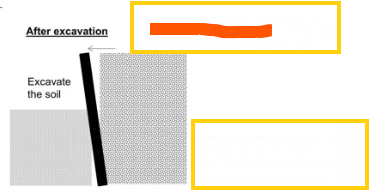
which type of pressure is the orange line
active (away from soil)- BIGGER MOVEMENTS
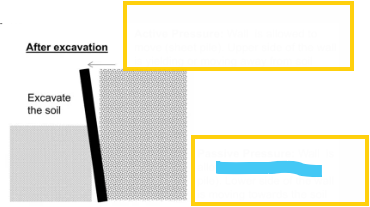
which type of pressure is the blue line
passive (towards from soil) -SMALLER MOVEMENTS
cases where the wall is fricitonless with a vertical back and horizonal backfill of granular soil
rainkine
the wall is prevented from yielding it is at a _____
at rest condition
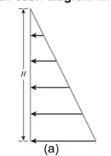
what condition is this? (cohesionless soil, cohesive-active, cohesive-passive)
cohesionless soil
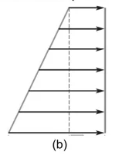
what condition is this? (cohesionless soil, cohesive-active, cohesive-passive)
cohesive-passive
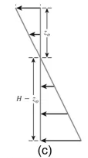
what condition is this? (cohesionless soil, cohesive-active, cohesive-passive)
cohesive-active (can have negative pressure from tension crack)
elastic deformation, no volume change, occurs during construction, coarse grain and fine grain
immediate elastic settlement
reduction of soil volume as results of pore water expulsion, long term, fine grain
primary consolidation settlement
reduction of soil volume as a result of plastic adjustment for soil late stages and beyond, fine grain
secondary consolidation settlement
total settlement is the sum of all three components
elastic, primary, secondary
drainage and therefore settlement occurs instantly, elastic and consolidation process can not be separated
consolidation of sand
do not undergo consolidation settlement due to relatively high hydraulic conductivity, undergo immediate settlement
consolidation of corse grain soils
low permeability, slow drainage, settlement can be separated, undergo settlement when dewater because effective stress increases
consolidation of clay
increases the density of unsaturated soil by reducing the volume of air in voids, instant process, water content does not change
compaction
increases the density of a saturated soil by draining out water, time depended, water content decreases
consolidation
consolidation test to predict the rate and amount of consolidation settlement
oedometer test
max past effective stress = to existing effective stress
normally consolidated clay
max past effective stress is less than the existing effective stress
over consolidated/ preconsolidated
ratio of past effective stress to the existing effective stress
Over consolidation ration (OCR)
doubling the drainage distance increases consolidation time by a factor of
4
the compression of soil layers as a result of construction of foundation or other loadings is caused by
deformation of soil particles, relocation/ rearrangement of soil particles, and expulsion of water and air from void spaces
spread footing and mat foundation
shallow foundation
enlargement at the bottom of a column or bearing wall that spreads the applied structural loads over a large soil area
spread footing
very large spread footing that usually encompasses the entire footprint of the structure
mat foundation
capability of the soil beneath a foundation to support a structure load
bearing capacity
F.S. = qult/ qall > ___
3
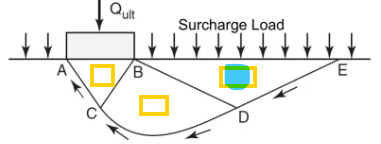
what zone is the blue area ?
passive zone 3
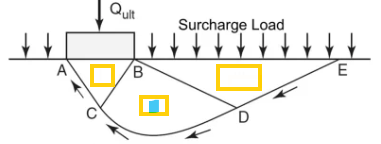
what zone is the blue area ?
radial zone 2
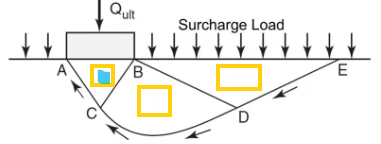
what zone is the blue area ?
active zone 1
foundation settles gradually into the ground, overturning of the foundation does not occur, structure no longer meets the service requirement due to excessive settlement, poor define shearzing plane
punching shear
occurs suddenly and is the most catastrophic to the structure , most common
general shear
foundation gradually settles and tilts in the subsoil
local shear failure
when water table rises to the ground surface the ultimate bearing capacity will
decrease
shear stresses developed in the soil exceed the corresponding shear strength of the soil
sliding
sliding surface parallel to the slope surface. weak seam (clay layer) below the slope surface or where loose topsoil rests on a hard subsoil
surficial slope failure (transitional slides)
large mass of the slope rotates along a curved failure surface which is simplified as a circular or log spiral curve for simplified analysis
rotational slope failure
designate a constant slope of infinite extent. (i.e. long slope of the face of the mountain)
infinite slope
limited in extent, slope length depends on height of the dam or embankment (slopes of embankments and earth dams)
finite slope
specific type of slope instability or failure. As the water level drops rapidly the reduction in pore water pressure leads to an increase in effective stress. Increase in effective stress can make the soil less stable
rapid drawdown slope failure
minimum F.S. for highway embankment side slopes
1.25 to 1.5
next to gravity, ____ is the most important factor in slope stability
water
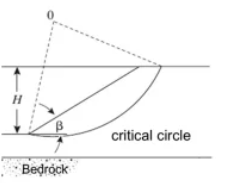
type of circular failure type- finite slope
toe circle
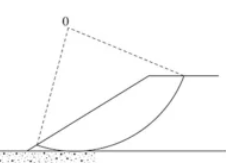
type of circular failure type- finite slope
slope circle
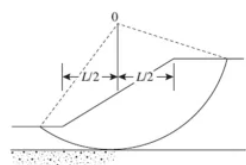
type of circular failure type- finite slope
base circle
for slopes in homogeneous clayey soils in undrained conditions (phi = 0 deg) the critical failure circle is always a toe circle when the slope angle is greater than ___ degrees
58
slopes extending a great distance in the height and length direction are considered to be ____extent (slopes may be both cohesive or non cohesive & w/ without seepage.
infinite
five ways to improve the slope stability
flatten slope, add berm to increase weight at toe, erosion protection at toe, lowering of groundwater table to reduce pore pressure in slope, plan for building desing to help aid stability
a retaining system should be sufficiently rigid so that only negligible deformations will occur during excavation. Most appropriate laterals earth pressure coefficient to use for design (Ka, Kp, Ko, Ks)
Ko
when a retaining structure moves towards the soil backfill the stress condition is called
passive
which can not be determined experimentally (total stress, porewater stress, effective stress, all)
effective stress
water table has influence on ____ and ___ but not on ____ when the water level fluctuates above ground
total and pore, not effective
water table has influence on ____ and ___ and on ____ when the water level fluctuates below ground
all three
rectangular area has a uniform surcharge load of 5000 lb/ft². The stress in the soil at a certain depth from the ground surface will ___ due to surface load. (increase, decrease, be the same)
increase
the sum of the vertical components of the forces developed at the points of contact of the soil particles per unit xs area of the soil mass is called.
effective stress
which of the following is estimated for the calculation of consolidation settlement (horizontal stress in soil, increase in pore water pressure, net increases of vertical effective stress in soil, none)
net increase of vertical effective stress in soil
when effective stress increases, _____ happens
settlement (sponge ex = consolidation = water out → soil squeezes → effective stress increases → settlement)
which of the following soils can have elastic and consolidation settlements occuring simultaneously
sandy
in a soil with low load bearing capacity, it is more economical to construct the entire structure over (spread footing, mat footing, both)
a mat foundation, (soil with low bearing capacity , the size of spread footings required is large af)
for heavier structures when great depth is required for supporting the load which of the following foundation is recommended (spread, mat, piles and drilled shafts)
piles and drilled shafts
the F.S. of a slope is defined as the ratio of… ( average ____ ____ possessed by the soil to average ______ ____ developed along the ______________)
shear strength, shear stress , potential failure surface
a slope will be stable if the F.S. is
greater than 1.25 (1.3-1.5 for sigificant damage failure slopes)
when slope failure occurs in a manner where the sliding surfaces passes some distance beneath the slopes toe it is determined as
base failure
if the failure plane is parallel to the top ground surface of the slope the slope is
an infinite slope
at the end of consolidation of clayey soil which is correct (total stress increase= effective stress increase) (excess porewater pressure=0) (total stress increase = excess porewater pressure) (none)
(total stress increase= effective stress increase) (excess porewater pressure=0)