Chemical Basis of Life: Atoms, Bonds, and Molecules in Biology
 Call Kai
 Learn
Learn Practice Test
 Spaced Repetition
 Match
Match Flashcards
 Knowt Play
1/46

There's no tags or description
Looks like no tags are added yet.
Name | Mastery | Learn | Test | Matching | Spaced | Call with Kai | Chat |
|---|
No analytics yet
Send a link to your students to track their progress
47 Terms
What is matter?
Anything that has mass and occupies space.
Define mass.
The amount of matter in an object.
What is weight?
The gravitational force acting on an object of a given mass.
What is an element?
The simplest type of matter with unique chemical properties, composed of atoms of only one kind.
Define atom.
The smallest particle of an element that has chemical characteristics of that element.
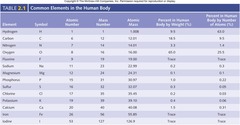
What are the four most common elements in the body?
Hydrogen (H), Carbon (C), Nitrogen (N), and Oxygen (O).
What are the three types of subatomic particles?
Neutrons (no charge), Protons (positive charge), and Electrons (negative charge).

What defines an element?
The number of protons in the atom.
What is the atomic number?
The number of protons in each atom.
Define mass number.
The number of protons plus the number of neutrons in an atom.
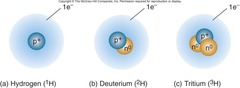
What are isotopes?
Two or more forms of the same element with the same number of protons and electrons but different numbers of neutrons.
What is atomic mass?
The average mass of naturally occurring isotopes of an element.
What is an ion?
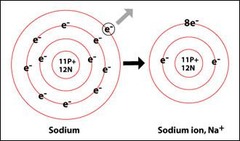
An atom or molecule that has lost or gained electrons and has a charge.

What is a cation?
An ion with a positive charge.
What is an anion?
An ion with a negative charge.
What are electrolytes?
Ions in the body that are essential for various physiological functions.
What are valence electrons?
Electrons in the outermost shell of an atom that can form chemical bonds.
What is a molecule?
Two or more atoms chemically combined to form an independent unit.
Define compound.
A substance composed of two or more different types of atoms chemically combined.
What is molecular mass?
The sum of the atomic masses of all atoms in a molecule.
What is ionic bonding?
A type of chemical bond where electrons are transferred from one atom to another.

What is covalent bonding?
A type of chemical bond where two or more atoms share electron pairs.

What is the octet rule?
Atoms are chemically stable when they have eight electrons in their valence shell.

What determines the type of chemical bond between two atoms?
The difference in electronegativity between the atoms.
What is a single covalent bond?
A bond where two atoms share one pair of electrons.
What is a double covalent bond?
A bond where two atoms share two pairs of electrons.
What characterizes a nonpolar covalent bond?
Electrons are shared equally because the nuclei attract the electrons equally.
What characterizes a polar covalent bond?
Electrons are not shared equally; one nucleus attracts the electrons more than the other.
What are hydrogen bonds?
Attractions between the positively charged hydrogen of one molecule and the highly electronegative atom of another molecule.

What is the difference between molecular and intermolecular forces?
Molecular forces are within a molecule, while intermolecular forces are between molecules.
What are intermolecular forces?
Forces between molecules resulting from weak electrostatic attractions.
What is the dissociation energy of covalent bonds?
Approximately 400 kcal.
What is solubility?
The ability of one substance (solute) to dissolve in another (solvent).
What is dissociation in ionic compounds?
Cations are attracted to the negative end and anions to the positive end of water molecules, causing separation.

What are nonelectrolytes?
Solutions made by molecules that dissolve in water but do not dissociate and do not conduct ionic current.
What are synthesis reactions?
Reactions where two or more reactants combine to form a larger product, storing energy in chemical bonds.
What are decomposition reactions?
Reactions where a large reactant is broken down into smaller products, releasing energy.
What are reversible reactions?
Reactions that can proceed from reactants to products or vice versa, reaching equilibrium.
What is oxidation?
The loss of an electron by a substance.
What is reduction?
The gain of an electron by a substance.
What is potential energy?
Energy stored in chemical bonds that could do work if released.
What is kinetic energy?
Energy that does work and moves matter.
What is the role of water in the body?
Water has cohesion and adhesion properties, stabilizes body temperature, and participates in chemical reactions.
What is a mixture?
Substances that are physically combined but not chemically combined.
What is a solution?
A mixture of liquids, gases, or solids that are uniformly distributed and chemically combined.
What is a solvent?
The substance that dissolves the solute in a solution.
What is a solute?
The substance that is dissolved in the solvent.