Locomotive Inspection and Safety Review
 Call Kai
 Learn
Learn Practice Test
 Spaced Repetition
 Match
Match Flashcards
 Knowt Play
1/45

Earn XP
Description and Tags
Practice flashcards for locomotive safety inspection and Transport Canada compliance based on lecture notes.
Name | Mastery | Learn | Test | Matching | Spaced | Call with Kai | Chat |
|---|
No analytics yet
Send a link to your students to track their progress
46 Terms
According to Transport Canada, what is the definition of a "SAFETY INSPECTION" for a locomotive?
An examination performed while stationary by a qualified person to verify the locomotive may move safely and to identify defects listed in Part III of the rules.
Under what condition must a certified locomotive inspector be recertified?
If they have not performed the prescribed duties for a period extending over three years.
What are four examples of safety appliances that must be included in a locomotive inspection?
Handrails, Running Boards (Front & Back), Pilot Steps & Ladders, and Side Handholds.
How many red fuses should be in the supply box, and what is their service life limit?
There should be 8 red fuses, and any bearing a date in excess of 5 years must be removed.
Besides flags and fuses, what air hoses must be present in the locomotive cab emergency equipment?
One Main Res. Air Hose and one Brake Pipe Air Hose.
What does a broken or missing seal on emergency equipment signify?
It is a visual indicator of tampering or emergency action.
How many fire extinguishers are on a GM F59 locomotive and what is their specification?
There are three Ansul Model 30 (30 lb.), Class B and C portable dry chemical, cartridge type extinguishers.
Where are the Fire extinguishers located on a locomotive?
Two are located in the engine room and one is located in the cab.
What is the primary method for testing warning lights on the annunciator panel?
Test all warning lights using the test button.
According to Section 28 of the Locomotive Inspection rules, what are the requirements for windows?
They shall be kept clean and free from cracks or obstructions.
What material must be used to replace a missing or defective form holder lens?
Polycarbonate material, because glass is dangerous and can cause severe personal injury.
What are the display and update requirements for Form 31-0006?
It must be displayed at all times in the cab, updated every 3 months maximum, and a new form applied every 12 months.
What is the maximum locomotive speed restriction typically posted in the cab for an MP40 and F59 Locomotive?
93 Mph and 83 Mph MAX
When inspecting wind deflector mirrors, what specific defect should be checked regarding the glass?
Ensure that reflective mirror foil has not separated from the glass.
What must be done to ensure awnings allow access to restricted areas of a facility?
They must be free to be "dropped" into the down position.
Where are the ground lights located on a locomotive unit?
One is located on each side of the unit above approximately the center of the lead truck.
How many step lights are controlled by the rear step lights switch?
Three step lights are controlled by the rear step light switch and Two step lights are controlled by the front step light switch
Which axles eject sand when the manual sand button is pressed with the reverser in the forward position? (Not reverse position)
Axle 1 on the front truck and axle 3 on the rear truck.
Under what condition will the horn at the Operator's station NOT sound?
When the GEN Field switch is off.
What are three examples of combustible materials to look for in engine room compartments?
Rags, paper, solvents, oil, grease, fuel oil, or excessive carbon deposits.
At what pressures does the air compressor governor cut in and cut out?
It cuts in at 130 psi and cuts out at 140 psi
What is the general minimum rail clearance for locomotive parts or appliances?
No part (excepting wheels and flexible sand pipe tips) shall be less than 2.5 inches above the top of the rail.
What are the minimum and maximum rail clearance heights for the pilot?
A minimum of 3 inches and a maximum of 6 inches.
What is the required clearance between handrails and the carbody?
2.5 inches must be maintained.
What is a specific requirement for dummy plugs on the front of the locomotive?
They must be in place and drilled for air venting.
When inspecting axle and roller bearings, what should you do if you find signs of overheating?
Report the evidence immediately; do not attempt to repair or tighten axle bearing bolts.
What visual indicator shows that a "Stink Bomb" heat indicator has been discharged?
A hole will appear in the heat indicator.
What is a sign that a lateral or vertical shock absorber is defective and needs replacement?
The presence of clearly formed droplets of oil.
What does a compressed segment of a coil spring indicate?
A broken spring.
What is the function of the Elliptical Springs in the locomotive suspension?
They provide secondary suspension, absorb vertical shocks, and provide damping.
What component supports the Spring Planks, Bolster Springs, and the entire weight of the locomotive?
Swing Hangers.
What are the inspection requirements for locomotive fuel and pollution tanks?
Ensure they are free of leaks, drain caps are secure, vents are clear of obstructions, and they are free from combustible accumulations.
What should be checked on the traction motor air duct boots?
Ensure they are not punctured, bolts are secure, and the lower flange is properly aligned to provide a good seal.
How many filler caps are on a traction motor gear case?
Two filler caps (one on each half).
Why must the handbrake be released briefly during its inspection?
To ensure proper operation of the corresponding locomotive piston.
What is the minimum required thickness for a brake shoe?
5/8 inch (Incl. backing plate)
When air brakes are released, how far should the brake shoes move away from the wheel tread?
3/8 inch.
What is the allowable range for brake piston travel?
2.5 to 4 inches
What color should the humidity indicators be in the air dryer if they working as intended?
Blue
What is the purpose of the Trickle Charger found in the short hood section?
It converts power to maintain a charge on the locomotive batteries to ensure they do not discharge when the Main Engine is out of service.
Spare 27 pin cables are located in?
Engine Room - Left Side
The Motive Power Equipment Inspection and Repair Certificate must be:
All of the above
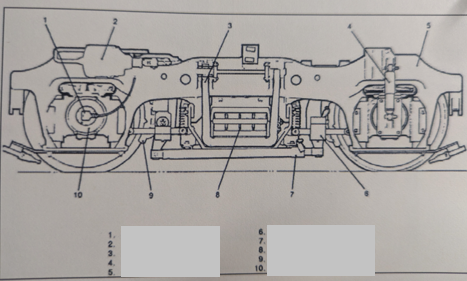
What is parts #1, #3, #6, #7, in that particular order
Axie Pulse Generator, Spring Hanger Assembly, Brake Rigging, Slack Adjuster
What is the vertical clearance for hoses in-between Equipment
4” for hoses
What is the minimum wheel tread thickness on a locomotive?
1 inch
What is unacceptable in regards to the fuel tank?
Loose mounting bolts on the fuel nozzle