Week 3: Platelet Function Testing
 Call Kai
 Learn
Learn Practice Test
 Spaced Repetition
 Match
Match Flashcards
 Knowt Play
1/55

There's no tags or description
Looks like no tags are added yet.
Name | Mastery | Learn | Test | Matching | Spaced | Call with Kai | Chat |
|---|
No analytics yet
Send a link to your students to track their progress
56 Terms
platelet closure times
time required to obtain full occlusion of the aperture
what types of conditions can be detected using the PFA?
von willebrand disorder
glanzmann thrombasthenia
aspirin
anti-platelet drugs
PFA stimulates the process of primary hemostasis _________
in vitro
the PFA measures the ability of platelets in __________ to occlude a cut in a membrane coated with collagen and epinephrine and collagen and ADP
whole blood
______ is the primary screener with PFA
Col/EPI
________ is used to indicate platelet dysfunction due to aspirin with PFA
Col/ADP
PFA sample requirements
whole blood in 3.8% or 3.2% sodium citrate
room temp
run within 4 hours
the specimens used for PFA cannot be what?
centrifuged or hemolyzed
the verify now system is an ________ detection system that measures platelet induced aggregation by microbead agglutination
optical
what does the verify now system cartridge contain?
lyophilized fibrinogen coated beads and a platelet agonist specific for the test
what type of specimen is needed for the verify now system?
whole blood
what is the agonist used for aspirin screening?
arachidonic acid
what is the agonist for P212 inhibitor or Clopidogrel screening?
ADP
what is the agonist for GP IIb/IIIa inhibitor, abciximab, or tirofiban screening?
thrombin
The phenomenon of platelet aggregation can be induced by adding aggregating agents to:
platelet rich plasma
whole blood
list of aggregation agents
ADP
epinephrine
collagen
ristocetin
thrombin
arachidonic acid
normal PLT count range
200,000 - 400,000 per uL
what type of specimen is used with optical aggregation?
platelet rich plasma PRP
principle of optical aggregation
infrared light thru 2 cuvettes — PRP sample + PPP reference
stimulus added → change in light transmission

what methodology is this?
optical aggregation
what is the % light transmission at 0% aggregation?
0
what are the 4 stages of platelet function?
shape change
primary aggregation
ATP release
second wave aggregation
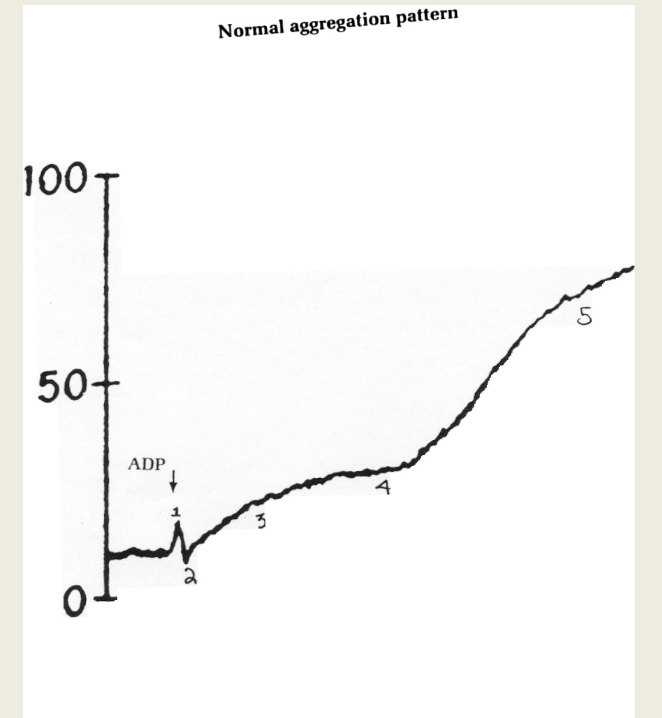
what causes 1?
slight increase in light transmission from the addition of the aggregating agent (like ADP)
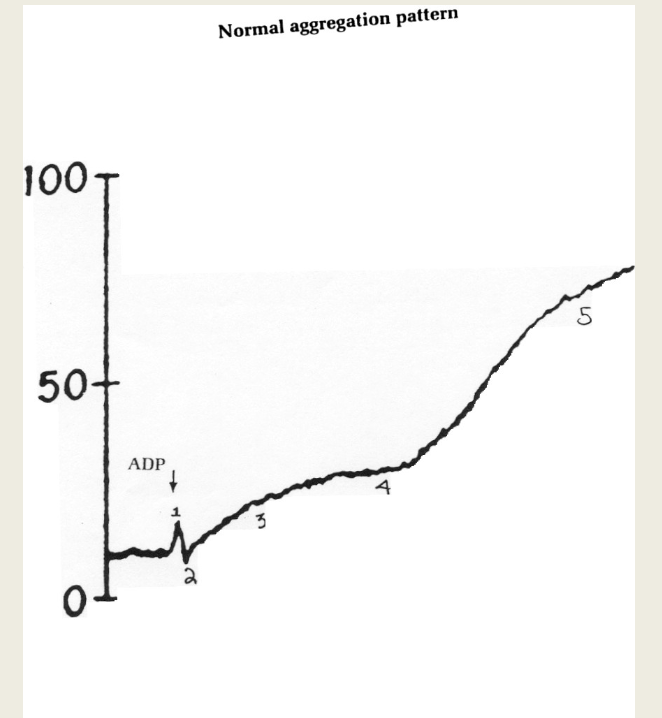
what causes 2?
slight decrease in light transmission due to shape change of platelets

what causes 3?
primary wave of aggregation

what causes 4?
release reaction

what causes 5?
completion of secondary wave of aggregation
with ___________ addition, there is a lag phase then single wave
collagen
with _______________ there is a single curve
arachidonic acid
what are the limitations of optical aggregation?
lack of other blood cells
excessive sample prep
loss of large platelets
lipemia and thrombocytopenia
pediatric patients
what is the specimen for impedance aggregation?
anticoagulated whole blood
with impedance aggregation, the entire ____________________ is present
PLT population
impedance method is non-__________
optical
principle of impedance aggregation methodology
electrode probe with 2 wires are placed in specimen
AC current applied
electrical resistance between the wires is measured
with impedance, a ______________ of platelets form on the wires with a baseline of 0 ohms
monolayer
with impedance methods, the aggregating agent is added to stimulate the platelets to adhere to the _____________
monolayer
the increase in impedance is directly proportional to the ______________
aggregation
how is whole blood diluted for impedance aggregation?
0.9% saline, 1:1 ratio
what does luminescence measure?
ATP release
principle of luminescence method
ATP is measured using firefly luciferin-luciferase reagent
photomultiplier = detection
firefly reaction
chrono-lume reagent + ATP → light
chrono-lume reagent components
luciferin
luciferase
magnesium sulfate
stabilizers and buffer
most common platelet defects
drugs (aspirin)
von willebrand disease (1-3% of population)
storage pool and secretion defects
conditions resulting in abnormal platelet release
prostaglandin synthetase deficiency
storage pool disease
release defect
prostaglandin synthetase deficiency
cyclooxygenase
also called aspirin-like defect
storage pool disease
dense granules are absent or deficient
release defect
a normal amount of stored nucleotides are present, but it requires increased concentrations of aggregating agent to induce release
what can these disorders be described as?
von willebrand disease
bernard soulier
glanzmann
storage pool
qualitative platelet disorders
what causes von willebrand disease?
a defect in the vWf on the platelet membrane which binds with Ib
what causes bernard soulier?
missing Ib which is the receptor for vWf
what causes glanzmann?
lack of IIb/IIIa for the attachment of fibrinogen
what platelet disorder is indicated?
ADP, Collagen, Epinephrine — Absent or severely impaired aggregation (flat curve)
ristocetin — normal
glanzmann thrombasthenia
what platelet disorder is indicated?
Ristocetin — Abnormal/absent agglutination that does not correct with the addition of normal plasma
ADP, Collagen, Epinephrine — Normal
bernard-soulier
what platelet disorder is indicated?
Ristocetin — Abnormal/absent agglutination that corrects when normal plasma (containing vWF) is added
ADP, Collagen, Epinephrine: Normal
von willebrand disease
what platelet disorder is indicated?
ADP, Epinephrine, Collagen — Biphasic or abnormal secondary wave
ristocetin — normal
storage pool disease
what platelet disorder is indicated?
arachidonic acid — absent
ADP and EPI — impaired secondary aggregation
ristocetin and high-dose collagen — usually normal
aspirin/COX defect