IB Biology A4.1 Evolution and Speciation HL
 Call Kai
 Learn
Learn Practice Test
 Spaced Repetition
 Match
Match Flashcards
 Knowt Play
1/32

There's no tags or description
Looks like no tags are added yet.
Name | Mastery | Learn | Test | Matching | Spaced | Call with Kai |
|---|
No analytics yet
Send a link to your students to track their progress
33 Terms
Define Lamarckism and give an example.
Jean-Baptiste Lamarck's theory of evolution that states organisms inherit acquired traits.
Ex. If a giraffe stretches its neck throughout its life to reach food, its neck grows longer and passes the trait to its offspring who would be born with a long neck.
Is Lamarckism true?
Lamarckism has been repeatedly falsified, there's no mechanism that causes specific adaptive changes to the base sequence of genes. Acquired characteristics are not inherited and don't lead to evolution.
Define Darwinism and give an example.
Charles Darwin's theory of evolution states that evolution is change in the heritable characteristics of a population. Traits are acquired because of natural selection, a trait has an advantage over another and reproduces.
Ex. A bird with a large beak can hold more food than a bird with a smaller beak making the large-beaked bird survive and the other to die off, reproducing more large-beaked birds.
What can you see when evolution occurs? What's an example?
Changes in the base sequence of DNA or RNA and in the amino acid sequences coded for by those sequences.
Ex. Coronavirus had many base sequence changes which affected the virus' traits. Some had traits that allowed survival and those reproduced causing the virus to evolve.
Evidence for evolution also comes from...
comparing base sequences of the same gene in different species. More closely related species are morphologically there ar fewer differences in base sequence. This is from the theory that species develop over time diverging from a common ancestor because of natural selection.
Why have humans done selective breeding? What does this change?
Meat and milk production, transport, and domestication are all reasons why humans have selectively bred animals for traits. There are large differences between livestock and the wild species they resemble. Now there's variation between different breeds of domesticated animals as well.
Along with animal domestication and selective breeding....
Crop plants including food for humans, fibers, and cut flower patterns are seen.
What is artificial selection?
Human caused/purposeful selection, or breeding specific traits of animals that humans find most beneficial to their needs.
Is artificial selection slow or fast?
RAPID evolution is contributed by artificial selection because changes from domesticated plants and animals have been seen over short periods of time. If artificial selection took 12,000 or so years to see visible changes it's reasonable to assume natural selection caused major evolutionary changes.
What are 4 examples of artificial selection?
1. Pug snout small size has been selectively breeded to make the pug look cuter, but naturally they have longer snouts.
2. Brassia oleracea is the common ancestor of cauliflower, broccoli, cabbage, brussel sprouts, kale, and many more because people selected larger stems or roots or flowers to make different vegetables.
3. Chicken Eggs, the larger egg producing chickens were chosen to keep on breeding to insure large eggs.
4. Belgian Blue cattle evolved from a different cow-like species for an abundance of meat.
Write the Homologus and Analogus Structure chart
...
What are pendactyl limbs, and the 5 parts?
5 digit limbs that are similar in many related species with differences in lengths and thicknesses of bone caused by evolution. Humerus, Ulna, Radius, Carpals, Phalanges.
What is a common ancestor?
One species or organism that many species root from or diverged from.
What are vestigial structures?
Structures from older ancestors that now serve no function and are gradually lost.
Color in this model of a Pentadactyl limb
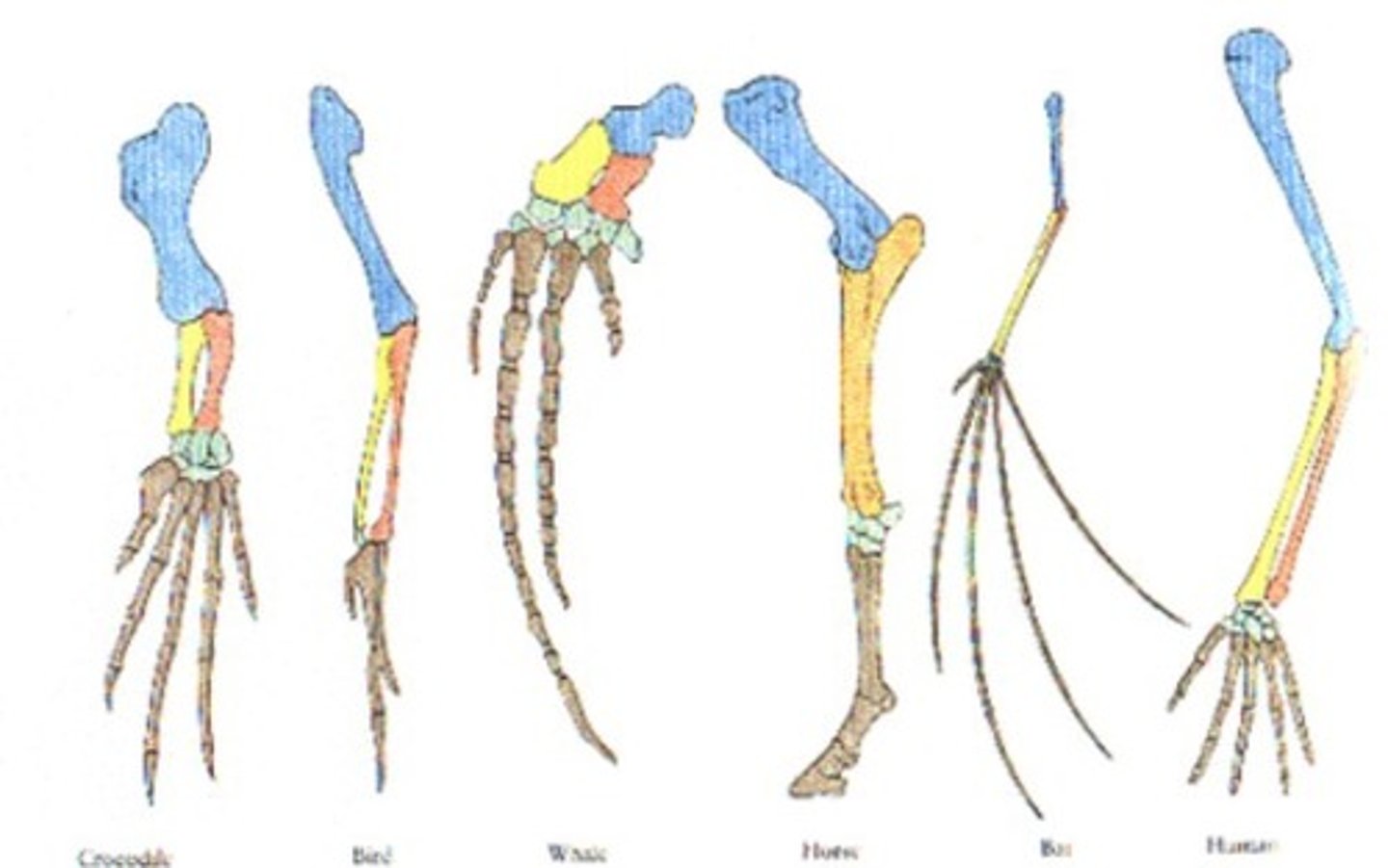
What is convergent evolution?
When unrelated species have developed similar characterstics that help with their survival because they live in similar environment.
What is speciation?
Formation of new species by splitting pre-existing species.
What are the 5 steps of speciation?
1. Two populations are SEPERATED so they can't interbreed
2. Natural selection acts differently on the two populations and they start to evolve differently
3. The characteristics eventually diverge
4. Later will be recognizably different
5. If the population had the chance to interbreed but didn't it would be clear they are two seperate species.
____ _____ the total number of species on Earth, and _____ _____ it.
Speciation increases, Extinction decreases
In order for speciation to occur, two processes are required:
reproductive isolation and differential selection.
What is reproductive isolation?
A barrier preventing genes to be mixed between the gene pools of the two populations. An example of this is Geographical Separation, which is a physical barrier (mountain, river) that divides.
What is differential selection?
Differences in selection pressures between two locations leads to natural selection occurring differently in each geographical location. Climate, predation, and competition
Example of speciation
Bonbo and chimpanzee, seperated by the Congo river water fell allowing to cross, geographical isolation from ancestors and underwent different selection pressures.
What is Allopatric and Sympatric speciation?
Allo - when populations in different geographical areas become separate species.
Symp- when a population of a species living together in one geographical area splits into two populations that do not interbreed (less common)
Reproductive isolation in sympatric populations may be a consequence of:
BEHAVIORAL differences in animals (mating behaviors)
TEMPORAL differences in animals or plants (timing of fertile season)
What are adaptions?
Characteristics that make an individual suited to its environment or way of life.
What is adaptive radiation?
The pattern of diversification in which species that have evolved from a common ancestor occupy a range of ecological roles. Homologous structures, selective pressures MINIMIZATION OF COMPETITION, thereby increasing biodiversity in ecosystems
Example of adaptive radiation:
Darwin's Finches: Over the past 2.3 million years, 14 species of finches have adapted from a common ancestor Galapagos Islands. Finches adapted to different food sources, and beaks show clear adaptions.
What is hybridization?
The crossbreeding of two species to create new varieties. However, most results are sterile. Little to no mixing of alleles from closely related species.
Cons of hybridization...
WASTE of resources, barriers have been evolved to prevent hybrid offspring. No mating is better than hybrid mating. Courtship behavior helps with this, as mates can look for behavioral features.
Reversing speciation with hybridization??
If barriers of hybridization aren't developed speciation may be reversed. If humans hybridize species that naturally and geographically are separated, the two could have traits from both species, and parent species can face extinction, which is a loss of biodiversity.
What is a polyploid?
Organisms with more than 2 sets of homologous chromosomes. It's caused by a duplication of chromosomes without cell division. An autotetraploid is when the genome duplication happens in the diploid cell creating 4 sets. STERILE
Polyploidy in cross breeding/hybridization
If individuals from different species cross-breed then the resulting cell duplicates but does not divide they will have 4 sets of chromosomes, which can overcome fertility problems (4). also known as ALLOPOLYPLOIDY, plants.