BIOL 221 week 2
 Call Kai
 Learn
Learn Practice Test
 Spaced Repetition
 Match
Match Flashcards
 Knowt Play
1/58

There's no tags or description
Looks like no tags are added yet.
Name | Mastery | Learn | Test | Matching | Spaced | Call with Kai |
|---|
No analytics yet
Send a link to your students to track their progress
59 Terms
What are the structural differences between a capsule and slime layer
Capsules have well organized glycocalyces that are closely associated with the cell while slime layers have more loosely organized glycocalyces that are very loosely associated with the cell
What are the functions of capsule and slime layer
Capsules and slime layers help bacterial cells attach to surfaces and protect them from phagocytes
What structures make up the flagellum
Flagellum is made of a long filament of flagellin which acts as a propeller for the bacterial cell. Attached to that is a bent hook that connects the filament to the cell. This hook is connected via a shaft to the basal body that has the L-ring and the P-ring that act as bushings to reduce friction in the rotation. Underneath this is the stator and the rotor which generate the torque and does the rotation, respectively. Finally, there is the C-ring that acts as a switch for the motor
What provides the power for a flagellum
The power for a flagellum is provided by the C-ring pumping proteins, which gives the energy for the rotation to occur
How can the direction of the flagellum change
The direction of the flagellum changes when receptor proteins sense attractants or repellants. If the frequency of the signal from an attractant continues increasing, the flagellum will rotate counterclockwise to propel the bacterium forward towards the attractant. If the frequency stays the same or starts to decreases, the receptor protein CheY will become phosphorylated and interact with the C-ring to make the motor move clockwise. This will send the bacteria into a tumble to prevent it from moving away from an attractant, or moving towards a repellant
What are three functions for pili
Pili ca be used for horizontal gene transmission, gliding movement, twitching movement, and nanowires
What are the three major types of storage granules
The three major types of storage granules are carbon, phosphate, and sulfur storage granules
What is a bacterial microcompartment
A bacterial microcompartment is a localized higher concentration of a certain protein or enzyme that performs a metabolic function. This is surrounded by a protein shell for selective permeability
What are four types of intracellular inclusion bodies found in bacterial cells
Four types of intracellular inclusion bodies are phycobilisomes (light-harvesting), chlorosomes (light-harvesting), magnetosomes (magnetic), and carboxysomes (Carbon fixation)
What are the seven steps in the production of an endospore
0. Normal growth through binary fission
1. Duplicating chromosomes
2. Asymmetric septation – splits into one smaller and one larger cell (smaller becomes endospore)
3. Engulfment – Larger cell uses it’s cytoplasmic membrane to surround the spore, larger cell’s DNA breaks down
4. Cortex synthesis
5. Coat synthesis
6. Lysis of mother cell
7. Free spore
What are the functions of the core, cortex and coat in the endospore
The core contains the cell and compacts the DNA down to A-DNA. The cortex is made of a special peptidoglycan with fewer side chains so that it is more flexible. The coat is made of many different proteins that protect against dehydration, UV damage, and chemical damage.
How does bacterial cell division differ from eukaryotic cell division
Bacterial cell division is much quicker than eukaryotic cell division. It doesn’t have nearly as many checkpoints, and has less steps
What are the steps in the formation of a biofilm
A biofilm is formed when planktonic bacteria attach to a surface (reversible attachment because can detach if necessary). The bacteria then produce a slime layer, which makes it an irreversible attachment because it would be very difficult for them to detach. The different bacteria then communicate to form microcolonies. After pretty sufficient cell proliferation, a mushrooming effect occurs. From here other species can feed off of this microcolony and what it is producing. Finally, the biofilm will break down, and bacteria will go off to form different colonies
What are the five categories of bacteria based on optimal temperature?
1. Psychrophiles (low temperature preferred)
2. Psychrotroph (can grow in lower temperature but prefer moderate)
3. Mesophile (live in moderate temperatures)
4. Thermophile (live in warmer temperatures)
5. Hyperthermophile (live in very hot temperatures, above boiling)
What are the five categories of bacteria based on oxygen requirement?
1. Obligate aerobe (has both superoxide dismutase and catalase, needs oxygen)
2. Facultative anaerobe (has both superoxide dismutase and catalase, can go with or without oxygen but grows much quicker with oxygen)
3. Obligate anaerobe (Doesn’t have superoxide dismutase or catalase, grow in low oxygen environments)
4. Microaerophile (Grows best with limited oxygen, has both superoxide dismutase and catalase but very little of them)
5. Aerotolerant (has superoxide dismutase, can grow in oxygen environments but don’t use it so the amount of oxygen doesn’t impact growth)
How is metabolism (respiration vs. fermentation) and ability to detoxify reactive oxygen different in each category?
The categories that have superoxidase dismutase and catalase can detoxify reactive oxygen, so they are the bacteria that can live in higher oxygen environments. Those that lack these enzymes grow in lower oxygen environments. Also, bacteria that require oxygen to do metabolism need to be in high oxygen environments while those that don’t need oxygen can live in low oxygen environments
What are the three categories of bacteria based on optimal pH?
1. Neutrophile (prefer neutral pH)
2. Acidophile (prefer acidic pH, pump protons from the cytoplasm into the environment to maintain cytoplasm pH and for energy)
3. Alkalophile (prefer basic pH, doesn’t pump protons for energy because not really protons present so instead pumps sodium ions)
What are the metabolic categories that explain how bacteria obtain carbon, energy, and electrons?
Carbon:
1. Heterotroph (must catabolize other organic materials)
2. Autotroph (gets carbon from CO2)
Energy:
1. Chemotroph (use free energy from redox reactions)
2. Phototrophs (use sunlight for energy)
Electrons:
1. Organotrophs (get electrons from reduced organic compounds)
2. Lithotrophs (get electrons from reduced inorganic compounds)
How are anaerobic bacteria and obligate intracellular parasites grown in the laboratory?
Anaerobic bacteria are grown in a laboratory by using a gas-pak jar or a glove box. Obligate intracellular parasites are grown in a laboratory using tissues cultures or embryonated eggs.
Draw a growth curve with the x-axis and y-axis properly labeled
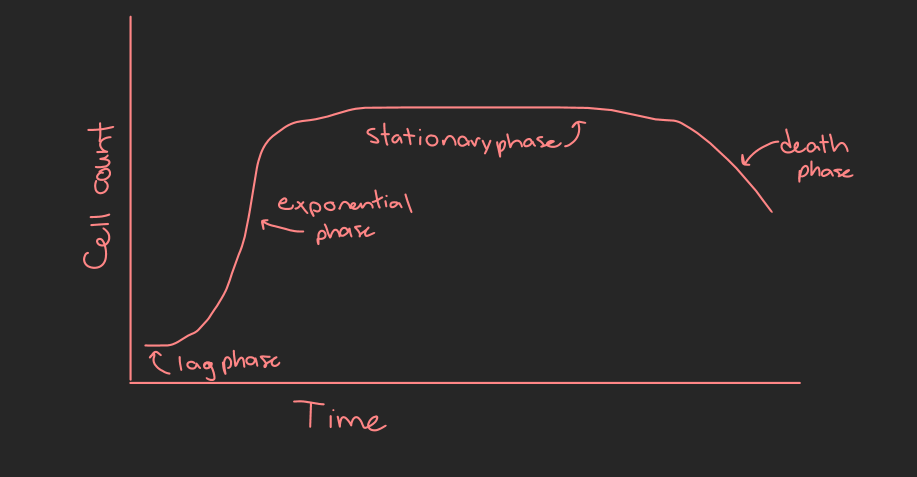
What are primary metabolites and where are they produced during a growth curve
Primary metabolites are growth factors produced by bacterial cells that are needed for growth these are produced mostly during the exponential phase of growth
What are secondary metabolites and where are they produced during a growth curve
Secondary metabolites are produced when bacterial cell growth decelerates, and are mostly produced during the stationary phase of growth
Petroff-Hauser chamber
Direct cell count method that has a slide with a special grid that the sample can be pipetted onto and cells can be counted
Coulter counter
Direct cell count method that has sample added to a solution with electrolyte that conducts a current, and there is a counter. As bacterial cells pass through the counter, they interrupt the current
Dilution and plating scheme
Viable cell count method where a serial dilution done to get a less concentrated sample, this is then placed on a plate and the number of colonies that form is counted
Membrane filtration
Viable cell count method where vacuum filtration is done to separate microbes from water, and filter paper containing microbes can be used to count colonies that form
MPN
A viable cell count method that uses a statistical method based on positive and negative growth using different dilution levels to monitor growth patterns and calculate concentration
Turbidity
A biomass measurement method that uses a spectrophotometer to look at how the sample scatters light, the more scattering there is the more cells there are, and this can be used to determine concentration
Weigh cells
A biomass measurement method that uses centrifugation of cells out of solution to be weighed
Durham tube
Measure cell products method where the tube contains broth and is placed upside down in the sample so as the bacteria produce carbon dioxide, this gas goes into the tube and gas collects at the top of the tube
Luciferase method
Method of measuring cell products by looking at ATP production by using luciferase which is an enzyme that uses ATP to produce light, so ATP produced by bacteria will be shown by the light, giving insight into how many bacteria there are
What is the difference between anabolic and catabolic reactions
Anabolic reactions build materials while catabolic reactions break materials down
What are redox reactions? How are redox reactions related to energy?
Redox reactions are reactions where electrons are transferred between materials so one is oxidized and one is reduced. These are related to energy because the transfer of electrons also means a transfer of energy between materials
How do enzymes function as biological catalysts
Enzymes function as biological catalysts by binding their substrate in their active site and then undergoing a conformational change to fit the substrate, called induced fit
What is the difference between competitive and noncompetitive (allosteric) control of enzymes
Competitive control of enzymes is where the competitor mimics the substrate and binds the active site of the enzyme while noncompetitive control is when the inhibitor binds a different part of the enzyme, causing a conformational change that doesn’t allow the substrate to bind
What environmental factors can lead to enzyme denaturation
Enzyme denaturation can be caused by too high of temperatures which loosen the tertiary structure of the protein, making it lose it’s structure. This can also be done by high acidity
What is the purpose and three main products of glycolysis
The purpose of glycolysis is catabolize glucose into pyruvate be used in many different metabolic pathways, it also produces ATP. The three main products of glycolysis are ATP, pyruvate, and NADH
How does oxidative decarboxylation of pyruvate produce energy
Oxidative decarboxylation of pyruvate produces energy by forming NADH which is a high energy electron carrier
What is the purpose and three main products of the TCA (Krebs) cycle
The purpose of the Krebs cycle is to oxidize Acetyl CoA and form ATP. The three main produces of the Krebs cycle are CO2, ATP, and electrons (as NADH and FADH2).
How do bacteria catabolize carbohydrates (other than glucose), lipids, and proteins
Bacteria catabolize carbohydrates by converting them into glucose or fructose so that they can enter glycolysis. They catabolize lipids by removing the fatty acids (which contribute to forming Acetyl CoA) and then using the glycerol in glycolysis. They catabolize proteins by breaking them into their amino acids and deaminating the amino acids so they can enter central catabolism
Where do the precursors for the anabolism of polysaccharides, lipids, nucleic acids, and amino acids come from
The precursors for anabolism of polysaccharides are intermediates from glycolysis. The precursors for lipids are glycerol and acetate. The precursors for nucleic acids are 6 carbon carbohydrates that are converted to 5 carbon to make ribose or deoxyribose. Precursors for amino acids come from many different intermediates in glycolysis and the Krebs cycle
How does an electron transport chain release redox energy
Why is it important to have electron carriers that carry both electrons and hydrogen ions (H+) and electron carriers that carry electrons only
How is PMF used to generate ATP via chemiosmosis? What enzyme is key to this process
What are three differences between bacterial and mitochondrial electron transport chains?
What are three alternate terminal electron acceptors that can be used by bacteria?
Describe the flow of electrons in the “Z-scheme” of oxygenic photosynthesis. What is the electron donor? How are ATP and NADPH produced?
Why is bacterial photosynthesis considered to be cyclic?
What is the electron donor(s) and electron acceptor for bacterial photosynthesis?
Why must purple sulfur bacteria use reverse electron transport for their photosynthesis while green sulfur bacteria do not?
Sterilization
Pasteurization
Disinfection
Decontamination
Sanitization
What is a decimal reduction time (D)? How many D’s are needed to say that a surface has been decontaminated, or solution has been pasteurized? What factors impact the decimal reduction time?
What are three methods for pasteurization?
What is the difference between filtration (membrane and depth) and radiation in the elimination of microorganisms?
What are the three bacterial structures that are targets for chemical disinfectants?