Lecture 1: Equine musculoskeletal anatomy and conformation
 Call Kai
 Learn
Learn Practice Test
 Spaced Repetition
 Match
Match Flashcards
 Knowt Play
1/47

There's no tags or description
Looks like no tags are added yet.
Name | Mastery | Learn | Test | Matching | Spaced | Call with Kai | Chat |
|---|
No analytics yet
Send a link to your students to track their progress
48 Terms
- the shape or structure of something, like various body regions relative to each other or in general appearance
- structure is not easily changed
What is conformation?
- size
- shape
- height
- angles
- contours
- transitions
- relative proportions
- left-right symmetry
- muscle development
- breed standards
What are conformational features?
- affects function
- affects performance
- can lead to injury
Why is confirmation clinically important?
- a broad base of support
- equal weight bearing across all limbs
What does ideal conformation provide?
- false --> function affects form by changes in structures, which can lead to lameness
True or false
- conformation affects form
- left-right hood asymmetry
- heel height asymmetries
- hoof landing
- medial-lateral hoof wall imbalance
What are examples of changes in function that lead to changes in form that can lead to leamness?
- the position in which someone holds their body when standing or sitting
- a function that can be modified or trained
What is posture?
- often due to pain, weakness, or neurologic deficits
Why might posture be altered?
- laminitic stance
- unweighted limb (normal resting or lameness)
- ataxia base wide stance
- severe weakness
What are 4 examples of altered posture?
- laminitic stance
- shifting weight off front feet
What is this altered posture and why?
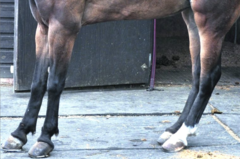
- leaning due to severe weakness
What is this altered posture and why?
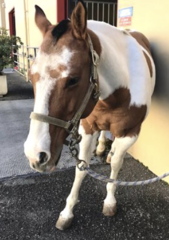
- base-wide, toe in
- fetlock osteoarthritis or splint bone disease
What is this conformational fault and what can it lead to?
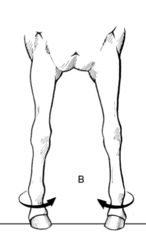
- base-wide, toe out
- fetlock osteoarthritis or splint bone disease
What is this conformational fault and what can it lead to?
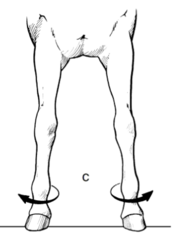
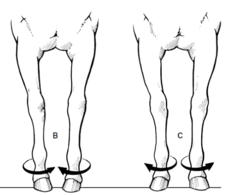
- base-narrow, toe out and base narrow, toe in
- fetlock osteoarthritis or splint bone disease
What are these conformational faults and what can it lead to?
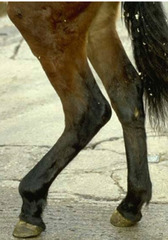
- base wide stance
- pain or ataxia
What is this postural fault and what can it be cause from?
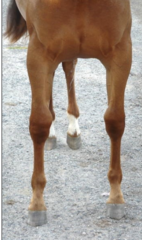
- base-wide, toed out
- splint bone dz due to extra strain on interosseous ligament and strain on fetlock joint
What is this stance and a common DDx for it?
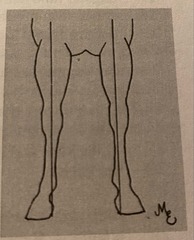
- entire limb is painful
Why might a horse have an externally rotated limb?
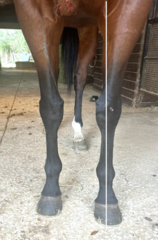
- paddling
How does a horse with a toed in limb walk?
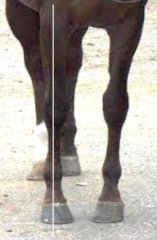
- swing in toward midline
- interference with contralateral limb
How does a horse with a toed out limb walk?
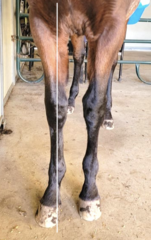
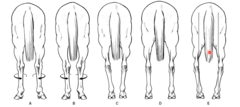
a. cow hocked (external rotation)
b. cow hocked, base narrow
c. base narrow (postural)
d. base wide (postural)
e bow legged (internal rotation = more prone to arthritis)
What are these flaws of the hindlimb? Which are postural rather than conformational?
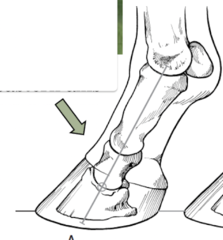
- yes
- supports limb loading and proper movement
Is this an ideal pastern angle? Tell us about it.
- no it's a upright pastern angle
Is this an ideal pastern angle?
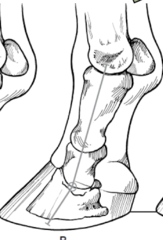
- short stride length
- prone to navicular disease and pastern osteoarthritis
- causes stress at the coffin bone
This horse have a upright pastern angle, what is seen with it?
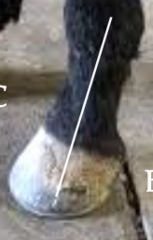
- no, its a sloping pastern angle
Is this an ideal pastern angle?
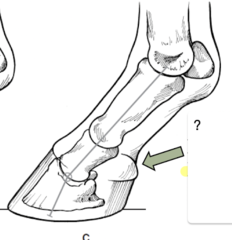
- longer stride length
- prone to soft tissue injuries such as suspensory ligament injury
This horse have a sloping pastern angle, what is seen with it?
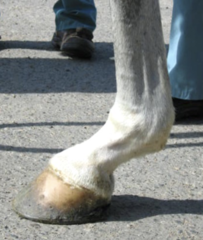
- conformational faults are not synonymous with lameness.
- however often contribute to altered limb loading and movement thus increased risk for musculoskeletal injuries
Why is confirmation important?
- often a sign of MSK pain or neurologic disease
What is the importance of altered posture?
16: carpus
D. radiocarpal joint
E. midcarpal joint
F. carpometacarpal joint
G: metacarpophalangeal joint (fetlock joint)
H: proximal interphalangeal joint (pastern joint)
I: distal interphalangeal joint (coffin joint)
What are the joints of the thoracic limb?
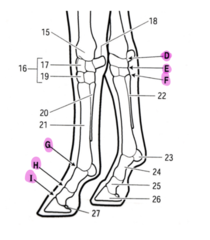
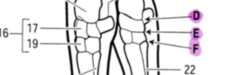
D. radiocarpal joint = most mobile with 90* of flexion
E. midcarpal joint = 40* of flexion
F. carpometacarpal joint = 0* of flexion
What is the mobility of the joints of the carpus like?
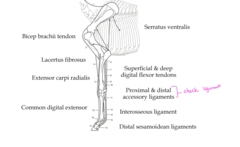
- an anatomical mechanism of the equine limb that allows the animal to stand with little muscular effort; includes many muscles, ligaments, and tendons
What is the stay apparatus of the forelimb?
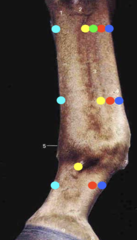
light blue = common digital extensor in forelimb and long digital extensor tendon in rear limb
yellow = suspensory ligament (body, branches, exensor branches)
red = deep digital flexor tendon
green - distal accessory (check) ligament
dark blue = superficial digital flexor tendon
What are these tendon of the distal limb?
- affected by lacerations or wounds leading to infections, which can be serious
Why is it important to know the synovial structures of the limb?
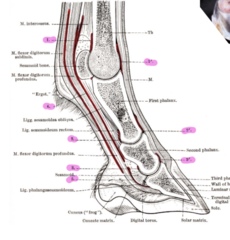
- each joint has a dorsal (X') and palmar pouch (X)
What are these joint spaces?
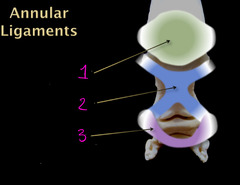
1. palmar annular ligament
2. proximal annular ligament
3. distal digital annular ligament
What are these digital annular ligaments in the horse?
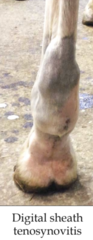
- surrounds the SDFT and DDFT
- extends from mid-cannon to mid P2
This is a digital tendon sheath that is abnormal. What is the digital tendon sheath?
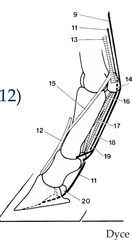
- SDFT (9)
- DDFT (11)
- interosseous ligament (13)
- extensor branches and common DET
- distal sesamoidean ligaments (16-18)
What are the components of the stay apparatus of the digit?
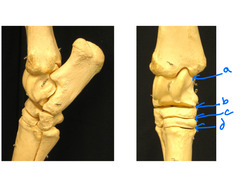
a. tibiotarsal joint
b. proximal intertarsal joint
c: distal intertarsal joint
d. tarsometatarsal joint
What are these tarsal articulations?
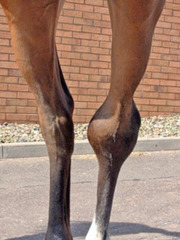
- tarsocrural joint
What joint has effusion?
- arthritis and other injuries
Why is the motion of a joint important?
- tibiotarsal joint
Which joints of the tarsus are high motion?
- proximal intertarsal joint
- distal intertarsal joint
- tarsometatarsal joint
Which joints of the tarsus are low motion?
- a patellar locking mechanism that works the same as the forelimb stay apparatus
What is the stay apparatus of the pelvic limb?
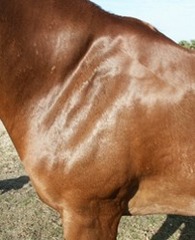
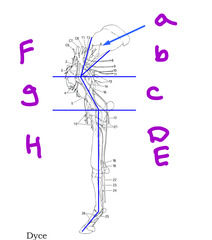
- suprascapular nerve
This horse has sweany shoulder, what nerve is impacted?
a. subscapular n
b. axillary n
c. radial n
d. median n
e. ulnar n
f. suprascapular n
g. musculocutaneous n
h. radial
What are the innervations of these parts of the equine thoracic limb?
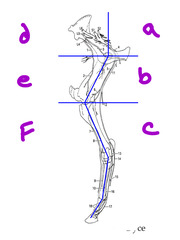
a. caudal gluteal n
b. sciatic n
c. tibial n
d. cranial gluteal n
e. femoral n
f. common fibular/peroneal n
What are the innervations of these parts of the equine pelvic limb?
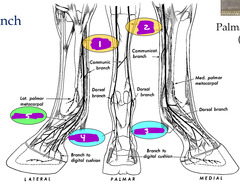
1. lateral palmar n
2. medial palmar n
3. medial digital n
4. lateral digital n
5. dorsal branch
What are these nerves of the distal limb, that are important for nerve blocks?
True
True or false
this is a radial nerve issue
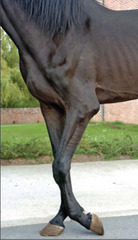
- tibial nerve
This horse can't extend its distal limb, which nerve could be impacted?