MSU ARC 1013 Final Exam
 Studied by 0 people
 Call Kai
 Learn
Learn Practice Test
 Spaced Repetition
 Match
Match Flashcards
 Knowt Play
1/190

There's no tags or description
Looks like no tags are added yet.
Name | Mastery | Learn | Test | Matching | Spaced |
|---|
No study sessions yet.
191 Terms
Architecture responds to...
-the needs of its users and rises to the level of art.
Architecture is connected to....
-a particular place and relates to the specifics of geography, climate, and the surroundings.
Site
-architects call the particular place a building is to be constructed
Why is architecture important?
-because it permanently records a civilization's aesthetic tastes, material resources, political and social aspirations
Architecture helps define...
place
Three principals Vitruvius felt essential to architecture:
-firmness (structure)
-commodity (function)
-delight (beauty)
Architects shape space using the following elements (9):
-solids
-voids
-scale
-massing
-proportion
-rhythm
-color
-texture
-light
Solids and Voids
-the relationship between solid and void creates architectural space
Symmetry
-designing one side of a space to mirror the opposite
Mies van der Rohe
"God is in the details."
Proportion
-a quantified relationship among the parts of an element, as well as the relationship of that element to the whole.
Golden Section
-known since the Greek mathematician Euclid, an irrational proportion with special mathematical and spatial relationships applicable to a wide variety of phenomena, including aesthetics, art, music, and nature
-"a line cut in such a way that the smaller section is to the greater as the greater is to the whole."
-approximately 8:5
Shed Roof
slopes to one side
Gable Roof
slopes to two sides
Hipped Roof
sloping ends and sides that meet at a ridge
Pavilion Roof
shaped like a pyramid and is used to cover a square structure
Barrel Vault
semi-circular roof
Gambrel Roof
roof combines two different pitches below the ridge
Mansard Roof
-roof combines two different pitches below the ridge
-named for French architect Francois Mansart
Flat Roof
-popular by European architects of 20th c
-makes roof over a building with large plan possible, rarely actually flat-but have a very low slope
Rusticated Wall
made of stone that are typically rough and raised off the wall surface
Half-timbered
having a timber framework with the spaces filled with masonry and plaster
Clapboard siding
wood siding laid horizontally
Board and Batten siding
wood siding laid vertically consisting of wide boards and narrow battens
Stucco
a course plaster composed of cement, sand, and lime, mixed with water and used to cover exterior walls
Glass
-ability to create large expanses of glass in a wall was made possible by manufacturing improvements in the late 19th and 20th century
-glass is not used in a structural way, except in most technically sophisticated buildings
Curtain Wall
a nonstructural frame and glass cladding system
Masonry
brick/stone/concrete block
Concrete
poured in place, pre-cast, tilt up panels
Lancet Window
-tracery-decorative stonework; trefoil-cloverleaf shape with three foils; quatrefoil-four foils; popular in gothic structures
Palladian Window
a round headed window flanked by two smaller windows
Oxeye Window
a comparatively small round or oval window used in frieze or dome
Double hung Window
a window having two vertically hung sashes, each in separate tracks
Dorner Window
a vertical window in a projection built out on a sloping roof
Bay Window
a window projecting from the surface of the wall to allow light from three sides
Ribbon Window
a horizontal band of windows
Casement Window
a window sash opening on hinges generally attached to the vertical side of the frame
Transom Window
a window above the transom of a doorway
Clerestory
a portion of an interior rising above adjacent rooftops and having windows to admit daylight
Arched Doorway
associated with Romanesque and Gothic architecture
Pedimented Doorway
triangular shaped element historically made of stone
Venetian Door
a door opening, with a semicircular window (fanlight) above and flanked by vertical windows (sidelights)
French Door
door having rectangular glass panes extending throughout its length often hung in panes
Sliding Door
a door that operates or moves by sliding on a track
Building Type
an architectural form which has become accepted by society through repeated use
Building Type Examples (9):
-cathedral
-bank
-train station
-palace
-castle
-skyscraper
-temple
-airport
-factory
Building Program
a client's list of practical requirements for a design project
Steps Required to Become a Licensed Architect:
-5 year BARC or 4+2 MARC or 3+ year MARC
-minimum 3 year internship
-pass 7 part ARE exam
Basic Architectural Services consist of the following phases:
-Schematic Design-15% of Fee
-Design Development- 25% of Fee
-Construction Documents- 35% of Fee
-Bidding and Contract Negotiation- 5% of Fee
-Construction Phase- 20% of Fee
Representation, abstraction, and symbolism
look up sketches
Orthographic Drawings
-2D
-Plan
-Section
-Elevation
Axonometric Drawings
-axon and metron- "axis" "measure"
-depict and require measurement in three dimensions
-"paraline"- parallel lines in the object are parallel in the drawing
-this is not how we perceive the world!
Perspective Drawings
-depict and require measurement in three dimensions
-"foreshortening"- parallel lines in the object appear to recede in depth
-this is how we see it-IT IS REALISTIC
"Dead" Loads
forces from all the "immovable" elements of a building (weight of building materials, walls, floors, built-ins, etc.)
"Live" Loads
forces from all the "movable" elements of a building (people, equipment, furniture, etc.)
Megalithic Structures
-stone megaliths
-menhirs, dolmen, henges, cromlech
Menhirs
single stone standing upright
Dolmen
several stones supporting a stone slab
Henges
circular ditches around which some megalithic monuments are arranged
Cromlech
a circle of stones
Remarkable Joinery
Mortise and tenon
Three Types of Pyramids
-Step pyramid-Dosers
-Bent pyramid-Snefuru's South Pyramid Dashur, Egypt
-Straight-sided pyramid- Cheops's Pyramid Giza, Egypt
Ziggurats
-stepped structures
-some of the oldest pyramids
-built from mud bricks
First Recorded Architect
-Egyptian named Imhotep
-born commoner
-btwn 2700-2600 Zoser hired Imhotep to design and build his tomb
-"translated" traditional building materials of mud, wood, and reeds into stone
-also an astronomer, magician, and doctor
Egypt- Pyramids
-pyramids were tombs for kings built on west bank of Nile River
-covered in reflective limestone
-gold veneer found at top
-thought king would walk on sun rays to eternity-if king lives forever, the people do too
-sealed the tomb, not a public space or place
-sculptural objects on the landscape
-represent rays of the sun
Pyramids ensure...
-the safety and long-lastingness of the pharaoh's corpse and makes tangible to "his people" the hope that resides in his perpetuity
The Lion Gate
-Mycennae, ca. 1300 BC
-forerunner to Post and Bean trabeated system
-precursor to Greek architecture
Lion's Gate
-sense of structure was an inheritance from Neolithic period
-Lion element borrowed from Egypt- but now more organic
-Post and Lintel
-Greeks will refine post and lintel triangular relief
-walls beyond narrow to allow defenders increased opportunity to repel attackers
Greek Architecture
-Greeks united by language
-Founded on: private property, individual freedom, "democracy"
Doric Order
-oldest, simplest, most massive
-columns placed close together, often no bases
-plain capitals
-entablatures have metopes and triglyphs
Ionic Order
-developed in Ionian islands
-characterized as delicate order "female"
-contrasted with "male" Doric order
-used for smaller buildings and interiors
-easily recognizable by volutes on capital (based on nautilus shells or animal horns)
Corinthian Order
-variation of Ionic Order
-same as Ionic except a new type of Capital
-capital is more ornate-acanthus leaves
-often found on interiors
Perfection of Ionic Order
Temple of Athena Nike
The Acropolis
-Athens, Greece
The Parthenon
-Athens 448-432 BCE
-refined perfection of Doric Order
-Supreme example of classical architecture
Elgin Marbles aka Lord Elgin
-purchased marble from Turks
-British Museum- London
Caryatids
a sculptured female figure used as a column
Greeks
-made objects in the landscape
-balance
-harmony
-refinement of form
-not structural innovation
-Post and Beam
Romans
-conquered the Greeks
-Etruscans brought Classical architecture to empire
1/5 of the world was under their rule
-made spaces; made images in context; made innovations in construction and technology
-The Arch: vault, dome, concrete
Tuscan Order
-unlike Doric, supports an entablature with no decoration
-used to create wooden temple with pitched roof
Composite Order
-combines Ionic volutes with Corinthian acanthus leaves
-a Roman innovation
Roman Structural Innovation
Barrel Vault and Groin Vault
Barrel Vault
extending arch along its depth
Groin Vault
-intersecting two barrel vaults
-opens a space in 4 directions
-used to create huge interiors in bathes and gyms
Pantheon
-pediment
-portico

Constantine I
-AD 306-337
-edict of Milan 313 AD
-proclaimed tolerance of all religions
Early Christian Churches
-based on timber-roofed basilicas
Roman Capital
-shifted East to Byzantium
-Capital City: Constantinople
Hagia Sophia
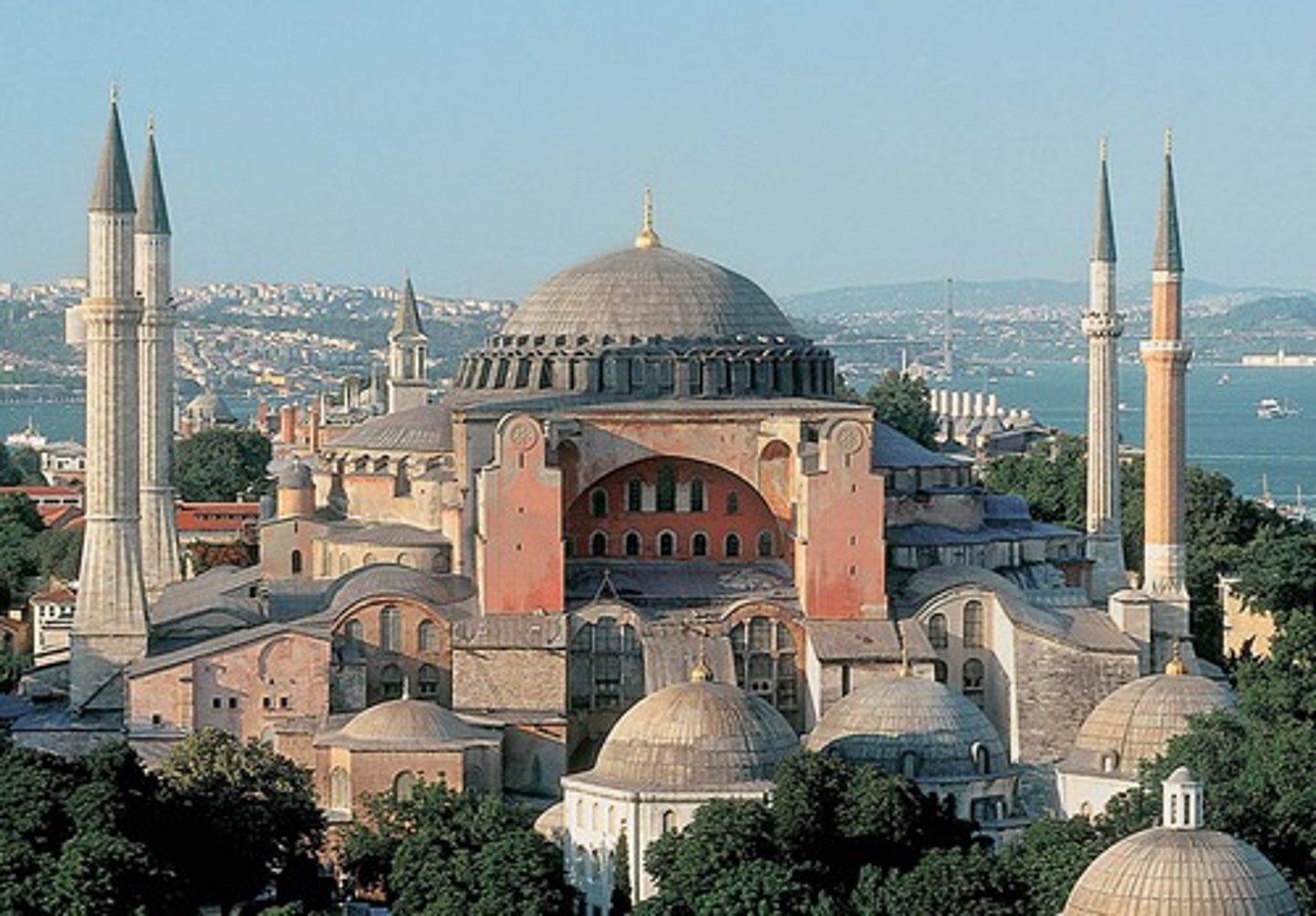
Not thick walls....
-use buttresses at right angles to take collected pressures of ribbed vault and arch
English Gothic
-Salisbury Cathedral 1220-1258
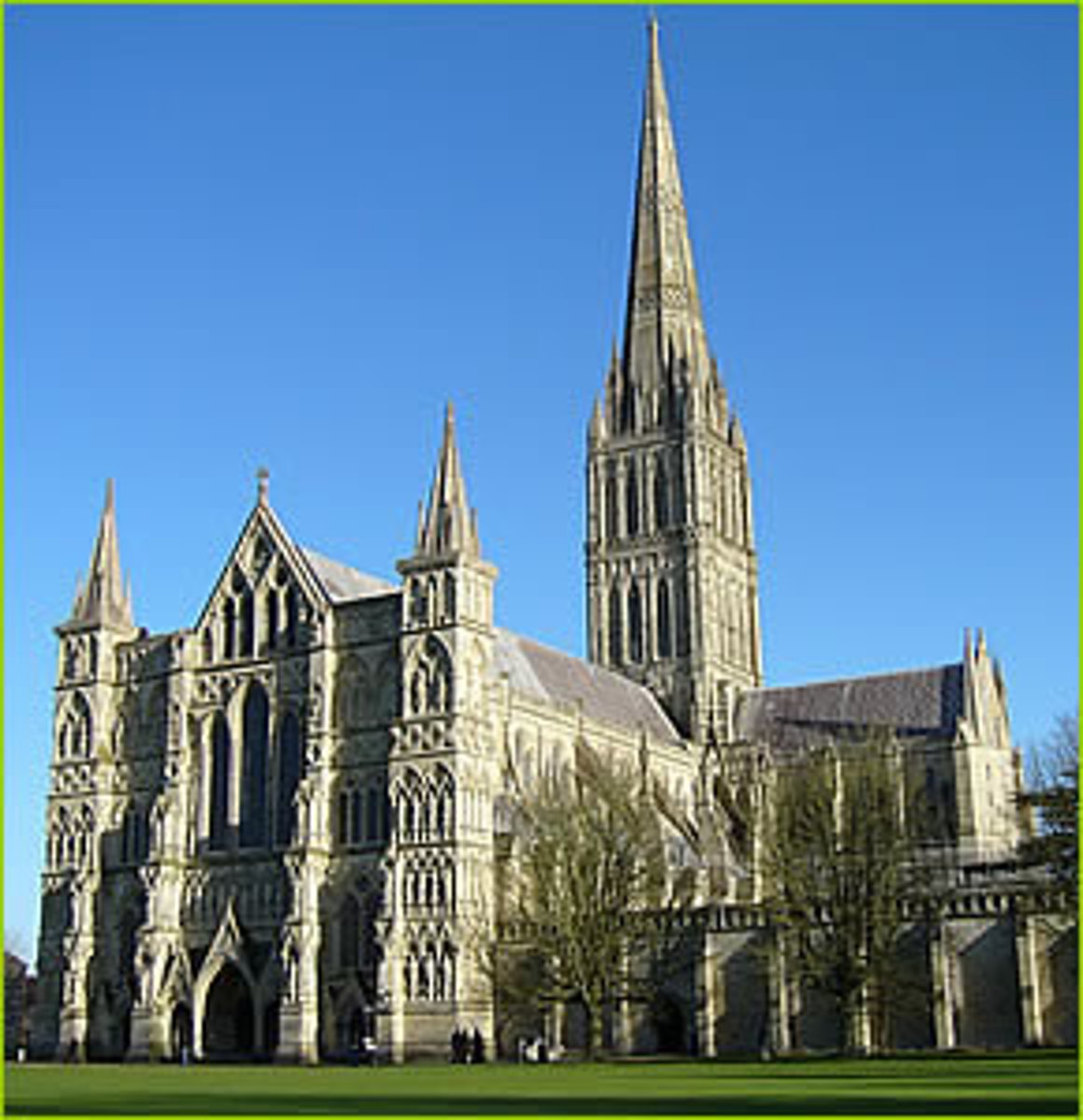
Gothic
-A-historical, asymmetrical
-architecture in service to God
Renaissance
-mathematics, rational, proportions, universal order
-not aspire to heavens, grounded to earth, human reason
-symmetry
-circle and square pure form
Renaissance 15th Century
-began in Florence
-authentic re-use of classicism, based in understanding of perspective, change size, and proportion of columns, pediments, etc.
-represent human intellect as much as the power of God
Renaissance definition
the activity, spirit or time of humanistic revival of classical art, literature, and learning; originating in Italy in the 14th century and extending to the 17th century making the transition from the medieval to the modern world
Renaissance Architecture
the various adaptations of Italian Renaissance architecture that occurred throughout Europe until the advent of Mannerism and the Baroque in the 16th and 17th centuries, characterized by the use of Italian Renaissance forms and motifs in more or less traditional buildings
"Renaissance Man"
Brunelleschi
First Renaissance building
-Brunelleschi
-Foundling Hospital- Florence, Italy 1422
-symmetrical forms
-proportions relate one element to another
-application scientific perspective
The "Duomo", Dome of the Cathedral of Florence
-largest dome built since the Romans
-technical achievement in its construction
-no "centering"- built to be self-supporting as it was constructed
-employed ribs and double shells
Brunelleschi
-Foundling Hospital
-Cathedral of Florence
-Pazzi Chapel