Lab 2: Cranial and Facial Bones
 Call Kai
 Learn
Learn Practice Test
 Spaced Repetition
 Match
Match Flashcards
 Knowt Play
1/73

There's no tags or description
Looks like no tags are added yet.
Name | Mastery | Learn | Test | Matching | Spaced | Call with Kai | Chat |
|---|
No analytics yet
Send a link to your students to track their progress
74 Terms
axial skeleton
composed of the bones along the central axis of the body, including the vertebral column, sternum, ribs and skull

frontal bone

temporal bone

parietal bone

occipital bone
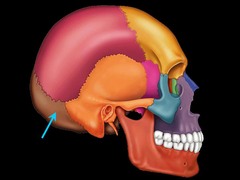
sutures
joint where the cranial bones have joined together

mandible
lower jaw bone

zygomatic bone
cheek bone

lacrimal bone
small fragile bone making up part of the front inner walls of each eye socket and providing room for the passage of the lacrimal ducts

vomer
nasal septum (thin, flat bone)

palatine bone
two irregularly shaped bones that form the back of the hard palate and help form the nasal cavity and the floor of the orbits

nasal bone
forms the bridge of the nose

inferior nasal conchae
form part of lateral walls of nasal cavity

foramen
hole in a bone for transmission of blood vessels and nerves
fossa
shallow depression on bone surface

process
prominent projection on a bone
protuberance
a bony outgrowth or protruding part

condyle
Rounded process that usually articulates with another bone

fissure
an opening; a groove; a split

canal
tubular passage or tunnel in a bone

ramus
extension of a bone making an angle with the rest of the structure
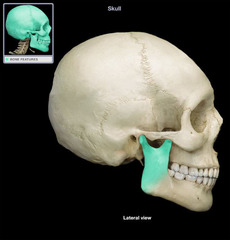
alveous
a pit or socket

flat bones
bones of the ribs, shoulder blades, pelvis, and skull

short bones
bones of the wrist and ankles

long bones
longer than they are wide

irregular bones
have elaborate and complex shapes, including bones of the vertebrae and face

sesimoid bones
small, knobular bones; embedded in tendons

supraorbital margin
superior rim of the eye socket located on the frontal bone

supraorbital foramen
holes above eye sockets

glabella
smooth area between the eyes

mandibular fossa
the depression in the temporal bone into which the condyle of the mandible fits
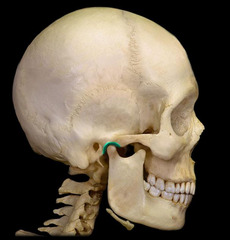
external acoustic meatus
ear canal

internal acoustic meatus
passage for CN VIII from the inner ear to the brain

styloid process
process extending downward from the temporal bone on each side of the skull

mastoid process
round projection on the temporal bone behind the ear

carotid canal
passageway for internal carotid artery

foramen magnum
large opening at the base of the skull through which the brain connects to the spinal cord.

occipital condyles
rounded projections lateral to the foramen magnum that articulate with the first cervical vertebra (atlas)

hypoglossal canal
holes through occipital condyles

external occipital protuberance
bump on back of head

external occipital crest
extends downward from the external occipital protuberance

superior nuchal line of occipital bone
one of the four curved lines on the external surface of the occipital bone: is an area for muscle attachment.

inferior nuchal line of occipital bone
line closest to foramen magnum
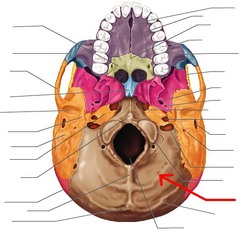
sphenoid bone
forms part of the base of the skull and parts of the floor and sides of the orbit

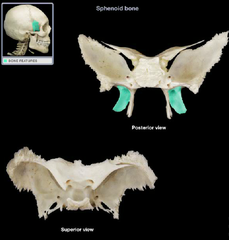
pterygoid process
process of the sphenoid bone, consisting of two plates
sella turcica
depression in the sphenoid bone where the pituitary gland is located

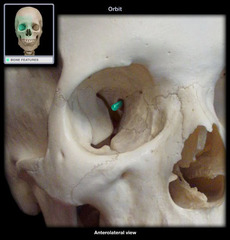
optic canal (foramen)
round hole through the sphenoid bone; carries the optic nerve from the eye to the brain
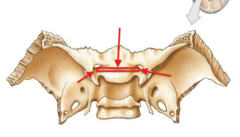
optic groove
transverse groove that crosses to the front of the saddle, above the seat
superior orbital fissure
middle opening in back of eye

inferior orbital fissure
fissure in the orbit floor between maxilla and greater wing of sphenoid

foramen rotundum

foramen ovale

foramen spinosum

ethmoid bone
forms part of the posterior portion of the nose, the orbit, and the floor of the cranium

crista galli
horn on ethmoid bone

cribriform plate
horizontal plate of the ethmoid bone separating the cranial cavity from the nasal cavity (flat, top spot)

perpendicular plate
forms superior part of nasal septum

superior nasal concha
not a named bone, but part of the ethmoid bone. Above middle nasal concha

middle nasal concha
the middle thin, spongy, bony plate with curved margins, part of the ethmoidal labyrinth, projecting from the lateral wall of the nasal cavity and separating the superior meatus from the middle meatus;

coronal suture
the suture between the parietal and frontal bones of the skull

squamous suture
suture between parietal and temporal bones
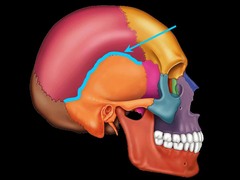
lambdoid suture
suture between parietal bones and occipital bone

sagittal suture
suture between parietal bones

mandibular ramus
vertical extension of the body on either side

coronoid process

mandibular notch

head of mandible

mandibular foramen
inside, side hole of mandible

mental foramen
front hole on chin

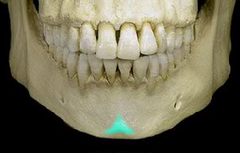
mental protuberance
middle bulge of chin
maxilla
upper jaw

alveoli
the cavities where the teeth sit inside

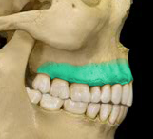
alveolar process
a ridge that forms the borders of the upper and lower jaws and contains the sockets of the teeth
infraorbital foramen
opening under the orbit carrying the infraorbital nerves and blood vessels the the nasal region
