Anatomy Hip Bones & Pelvic Ligaments
 Call Kai
 Learn
Learn Practice Test
 Spaced Repetition
 Match
Match Flashcards
 Knowt Play
1/29

There's no tags or description
Looks like no tags are added yet.
Name | Mastery | Learn | Test | Matching | Spaced | Call with Kai | Chat |
|---|
No analytics yet
Send a link to your students to track their progress
30 Terms
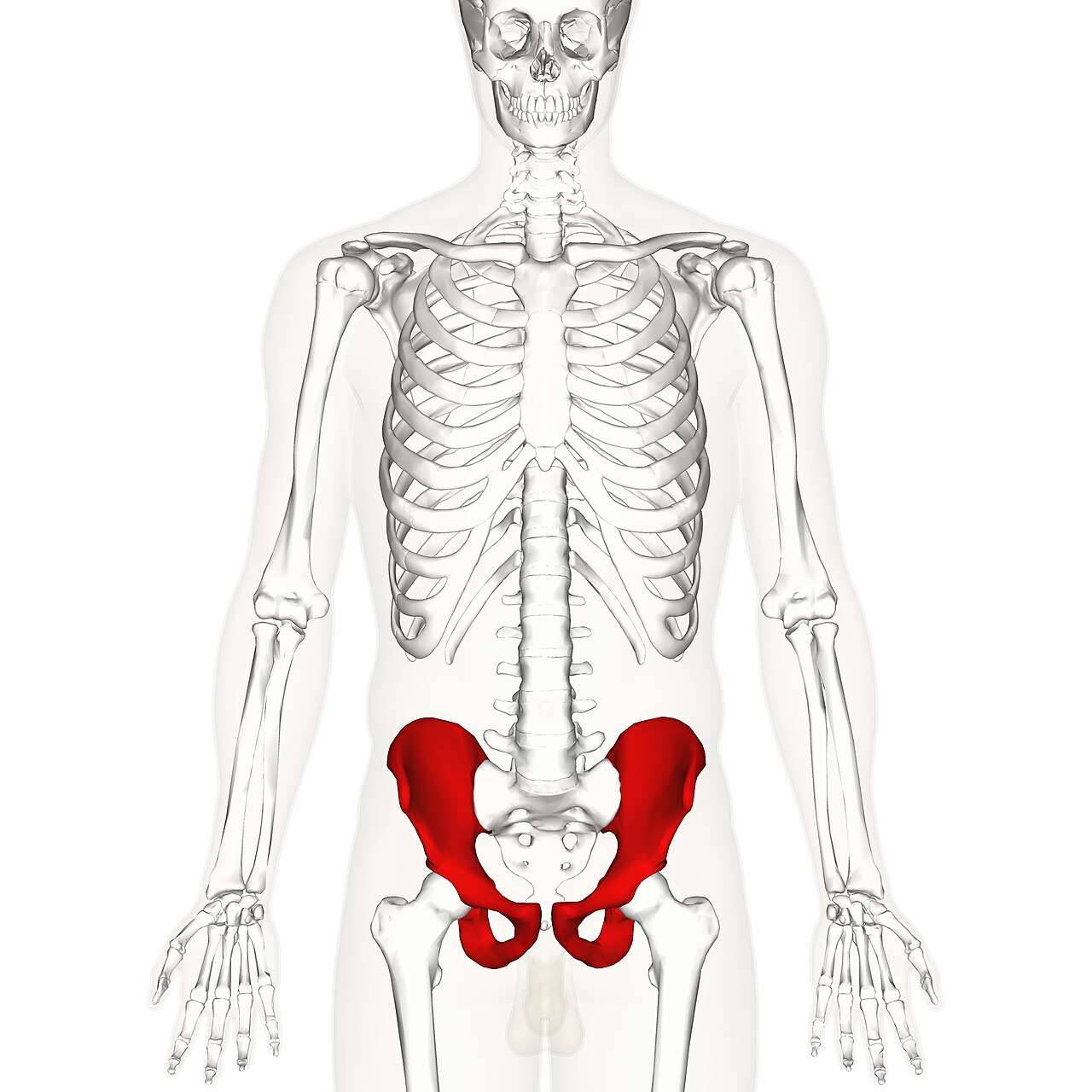
The large, flat, irregular bone formed by three fused parts.
Hip bone

The largest, uppermost, fan-shaped portion of the hip bone.
Ilium

The strong, lower-back portion of the hip bone.
Ischium

The front, forward-facing portion of the hip bone.
Pubis

The thickened upper border of the hip bone (the hip ridge).
Iliac crest

The prominent bony point at the front of the hip crest.
Anterior superior iliac spine

A smaller bump located just below the anterior superior spine.
Anterior inferior iliac spine

A deep curve on the lower back edge for major nerves.
Greater sciatic notch

The broad, smooth, shallow inner surface of the upper hip.
Iliac fossa

A thin bar of bone extending forward from the sit bone.
Ischial ramus

The huge central opening enclosed by the pubis and ischium.
Obturator foramen

A pointed bony projection pointing backward above the sit bone.
Ischial spine
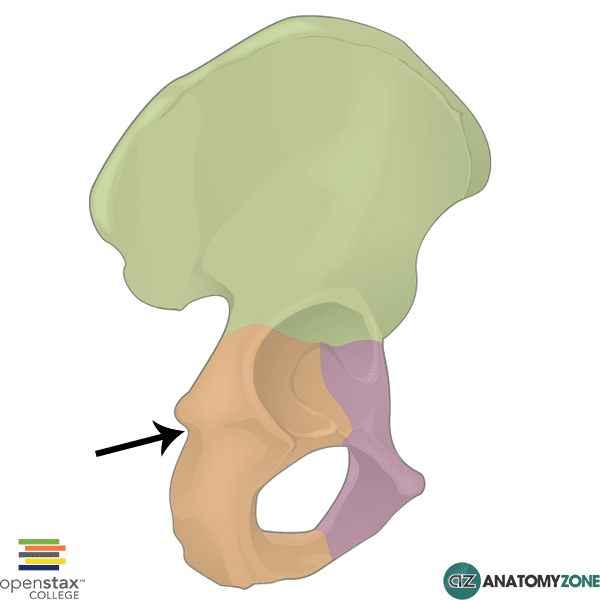
A small indentation located right below the ischial spine.
Lesser sciatic notch

The rough, thick bottom curve that bears sitting weight; also known as the sit bone.
Ischial tuberosity

The thick, wide midsection of the front pelvic bone.
Body of pubis
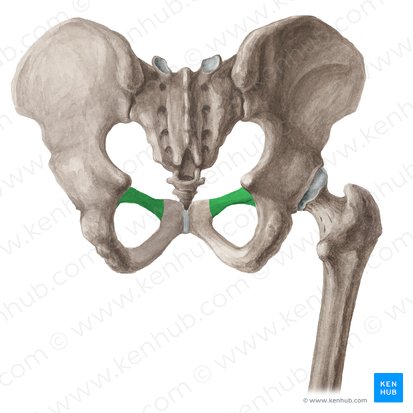
A bar of pubic bone running upward and backward toward the ilium.
Superior ramus

A bar of pubic bone running downward to meet the ischium.
Inferior ramus

The cartilaginous joint connecting the left and right hip bones.
Pubic symphysis

A small bump on the front bone for inguinal ligament attachment.
Pubic tubercle

Front band connecting tailbone base to hip bone.
Anterior sacroiliac ligament

Strong back band anchoring tailbone base to hip bone.
Posterior sacroiliac ligament

Band connecting lower tailbone to the inner hip bone spine.
Sacrospinous ligament

Band connecting tailbone to the sit bone.
Sacrotuberous ligament

Upper pelvic gap allowing the sciatic nerve into the leg.
Greater sciatic foramen

Lower pelvic gap for vessels and nerves entering the groin area.
Lesser sciatic foramen

Groin crease band separating abdomen from thigh.
Inguinal ligament

Main pelvic floor muscle that supports pelvic organs and controls urination and bowel movements.
Levator ani

Muscle at the back of the pelvic floor that supports pelvic organs and pulls the tailbone forward.
Coccygeus

Front opening in the pelvic floor allowing passage of the urethra (and vagina in females).
Urogenital hiatus
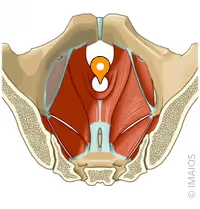
Opening or region in the pelvic floor that allows passage of the digestive and reproductive tracts.
Anogenital hiatus