3 - Specific Poisons
 Call Kai
 Learn
Learn Practice Test
 Spaced Repetition
 Match
Match Flashcards
 Knowt Play
1/121

Earn XP
Description and Tags
Proverbs 16:3
Name | Mastery | Learn | Test | Matching | Spaced | Call with Kai | Chat |
|---|
No analytics yet
Send a link to your students to track their progress
122 Terms
a. "Silent gas"
[Environmental agents]
Carbon monoxide (CO) is referred to as this because it is odorless and colorless
a. "Silent gas"
b. "Invisible killer"
c. "Silent killer"
d. "Colorless threat"
d. Odorless, colorless gas
[Environmental agents]
Physical characteristics of Carbon monoxide (CO)
a. Colored, odorous gas
b. Colorless, odorous gas
c. Colored, odorless gas
d. Odorless, colorless gas
b. Incomplete combustion of carbon containing fuels (gasoline, wood, etc.)
[Environmental agents]
Source of Carbon monoxide (CO)
a. Burning of fossil fuels and volcanoes
b. Incomplete combustion of carbon containing fuels (gasoline, wood, etc.)
c. Burning of fossil fuels only
d. Volcanoes and industrial waste
c. 200x
[Environmental agents]
Carbon monoxide has how many times greater affinity for hemoglobin (Hb)?
a. 50x
b. 100x
c. 200x
d. 300x
d. Complex IV (Cytochrome oxidase) , resulting in less ATP production
[Environmental agents]
Carbon monoxide inhibits which complex in the electron transport chain (ETC), resulting in less ATP production?
a. Complex I
b. Complex II
c. Complex III
d. Complex IV (Cytochrome oxidase)
Hypoxia, headache, confusion, dizziness,
Rosy/cherry-red complexion
[Environmental agents]
Presentation of carbon monoxide toxicity includes _______ [2]
b. Hyperbaric oxygen (100% – high pressure oxygen)
[Environmental agents]
Treatment for carbon monoxide toxicity is:
a. Oxygen mask only
b. Hyperbaric oxygen
c. Antibiotics
d. Antidote
Burning of fossil fuels
Volcanoes
[Environmental agents]
Sulfur dioxide (SO₂) sources include:
a. Burning of fossil fuels and volcanoes
b. Forest fires and smoking
c. Industrial waste and mining
d. Agriculture and livestock
b. Sulfurous acid (H₂SO₃)
[Environmental agents]
Sulfur dioxide (SO₂) + Water (H₂O) forms:
a. Sulfuric acid
b. Sulfurous acid (H₂SO₃)
c. Sulfonic acid
d. Hydrogen sulfide
b. Bronchoconstriction → COPD
[Environmental agents]
Presentation of sulfur dioxide toxicity includes:
a. Bronchodilation
b. Bronchoconstriction → COPD
c. Pulmonary fibrosis
d. Asthma
b. Smoking
[Environmental agents]
The most common cause of COPD is:
a. Pollution
b. Smoking
c. Sulfur dioxide exposure
d. Carbon monoxide exposure
a. True
[Environmental agents]
Smoking and pollution can cause COPD.
a. True
b. False
Cassava
Seeds of Prunus spp. (almonds, cherries, apricot, peaches, etc.)
Apples
[Environmental agents]
Sources of cyanide include _______ [3]
d. Complex IV (Cytochrome oxidase) , resulting in less ATP production?
[Environmental agents]
Cyanide inhibits which complex in the electron transport chain (ETC), resulting in less ATP production?
a. Complex I
b. Complex II
c. Complex III
d. Complex IV (Cytochrome oxidase)
Bitter almond breath
Respiratory depression
[Environmental agents]
Presentation of cyanide toxicity include ______ [2]
IV Hydroxocobalamin
Cyanide kit
[Environmental agents]
Treatment for cyanide toxicity includes:
a. IV Hydroxocobalamin and Cyanide kit
b. Hyperbaric oxygen and activated charcoal
c. Naloxone and flumazenil
a. Cyanocobalamin
[Environmental agents]
Hydroxocobalamin + Cyanide (CN) forms:
a. Cyanocobalamin
b. Cyanide complex
c. Vitamin B12
d. Hydroxycobalamin
Amyl nitrite (inhalational)
Sodium nitrite (IV)
Sodium thiosulfate (IV)
📌Cyanide Kit
[Environmental agents]
Less preferred treatments for cyanide toxicity than IV hydroxocobalamin include:
a. Amyl nitrite (inhalational), Sodium nitrite (IV), Sodium thiosulfate (IV)
b. Hyperbaric oxygen
c. Activated charcoal
d. Naloxone
d. Hydroxocobalamin (IV)
[Environmental agents]
Which of the following is the preferred treatment for cyanide toxicity?
a. Amyl nitrite (inhalational)
b. Sodium nitrite (IV)
c. Sodium thiosulfate (IV)
d. Hydroxocobalamin (IV)
a. Colorless with a rotten egg odor
[Environmental agents]
Hydrogen sulfide (H₂S) is:
a. Colorless with a rotten egg odor
b. Colorless with a sweet odor
c. Yellow with a pungent odor
d. Colorless with no odor
Sewage
Liquefied Petroleum Gas (LPG)
[Environmental agents]
Sources of hydrogen sulfide include:
a. Sewage and Liquefied Petroleum Gas (LPG)
b. Cassava and apple seeds
c. Incomplete combustion of fuels
d. Burning of fossil fuels and volcanoes
b. Detect leakage immediately
[Environmental agents]
Liquefied Petroleum Gas (LPG) is intentionally spiked with hydrogen sulfide to:
a. Increase its flammability
b. Detect leakage immediately
c. Improve its odor
d. Enhance combustion
d. Complex IV (Cytochrome oxidase) , leading to decreased ATP production
[Environmental agents]
Hydrogen sulfide inhibits which complex in the electron transport chain (ETC), leading to decreased ATP production?
a. Complex I
b. Complex II
c. Complex III
d. Complex IV (Cytochrome oxidase)
Mucosal irritation
Green line on gums
Photophobia
Darkening of silverware
[Environmental agents]
Presentation of hydrogen sulfide toxicity includes [4]
b. Corrosives (only if very strong)
[Environmental agents]
Acids are also known as:
a. Caustics
b. Corrosives
c. Oxidizers
d. Reducers
b. Protein denaturation (destroy secondary to quaternary structure)
[Environmental agents]
The mechanism of toxicity (MOT) of acids is:
a. Saponification of lipids
b. Protein denaturation
c. Inhibition of cytochrome oxidase
d. Alkylation of DNA
b. Coagulative necrosis
[Environmental agents]
Acids have no effect on lipids, so only the inside of the cell is damaged, not the phospholipid cell membrane, resulting in:
a. Liquefactive necrosis
b. Coagulative necrosis
c. Caseous necrosis
d. Fat necrosis
b. Caustics
[Environmental agents]
Bases are also known as:
a. Corrosives
b. Caustics
c. Oxidizers
d. Reducers
c. Protein denaturation + saponification of lipids
[Environmental agents]
The mechanism of toxicity (MOT) of bases is:
a. Protein denaturation only
b. Saponification of lipids only
c. Protein denaturation + saponification of lipids
d. Inhibition of cytochrome oxidase
b. Liquefactive necrosis
[Environmental agents]
Bases damage both the inside and outside of the cell, resulting in:
a. Coagulative necrosis
b. Liquefactive necrosis
c. Caseous necrosis
d. Fat necrosis
a. True
[Environmental agents]
Acids denature proteins and damage only the inside of the cell, while bases denature proteins and saponify lipids, damaging both the inside and outside of the cell.
a. True
b. False
b. Rotten egg odor
[Environmental agents]
Hydrogen sulfide has a:
a. Bitter almond odor
b. Rotten egg odor
c. Sweet odor
d. Pungent odor
c. Hydrogen sulfide
[Environmental agents]
A green line on the gums is a presentation of toxicity from:
a. Carbon monoxide
b. Cyanide
c. Hydrogen sulfide
d. Sulfur dioxide
c. Hydrogen sulfide
[Environmental agents]
Darkening of silverware is a presentation of toxicity from:
a. Carbon monoxide
b. Cyanide
c. Hydrogen sulfide
d. Sulfur dioxide
a. FD & C Yellow 5
[Environmental agents]
Tartrazine is also known as:
a. FD & C Yellow 5
b. FD & C Red 3
c. FD & C Blue 1
d. FD & C Green 3
b. Lemon yellow
[Environmental agents]
Tartrazine is described as:
a. Cherry red
b. Lemon yellow
c. Brilliant blue
d. Forest green
b. Thyroid cancer
[Environmental agents]
Tartrazine can cause:
a. Colorectal cancer
b. Thyroid cancer
c. Liver cancer
d. Lung cancer
b. FD & C Red 3
[Environmental agents]
Erythrosine is also known as:
a. FD & C Yellow 5
b. FD & C Red 3
c. FD & C Blue 1
d. FD & C Green 3
b. Cherry red
[Environmental agents]
Erythrosine is described as:
a. Lemon yellow
b. Cherry red
c. Brilliant blue
d. Forest green
b. Colorectal cancer (declared carcinogenic since January 25, 2025)
[Environmental agents]
Erythrosine causes:
a. Thyroid cancer
b. Colorectal cancer
c. Liver cancer
d. Lung cancer
c. 2027
[Environmental agents]
Erythrosine must be totally banned by:
a. 2025
b. 2026
c. 2027
d. 2028
b. Carcinogen
[Environmental agents]
The mechanism of toxicity for both Tartrazine and Erythrosine is:
a. Neurotoxin
b. Carcinogen
c. Hepatotoxin
d. Nephrotoxin
a. Vetsin
[Environmental agents]
Monosodium glutamate (MSG) is also known as:
a. Vetsin
b. Ajinomoto
c. Salt
d. Sugar
b. Flavorant
[Environmental agents]
Monosodium glutamate (MSG) is used as a:
a. Preservative
b. Flavorant
c. Colorant
d. Sweetener
b. Anaphylactoid reaction (non-IgE mediated)
force release of histamine without the need for receptor)
[Environmental agents]
Mechanism of toxicity of MSG is:
a. IgE-mediated anaphylaxis
b. Anaphylactoid reaction (non-IgE mediated)
c. Cytotoxic reaction
d. Immune complex reaction
b. Anaphylactic
[Environmental agents]
IgE mediated
a. Anaphylactoid
b. Anaphylactic
a. Anaphylactoid
[Environmental agents]
Non IgE mediated
a. Anaphylactoid
b. Anaphylactic
Wheals (hives)
Shortness of Breath (dyspnea)
Chinese restaurant syndrome
[Environmental agents]
Clinical presentation of MSG toxicity includes _____ [3]
Migraines
Allergies
Low IQ
Haux (not medically recognized)
[Environmental agents]
Chinese restaurant syndrome is associated with:
a. Wheals and hives
b. SOB and dyspnea
c. Migraines, allergies, and low IQ
d. All of the above
c. Chinese restaurant syndrome
[Environmental agents]
Clinical syndrome associated with MSG toxicity presentation
a. Woolsorter's disease
b. Chinese fried rice syndrome
c. Chinese restaurant syndrome
d. Malignant pustule syndrome
Denatured alcohol
Perfumes
Contaminated liquor (homemade)
[Solvent]
Sources of Methanol poisoning include ________
a. Burning of fossil fuels, volcanoes
b. Denatured alcohol, perfumes, contaminated liquor (homemade)
c. Gasoline, industrial waste
d. Incomplete combustion of carbon fuels
Metabolites of methanol (formic acid)":
MeOH → Formaldehyde → Carboxylic acid (Formic acid)
[Solvent]
Mechanism of toxicity of Methanol
a. 200x greater affinity for hemoglobin
b. Inhibits Complex IV in ETC
c. MeOH → Formaldehyde → Carboxylic acid (Formic acid)
d. Force release of histamine without recepto
Optic nerve damage
Metabolic acidosis
[Solvent]
Clinical presentation of Methanol poisoning
a. Wheals, dyspnea, Chinese restaurant syndrome
b. Bronchoconstriction, COPD
c. Hypoxia, headache, rosy complexion
d. Optic nerve damage, metabolic acidosis
Ethanol (50%) Vodka
Fomepizole
[Solvent]
Treatment for Methanol poisoning
a. Hyperbaric oxygen (100%)
b. N-acetylcysteine
c. Ethanol (50%) Vodka, Fomepizole
d. Naloxon
d. Mutagenicity → cancer
[Solvent]
Mechanism of toxicity of Hydrocarbons
a. Force release of histamine without receptor
b. Inhibits Complex IV in ETC
c. 200x greater affinity for hemoglobin
d. Mutagenicity → cancer
c. Gasoline
[Solvent]
Source of Hydrocarbon poisoning
a. Denatured alcohol and perfumes
b. Burning of fossil fuels
c. Gasoline
d. Contaminated liquor
Injection
Inhalation
[Solvent]
Routes of exposure to Hydrocarbons
a. Fecal-oral and droplet
b. Vector-borne and direct contact
c. Ingestion and inhalation
d. Injection and inhalation
c. Atelectasis
[Solvent]
Hydrocarbon poisoning that presents as collapsed lungs
a. Benzene toxicity
b. Toluene toxicity
c. Atelectasis
d. CFC toxicity
b. Toluene
[Solvent]
Active component of rugby that causes:
Euphoria
Satiety leading to rhabdomyolysis
a. Benzene
b. Toluene
c. Butane
d. CFC
d. Benzene
[Solvent]
Hydrocarbon associated with leukemia
a. Toluene
b. Butane
c. CFC
d. Benzene
CFC (banned)
Butane
[Solvent]
Hydrocarbons associated with causing arrhythmias
a. Benzene and toluene
b. Gasoline and mineral oil
c. CFC (banned) and butane
d. Atelectasis and rhabdomyolysis
a. Arrhythmias
[Solvent]
CFCs are banned because they cause:
a. Arrhythmias
b. Ozone depletion
c. Cancer
d. Atelectasis
Oxygen (O₂)
SABA
Mineral oil (decrease absorption and increase peristalsis)
[Solvent]
Treatment for Hydrocarbon poisoning
a. Ethanol (50%) Vodka, Fomepizole
b. N-acetylcysteine
c. Hyperbaric oxygen (100%)
d. O₂, SABA, mineral oil (decrease absorption and increase peristalsis)
a. Decrease absorption and increase peristalsis
[Solvent]
Mineral oil is used in hydrocarbon toxicity to:
a. Decrease absorption and increase peristalsis
b. Induce vomiting
c. Neutralize the toxin
d. Increase absorption
b. Lewisite metal
[Heavy Metals]
Arsenic (As) is also known as
a. Plumbism metal
b. Lewisite metal
c. Cadmium metal
d. Divalent metal
Mines
Cigarettes
[Heavy Metals]
Sources of Arsenic (As) poisoning
a. Paint, earthenware, gasoline, pencil
b. Cigarettes, battery, plastics
c. Iron supplements, blood transfusions
d. Mines, cigarettes
Garlic odor breath
Mees' lines (white bands on nails)
Arsenical keratosis (palms and soles; premalignant lesions)
[Heavy Metals]
Clinical presentation of Arsenic (As) poisoning
a. Anemia, decreased IQ, burton's line
b. Itai-Itai disease, severe joint pain, bone softening
c. Garlic odor breath, Mees' lines (white bands on nails), arsenical keratosis (palms and soles; premalignant lesions)
d. GI bleeding, melena, hematemesis
b. White bands on nails
[Heavy Metals]
Mees' lines seen in Arsenic (As) poisoning appear as
a. Blue-black lines on the gums
b. White bands on nails
c. Brown discoloration on palms
d. Red streaks on the skin
c. Physical and psychological stress
[Heavy Metals]
Mees' lines can also occur due to this reason aside from Arsenic poisoning
a. Lead poisoning and cadmium exposure
b. Iron deficiency and anemia
c. Physical and psychological stress
d. Hydrocarbon exposure and mutagenicity
c. Palms and soles; premalignant lesions
[Heavy Metals]
Arsenical keratosis seen in Arsenic (As) poisoning appears on these areas and is classified as
a. Gums and tongue; malignant lesions
b. Nails and hair; benign lesions
c. Palms and soles; premalignant lesions
d. Face and neck; malignant lesions
c. Plumbism
[Heavy Metals]
Lead (Pd) poisoning is also known as
a. Lewisite disease
b. Itai-Itai disease
c. Plumbism
d. Cadmium disease
British Anti-Lewisite (BAL) / Dimercaprol
Succimer / Dimercaptosuccinic acid (DMSA)
[Heavy Metals]
Treatment for Arsenic (As) poisoning
a. BAL, succimer, preferred EDTA
b. Deferoxamine IV, Deferasirox PO
c. EDTA only
d. British Anti-Lewisite (BAL) and Dimercaptosuccinic acid
b. Oral form of BAL
[Heavy Metals]
DMSA (Dimercaptosuccinic acid) also known as succimer is classified as
a. Intravenous form of BAL
b. Oral form of BAL
c. Injectable form of EDTA
d. Topical form of dimercaprol
Paint
Earthenware
Gasoline (unleaded — wala na lead)
Pencil (graphite na ngayon)
Cosmetics
[Heavy Metals]
Sources of Lead (Pd) poisoning
a. Mines, cigarettes
b. Iron supplements, blood transfusions
c. Paint, earthenware, gasoline (unleaded — wala na lead), pencil (graphite na ngayon), cosmetics
d. Cigarettes, battery, plastics
d. Inhibits heme synthesis leading to no hemoglobin leading to anemia
[Heavy Metals]
Mechanism of toxicity of Lead (Pd) leading to anemia
a. Competes with divalent ions (Ca, Mg)
b. Directly damages GI lining
c. Mutagenicity leading to cancer
d. Inhibits heme synthesis leading to no hemoglobin leading to anemia
Anemia
Low IQ
Burton's line (blue-black lines on the gums/bibig)
[Heavy Metals]
Clinical presentation of Lead (Pd) poisoning
a. Garlic odor breath, Mees' lines, arsenical keratosis
b. Anemia, decreased IQ, burton's line (blue-black lines on the gums/bibig)
c. Itai-Itai disease, severe joint pain, bone softening
d. GI bleeding, melena, hematemesis
d. Blue-black lines on the gums
[Heavy Metals]
Burton's line seen in Lead (Pd) poisoning is described as
a. White bands on nails
b. Red streaks on the skin
c. Brown discoloration on palms
d. Blue-black lines on the gums
British Anti-Lewisite (BAL) / Dimercaprol
Succimer / Dimercaptosuccinic acid (DMSA)
EDTA (ethylene diamine tetraacetic acid)
[Heavy Metals]
Treatment for Lead (Pd) poisoning
a. Deferoxamine IV, Deferasirox PO
b. British Anti-Lewisite (BAL), DMSA only
c. EDTA only
d. BAL, succimer, preferred EDTA (ethylene diamine tetraacetic acid)
a. EDTA (ethylene diamine tetraacetic acid)
Preferred agent for lead toxicity
a. EDTA (ethylene diamine tetraacetic acid)
b. Deferoxamine
c. Deferasirox
d. Penicillamine
Cigarettes
Battery (Ni-Cd)
Plastics (inhaled when burned)
[Heavy Metals]
Cadmium (Cd) poisoning is acquired from these sources
a. Paint, earthenware, gasoline, pencil
b. Mines, cigarettes
c. Cigarettes, battery (Ni-Cd), plastics (inhaled when burned)
d. Iron supplements, blood transfusions
Calcium (Ca 2+)
Magnesium (Mg 2+)
[Heavy Metals]
Cadmium (Cd+2) causes toxicity by competing with these divalent ions in the body
a. Na, K
b. Fe, Zn
c. Cu, Mn
d. Ca, Mg
c. Ouch-ouch
[Heavy Metals]
Itai-Itai disease caused by Cadmium (Cd) poisoning literally means
a. Bone-bone
b. Pain-pain
c. Ouch-ouch
d. Soft-soft
d. Japanese farmers exposed to cadmium contaminated rice
[Heavy Metals]
Commonly affected by Itai-Itai disease due to Cadmium (Cd) poisoning
a. Filipino fishermen exposed to contaminated water
b. Factory workers exposed to cadmium fumes
c. Children exposed to cadmium-containing paint
d. Japanese farmers exposed to cadmium contaminated rice
c. Itai-Itai disease
[Heavy Metals]
A farmer who eats Cd-contaminated rice presents with this disease
a. Plumbism
b. Lewisite disease
c. Itai-Itai disease
d. Hemochromatosis
b. Itai-Itai disease
[Heavy Metals]
Cadmium (Cd) poisoning is also known as:
a. Plumbism
b. Itai-Itai disease
c. Hemochromatosis
d. Minamata disease
Severe joint pain
Bone softening
[Heavy Metals]
Symptoms of Itai-Itai disease caused by Cadmium (Cd) poisoning
a. Garlic odor breath, Mees' lines, arsenical keratosis
b. Anemia, decreased IQ, burton's line
c. GI bleeding, melena, hematemesis
d. Severe joint pain, bone softening
d. EDTA
[Heavy Metals]
Treatment for Cadmium (Cd) poisoning
a. BAL, succimer, preferred EDTA
b. British Anti-Lewisite (BAL), DMSA
c. Deferoxamine IV, Deferasirox PO
d. EDTA
Iron supplements (BN: Stresstab , Flintstones)
Blood transfusions (patient with CKD, thalassemia)
Genetic (hemochromatosis)
[Heavy Metals]
Iron (Fe) poisoning is acquired from these sources
a. Cigarettes, battery, plastics
b. Paint, earthenware, gasoline, pencil
c. Iron supplements (BN: Flintstones), blood transfusions (CKD, thalassemia), genetic (hemochromatosis)
d. Mines, cigarettes
c. Directly damages GI lining leading to GI bleeding
[Heavy Metals]
Iron (Fe) causes toxicity through this mechanism
a. Competes with divalent ions (Ca, Mg)
b. Inhibits heme synthesis leading to anemia
c. Directly damages GI lining leading to GI bleeding
d. Mutagenicity leading to cancer
Black tarry stool (melena)
Bloody vomitus (hematemesis)
[Heavy Metals]
Iron (Fe) poisoning presents as upper GI bleeding which manifests as
a. Fresh blood in stool (hematochezia)
b. Severe joint pain and bone softening
c. Garlic odor breath and Mees' lines
d. Black tarry stool (melena) and bloody vomitus (hematemesis)
c. Fresh blood in stool (hematochezia)
[Heavy Metals]
Iron (Fe) poisoning presents as lower GI bleeding which manifests as
a. Bloody vomitus (hematemesis)
b. Black tarry stool (melena)
c. Fresh blood in stool (hematochezia)
d. Garlic odor breath
Deferoxamine (IV)
Deferasirox (PO)
[Heavy Metals]
Treatment for Iron (Fe) poisoning
a. BAL, succimer, preferred EDTA
b. British Anti-Lewisite (BAL), DMSA
c. EDTA only
d. Deferoxamine (IV), Deferasirox (PO)
Inhibits MAO leading to Increased catecholamine
Inhibits superoxide dismutase (SOD) and catalase leading to increased free radicals
[Heavy Metals]
Mechanism of toxicity of Mercury (Hg) [2]
c. Increased catecholamine
[Heavy Metals]
Mercury (Hg) inhibits MAO leading to this effect
a. Decreased catecholamine
b. Increased free radicals
c. Increased catecholamine
d. Decreased serotonin
d. Increased free radicals leading to mutation leading to cancer
[Heavy Metals]
Mercury (Hg) inhibits superoxide dismutase (SOD) and catalase leading to this effect
a. Decreased catecholamine
b. Increased ATP production
c. Decreased free radicals
d. Increased free radicals leading to mutation leading to cancer
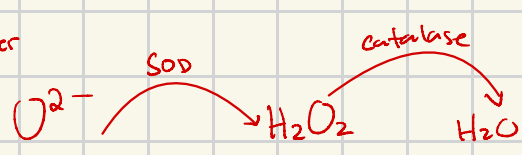
O₂⁻ is converted by SOD to H₂O₂ which is then converted by catalase to H₂O
[Heavy Metals]
Pathway of free radical neutralization:
c. Elemental mercury
[Heavy Metals]
Form of Mercury (Hg) classified as lipophilic
a. Inorganic mercury
b. Organic mercury
c. Elemental mercury
d. Mercuric mercury
c. Inorganic mercury
Mercuric Chloride (HgCl2) / Corrosive sublimate
Mercurous Chloride (Hg2Cl2)
[Heavy Metals]
Form of Mercury (Hg) classified as less lipophilic
a. Elemental mercury
b. Organic mercury
c. Inorganic mercury
d. Methylmercury
d. Organic mercury
[Heavy Metals]
Form of Mercury (Hg) with highest lipophilicity
a. Elemental mercury
b. Inorganic mercury
c. Mercuric mercury
d. Organic mercury
Preservative in vaccine
Component of Merthiolate
[Heavy Metals]
Thimerosal/Thiomersal is an organic form of Mercury used as
a. Bioaccumulation in seafood
b. Treatment for mercury poisoning
c. Preservative in vaccine, component of Merthiolate
d. Component of corrosive sublimate