Interlude C: Rock Cycle
 Call Kai
 Learn
Learn Practice Test
 Spaced Repetition
 Match
Match Flashcards
 Knowt Play
1/20

There's no tags or description
Looks like no tags are added yet.
Name | Mastery | Learn | Test | Matching | Spaced | Call with Kai | Chat |
|---|
No analytics yet
Send a link to your students to track their progress
21 Terms
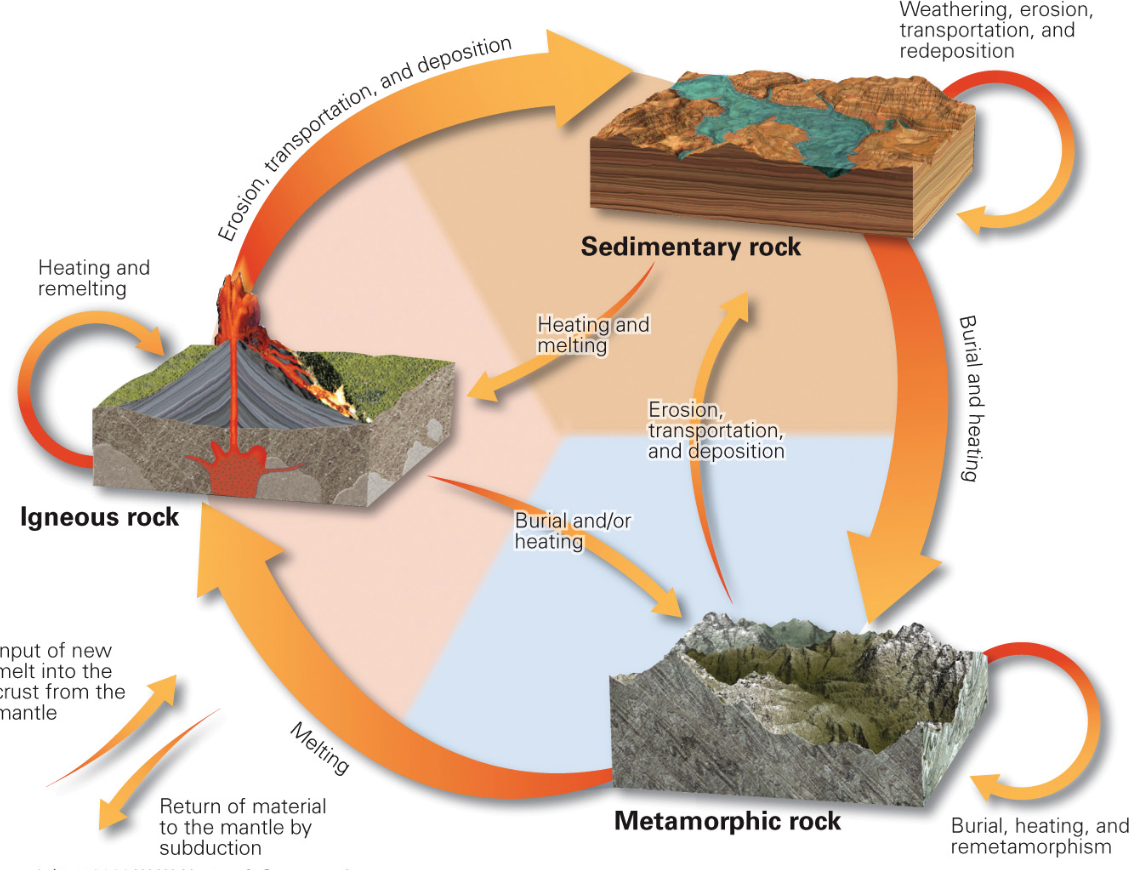
Which cycle in the Earth System is illustrated in the below figure?
Rock cycle
What is the rock cycle?
The transfer of material from one rock type to another
Why is the rock cycle important?
Because it explains how rocks are constantly changing from one type to another
Sedimentary rocks form in the rock cycle through deposition at the Earth’s surface on top of older rocks. As a result, there are more ______ rocks at the Earth’s surface compared to ______ rocks.
Younger; older
Compared to younger rocks, rocks that were created earlier in the Earth’s history are likely to be ________.
Consumed or transformed by processes in the rock cycle
What is the progression of rock types if the steps along the rock cycle proceed as follows?
melting and crystallization → weathering, erosion, deposition, and lithification → burial
Igneous → sedimentary → metamorphic
What is the progression of rock types if the steps along the rock cycle proceed as follows?
burial → uplift, weathering, erosion, deposition, lithification → burial → melting and crystallization
Metamorphic → sedimentary → metamorphic → igneous
If a rock is melted, then erupted at the Earth’s surface and solidified, then subsequently weathered, eroded, deposited, and lithified, what two rock types are involved in the sequence?
Igneous and sedimentary
Identify the correct sequence of processes in the rock cycle to create an igneous rock, and transform it into a metamorphic rock, and then transform that metamorphic into a new igneous rock.
Melted and solidified → buried deeply → remelted and solidified
Identify the correct sequence of processes in the rock cycle that could create a metamorphic rock and eventually transform it into a sedimentary rock.
Burial → melting → weathering, erosion, deposition, and lithification
Identify the correct steps in the transformation of a sedimentary rock into a metamorphic rock.
Rock weathered and eroded away and deposited in ocean basin → rock buried under many layers of sediments
What process is necessary to transform a metamorphic rock into an igneous rock?
Melting
What process must occur for an igneous rock to turn into a sedimentary rock?
Erosion
If a rock is buried, then exposed, weathered and eroded, and the sediment is then lithified, after which the rock is melted and solidified, what type of rock is the end result?
Igneous
If a rock is uplifted and exposed, what is likely the next type of rock that will form?
Sedimentary
The rock cycle is driven by __________.
The Earth’s internal and external sources of energy
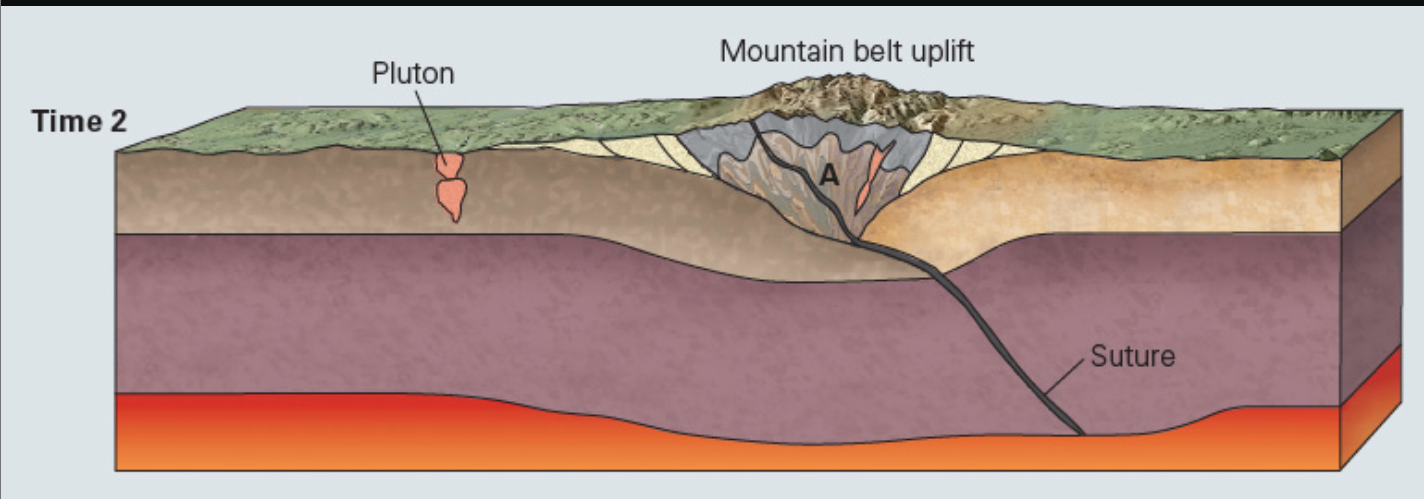
Specific rock types (igneous, sedimentary, and metamorphic) are commonly found in specific geologic settings. What type of rock would most likely be formed at location A in the figure?
Metamorphic
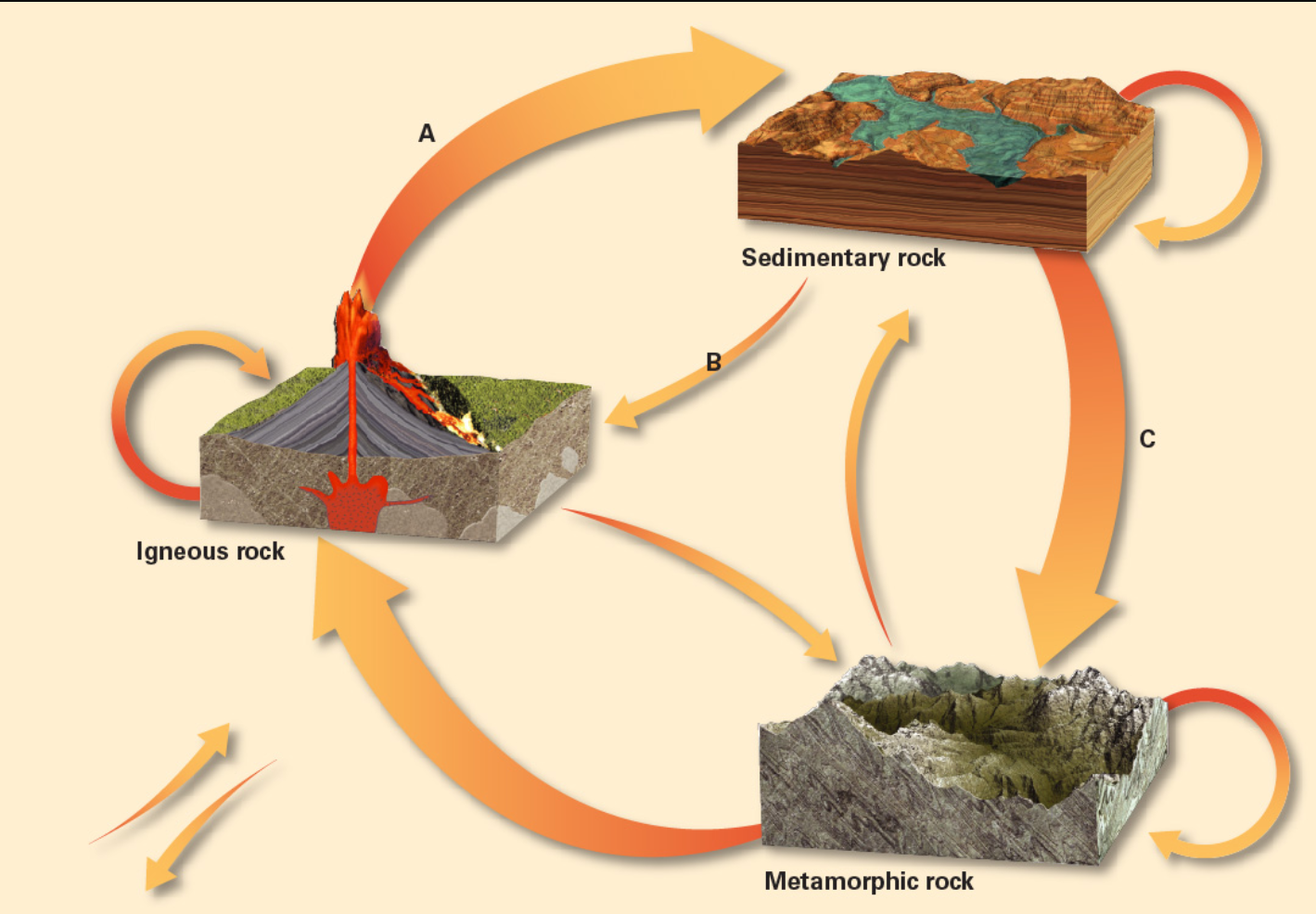
The image shows the rock cycle. The three different rock types are represented, but the processes that connect the rocks within the cycle are not labeled. What process(s) would be responsible for the transition labeled A?
Weathering, erosion, transportation, and deposition
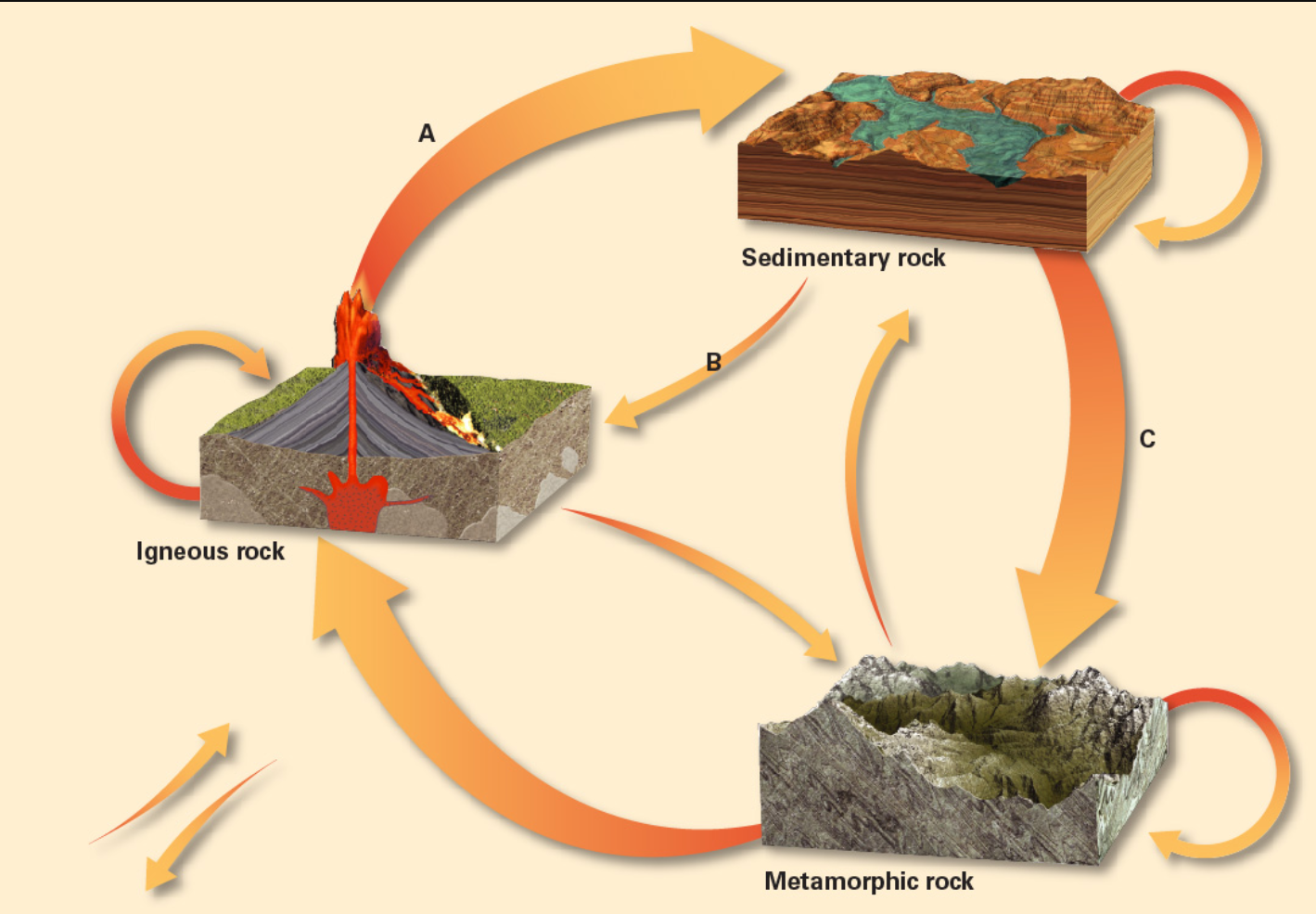
The image shows the rock cycle. The three different rock types are represented, but the processes that connect the rocks within the cycle are not labeled. What process(s) would be responsible for the transition labeled B?
Melting
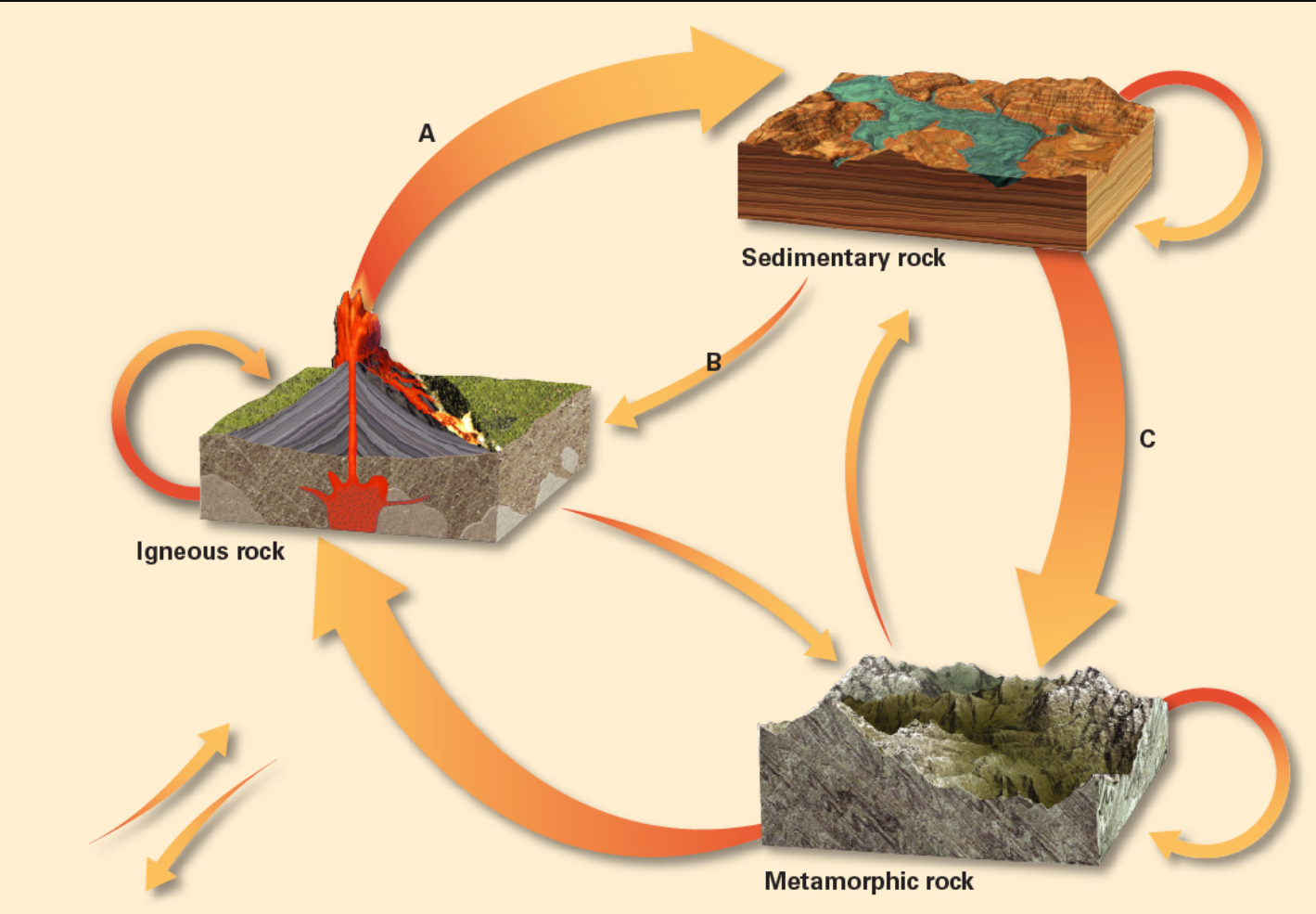
The image shows the rock cycle. The three different rock types are represented, but the processes that connect the rocks within the cycle are not labeled. What process(s) would be responsible for the transition labeled C?
Burial and heating