Exercise Physiology Exam 1: Cardiovascular system
 Call Kai
 Learn
Learn Practice Test
 Spaced Repetition
 Match
Match Flashcards
 Knowt Play
1/724

There's no tags or description
Looks like no tags are added yet.
Name | Mastery | Learn | Test | Matching | Spaced | Call with Kai | Chat |
|---|
No analytics yet
Send a link to your students to track their progress
725 Terms
What is stroke volume?
EDV-ESV
What is total peripheral resistance (TPR)
It is the total resistance to blood flow in the systemic circulation
What is end diastolic volume (EDV)?
The volume of he blood in the ventricles at the end of diastole, this is right before the ventricles are going to contract
What is end systolic volume (ESV)?
The volume of the blood remaining in the ventricles at the end of contraction (systole)
What is mean arterial pressure?
This is the average arterial pressure throughout one cardiac cycle
What is systolic blood pressure?
The peak arterial pressure reached during ventricular contraction, representing the maximum force exerted by blood against systemic arterial walls
What is diastolic blood pressure?
The minimum arterial pressure exerted against vascular walls during ventricular relaxation and filling
What is cardiac output at rest?
5 L/min
What is cardiac output at max exercise?
25 L/min
What is the goal of cardiac output?
Get oxygen to the cells
Equation for cardiac output
HR x SV
To maintain cardiac output what two variables can be altered:
HR or SV
What is stroke volume affected by?
Exercise, blood flow, blood volume, vascular changes, cardiac morphology, muscle function, hormones, nervous system
What is heart rate affected by?
Intrinsic control, hormones, and the nervous system
Under most conditions the body will change: SV or HR first?
Stroke volume, however if one variable changes, the other must change accordingly
How does the central command, AKA brain control the heart?
It is always recieving 2 signals at all times parasympathetic signal and sympathetic signal, it withdrawls one of these signals depending on the activity of the body
The brain is a feed forward system, so it can anticipate when it is about to workout and usually begin to stress itself by withdrawing the parasympathetic tone and the sympathetic tone will be more present allowing for increase in heart rate
What are arterial baroreceptors?
Receptors in wall of carotid sinus and aortic arch
sense levels of arterial pressure
primary short term controllers for arterial pressure
What type of individual is there a concern for arterial baroreceptors?
Hypertension individuals
What do muscle metaboreceptors do?
They are capable of eliciting profound increases in sympathetic activity and arterial pressure
Activation of muscle metaboreceptors increases what?
Heart rate, ventricular performance, cardiac output, peripherial vasocontriction, central blood volume mobilization
What is preload?
Length tension relationship
degree of tension on the ventricle prior to contraction. The greater the tension from the volume of blood, the greater the contraction.
What happens to stroke volume and cardiac output when you increase preload?
It increases as well
What is afterload?
The resistance the heart must overcome in order to eject blood into systemic circulation
What is another name of afterload?
Aortic or arterial pressure
Why is high afterload bad?
The higher the afterload, the harder it is for blood to get ejected
How does afterload act against preload (acts the same or opposite of preload)?
It opposes preload
When you chronically train how much will it increase blood volume (%)?
15-20%
What is normal blood volume in an untrained individual (mL/kg)?
80 mL/kg
What is blood volume in trained individuals (mL/kg)?
90-100 mL/kg
How does blood volume affect performance?
increase Blood volume → increases venous return → increases preload → increase stroke volume → increase cardiac output
What is hypovolemia?
Low blood volume
What is hypervolemia?
It is when you have high blood volume
What is doping in terms of hypervolemia?
Remove RBC from blood → then inject the blood cells in before an oxygen demanding activity (running or cycling) → blood becomes very viscous and hard to pump bc there is an increase of RBC in the blood and low plasma so its very hard for the heart to pump and these people will usually die in their sleep
What is the blood flow to the heart always?
4% of total blood flow
What is the blood flow to the brain (ml/min)?
750 ml/min
When you begin exercising what happens to heart rate?
There is an initial increase in HR because of the removal of the vagal (parasympathtic) tone
How will sympathtic tone increase?
It will increase according to the degree of exercise intensity
When you are done exercising what tone or nervous system signal will come back?
Parasymphathetic tone
How are heart transplants or cardiac deinnervation a clinical concern for heart rate response to exercise?
There is no direct parasympathtic and sympathtic nerve control

Explain why the dashed line does not happen
The heart cannot fill quickly enough
When you become a consistent trainer what happens to your parasympathetic tone and what neurotransmitter is released more?
There is an increase of parasympathetic tone and there is more AcH released at the heart
When you become a consistent trainer what happens to sympathetic tone and what hormone is released less?
There is a reduced sympathetic tone following exercise and there is a decrease in NE release
When you become a more consistent trainer how does your sensitivity to catecholamines change?
It reduces
What happens to contractility when the heart rate increases?
Contractility increases
What are the three terms that describe the increased contractility associated with increased HR?
Bowditch effect, treppe, and positive inotropic effects of activation
What ions are involved in the contractility of the heart?
Calcium and sodium
What happens when more calcium and sodium become avaliable to apparatus?
Contractile force increases
How does increased heart rate affect the cardiac cycle?
The systolic phase increases and the diastolic phase decreases
Up to approx. what HR is increasing HR generally beneficial for cardiac contractility?
160 BPM
Why does increasing HR eventually become problematic?
Anatomical/physiological limitations prevent the heart from functioning effectively at high rates.
Why is shortening of diastole potentially problematic?
The heart has less time to relax and fill with blood
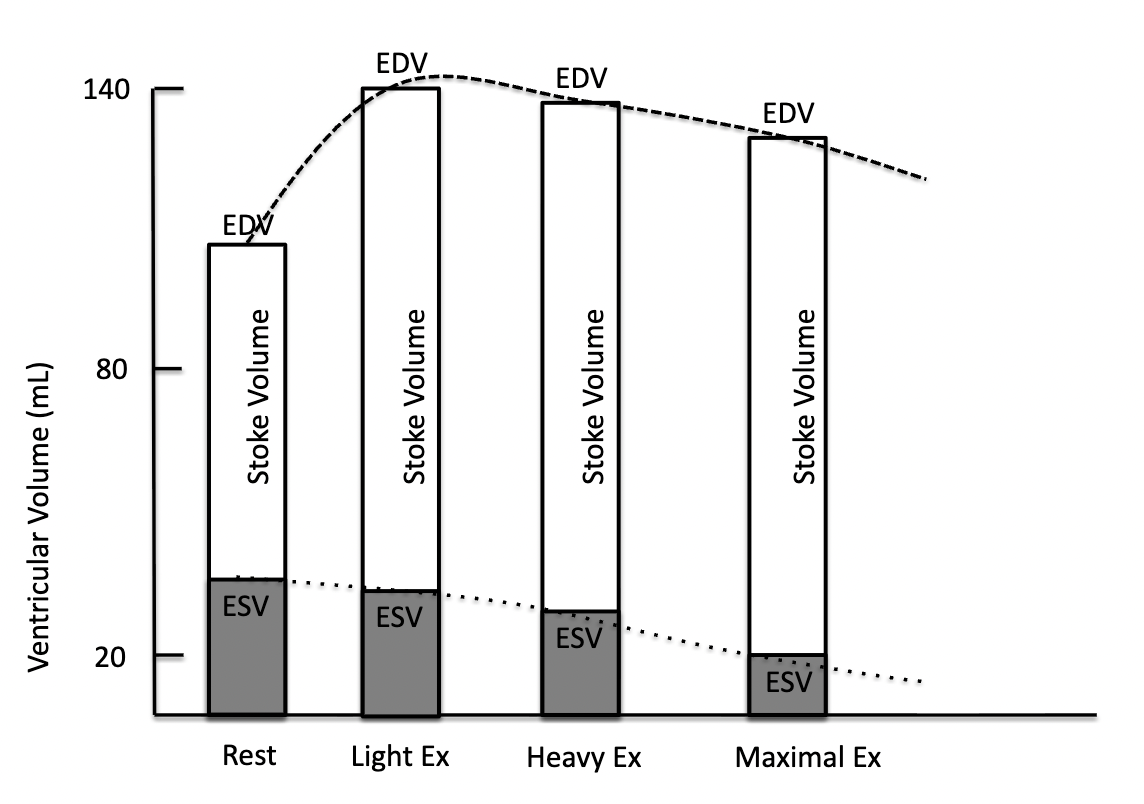
Explain this graph and more so significance of stroke volume during exercise
Talk about EDV, ESV, and stroke volume amount
EDV goes down because heart rate causes valves to close not giving heart enough time to fill with blood
ESV goes down which is a good thing because that means more blood is getting ejected
Stroke volume amount is same during exercise and also at rest as body needs to always maintain same stroke volume
What is the definition of ejection fraction?
The % of blood ejected from the ventricle into systemic circulation
At rest what percentage of blood is ejected?
50-70%
How much, percentage wise, does ejection fraction increase to with exercise intensity?
80-85%
When an individual has ejection fraction of 35% what is the clinical concern?
Heart failure/cardiomyopathies
What is cardiac index (CI)?
CI = CO/Body surface area (BSA)
What is the normal cardiac output and body surface area of an individual?
CO = 5 ml/min
BSA = 1.5 meters squared
What is the best measure of capacity of the cardiovascular system?
Whole body oxygen consumption because it reflects how much oxygen the cardiovascular system can deliver to tissues and how much the body can utilize
How does increased cardiac output (CO) affect preload?
Increased CO → increased venous return → increased preload
In what body position is EDV the greatest?
Supine (lying down)
Why is EDV greater in the supine position than when siting or standing?
Gravity causes less blood to pool in legs when lying down, increasing venous return to the heart
How does sympathetic stimulation affect preload?
It causes vasoconstriction, which pushes more blood back toward the heart → increased venous return and preload
In what position is EDV the greatest?
Supine (lying down)
Why is EDV greater in the supine position than when sitting or standing?
Gravity causes less blood to pool in the legs when lying down, increasing venous return to the heart
How does increased sympathetic stimulation affect preload?
It causes vasoconstriction, which pushes more blood back toward the heart → increased venous return and preload
How does blood volume affect preload?
Increase blood volume → increase venous return → increase preload
What is atrial priming?
The atria contract and provide an additional push of blood into the ventricles, increasing ventricular filling
How does atrial contraction affect ventricular preload?
Strong atrial contraction → more blood enters the ventricles → increased preload
What is the muscle pump?
Contraction of skeletal muscle, especially in the legs, compresses veins and pushes blood back toward the heart
What is the repiratory pump?
Changes in the throacic pressure during breathing that help move venous blood toward the heart
How does negative pressure in the thorax affect venous return?
Negative thoracic pressure expands large blood vessels and draws blood toward the heart → increase in venous return
What happens to afterload with increased sympathetic stimulation?
Increased sympathetic stimulation → increased total peripheral resistance (TPR) → increase blood pressure → increased afterload
Why does increased total peripheral resistance increase afterload?
Higher TPR means the heart has to pump against greater resistance
What effect does parasympathetic stimulation have on sympathetic effects?
It opposes/reduces the effects of sympathetic stimulation
What is isometric exercise?
Static exercise in which muscles contract without significant movement
How does isometric exercise affect blood flow?
Sustained muscle contraction can impede blood flow, increasing vascular resistance/afterload
What is the Valsalva maneuver?
Forceful expiration against a close airway
How does the valsalva maneuver affect the cardiovascular system?
It changes pressure in the chest, which affects venous return, blood pressure, and the hearts workload
What happens to the efficiency/strength of the contractility when you decrease EDV?
There is less stretch on the ventricle because of the low amount of volume in the filling phase of contraction

Explain the gradual slope for sympathetic compared to the drop of parasympathetic innervation
There is a gradual slope for sympathetic innervation as the sympathetic system innervation will increase with intensity of exercise
You are trying to conserve as many substrates as you can, you don’t want to waste
What happens to systolic blood pressure (SBP) during progressive exercise?
SBP increases linearly as exercise intensity increases
How much does SBP increase for every 1 MET increase in exercise intensity?
About 8-12 mmHg
What happens to total peripheral resistance during exercise?
Decreases with exercise
What happens to diastolic blood pressure during exercise?
It remains unchanged
Why does diastolic blood pressure relatively remain unchanged during exercise?
Because cardiac output increases while TPR decreases, balancing each other out and keeping DBP relatively stable
What role does blood pressure play during exercise?
Blood pressure helps the heart move blood throughout the body
What are factors that increase arterial blood pressure?
blood volume increases
heart rate increases
stroke volume increases
blood viscosity increases
peripheral resistance increases
What triggers the renin-angiotensin-aldosterone system (RAAS)?
Low blood pressure or low blood pressure to the kidneys
What hormone is released by the kidneys when blood pressure drops?
Renin
What is the main cardiovascular effect of angiotensin II?
Vasoconstriction, increase in blood pressure
What enzyme converts angiotensin I to angiotensin II?
ACE
Where is ACE primarily found?
Lungs
What does angiotensin II cause the adrenal glands to release?
Aldosterone
What does aldosterone do in terms of blood pressure?
It helps with sodium retention so this would increase blood volume and blood pressure
What is coronary blood flow?
This is blood flow to the heart muscle
What is the total cardiac/coronary blood flow at rest?
250 mL/min
How much oxygen does the heart extract from the blood?
About 80% of the available O2
When does the most coronary blood flow occur?
During diastole, because the coronary vessels are less compressed
When are coronary vessels partially/completely compressed?
During systole, when the heart muscle contracts