Cognitive Development
 Call Kai
 Learn
Learn Practice Test
 Spaced Repetition
 Match
Match Flashcards
 Knowt Play
1/40

There's no tags or description
Looks like no tags are added yet.
Name | Mastery | Learn | Test | Matching | Spaced | Call with Kai | Chat |
|---|
No analytics yet
Send a link to your students to track their progress
41 Terms
Primary Mental Abilities
Seven factors used to identify intelligence
Jean Piaget
Theorist known for his theory of cognitive development
Triarchic Theory of Intelligence
A multiple-factor view of intelligence in 3 areas: analytics, creativity, and practicality
Least Restrictive Environment (LRE)
the classroom or setting where the child can be successful, with or without accommodations, and with typical age/grade level peers. Ex: gen ed classroom
Individuals with Disabilities Education Act (IDEA)
Law mandating that all students with disabilities must receive a free and appropriate education that is tailored to their needs and abilities. Ex: IEP goals
Deductive Reasoning
Using two or more known premises to draw a conclusion. Ex: all cats say meow (premise 1). Jackie is a cat (premise 2), therefore we can deduce that Jackie says meow (conclusion)
Inductive Reasoning
Generalizing knowledge from one area to another. Ex: If a random sample of a population shows a correlation in improved health with a new drug, it can be induced that the drugs will be helpful for others in the population
Cognitive Development
Development of the ability to reason, think through problems, and explore new situations and stimuli; develops in 4 stages from birth to roughly 15 years old, according to Jean Piaget’s theory of child development
Creative Thinking
Looking from a new perspective. Ex: brainstorm, have a debate
Multiple-Factor View of Intelligence
Considering an individual’s intelligence level by looking at a variety of areas
Undifferentiated Perspective
Attributing one’s own perspective to everyone else’s; generally having an inability to attribute any other perspective to anyone else. Ex: Jessica loves peanut butter and jelly sandwiches. She thinks everyone else loves them too
Conservation
Understanding that things can stay the same in quantity even if their appearance changes. Ex: knowing that the amount of liquid does not change when poured from one container to another of a different size
Accommodations
Assistance or changes to the learning process to allow the student to learn the same material as others (Changes HOW they learn). Ex: Extended time on a test
Third-Party Perspective
Seeing from one’s own, others, and a third person’s perspective (neutral bystander, hence sometimes called the bystander perspective); generally keeps multiple perspectives in mind at the same time. Ex: Jessica loves peanut butter and jelly sandwiches. She knows that some other people don’t like them, but that it’s alright for two people to hold different opinions about a subject
Questioning
Asking questions to gather information. Ex: troubleshoot an issue, design a questionaire
Theory of General Intelligence
Intelligence is a general cognitive ability that can be measured and expressed
Critical Thinking
Analysis and judgement. Ex: Design an experiment, determine important part of a word problem, make a flowchart
Response to Intervention (RtI)
A process to monitor and measure student progress in the general education curriculum after instructional intervention is provided. Ex: small group pull-out, tutoring
Free Appropriate Public Education (FAPE)
An educational right of all children to receive instruction tailored to their needs at no cost to their family by the local education agency (LEA)
Exceptional Student Education (ESE)
The services offered at schools to children with disabilities. Helps each child with a disability progress in school and prepare for life after school. ESE services include specifically designed instruction to meet the unique needs of the child
Inclusion
Ensuring students with disabilities are included in classroom activities as much as possible
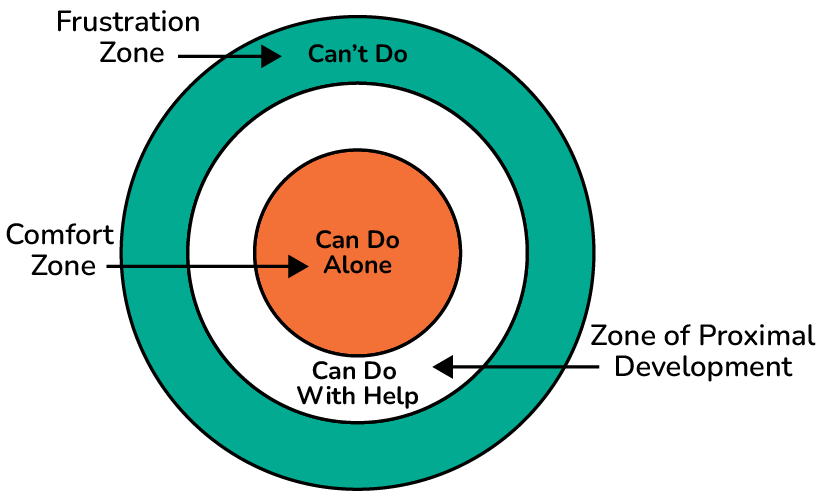
Zone of Proximal Development
The range of tasks that a learner can perform with the guidance or support of a teacher
Local Education Agency (LEA)
The education agency responsible for the school
Individualized Education Program (IEP)
Legally mandated, customized educational plan developed for students with disabilities in the United States, outlining specific learning goals, services accommodations, and supports needed to meet their unique educational needs
Preoperational Stage
The second stage of Piaget’s Theory of Cognitive development, occurring from 2-7 years old, in which children think egocentrically and symbolically
Memory/Recall
The ability to provide facts from given information. Ex: recite a poem, make a timeline, list main events
Lev Vygotsky
Social psychologist who believed that humans developed through intrapersonal connections with society. Ex: associated with constructivism
Reasoning and Planning
Solving problems and making decisions. Ex: Create a model, demonstrate a method, make up a game
Morality
Principles derived from a religion, culture, or belief system; differentiation of right and wrong
Modifications
Changes made to the curriculum or instructional practices to alter the expectations or performance criteria for students, often used to support learners with special needs by providing a more accessible and tailored educational experience
Concrete Operational Stage
The third stage of Piaget’s Theory of Cognitive development, occurring from 7 years old to adolescence, in which children begin to think logically and use inductive reasoning
Societal Perspective
Understanding that the neutral bystander is influenced by the societal and cultural context; generally realizes that different societies would have different neutral perspectives. Ex: Jessica loves peanut butter and jelly sandwiches and understands that other people do not. She also understands that both her opinion and the opinion of the other are influenced by larger institutions, such as a family and culture
Review of Existing Data (REED)
A mandated review of all existing evaluation data including the intial evaluation, any re-evaluations, classroom observations, and standardized testing to determine if dismissal of services is necessary
Theory of Multiple Intelligences
Eight different and distinct forms of intelligence, which cannot be numerically measured or expressed
Differentiated Instruction
Tailoring teaching methods to meet indvidual needs. Ex: Using varied reading levels for different student groups
Formal Operational Stage
The final stage of Piaget’s Theory of Cognitive development, occurring from 12 years old and beyond, in which people can use deductive reasoning to think abstractly and solve complex problems
Self-Reflective Perspective
Seeing, thinking, and feeling from the other person’s perspective (first signs of empathy); generally still assumes the other perspectives are equally valid. Ex: Jessica loves peanut butter and jelly sandwiches. She knows that some other people don’t like them and can begin to understand that the other person’s perspective is ok.
Reasoning and Planning
Solving problems and making decisions. Ex: Create a model, demonstrate a method, make up a game
Social-Informative Perspective
Understanding that perspectives exist and can be different for different persons; generally still assumes their own perspective is the best. Ex: Jessica loves peanut butter and jelly sandwiches. She knows that some other people don’t like them, but she thinks they are wrong.
Sensorimotor Stage
The first stage of Piaget’s Theory of Cognitive development, occurring from birth to two years, in which the world is experienced through objects